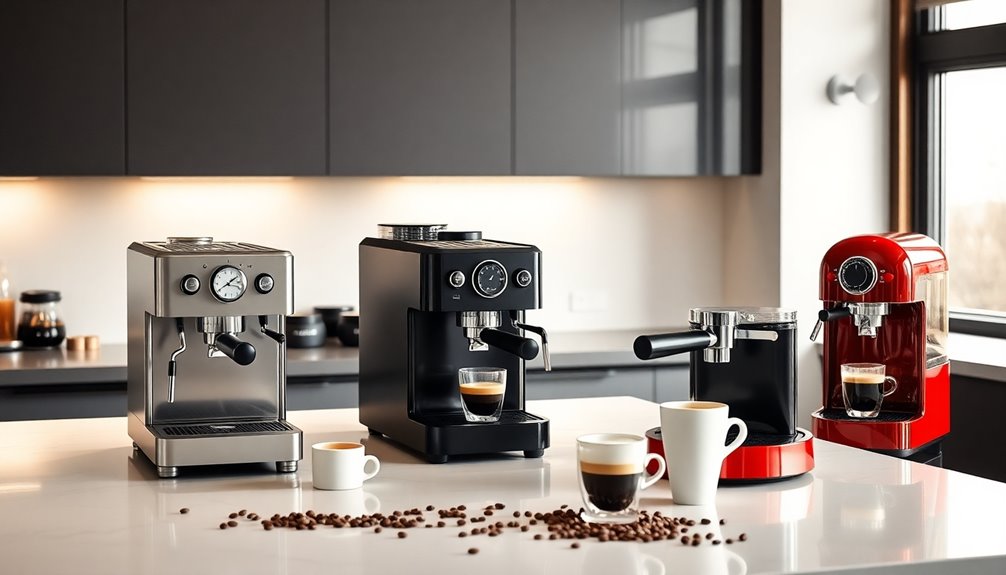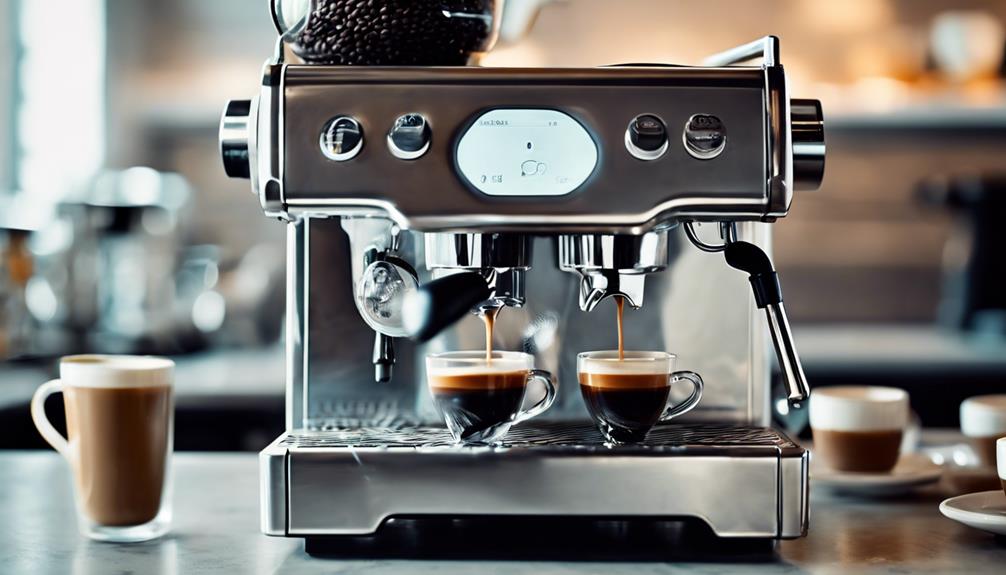

Choosing the right affordable home espresso machine requires balancing pressure consistency, milk frothing capability, and footprint size without breaking the bank. The De’Longhi Stilosa stands out as the best overall pick for its reliable manual control and durable build, while the SHARDOR 20-Bar Semi-Automatic offers superior convenience with its touchscreen interface. Buyers often face a tradeoff between manual tinkering for better extraction and automated convenience for speed. This guide breaks down fifteen models to help you identify which machine aligns with your skill level and kitchen space.

Get kitchen staples and gadgets delivered free with Prime
- Fast, free delivery on millions of items
- Prime Video, Amazon Music and more included
- Member-only deals all year
Complete the kit


Key Takeaways
- Most budget machines rely on 20-bar pumps, but actual extraction quality depends more on temperature stability than raw pressure numbers.
- Compact models like the BYESHOP sacrifice water tank capacity and steam power to fit small counters, requiring more frequent refilling.
- Semi-automatic machines with PID temperature control, such as the RIOSKY, offer significantly more consistent shots than basic single-thermometer models.
- Steam-driven machines like the Mr. Coffee 4-Shot are cheaper but cannot produce true espresso or microfoam, limiting their versatility.
- Build materials matter: stainless steel housings on models like the CASABREWS 3700 often indicate better long-term durability than plastic alternatives.
| BYESHOP 20-Bar Compact Espresso Machine with Milk Frother |  | Best for Tech-Oriented Beginners | Pump Pressure: 20 bar | Water Tank Capacity: 37 oz | Control Type: LED Touchscreen | VIEW ON AMAZON | See Our Full Breakdown |
| Neretva 20-Bar Compact Espresso Machine, Beige |  | Best for Aesthetic Integration | Pump Pressure: 20 bar | Power: 1350 watts | Water Tank Capacity: 1.3 liters | VIEW ON AMAZON | See Our Full Breakdown |
| SHARDOR 20-Bar Semi-Automatic Espresso Machine with Milk Frother and Touchscreen |  | Best for Maintenance Convenience | Pump Pressure: 20 bar | Power: 1350 watts | Water Tank Capacity: 45 oz | VIEW ON AMAZON | See Our Full Breakdown |
| CASABREWS 3700 Essential Stainless Steel Espresso Machine with Steam Wand |  | Best Value for Basic Functionality | Pump Pressure: 20 bar | Power: 1350 watts | Water Tank Capacity: 43.9 oz | VIEW ON AMAZON | See Our Full Breakdown |
| AERCANA 20 Bar Semi-Automatic Espresso Machine with Milk Frother |  | Best for Speed and Space Efficiency | Preheat Time: 20 Seconds | Power: 1450 Watts | Water Tank Capacity: 34 oz | VIEW ON AMAZON | See Our Full Breakdown |
| Mr. Coffee 4-Shot Steam Espresso Maker with Milk Frother and Stainless Steel Pitcher |  | Best for High-Volume Family Mornings | Brand: Mr. Coffee | Model: BVMCECM-STMMN-BL | Type: Semi-automatic steam espresso machine | VIEW ON AMAZON | See Our Full Breakdown |
| RIOSKY Compact Espresso Machine with Steam Wand and PID Temperature Control |  | Best Overall for Balance of Features and Size | Power: 1400 W | Pump Pressure: 20 bar | Temperature Control: PID and NTC | VIEW ON AMAZON | See Our Full Breakdown |
| Chefman CraftBrew Semi-Automatic Espresso Machine with Steam Wand | 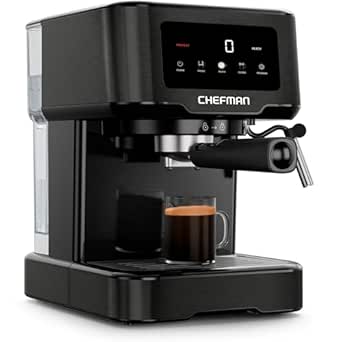 | Best for Simple Touch-Control Operation | Operation Mode: Semi-automatic | Pump Pressure: 15 bar | Water Reservoir Capacity: 1.5 liters | VIEW ON AMAZON | See Our Full Breakdown |
| 20-Bar Espresso Machine with Milk Frother and Cold Brew Function |  | Best for Cold Brew Enthusiasts | Operation Mode: Semi-automatic | Pump Pressure: 20 bar | Wattage: 1350 watts | VIEW ON AMAZON | See Our Full Breakdown |
| XIXUBX Compact Espresso Machine with Milk Frother, White |  | Best for Small Spaces and Minimalists | Operation Mode: Semi-automatic | Pressure: 20 bar | Wattage: 1100 watts | VIEW ON AMAZON | See Our Full Breakdown |
| Atatix Espresso Machine with Milk Frother, 20-Bar Pressure |  | Best for Manual Control Enthusiasts | Pump Pressure: 20 bar | Operation Mode: Semi-automatic | Wattage: 1350 watts | VIEW ON AMAZON | See Our Full Breakdown |
| Aromaster 1400W Semi-Automatic Espresso Machine with Milk Frother |  | Best for Temperature Stability | Pump Pressure: 20 bar | Power: 1400W | Water Tank Capacity: 37 fl oz | VIEW ON AMAZON | See Our Full Breakdown |
| AMZCHEF Compact 20-Bar Espresso Machine with Milk Frother |  | Best Budget-Friendly Starter | Pump Pressure: 20 bar | Power: 1350 watts | Heating Time: 30 seconds | VIEW ON AMAZON | See Our Full Breakdown |
| Arecovas Espresso Machine with 20-Bar Pressure, Touchscreen, and Milk Frother |  | Best Modern Interface | Pump Pressure: 20 bar | Wattage: 1300 watts | Water Tank Capacity: 1.2 L (41 oz) | VIEW ON AMAZON | See Our Full Breakdown |
| De’Longhi Stilosa Compact Manual Espresso Machine with Milk Frother |  | Best for Durability and Brand Trust | Pump Pressure: 15 bar | Operation Mode: Manual | Wattage: 1100 watts | VIEW ON AMAZON | See Our Full Breakdown |
| affordable home espresso machine | Pump Pressure | Dimensions | Water Tank Capacity |
|---|---|---|---|
| BYESHOP 20-Bar Compact Espress | 20 bar | — | 37 oz |
| Neretva 20-Bar Compact Espress | 20 bar | — | 1.3 liters |
| SHARDOR 20-Bar Semi-Automatic | 20 bar | — | 45 oz |
| CASABREWS 3700 Essential Stain | 20 bar | — | 43.9 oz |
| AERCANA 20 Bar Semi-Automatic | — | — | 34 oz |
| Mr. Coffee 4-Shot Steam Espres | — | 11.2 × 11.2 × 15 in | — |
| RIOSKY Compact Espresso Machin | 20 bar | 11.4 x 5.3 x 11.4 in | 57.5 oz |
| Chefman CraftBrew Semi-Automat | 15 bar | 10.8 × 8.9 × 11.9 inches | — |
| 20-Bar Espresso Machine with M | 20 bar | 13.2 x 6.65 x 12 inches | 45 fluid ounces |
| XIXUBX Compact Espresso Machin | — | 11.4 × 6.7 × 11.8 inches | — |
| Atatix Espresso Machine with M | 20 bar | 12 × 5 × 11 inches | — |
| Aromaster 1400W Semi-Automatic | 20 bar | 13 x 7 x 14 in | 37 fl oz |
| AMZCHEF Compact 20-Bar Espress | 20 bar | 12.5 × 7 × 14.4 inches | — |
| Arecovas Espresso Machine with | 20 bar | 12 × 5.2 × 11.9 in | 1.2 L (41 oz) |
| De’Longhi Stilosa Compact Manu | 15 bar | 12.13" x 9.45" x 14.17" | — |
More Details on Our Top Picks
BYESHOP 20-Bar Compact Espresso Machine with Milk Frother
This model stands out for its LED touchscreen interface, which simplifies the learning curve often associated with semi-automatic machines. Unlike the Neretva 20-Bar Compact Espresso Machine, which relies on traditional buttons and manual timing, the BYESHOP allows users to save custom shot volumes and extraction times. This digital precision helps achieve consistency without requiring extensive barista skills. However, the listed dimensions appear unusually small for a countertop appliance, suggesting potential stability issues or inaccurate marketing. While the stainless steel housing offers a modern look, the reliance on ground coffee means you still need a separate grinder. It is a solid choice for those who prefer digital controls over analog dials.
Pros:- Touchscreen allows saving custom one- and two-cup preferences
- Pressure and temperature gauges provide visual brewing feedback
- Removable water tank and drip tray simplify daily maintenance
- Stainless steel construction feels durable and modern
Cons:- Listed dimensions seem unusually compact for a full espresso machine
- Lacks a built-in grinder, requiring separate preparation of ground coffee
- Touchscreen interfaces can be less responsive than physical buttons
Best for: Tech-savvy beginners who want digital preset control over shot volume and extraction time.
Not ideal for: Users with limited counter space who are wary of inaccurate dimension listings or bulky footprints.
- Pump Pressure:20 bar
- Water Tank Capacity:37 oz
- Control Type:LED Touchscreen
- Milk Frothing:Steam Wand
- Housing Material:Stainless Steel
- Coffee Input:Ground Coffee Only
Our verdict“Choose this if you want digital precision and saved presets without the complexity of high-end machines.”
Neretva 20-Bar Compact Espresso Machine, Beige
The Neretva distinguishes itself with a beige metal finish that blends seamlessly into modern, neutral kitchens, a stark contrast to the industrial silver look of the SHARDOR 20-Bar Semi-Automatic Espresso Machine. Its low-pressure pre-infusion feature is a significant advantage for flavor extraction, allowing water to saturate the coffee puck evenly before full pressure is applied. This results in a smoother, less bitter shot compared to machines that jump straight to 20 bars. The included cup warmer is a thoughtful touch, though it requires the machine to be running to function effectively. While the 1.3-liter tank is adequate, the manual operation demands attention during the brew cycle, making it less convenient for multitaskers.
Pros:- Low-pressure pre-infusion improves flavor extraction quality
- Beige metal design integrates well with modern interior decor
- Integrated cup warmer keeps mugs ready for hot drinks
- Includes essential accessories like portafilter and filters
Cons:- Semi-automatic nature requires manual monitoring of brew time
- Beige finish may show stains more easily than stainless steel
- No digital presets for shot volume or temperature
Best for: Style-conscious buyers who prioritize kitchen aesthetics and want pre-infusion for smoother espresso.
Not ideal for: Those who want hands-free operation or have dark-themed kitchens where beige might clash.
- Pump Pressure:20 bar
- Power:1350 watts
- Water Tank Capacity:1.3 liters
- Special Feature:Low-Pressure Pre-Infusion
- Color:Beige
- Included Accessories:Portafilter, Filters, Spoon
Our verdict“Ideal for users who value design harmony and are willing to manage the brew process manually for better taste.”
SHARDOR 20-Bar Semi-Automatic Espresso Machine with Milk Frother and Touchscreen
While similar to the BYESHOP in its touchscreen controls, the SHARDOR adds a one-touch descaling function, addressing a common pain point in home espresso machines. This feature automates a tedious maintenance task, extending the machine’s lifespan and ensuring consistent brewing temperatures. The 45-ounce water tank is larger than many competitors, reducing refill frequency for households with multiple drinkers. However, the machine requires a completely dry cup for the top warming area, a minor but annoying constraint. The three temperature settings offer more control than basic models, allowing users to tweak extraction for different bean roasts. It strikes a balance between automation and manual control.
Pros:- One-touch descaling simplifies routine maintenance
- 45 oz water tank reduces need for frequent refills
- Three temperature settings allow for roast-specific adjustments
- Two-year warranty provides peace of mind
Cons:- Cup warming area requires completely dry mugs to function
- Descaling process interrupts brewing availability
- Touchscreen may lag compared to physical button responses
Best for: Busy households that want to minimize maintenance chores and need a larger water reservoir.
Not ideal for: Users who prefer analog controls or find digital descaling cycles too long to wait through.
- Pump Pressure:20 bar
- Power:1350 watts
- Water Tank Capacity:45 oz
- Temperature Settings:3 Levels
- Warranty:2 Years
- Weight:8.5 lbs
Our verdict“Pick this if you hate descaling and want a larger tank for daily multi-person use.”
CASABREWS 3700 Essential Stainless Steel Espresso Machine with Steam Wand
The CASABREWS 3700 strips away digital frills to focus on core espresso mechanics, making it a direct competitor to the AERCANA 20 Bar but with a more traditional interface. It lacks the pressure gauge found on the BYESHOP, meaning users must rely on time and taste rather than visual data to dial in shots. This can be a hurdle for beginners but encourages skill development. The removable 43.9-ounce tank is easy to clean, and the included one- and two-cup filters cover most single-serving needs. It is a no-nonsense machine that prioritizes function over form, suitable for those who want reliable espresso without learning a touchscreen.
Pros:- Simple mechanical controls are intuitive and durable
- Removable tank and drip tray are easy to clean
- Compact footprint fits well in office or small home kitchens
- Includes both single and double cup filters
Cons:- No pressure gauge for monitoring extraction
- Requires a mandatory first-use cycle before brewing
- Lacks temperature control or digital presets
Best for: Budget-focused buyers who want a simple, durable machine without digital complexity.
Not ideal for: Users who need visual pressure feedback or want automated shot stopping via digital presets.
- Pump Pressure:20 bar
- Power:1350 watts
- Water Tank Capacity:43.9 oz
- Included Filters:One-Cup and Two-Cup
- Milk Frothing:Steam Wand
- Color:Silver
Our verdict“A straightforward choice for those who want to learn manual espresso without digital distractions.”
AERCANA 20 Bar Semi-Automatic Espresso Machine with Milk Frother
With a 20-second preheat time, the AERCANA is significantly faster to start than the Neretva, which lacks such rapid heating claims. This speed is ideal for early risers who cannot wait for a boiler to warm up. The A4-sized footprint makes it the most space-efficient option in this lineup, fitting easily on crowded counters where the bulkier SHARDOR might struggle. The powerful 1450W system drives the steam wand effectively for microfoam, though it requires a cooling period between steaming and brewing. This thermal management constraint means you cannot make a latte and an espresso back-to-back without waiting.
Pros:- 20-second preheat time saves time in the morning
- Compact A4-sized footprint maximizes counter space
- High-wattage steam wand produces quality microfoam
- Hot water dispenser allows for Americanos or tea
Cons:- Requires cooling period between steaming and brewing
- Semi-automatic operation has a learning curve for novices
- 34 oz tank is smaller than competitors like Shardor
Best for: Small kitchen owners and speed-focused users who need quick access to espresso.
Not ideal for: Users who frequently alternate between steaming milk and brewing coffee without pausing.
- Preheat Time:20 Seconds
- Power:1450 Watts
- Water Tank Capacity:34 oz
- Footprint:A4 Size
- Special Features:Auto Shut-Off, Cup Warmer
- Material:Stainless Steel
Our verdict“The best pick for tight spaces and quick mornings, provided you accept the thermal wait time.”
Mr. Coffee 4-Shot Steam Espresso Maker with Milk Frother and Stainless Steel Pitcher
This machine distinguishes itself by prioritizing speed and capacity over traditional espresso purity. Unlike the RIOSKY or XIXUBX, which rely on 20-bar pump systems for authentic crema, the Mr. Coffee uses a steam brewing method. This means the coffee will be stronger than drip but lacks the rich, golden crema found in pump-based models. However, for households needing four shots quickly before leaving the house, this efficiency is a major advantage. The included stainless steel pitcher is a practical touch, though the steam wand is less precise than the rotating wands on the Chefman CraftBrew. It is a pragmatic choice for those who value convenience and volume over café-quality extraction mechanics.
Pros:- Brews up to four shots simultaneously, saving time during rush hours
- Includes a durable stainless steel frothing pitcher
- Marked water pitcher simplifies the brewing process
- Simple operation requires no complex programming
Cons:- Steam brewing produces weaker crema compared to pump-based systems
- No PID control means temperature consistency varies
- Lacks the precise pressure needed for authentic espresso extraction
Best for: Large families or office teams who need to brew multiple cups rapidly and prioritize speed over authentic crema.
Not ideal for: Espresso purists seeking true pump pressure and rich crema, as steam brewing cannot replicate the texture of 15-20 bar machines.
- Brand:Mr. Coffee
- Model:BVMCECM-STMMN-BL
- Type:Semi-automatic steam espresso machine
- Brewing Capacity:Up to 4 shots
- Wattage:1200 watts
- Dimensions:11.2 × 11.2 × 15 in
- Materials:Metal, plastic, stainless steel
Our verdict“Choose this if you prioritize brewing speed for multiple people and accept a compromise on espresso texture.”
RIOSKY Compact Espresso Machine with Steam Wand and PID Temperature Control
The RIOSKY stands out as the most versatile option in this lineup by combining a compact footprint with advanced features like PID temperature control and pre-infusion. While the Mr. Coffee focuses on volume, the RIOSKY focuses on extraction quality, offering 20 bars of pressure that rivals more expensive units. Its 45-second preheat is faster than many competitors, and the touchscreen interface with shot memory adds convenience often missing in budget models. Compared to the Chefman CraftBrew, the RIOSKY offers better temperature stability due to its PID system, which is critical for consistent taste. The inclusion of a cold brew function is a unique bonus, making it a true multi-tool for coffee lovers with limited counter space.
Pros:- PID and NTC control ensure consistent brewing temperatures
- 45-second preheat time reduces morning wait
- Touchscreen with shot memory simplifies repeat brewing
- Includes hot water and cold brew options for versatility
Cons:- Manual steam wand requires practice to master milk texture
- 57.5 oz tank may require frequent refilling for heavy drinkers
- Requires separate grinder for best results
Best for: Home baristas who want precise temperature control and pre-infusion in a machine small enough for tight kitchens.
Not ideal for: Users who prefer fully automatic one-touch operation, as this requires manual grinding, tamping, and milk steaming.
- Power:1400 W
- Pump Pressure:20 bar
- Temperature Control:PID and NTC
- Preheat Time:45 seconds
- Water Tank Capacity:57.5 oz
- Dimensions:11.4 x 5.3 x 11.4 in
- Weight:7.2 lb
- Features:Steam wand, touchscreen, pre-infusion, cup warmer, cold brew function
Our verdict“This is the best all-rounder for those who want café-quality features without taking up excessive counter space.”
Chefman CraftBrew Semi-Automatic Espresso Machine with Steam Wand
The Chefman CraftBrew offers a streamlined experience with touch controls that adjust shot volume, making it easier to dial in preferences than the button-heavy XIXUBX. It operates at 15 bar, which is sufficient for decent espresso, though it lacks the explicit PID temperature control found in the RIOSKY. This means you might see slightly more variation in shot consistency if you are particular about extraction temperatures. However, its 1.5-liter reservoir is larger than the XIXUBX’s 34-ounce tank, reducing refill frequency. The design is straightforward and cETL approved, offering peace of mind. It serves as a solid middle ground for those who find the RIOSKY’s touchscreen too complex but want more precision than basic dial models.
Pros:- Touch controls allow easy adjustment of shot volume
- 1.5-liter reservoir reduces need for frequent refills
- Built-in descale function simplifies maintenance
- cETL approved for safety compliance
Cons:- Lacks explicit PID temperature control for precise brewing
- Manual milk steaming still requires user skill
- 15 bar pressure is adequate but less robust than 20 bar models
Best for: Beginners who want adjustable shot volumes and a larger water tank without navigating complex digital interfaces.
Not ideal for: Temperature-sensitive baristas who require PID control for precise extraction, as this model lacks explicit PID specs.
- Operation Mode:Semi-automatic
- Pump Pressure:15 bar
- Water Reservoir Capacity:1.5 liters
- Wattage:1350 watts
- Dimensions:10.8 × 8.9 × 11.9 inches
- Included Features:Built-in steam wand, touch control panel, timer, descale function
- Certification:cETL approved
- Warranty:1-year assurance
Our verdict“A user-friendly option for those who prioritize adjustable volume and tank size over advanced temperature tech.”
20-Bar Espresso Machine with Milk Frother and Cold Brew Function
While many machines in this list focus on hot espresso, this unit explicitly highlights a cold brew function alongside its 20-bar pump and PID control. This makes it distinct from the Chefman CraftBrew, which lacks this versatility. The inclusion of pre-infusion helps mimic professional extraction techniques, improving shot quality. However, the interface is less intuitive than the RIOSKY’s touchscreen, and the 45-ounce tank is smaller than the Chefman’s 1.5-liter reservoir. It is a robust machine that handles milk frothing well, but the semi-automatic nature means you are still responsible for tamping and grinding. It appeals to those who want one machine to cover both hot espresso and cold coffee preferences.
Pros:- Dedicated cold brew function adds unique utility
- PID temperature control ensures consistent extraction
- 20-bar pump provides sufficient pressure for crema
- Removable tank and drip tray simplify cleaning
Cons:- Semi-automatic operation requires hands-on preparation
- 45-ounce tank is smaller than competitors like the Chefman
- Wider footprint may not fit under all cabinets
Best for: Coffee drinkers who enjoy both hot espresso drinks and cold brew and want a single device for both.
Not ideal for: Users with limited counter space, as its 13.2-inch width is wider than the RIOSKY or XIXUBX.
- Operation Mode:Semi-automatic
- Pump Pressure:20 bar
- Wattage:1350 watts
- Water Tank Capacity:45 fluid ounces
- Dimensions:13.2 x 6.65 x 12 inches
- Weight:9 pounds
- Features:PID temperature control, pre-infusion, milk frother, programmable, auto-clean
Our verdict“The ideal choice for households that split their coffee preference between hot espresso and cold brew.”
XIXUBX Compact Espresso Machine with Milk Frother, White
The XIXUBX is the most space-efficient option here, with a slim 6.7-inch width that easily slides under standard kitchen cabinets. While it shares the 20-bar pressure and PID control of the RIOSKY, it offers a simpler one-button operation for single or double shots. This simplicity comes at the cost of the advanced touchscreen and cold brew features found in the RIOSKY or the 20-Bar model. The 34-ounce tank is the smallest in this group, meaning frequent refills are a reality. However, for RV owners or students with tiny kitchens, the trade-off in capacity is worth the footprint savings. It includes a stainless steel pitcher, making it ready for latte art right out of the box.
Pros:- Slim 6.7-inch width fits easily under cabinets
- One-button operation simplifies daily brewing
- PID control and pre-infusion ensure quality shots
- Includes a stainless steel frothing pitcher
Cons:- Small 34-ounce tank requires frequent refilling
- Semi-automatic brewing involves more user input
- Lacks advanced features like cold brew or shot memory
Best for: Students, RV owners, or small apartment dwellers who need a compact machine with basic espresso functionality.
Not ideal for: High-volume drinkers, as the 34-ounce tank requires constant refilling and lacks advanced brewing modes.
- Operation Mode:Semi-automatic
- Pressure:20 bar
- Wattage:1100 watts
- Capacity:34 fluid ounces
- Dimensions:11.4 × 6.7 × 11.8 inches
- Weight:7 pounds
- Special Features:Auto shut-off, milk frother, PID temperature control, pre-infusion
- Included Accessory:Stainless steel frothing pitcher
Our verdict“A space-saving champion for those who prioritize footprint over tank size and advanced features.”
Atatix Espresso Machine with Milk Frother, 20-Bar Pressure
This unit stands out for its dual extraction modes, allowing users to switch between automatic presets and fully manual control. While many competitors like the Aromaster 1400W focus on one-touch convenience, the Atatix grants you authority over shot timing and volume, which is vital for dialing in specific beans. The 20-bar pump ensures adequate pressure for crema, though the lack of an included grinder means you must supply your own grounds. Its compact stainless steel build feels sturdy compared to the plastic-heavy alternatives, yet the 7.5-pound weight keeps it manageable on smaller counters. If you enjoy tweaking variables to perfect your espresso, this machine offers the flexibility that simpler models lack.
Pros:- Offers both automatic and customizable manual extraction settings
- Compact stainless steel design feels more durable than plastic rivals
- Steam wand produces dense milk foam suitable for lattes
- Detachable water tank and drip tray simplify daily cleaning
Cons:- Manual extraction requires trial and error to dial in shot sizes
- No grinder included, adding to the total setup cost
- Temperature range is fixed, offering less precision than PID models
Best for: Hobbyists who want to practice manual extraction techniques without buying a prosumer machine
Not ideal for: Users who want a strictly push-button experience with no learning curve
- Pump Pressure:20 bar
- Operation Mode:Semi-automatic
- Wattage:1350 watts
- Preheat Time:30 seconds
- Dimensions:12 × 5 × 11 inches
- Weight:7.5 pounds
- Material:Stainless steel and ABS
Our verdict“Choose this if you want to learn manual espresso techniques on a budget-friendly, sturdy machine.”
Aromaster 1400W Semi-Automatic Espresso Machine with Milk Frother
Compared to the Atatix, which relies on simpler temperature control, the Aromaster integrates PID and NTC technology, resulting in more consistent extraction temperatures. This stability is critical for avoiding bitter or sour shots when brewing different roast levels. The 360-degree swivel steam wand offers greater maneuverability for frothing large volumes of milk than the fixed wands on some compact rivals. However, the machine’s 14-inch height makes it taller than the AMZCHEF Compact, potentially limiting under-cabinet fit. It includes one-touch descaling, a feature often missing in entry-level units, which extends its lifespan significantly. This model prioritizes brewing precision and maintenance ease over the manual tweaking found in more hobbyist-focused devices.
Pros:- PID and NTC temperature control ensure consistent extraction
- 360-degree swivel steam wand offers flexible milk frothing
- One-touch descaling function simplifies long-term maintenance
- Includes pre-infusion for improved flavor extraction
Cons:- Taller profile (14 inches) may not fit under standard cabinets
- No grinder included in the box
- Semi-automatic operation still requires manual dosing
Best for: Users who prioritize consistent shot quality and easy maintenance over manual tweaking
Not ideal for: Those with very low overhead cabinets, as the 14-inch height may not fit
- Pump Pressure:20 bar
- Power:1400W
- Water Tank Capacity:37 fl oz
- Dimensions:13 x 7 x 14 in
- Material:Stainless steel
- Features:Pre-infusion, PID control, auto shut-off
- Included Components:Portafilter, filters, coffee spoon
Our verdict“This is the smart choice for those who value temperature precision and hassle-free cleaning cycles.”
AMZCHEF Compact 20-Bar Espresso Machine with Milk Frother
The AMZCHEF targets the beginner market with a plastic construction that keeps weight and cost down, contrasting sharply with the metal bodies of the Arecovas or Aromaster. Despite the lighter build, it retains PID temperature control, a feature usually reserved for pricier machines, ensuring decent shot consistency for new users. The 12.5-inch depth makes it slightly deeper than the Atatix, but its white aesthetic fits modern kitchens well. Users should note the discrepancy in listed water capacity, which may affect how often you refill compared to larger tanks. It is an ideal entry point for those who want PID benefits without the premium price tag or weight of stainless steel competitors.
Pros:- Includes PID temperature control at an entry-level price point
- Lightweight plastic construction is easy to move and clean
- 30-second heat-up time reduces wait time for morning coffee
- Removable water tank simplifies refilling and washing
Cons:- Plastic body may feel less premium than metal alternatives
- Confusing water tank capacity specifications (50 oz vs 40 oz)
- Heavier than some ultra-compact rivals at 8.2 pounds
Best for: First-time espresso makers who want PID control without a heavy metal build
Not ideal for: Buyers who prefer the durability and feel of stainless steel exteriors
- Pump Pressure:20 bar
- Power:1350 watts
- Heating Time:30 seconds
- Temperature Control:PID, ±2°C
- Dimensions:12.5 × 7 × 14.4 inches
- Weight:8.2 pounds
- Material:Plastic
- Coffee Input:Ground coffee
Our verdict“A solid entry-level pick that brings PID precision to beginners who don’t mind a plastic exterior.”
Arecovas Espresso Machine with 20-Bar Pressure, Touchscreen, and Milk Frother
This model differentiates itself with a touchscreen interface and real-time pressure gauge, offering a visual feedback loop that the AMZCHEF lacks. The PID algorithm with dual NTC sensors provides tight temperature stability, comparable to the Aromaster, but the addition of an Americano setting expands its utility beyond pure espresso. While the 1.2L tank is smaller than the Aromaster’s, it is sufficient for individual users who prefer fresh water. The stainless steel finish gives it a premium look similar to the Atatix, but the digital controls make it feel more modern. It suits those who want guided brewing and visual data to monitor their extraction process.
Pros:- Touchscreen controls and LED display offer modern usability
- Real-time pressure gauge helps monitor extraction quality
- Dedicated Americano setting adds versatility to drink options
- Compact stainless steel design with a removable tank
Cons:- 1.2L water tank requires frequent refilling for multiple users
- Touchscreen interfaces can be sensitive to steam and moisture
- Semi-automatic nature still requires manual portafilter handling
Best for: Tech-savvy users who prefer digital controls and visual extraction data
Not ideal for: Households with multiple coffee drinkers, due to the smaller 1.2L tank
- Pump Pressure:20 bar
- Wattage:1300 watts
- Water Tank Capacity:1.2 L (41 oz)
- Temperature Control:PID with dual NTC sensors
- Controls:Touchscreen
- Dimensions:12 × 5.2 × 11.9 in
- Shot Output:Single: 30–41 ml; Double: 66–78 ml
Our verdict“Pick this for a sleek, modern interface that guides you through the brewing process with visual aids.”
De’Longhi Stilosa Compact Manual Espresso Machine with Milk Frother
The De’Longhi Stilosa offers a 5-year warranty and a stainless-steel boiler, signaling a level of durability that generic brands like the Atatix cannot match. Unlike the 20-bar pressure of its competitors, it uses a 15-bar pump, which is traditionally considered sufficient for home espresso extraction without the risk of channeling. The fully manual operation means there are no digital components to fail, making it a long-term investment for those who prefer simplicity. While it lacks the PID precision of the Aromaster, its robust build and established brand reputation provide peace of mind. It is best suited for buyers who value longevity over the latest technological features.
Pros:- 5-year warranty reflects confidence in build quality
- Stainless-steel boiler provides consistent heat retention
- 15-bar pump is calibrated for traditional espresso extraction
- Compact footprint fits easily on crowded countertops
Cons:- Fully manual operation requires practice for tamping and steaming
- No automatic cleaning or descaling cycles
- 1L water tank is small for heavy daily use
Best for: Buyers who prioritize long-term durability and brand warranty over digital features
Not ideal for: Users who want automated dosing or digital temperature displays
- Pump Pressure:15 bar
- Operation Mode:Manual
- Wattage:1100 watts
- Capacity:1000 ml
- Dimensions:12.13″ x 9.45″ x 14.17″
- Weight:8.6 pounds
- Warranty:5 years
Our verdict“Choose the Stilosa if you want a reliable, no-nonsense machine backed by a strong warranty.”

How We Picked
I evaluated these machines based on extraction consistency, milk texturing capability, and ease of maintenance. While many brands advertise 20-bar pressure, I prioritized models that maintain stable brewing temperatures, as this is the primary driver of shot quality in budget devices. I also assessed the usability of steam wands, distinguishing between panarello-style frothers that create large bubbles and professional-style wands capable of microfoam.
Ranking logic favored machines that offer the best balance of features and build quality for the price point. Models with plastic internal components or unreliable pressure profiles were ranked lower, while those with stainless steel boilers or PID controls rose to the top. I also considered footprint size, ensuring that compact options were truly suitable for small kitchens without compromising essential functionality.
Factors to Consider When Choosing Affordable Home Espresso Machine
Selecting an affordable espresso machine involves navigating marketing jargon and understanding which features actually impact your daily coffee routine. Here are the critical factors to weigh before making a purchase.Pump Pressure vs. Brewing Temperature
Marketing materials often highlight 20-bar pressure as a key selling point, but this number alone does not guarantee a good shot. True espresso extraction relies on water being pushed through coffee grounds at a consistent 9 bars of pressure at the group head. Many budget machines use a 15 or 20-bar pump that creates excess pressure, which is then released by a bypass valve. Temperature stability is far more important for flavor; look for machines with PID temperature control or dual boilers if you want consistent results. Without stable heat, you will encounter sour or burnt tastes regardless of the pressure rating.
Steam Wand Types and Milk Quality
Not all frothers are created equal, and this is often the biggest hidden cost of buying cheap. Panarello wands use an air-intake sleeve to create foam automatically, which results in large, dry bubbles unsuitable for latte art. Professional-style steam wands require manual technique but allow you to create silky microfoam essential for cappuccinos and lattes. If you drink mostly milk-based drinks, prioritize a machine with a standard commercial-style wand over one with a plastic panarello. The learning curve is steeper, but the texture difference is immediate and noticeable.
Footprint and Water Tank Capacity
Compact machines are ideal for small apartments, but they often come with a functional drawback: small water reservoirs. A tank holding less than 1 liter might require refilling after every two or three shots, which disrupts the brewing flow. Check the dimensions carefully, ensuring the machine fits under your upper cabinets if it has a tall steam wand or portafilter handle. Some models, like the BYESHOP, are designed specifically for tight spaces, but you must weigh the convenience of size against the inconvenience of constant maintenance. For busy households, a slightly larger footprint with a bigger tank often provides a better user experience.
Maintenance and Descaling Frequency
Budget machines often lack advanced descaling alerts or accessible group heads, making maintenance more manual and frequent. Thermoblock heating systems are common in affordable models and heat up quickly, but they can be prone to scale buildup if you use hard water. Regular descaling is mandatory to prevent clogs and maintain temperature accuracy. Look for machines with removable water tanks and accessible drip trays, as these features simplify daily cleaning. If you live in an area with hard water, consider if the machine’s build materials can withstand frequent cleaning cycles without degrading.
Grinder Integration and Accessories
Most affordable espresso machines do not include a built-in grinder, forcing you to buy pre-ground coffee or purchase a separate burr grinder. Pre-ground coffee loses freshness rapidly, leading to flat-tasting espresso within days of opening the bag. If you are serious about espresso quality, budget for a decent burr grinder alongside your machine. Some models, like the SHARDOR, may include basic accessories, but these are rarely sufficient for serious brewing. Understanding that the grinder is half the equation helps you allocate your budget more effectively, rather than overspending on the machine itself.
Frequently Asked Questions
Do affordable espresso machines actually produce real espresso?
Yes, provided they meet the standard requirements of forcing hot water through finely ground coffee at approximately 9 bars of pressure. Many budget machines labeled as ‘espresso makers’ are actually steam-driven, which produces a weaker, less concentrated beverage similar to strong coffee. To ensure you are getting true espresso, verify that the machine uses a pump-driven system rather than steam pressure. Machines with a portafilter and a tamper are generally more capable of producing authentic espresso than automatic pod machines or steam wands. Always check the mechanism type to avoid disappointment.
How long do budget espresso machines typically last?
Lifespan varies greatly depending on build quality and maintenance habits. Machines with plastic boilers or internal components may degrade faster, especially if exposed to hard water, lasting two to three years with regular use. Models featuring stainless steel boilers and brass fittings, such as the CASABREWS or De’Longhi, often last five years or longer if descaled regularly. The pump is the most common failure point in cheaper units. Investing slightly more in a machine with metal internal parts usually pays off in longevity compared to the cheapest plastic alternatives.
Is a PID controller worth the extra cost on a budget machine?
A PID controller allows you to adjust the brewing temperature precisely, which is critical for dialing in different roast levels. Lighter roasts often require higher temperatures, while dark roasts can turn bitter if too hot. On budget machines, basic thermostats can fluctuate by several degrees, leading to inconsistent shots. If you enjoy experimenting with coffee beans and want to improve flavor extraction, the extra cost for a PID is justified. However, if you stick to medium-dark commercial blends and use pre-ground coffee, a standard thermostat may suffice for your needs.
Can I make cold brew with these espresso machines?
Traditional espresso machines are not designed for cold brew, as they rely on heat to extract flavors. Some models, like the 20-Bar Espresso Machine with Cold Brew Function, offer a specific mode that bypasses heating elements to force cold water through grounds. However, this method is often faster and less nuanced than traditional slow-drip cold brew. If cold brew is your primary goal, a dedicated cold brew maker might be a better investment. If you want versatility, ensure the machine has a genuine cold brew setting rather than just a marketing label.
What is the difference between semi-automatic and fully automatic machines?
Semi-automatic machines require you to grind, dose, tamp, and start/stop the shot manually, giving you control over the process. Fully automatic machines handle grinding and tamping at the push of a button, prioritizing convenience over control. In the affordable category, true fully automatic machines are rare and often compromise on espresso quality. Most ‘affordable’ options labeled as automatic are actually semi-automatic with some pre-programmed buttons. For beginners, semi-automatic machines teach valuable skills, while automatics are better for offices or those who prioritize speed over craft.
Conclusion
Choosing the right affordable home espresso machine comes down to matching your willingness to learn with your desired convenience level. For those seeking the best overall balance of quality and price, the De’Longhi Stilosa remains a reliable choice with proven durability. If you prioritize modern features and ease of use, the SHARDOR 20-Bar Semi-Automatic offers excellent value with its touchscreen and integrated frothing. Beginners who want to skip the learning curve of tamping might prefer the AERCANA for its guided process, while those with limited counter space should look at the BYESHOP or NERETVA. Ultimately, investing in a good grinder alongside your machine will do more for your coffee quality than upgrading the machine itself.
As an affiliate, we earn on qualifying purchases.Halloween Picks
halloween