TL;DR

Get kitchen staples and gadgets delivered free with Prime
- Fast, free delivery on millions of items
- Prime Video, Amazon Music and more included
- Member-only deals all year
Anchovies are one of Italian cooking’s most powerful “invisible” ingredients: served whole sometimes, but more often melted into sauces and dressings where they add salt and savory depth without tasting fishy. This guide covers bagna cauda (Piedmont’s warm anchovy-garlic dip), Colatura di Alici di Cetara (a PDO amber anchovy essence from the Amalfi Coast), spaghetti with colatura, and how to buy and store every type.
The most important anchovy in your kitchen is probably the one you can’t taste. In restaurants and home kitchens across Italy, cured anchovies disappear into tomato sauces, braised greens, and lamb roasts, where their naturally occurring glutamates amplify everything around them. The dish doesn’t taste fishy. It tastes more like itself.
Italy celebrates anchovies two ways: invisibly, as a seasoning that dissolves into a sauce, and proudly, as the star of the plate. Both approaches reach their peak in two places — Piedmont, the landlocked northwest region where salted anchovies traveled historically over trade routes from Ligurian ports, and Cetara, a fishing town on Campania’s Amalfi Coast that produces one of the most remarkable seasonings in the Mediterranean.
In this guide, you’ll learn what bagna cauda actually is, how colatura di alici gets made, how to cook spaghetti with it properly, and how to choose between salt-packed, oil-packed, and fresh anchovies at the store. You’ll also pick up the small techniques — low heat, unsalted pasta water, gradual seasoning — that separate an Italian anchovy dish from a salty mistake.
Anchovies work as invisible seasoning: their glutamates melt into warm fat and deepen flavor without tasting fishy, provided you use low heat and restraint.
Bagna cauda is Piedmont’s warm dip of anchovies, garlic, and olive oil — keep the heat low so the garlic never browns and the anchovies dissolve, and serve it…
Colatura di Alici di Cetara is a PDO (2020) amber liquid made by dripping salt-packed anchovies in chestnut barrels; buy the labeled authentic version, not gen…
For spaghetti with colatura: unsalt or lightly salt the pasta water, start with about one teaspoon of colatura per serving, add it off the heat, and skip the c…
Choose salt-packed anchovies for maximum flavor (after rinsing and filleting), oil-packed for convenience (refrigerate under oil after opening), and buy fresh…
Why Anchovies Don’t Make Italian Food Taste Fishy
Anchovies don’t make food taste fishy because their glutamates — the same savory compounds behind Parmigiano-Reggiano and tomatoes — dissolve into fat and intensify the dish rather than announce themselves. Cured anchovy fillets heated gently in olive oil break apart into tiny particles that disperse through a sauce. They don’t literally vanish, but their identity becomes impossible to detect.
Think of a clove of garlic melted into a Bolognese. Nobody tastes that garlic and says “garlic sauce.” It works the same way. One or two fillets, pressed into warm oil with the back of a spoon, will deepen a simple tomato sugo in about ninety seconds.
The failure mode is real, though. Three things push anchovies toward assertively fishy: too many fillets, poor-quality fish, and high heat. Burnt anchovy is harsh and bitter. The fix is always patience — low flame, gentle stirring, and restraint.
The European anchovy behind all of this is Engraulis encrasicolus. In Italian you’ll see both alice (or alici) and acciuga (or acciughe). They usually mean the same fish; usage varies by region and context rather than indicating two species. Many speakers lean toward alici for fresh fish and acciughe for cured, but that’s habit, not rule.
Anchovies are also quietly good for you: protein, omega-3 fatty acids, and calcium from the tiny edible bones. Because they’re small and short-lived, they generally accumulate less mercury than large predatory fish. The tradeoff is sodium — cured anchovies and colatura are seasonings, not portions.
Colatura di Alici di Cetara authentic
As an affiliate, we earn on qualifying purchases.
As an affiliate, we earn on qualifying purchases.
Bagna Cauda: Piedmont’s Warm Anchovy Bath You Can Make at Home
Bagna cauda — “hot bath” in the Piedmontese dialect — is a warm emulsion of anchovies, garlic, and olive oil, served in the colder months with raw and cooked vegetables for dipping. It’s technically a sauce, but the traditional spread of vegetables and the communal way of eating it make it a full meal and a social ritual at once.
Here’s the curious part: Piedmont has no coastline. Salted anchovies reached the region through historic trade routes connecting it to Ligurian ports and southern France. That’s why one of Italy’s most famous fish dishes comes from one of its most inland regions.
The vegetables matter as much as the sauce. The classic accompaniments:
- Cardoons — the thistle stalks Piedmontese cooks blanch and serve raw with the dip
- Peppers, roasted or raw
- Jerusalem artichokes and cabbage
- Fennel, celery, and radishes
- Boiled potatoes, onions, and raw or roasted cauliflower
Traditionally the sauce stays warm at the table in a communal earthenware vessel; today many households use individual fujot — small warmers that keep each diner’s portion at dipping temperature.
The technique is everything, and it comes down to one rule: low heat. Garlic should turn soft and fragrant, never brown. Anchovies should gradually dissolve into the oil, never fry. Try this sequence:
- Warm good extra-virgin olive oil over the lowest flame with sliced or smashed garlic — a traditional version may use a head’s worth of cloves.
- Let the garlic soften for 10 to 15 minutes until pale gold and mellow.
- Add rinsed, chopped salted or oil-packed anchovy fillets and stir until they melt into the oil, another 5 minutes or so.
- Transfer to a fujot or a small pot over a candle warmer and serve immediately with your vegetables.
Worried about the garlic? Some cooks simmer the cloves in milk or water first to soften the punch; purists say that compromises the rustic character. Butter appears in some regional and modern versions, but anchovies, garlic, and olive oil remain the defining trio.
Colatura di Alici: The Amber Liquid from Cetara Worth Seeking Out
Colatura di alici is an amber-colored liquid seasoning produced in Cetara, a fishing town on Campania’s Amalfi Coast. Its name comes from colare, “to drip” or “to strain” — because that’s literally how it’s harvested, dripping slowly out of salt-packed anchovies over months.
Traditional production is patient work:
- Anchovies are cleaned and layered with sea salt shortly after the catch.
- The layers are pressed inside wooden barrels, traditionally made from chestnut.
- Over months of maturation, a deeply flavored liquid emerges from the packed fish.
- The liquid is collected, filtered, and sometimes passed back through the anchovies before bottling.
The result is clear, concentrated, and intensely savory. It works much like Southeast Asian fish sauce — same job, different coastline. It’s often called a descendant of Roman garum, the fermented fish sauce of antiquity, though an unbroken line of descent is hard to prove. The safer claim: both belong to the ancient Mediterranean tradition of salt-cured fish seasonings.
What should you look for when buying? Authentic Colatura di Alici di Cetara received European Protected Designation of Origin (PDO) status in 2020. The label guarantees the geographic origin, the methods, and the reputation — and distinguishes real Cetara colatura from generic “anchovy extract.” A good bottle should be clear, aromatic, and amber to mahogany in color. Store it tightly closed in a cool, dark place, and follow the label’s refrigeration guidance after opening.
Colatura is a seasoning, not a sauce. One teaspoon per serving is a sensible starting point — you can always add more, but you cannot take it out.
Chefs have moved well beyond pasta with it: colatura now shows up in vegetable dishes, vinaigrettes, risotto, and even meat preparations, used the way you’d use a finishing salt with an ocean behind it.
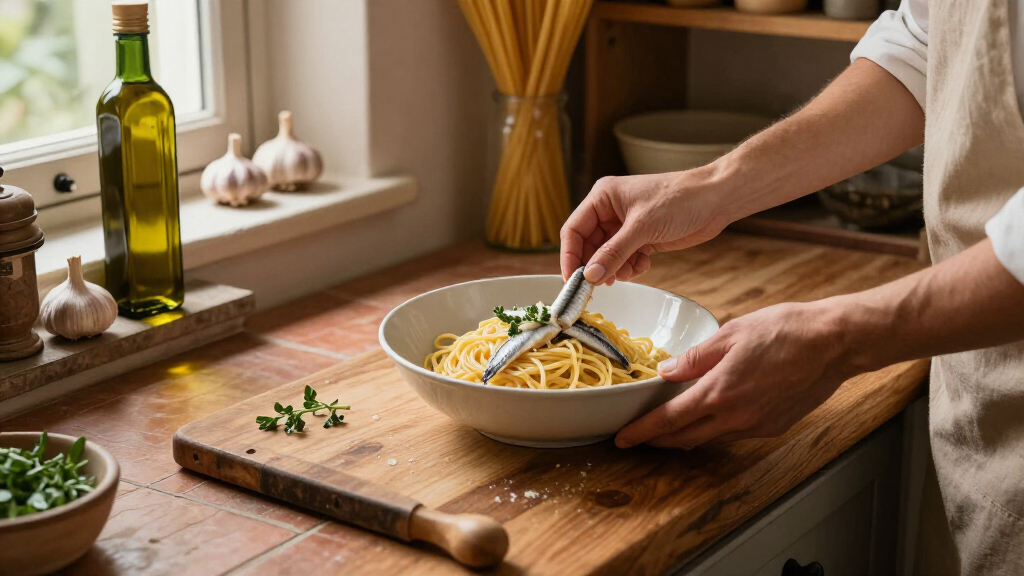
Spaghetti with Colatura: A Complete Pasta with Almost No Cooking
Spaghetti con la colatura di alici proves the Italian principle that a few powerful ingredients can make a finished dish. The dressing isn’t really cooked at all — hot pasta is tossed with the colatura mixture off the heat, with a splash of pasta water to form an emulsion, the same technique behind cacio e pepe.
A typical version for four people:
- Spaghetti or linguine (about 400 g / 14 oz)
- 2 to 4 teaspoons colatura di alici, added gradually
- Extra-virgin olive oil (3 to 4 tablespoons)
- One clove of garlic, sliced thin or crushed
- Chopped parsley, optional chili, and sometimes lemon zest or toasted breadcrumbs
The single most common mistake is salting the pasta water normally. Colatura is already extremely concentrated with salt; salted water can push the finished dish into unpleasant territory. Use lightly salted or unsalted pasta water, then adjust at the table.
Another rule: skip the cheese. Strong cheese competes with colatura’s marine character, which is why many Italian seafood pastas traditionally go without it. This isn’t a general anchovy prohibition — anchovies pair beautifully with butter and cheese in other Italian preparations — but colatura pasta wants a clean stage.
Finally, don’t boil the colatura. Add it off the heat or at the very end of cooking; prolonged boiling flattens its more delicate aromas. Serve immediately, while the emulsion is glossy.
Beyond the Two Headliners: Where Anchovies Hide Across Italy
Anchovies appear across Italy in both conspicuous and nearly invisible forms, and knowing where to look will change how you read an Italian menu. In some dishes they’re the point; in others they’re pure engineering.
| Dish | Region | What the anchovy does |
|---|---|---|
| Spaghetti alla puttanesca | Campania / Lazio | Melts into tomato, olives, capers, and garlic for depth |
| Pasta con le sarde | Sicily | Deepens the sardine, fennel, raisin, and pine nut sauce |
| Bigoli in salsa | Veneto | Slow-cooked with onions into a savory paste for pasta |
| Salsa verde | Piedmont | Seasons the parsley sauce served with boiled meats |
| Vitello tonnato | Piedmont | Enriches the tuna-and-caper sauce in some versions |
| Puntarelle alla romana | Lazio | Anchovy-garlic dressing for crisp chicory shoots |
| Insalata pantesca | Pantelleria | Sharpens the potato, tomato, olive, and caper salad |
Then there are the anchovies you actually see. Alici fritte — lightly floured or battered fried anchovies — are southern Italian street food at its best, crisp and eaten whole. Alici marinate are fresh anchovies cured in vinegar or citrus and dressed with olive oil, garlic, and herbs; they’re brighter and more delicate than long-aged salted anchovies, a different animal entirely. Alici imbottite, stuffed anchovies, belong especially to southern coastal cooking. And on pizza, anchovies show up alongside tomato, oregano, capers, or olives — called pizza Napoli or pizza romana depending on where you are.
One safety note worth remembering: acid curing is not cooking. Vinegar or citrus changes the texture of the flesh but doesn’t eliminate every food-safety risk. Home preparation of raw or marinated anchovies requires proper parasite-control procedures — freezing the fish at specified temperatures first. When in doubt, leave alici marinate to restaurants with trusted supply chains.
How to Buy, Prep, and Store Anchovies So They Last
Salt-packed anchovies usually offer the most complex flavor, but they demand a few minutes of work; oil-packed fillets trade a little intensity for convenience. Colatura sits apart as a liquid. Here’s how to handle each type.
Salt-packed: Rinse or wipe away excess salt, separate the fillets, remove the backbone if necessary, and pat them dry before using. The payoff is a fuller, more nuanced flavor than pre-packed fillets — worth it for bagna cauda, where the anchovy is the point.
Oil-packed: Look for intact fillets fully submerged in good-quality oil, not broken shards swimming in murky liquid. After opening, keep the tin refrigerated with the fillets covered in oil, and follow the producer’s storage instructions. Most stay good for weeks this way — check the label for the specific guidance.
Colatura: Clear, aromatic, amber to mahogany. A cloudy or dull-smelling bottle has been handled badly. Cool, dark cupboard until opened; then follow the label.
Fresh anchovies: They should smell clean and marine — like the sea, not the fish counter — with bright eyes and firm, silvery bodies. They deteriorate fast, so clean and cook or cure them the same day. Fresh ones are delicious but unforgiving; there’s no shame in starting with cured.
Adjust salt only after the anchovies go in. Cured anchovies are salty by design, and seasoning before they’re incorporated is the most common way home cooks oversalt a dish.
Frequently Asked Questions
Are anchovies and sardines the same fish?
No. They’re different species. Anchovies are generally smaller, with a more pointed snout and a stronger flavor after curing. Sardines are fleshier and milder. Both are used in Italian cooking — bigoli in salsa and pasta con le sarde traditionally feature sardines, though anchovies appear in both depending on household and period.
Does cooking anchovies make food taste fishy?
Used sparingly, no — they create savory depth rather than a recognizable fish flavor. Excessive quantities, poor-quality fish, or high heat can make the taste more assertive. Low, gentle heat is the technique that lets anchovies dissolve and disappear.
Can fish sauce replace colatura di alici?
It can supply salt and umami in a pinch, but it won’t reproduce colatura’s exact aroma or Italian character. Begin with a smaller quantity than the recipe’s colatura and adjust carefully. The reverse is also true: colatura can substitute for fish sauce, with a lighter, cleaner profile.
Why should the pasta water for spaghetti with colatura be unsalted?
Because colatura is extremely concentrated with salt — it is the seasoning. Salting the water normally, as you would for other pasta, can push the finished dish well past pleasant. Use unsalted or lightly salted water, then taste and adjust at the end.
Can bagna cauda be made less garlicky?
Yes. Use fewer cloves, or poach them gently in milk or water before adding them to the oil to soften their pungency. Traditionalists argue this dulls the dish’s rustic force, so it’s a tradeoff between mildness and authenticity — but the anchovy-garlic-olive oil trio remains the definition of the dish.
Are marinated anchovies (alici marinate) cooked?
Not by heat. Vinegar or citrus changes the flesh’s texture — it firms and opacifies — but acid alone is not cooking and doesn’t eliminate every food-safety risk. Home preparation of raw anchovies requires proper parasite-control procedures, so raw marinated versions are best left to trusted restaurants and producers.
Are anchovies healthy and sustainable?
They’re nutrient-dense — protein, omega-3s, and calcium from the edible bones — and typically low in mercury. But cured forms are high in sodium, so treat them as seasoning. People with fish allergies must avoid them, and improperly stored fish can pose a histamine risk. Sustainability depends on the specific stock, location, and fishing method; look for traceable products and credible certification rather than judging by species alone.
Conclusion
Start small. Melt two anchovy fillets into your next tomato sauce and notice what happens — the sauce gets rounder, deeper, more itself, and nobody at the table will identify the fish. Once that clicks, work up to bagna cauda on a cold night, and keep a small bottle of colatura from Cetara next to the stove for pasta evenings when you have almost nothing in the house.
That’s the Italian lesson in miniature: a humble preserved fish, treated with patience and paired with the right vegetables or the right spaghetti, becomes one of the most satisfying things in the Mediterranean kitchen.
Fall Picks
fall essentials
As an affiliate, we earn on qualifying purchases.