
For high-volume service, the Zulay 100-Cup Stainless Steel Coffee Urn is my best overall pick for buyers who need a large batch and a durable steel body. The BUNN VPR-2GD suits steady service where brewing fresh pots and keeping two decanters warm matters more than urn capacity, while the VEVOR 60-Cup Urn offers a middle ground for smaller crowds. The main tradeoffs are batch size versus fresh-pot flexibility, manual filling versus a plumbed water line, and compact counter use versus the space needed for large urns. These products range from basic event dispensers to commercial-style drip brewers, so the right choice depends on how many people you serve and how often. Read on for the full breakdown and buying guidance.

Get kitchen staples and gadgets delivered free with Prime
- Fast, free delivery on millions of items
- Prime Video, Amazon Music and more included
- Member-only deals all year
Key Takeaways
- Urn capacity sets the clearest dividing line: the Zulay and West Bend models hold up to 100 cups, while the VEVOR 60-Cup, BLACK+DECKER 40-Cup, and Hamilton Beach 45-Cup options target smaller batches.
- Decanter brewers favor a steady flow of fresh coffee: the BUNN VPR-2GD, SYBO SF-CB-2GA, VONCI, and several VEVOR and NUPANT models use carafes and warmers instead of one large dispensing vessel.
- A direct water line changes the setup: the NUPANT auto-filling model can reduce repeated manual filling, but it calls for a suitable water connection and installation planning.
- Capacity claims need context: cup counts describe serving volume, not necessarily a full-size mug; match the machine to your actual serving size and refill rhythm.
- There is no single best format for every venue: urns simplify self-service for crowds, while two-carafe brewers make it easier to keep separate pots available during ongoing service.
| VEVOR Commercial Coffee Urn, 60-Cup, 9.5-Quart |  | Best for Extended Serving | Capacity: 9.5 qt / 304 oz; up to 60 cups | Full-batch brewing time: About 45 minutes | Wattage: 950 W | VIEW ON AMAZON | See Our Full Breakdown |
| VONCI 12-Cup Commercial Drip Coffee Maker with 2 Carafes and 2 Warmers |  | Best for Fast Pot-to-Pot Brewing | Capacity: 12 cups per carafe | Carafe capacity: 1.8 liters each | Power: 1610 W | VIEW ON AMAZON | See Our Full Breakdown |
| Zulay Commercial 100-Cup Stainless Steel Coffee Urn |  | Best for Large Events | Capacity: Up to 100 five-ounce cups | Brew rate: About 1 cup per minute | Outer material: 0.41 mm 430 stainless steel | VIEW ON AMAZON | See Our Full Breakdown |
| BLACK+DECKER 40-Cup Coffee Urn with Drip-Free Spigot |  | Best for Mixed Hot Drinks | Capacity: 40 cups | Brew rate: 1 cup per minute | Coffee type: Drip | VIEW ON AMAZON | See Our Full Breakdown |
| NUPANT 12-Cup Commercial Coffee Maker with Water Line, 1.8L Auto-Filling Drip Coffee Machine with 2 Glass Carafes and Warmers |  | Best for Plumbed-In Service | Capacity: 12 cups | Water tank: 1.8 L | Power: 1610 W | VIEW ON AMAZON | See Our Full Breakdown |
| Hamilton Beach 45-Cup Fast Brew Coffee Urn and Hot Beverage Dispenser |  | Best for Fast Group Service | Type: Manual drip coffee maker | Capacity: 15–45 cups | Brew time: 28 minutes for 45 cups | VIEW ON AMAZON | See Our Full Breakdown |
| SYBO 12-Cup Commercial Pour Over Coffee Maker SF-CB-2GA |  | Best for Smaller Commercial Batches | Capacity: 12 cups | Wattage: 2500 watts | Voltage: 120 V | VIEW ON AMAZON | See Our Full Breakdown |
| West Bend Commercial Coffee Urn, Polished Aluminum, 100-Cup, Automatic Temperature Control |  | Best for High-Volume Service | Capacity: 100 cups | Brew rate: 1 cup per minute | Power: 1500 W | VIEW ON AMAZON | See Our Full Breakdown |
| BUNN VPR-2GD 12-Cup Pourover Commercial Coffee Brewer with Warmers and Glass Decanters |  | Best for a Basic Two-Decanter Station | Product type: Coffee maker | Capacity: 12 cups | Warmers: Upper and lower | VIEW ON AMAZON | See Our Full Breakdown |
| Hamilton Beach 45-Cup Coffee Urn and Hot Beverage Dispenser | 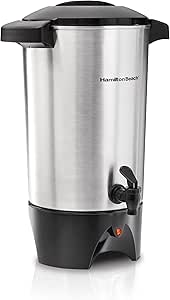 | Best for Simple, Flexible Dispensing | Capacity: 15–45 cups | Brewing speed: About 1 cup per minute | Dispensing: Two-way lever for single cups or continuous filling | VIEW ON AMAZON | See Our Full Breakdown |
| NUPANT 12-Cup Commercial Drip Coffee Maker, 1.8L Pour-Over |  | Best for Continuous Small-Batch Service | Capacity: 12 cups (1.8 L) | Power: 1450 W | Brew time: About 7 minutes per pot | VIEW ON AMAZON | See Our Full Breakdown |
| VEVOR Commercial 12-Cup Drip Coffee Maker |  | Best for Faster Pot Turnover | Capacity: 12 cups | Brew time: About 6 minutes | Warming plates: 2 | VIEW ON AMAZON | See Our Full Breakdown |
| industrial coffee machine | Capacity |
|---|---|
| VEVOR Commercial Coffee Urn | 9.5 qt / 304 oz; up to 60 cups |
| VONCI 12-Cup Commercial Drip C | 12 cups per carafe |
| Zulay Commercial 100-Cup Stain | Up to 100 five-ounce cups |
| BLACK+DECKER 40-Cup Coffee Urn | 40 cups |
| NUPANT 12-Cup Commercial Coffe | 12 cups |
| Hamilton Beach 45-Cup Fast Bre | 15–45 cups |
| SYBO 12-Cup Commercial Pour Ov | 12 cups |
| West Bend Commercial Coffee Ur | 100 cups |
| BUNN VPR-2GD 12-Cup Pourover C | 12 cups |
| Hamilton Beach 45-Cup Coffee U | 15–45 cups |
| NUPANT 12-Cup Commercial Drip | 12 cups (1.8 L) |
| VEVOR Commercial 12-Cup Drip C | 12 cups |
More Details on Our Top Picks
VEVOR Commercial Coffee Urn, 60-Cup, 9.5-Quart
The VEVOR 60-cup urn suits offices and event hosts who want one large batch held at serving temperature. Its 9.5-quart capacity and 194°F–203°F keep-warm range support a long serving window, while the reusable mesh filter cuts out paper-filter handling. Compared with the BLACK+DECKER 40-Cup Coffee Urn, VEVOR holds more coffee, but the BLACK+DECKER is lighter and can heat water for other drinks. The tradeoff here is batch timing: a full urn takes about 45 minutes, so it is less suited to quick, staggered demand than the VONCI, which brews a pot in about seven minutes. Its insulated handles and anti-dry-burn protection add practical safeguards, though this is still a large appliance that needs a nearby outlet and serving space.
Pros:- Holds up to 60 cups for group service
- Keeps coffee warm between servings
- Reusable mesh filter avoids disposable paper filters
- Two-way no-drip spout and insulated handles support serving
Cons:- A full batch takes about 45 minutes to brew
- Requires AC power and dedicated counter or table space
Best for: Office managers and event hosts who serve a large group at once and need coffee kept warm between pours
Not ideal for: Small teams or hosts who need fresh coffee in short intervals rather than waiting for a full batch to brew
- Capacity:9.5 qt / 304 oz; up to 60 cups
- Full-batch brewing time:About 45 minutes
- Wattage:950 W
- Voltage:120 V
- Keep-warm temperature:194°F–203°F (90°C–95°C)
- Filter:Reusable mesh
- Material:Stainless steel
- Dimensions:12.2 × 11.4 × 18.3 in
Our verdict“Choose the VEVOR when serving capacity and keeping a batch warm matter more than fast, smaller brew cycles.”
VONCI 12-Cup Commercial Drip Coffee Maker with 2 Carafes and 2 Warmers
The VONCI 12-cup brewer fits a break room or small café where serving a second fresh pot matters more than holding a huge batch. It brews a carafe in about seven minutes and can start another immediately; two glass carafes and warmers let staff serve one pot while the next brews. That makes it more responsive than the VEVOR 60-Cup Coffee Urn, which is built around a much slower full batch. The urn, however, can serve a larger group without repeated brewing. VONCI’s even-spray system is designed to distribute water across the grounds, but strength still depends on manually adjusting the coffee amount. The stainless housing is straightforward to wipe down, while cleaning the tank and less accessible areas calls for following the manual.
Pros:- Brews a 12-cup carafe in about seven minutes
- Can begin brewing a second pot immediately
- Two carafes and warmers support a steady serving rotation
- ETL safety certified stainless steel housing
Cons:- Coffee strength requires manual adjustment of grounds
- Tank and hard-to-reach areas require careful cleaning
Best for: Office coordinators and café staff who serve successive groups and want two carafes ready to rotate
Not ideal for: Event organizers who need a single large reservoir of coffee for continuous self-service
- Capacity:12 cups per carafe
- Carafe capacity:1.8 liters each
- Power:1610 W
- Brewing time:About 7 minutes per pot
- Warming temperature:176°F (about 80°C)
- Carafes:2 tempered glass pots
- Warming plates:2
- Certification:ETL safety certified
Our verdict“Pick the VONCI for quick, repeated 12-cup batches when rotating carafes works better than a large urn.”
Zulay Commercial 100-Cup Stainless Steel Coffee Urn
For a high-attendance event, the Zulay 100-cup urn puts capacity first: it brews up to 100 five-ounce servings at about one cup per minute. Its double-wall stainless construction helps retain heat, and the two-way faucet supports both single-cup pours and continuous dispensing. Compared with the VEVOR 60-Cup Coffee Urn, Zulay holds substantially more, making fewer refills necessary for a crowd; VEVOR is the more manageable fit when attendance is smaller. The stated serving size matters: these are five-ounce cups, so buyers expecting full mugs should plan for fewer servings. This urn’s scale can also be awkward for routine office use, where the VONCI 12-Cup brewer offers faster, smaller batches. Cool-touch handles and a twist-lock lid aid handling, but the unit is purpose-built for group service.
Pros:- Capacity of up to 100 five-ounce cups
- Brews at about one cup per minute
- Double-wall construction helps retain heat
- Two-way faucet supports single-cup or continuous pouring
Cons:- Five-ounce serving size may overstate servings for mug drinkers
- Large capacity can be excessive for everyday office use
Best for: Event venues, community organizations, and caterers serving a large crowd in small cups
Not ideal for: Small offices or households that rarely need a large batch and lack space for a full-size urn
- Capacity:Up to 100 five-ounce cups
- Brew rate:About 1 cup per minute
- Outer material:0.41 mm 430 stainless steel
- Inner material:0.41 mm 304 stainless steel
- Dispensing:Two-way faucet for single-cup or continuous pouring
- Insulation:Double-wall
- Other features:Concealed heating element, cool-touch handles, twist-lock lid, keep-warm indicator
- Guarantee:Lifetime
Our verdict“Choose Zulay when a large event needs high-volume urn service and five-ounce portions match the serving plan.”
BLACK+DECKER 40-Cup Coffee Urn with Drip-Free Spigot
The BLACK+DECKER 40-cup urn is a flexible pick for offices or gatherings where coffee is only one of several hot drinks. It can heat water for tea, hot chocolate, or instant coffee, and its reusable basket and dishwasher-safe removable parts simplify cleanup after service. Against the VEVOR 60-Cup Coffee Urn, it gives up capacity but adds that water-heating use and weighs just 2.9 pounds. The Zulay 100-Cup Urn is better for large events, while BLACK+DECKER’s 40-cup size is easier to justify for a smaller group. Its one-cup-per-minute brew rate supports timely setup, although the urn must sit on a flat, sturdy, heat-resistant surface. Buyers needing repeated small, fresh pots may prefer the VONCI’s carafe-based design.
Pros:- Heats water for drinks beyond coffee
- Brews at a rate of one cup per minute
- Reusable basket and dishwasher-safe removable parts ease cleanup
- Drip-free spigot and cool-touch side handles support serving
Cons:- Requires a flat, sturdy, heat-resistant surface during operation
- Lower capacity than the 60-cup VEVOR and 100-cup Zulay urns
Best for: Office hosts and community groups serving coffee alongside tea, hot chocolate, or instant drinks
Not ideal for: Large event caterers who need more than 40 cups available from one batch
- Capacity:40 cups
- Brew rate:1 cup per minute
- Coffee type:Drip
- Operation mode:Fully automatic
- Input type:Ground coffee
- Filter:Reusable
- Dimensions:10.63 × 10.63 × 15.95 in
- Weight:2.9 lb
Our verdict“Choose this urn for moderate-size service where heating water for other drinks is as useful as brewing coffee.”
NUPANT 12-Cup Commercial Coffee Maker with Water Line, 1.8L Auto-Filling Drip Coffee Machine with 2 Glass Carafes and Warmers
The NUPANT 12-cup brewer is the lineup’s clearest fit for a fixed break room or café station with a water connection. Its auto-fill water line reduces manual tank refills, while two carafes and warming plates let staff keep one batch available as another brews. Compared with the VONCI 12-Cup Commercial Drip Coffee Maker, it adds direct water supply for a more permanent setup; VONCI is the simpler choice if the machine needs to move or operate without plumbing. NUPANT’s 1610 W power and roughly seven-minute brewing claim support quick service, but the absence of auto-off means staff must shut it down manually. The supplied data also calls for descaling after about 2,800 uses, so ongoing upkeep belongs in the operating routine. This is less compelling for a home kitchen or a portable service table.
Pros:- Auto-fill water line reduces manual refilling
- Two carafes and warming plates support serving during another brew cycle
- 1610 W power and about seven-minute brewing support quick batches
- SS304 stainless steel construction
Cons:- No auto-off feature; requires manual shutdown
- Needs descaling after approximately 2,800 uses
- Water-line setup makes it less suited to portable or home use
Best for: Office managers and café operators with a fixed counter, water line, and frequent refills
Not ideal for: Pop-up vendors or home users who need a portable brewer or automatic shutdown
- Capacity:12 cups
- Water tank:1.8 L
- Power:1610 W
- Material:SS304 stainless steel
- Water line:Auto-fill with 1.04-inch ID hose
- Carafes:2 glass carafes
- Warming plates:2
- Auto-off:No; manual shutdown recommended
Our verdict“Pick NUPANT for a fixed commercial station where reducing refill work matters and staff can manage shutdown and descaling.”
Hamilton Beach 45-Cup Fast Brew Coffee Urn and Hot Beverage Dispenser
For meetings, community events, or a buffet that needs a full urn on a schedule, this Hamilton Beach makes a practical case with a 45-cup capacity and a stated 28-minute brew time. Its dual heaters keep coffee hot after brewing, while the one-hand spout makes serving easier when guests are moving through a line. Compared with the SYBO 12-Cup Commercial Pour Over, it serves a much larger batch without needing carafes, but it gives up the SYBO’s two separate warmers and stainless-steel build. The removable reusable basket avoids paper filters, and the level window helps track remaining water and coffee. Its aluminum body and batch-focused format suit occasional high-volume service, though it is not a flexible choice for brewing a few cups at a time.
Pros:- Brews up to 45 cups in a stated 28 minutes
- Dual heaters help maintain serving temperature
- One-hand dispensing is convenient for self-service
- Reusable filter basket and water-level window simplify operation
Cons:- Batch urn format is less suited to brewing small amounts
- Aluminum construction is less robust in feel than the SYBO stainless-steel brewer
Best for: Event organizers and office hosts who need a large batch ready quickly and simple self-service dispensing
Not ideal for: Small teams or cafés that need frequent smaller batches, separate carafes, or a stainless-steel brewer
- Type:Manual drip coffee maker
- Capacity:15–45 cups
- Brew time:28 minutes for 45 cups
- Wattage:1500 watts
- Voltage:120 V
- Filter:Reusable, removable filter basket
- Dimensions:12.2 × 11.8 × 15.1 in (D × W × H)
- Material:Aluminum
Our verdict“Choose this urn when fast, high-volume batch service matters more than carafes or smaller-batch flexibility.”
SYBO 12-Cup Commercial Pour Over Coffee Maker SF-CB-2GA
The SYBO is the more service-oriented pick for a kitchen that needs two ready carafes and steady turnover instead of one oversized urn. Its 12-cup capacity, dual warmers, and stated brewing time under 10 minutes make it easier to keep a smaller office or hospitality counter supplied in rounds. The even spray head is intended to distribute water across the grounds, while drip-free carafes help reduce mess during serving. Compared with the 45-cup Hamilton Beach Fast Brew Urn, this machine handles less coffee per batch but offers more flexibility between pots and a stainless-steel body. That added commercial setup comes with a 16.4-pound footprint and 2500-watt draw; it also uses ground coffee, so it will not suit operators who depend on pods or whole-bean automation.
Pros:- Two carafes and dual warmers support ongoing service
- Stainless-steel construction is suited to commercial settings
- Brews a batch in under 10 minutes according to the description
- Reusable filter and even spray head support straightforward drip brewing
Cons:- 16.4-pound weight and counter footprint can be awkward in compact kitchens
- 2500-watt draw may constrain outlet planning
- Works with ground coffee only
Best for: Small offices, cafés, and hospitality counters that serve successive pots and want two carafes available
Not ideal for: Event venues serving very large crowds or kitchens with limited counter space and electrical capacity
- Capacity:12 cups
- Wattage:2500 watts
- Voltage:120 V
- Material:Stainless steel
- Dimensions:13.9 × 8.2 × 16.5 in (D × W × H)
- Weight:16.4 pounds
- Carafes:2
- Filter type:Reusable
Our verdict“Pick the SYBO for a compact commercial coffee station that benefits from two warm carafes and quick repeat batches.”
West Bend Commercial Coffee Urn, Polished Aluminum, 100-Cup, Automatic Temperature Control
When a venue needs coffee for a crowd in one continuous serving vessel, the West Bend’s 100-cup capacity sets it apart from the smaller urns in this group. The stated rate of one cup per minute points to a straightforward service rhythm: brew ahead, then let the automatic temperature control maintain warmth. Its dripless faucet can handle single cups or a continuous fill, and the lockable cover helps keep the urn closed during service. Compared with the 45-cup Hamilton Beach Coffee Urn, West Bend can serve a much larger gathering before a refill, but its 23-inch height and 14.5-inch depth demand more storage and counter space. Polished aluminum keeps the design simple, though buyers seeking a stainless-steel body may prefer the separate Zulay 100-cup option in this roundup.
Pros:- 100-cup capacity suits high-volume gatherings
- One-cup-per-minute brew rate supports predictable batch planning
- Automatic temperature control maintains coffee after brewing
- Faucet supports single-cup pours and continuous filling
Cons:- Large dimensions make storage difficult in compact kitchens
- Polished aluminum may not appeal to buyers seeking stainless-steel construction
Best for: Caterers, halls, and event hosts who routinely serve large groups from a single urn
Not ideal for: Small offices or kitchens that lack room to store and operate a 23-inch-tall urn
- Capacity:100 cups
- Brew rate:1 cup per minute
- Power:1500 W
- Voltage:120 V AC
- Dimensions:23 in H × 14.5 in D
- Material:Polished aluminum
- Temperature control:Automatic keep-warm mode
- Approval:NSF approved
Our verdict“Choose the West Bend when serving a crowd from one urn is more useful than saving counter and storage space.”
BUNN VPR-2GD 12-Cup Pourover Commercial Coffee Brewer with Warmers and Glass Decanters
The BUNN VPR-2GD fits buyers who want a familiar pourover brewer with two glass decanters and warmers, without relying on a water-line setup. Upper and lower warmers let staff keep one pot available while another is brewing, a more useful service pattern than the single-vessel West Bend 100-Cup Urn for a counter serving smaller groups throughout the day. Its 12-cup capacity also aligns more closely with the SYBO brewer, though the available product details provide less information about brewing speed, controls, and construction. That makes it harder to compare operationally or judge fit before buying. The package dimensions and weight suggest a substantial unit, so I would reserve it for a dedicated coffee counter rather than a cramped break area.
Pros:- Two glass decanters support serving and brewing in parallel
- Upper and lower warmers keep pots available
- 12-cup batch format suits smaller service rounds
- Pourover design does not specify a water-line requirement
Cons:- Available specifications do not state brew time or wattage
- Package dimensions and weight point to a bulky setup
- The provided data does not clarify materials or control features
Best for: Small commercial counters that need two glass pots and a simple pourover workflow
Not ideal for: Buyers who need documented brew speed, compact dimensions, or detailed operating specifications before choosing
- Product type:Coffee maker
- Capacity:12 cups
- Warmers:Upper and lower
- Decanters:2 glass decanters
- Package dimensions:27.24 × 22.24 × 11.98 in
- Package weight:23.99 pounds
- Package quantity:1
Our verdict“Choose the BUNN for a dedicated counter that needs two warmed decanters and can accommodate its sizable package.”
Hamilton Beach 45-Cup Coffee Urn and Hot Beverage Dispenser
This Hamilton Beach suits gatherings where the serving method matters as much as the batch size: its two-way lever can pour a single cup or fill a larger container continuously. With a capacity of 15 to 45 cups and a stated pace of about one cup per minute, it provides a simple way to serve a crowd without setting out several carafes. Compared with the newer Hamilton Beach Fast Brew Urn, this model’s listed brew rate is slower for a full batch, but its twist-lock lid and brew basket are dishwasher safe, which can ease cleanup after service. The glossy aluminum body keeps the format straightforward, though the product data gives no dimensions or weight, making counter and storage planning uncertain. It is designed for batch brewing, so small daily servings are a poor fit.
Pros:- 15–45-cup range accommodates different gathering sizes
- Two-way lever handles single-cup pours and continuous filling
- Ready light and water-level markings simplify operation
- Dishwasher-safe lid and brew basket make cleanup easier
Cons:- Batch format is inefficient for making only a few cups
- No dimensions or weight are supplied for space planning
- Aluminum construction may be less appealing than stainless-steel commercial brewers
Best for: Community groups and office hosts who need adjustable batch size and both single-cup and continuous dispensing
Not ideal for: Households or small teams that usually brew just one or two cups at a time
- Capacity:15–45 cups
- Brewing speed:About 1 cup per minute
- Dispensing:Two-way lever for single cups or continuous filling
- Finish:Glossy aluminum
- Dishwasher-safe parts:Twist-lock lid and brew basket
- Warranty:1 year
- Model number:40515R
Our verdict“Pick this model for gatherings that need a flexible serving lever and easy cleanup more than the faster brew time of its sibling.”
NUPANT 12-Cup Commercial Drip Coffee Maker, 1.8L Pour-Over
The NUPANT suits workplaces, church kitchens, and small cafés that need fresh pots ready in rotation rather than one large urn for a crowd. Its two glass carafes and independently controlled warming plates let staff keep one pot serving while another stays hot, a more flexible setup than the 60-cup VEVOR Commercial Coffee Urn. A full 1.8 L pot brews in about seven minutes, and the SS304 stainless steel housing and funnel are practical for frequent use. The tradeoff is a larger countertop footprint than a single-pot brewer, plus no built-in grinder or stated strength adjustment. The descaling reminder helps track upkeep, but regular descaling is still needed to maintain performance.
Pros:- Brews a 12-cup (1.8 L) pot in about seven minutes
- Two carafes and separate warming controls support continuous serving
- SS304 stainless steel housing and funnel
- Descaling reminder helps track maintenance
Cons:- Bulky for small countertops
- Requires regular descaling
- No built-in grinder for freshly ground beans
Best for: Small cafés, church kitchens, and office break rooms that serve coffee in successive 12-cup batches.
Not ideal for: Compact kitchens or event halls needing one large batch; its two-pot setup takes counter space, while an urn such as the 60-cup VEVOR serves more people at once.
- Capacity:12 cups (1.8 L)
- Power:1450 W
- Brew time:About 7 minutes per pot
- Housing and funnel:SS304 stainless steel
- Carafes included:2 glass coffee pots
- Warming plates:2, with separate keep-warm controls
- Descaling reminder:After approximately 2,800 uses
Our verdict“Choose the NUPANT if you need two pots in rotation for steady small-group service and have room for its countertop footprint.”
VEVOR Commercial 12-Cup Drip Coffee Maker
For a small service counter where the queue matters, the VEVOR’s about-six-minute brew time gives it a slight speed advantage over the NUPANT 12-Cup Commercial Drip Coffee Maker, which takes about seven minutes per pot. Both provide two glass carafes and dual warming plates, so the VEVOR can keep one batch ready while the next brews. Its detachable 304 stainless steel funnel also makes cleanup simpler between runs. Independent mechanical switches with indicator lights keep operation straightforward, though the product data does not specify strength settings or a descaling reminder. This is a compact-batch brewer, not an urn for serving a large gathering at once; the 60-cup VEVOR Commercial Coffee Urn is better suited to that job.
Pros:- Brews 12 cups in about six minutes
- Two glass carafes and warming plates keep coffee ready between batches
- Detachable 304 stainless steel funnel simplifies cleaning
- Independent switches with indicator lights make operation clear
Cons:- No adjustable brew-strength settings are specified
- Product information provides no durability details
- A 12-cup capacity requires repeated batches for large gatherings
Best for: Small cafés, meeting rooms, and staff kitchens that serve repeated 12-cup batches and value quick turnover.
Not ideal for: Caterers serving large crowds or buyers who need stated brew-strength controls or durability information.
- Capacity:12 cups
- Brew time:About 6 minutes
- Warming plates:2
- Carafes:2 glass
- Funnel material:304 stainless steel
- Controls:Independent mechanical switches with indicator lights
- Funnel:Detachable
Our verdict“Pick the VEVOR for faster small-batch service with simple controls, and choose a commercial urn when one 12-cup cycle cannot meet demand.”

How We Picked
I compared these industrial coffee machines by the jobs their formats handle: large-batch service, continuous pot brewing, and lower-volume commercial use. Capacity, dispensing style, water supply, carafe and warmer setup, and stated construction all informed the evaluation. I gave larger urns an advantage for events and self-service settings, while drip brewers ranked higher for venues that want repeated fresh pots. A water line can reduce staff refills, but it adds setup needs, so I treated it as a fit advantage rather than an automatic win.
The ranking favors machines with a clear use case and useful service features, while accounting for drawbacks such as bulk, limited batch size, or reliance on manual filling. The Zulay leads for its high-capacity stainless steel urn design; the BUNN ranks highly for a different need—two warmed decanters and pour-over operation. Similar Hamilton Beach urn entries remain distinct by listed capacity, while the two NUPANT and two VEVOR drip models are separated by their stated water supply and serving setup. Product descriptions do not establish long-term reliability or brewing results, so I base these recommendations on listed design and buyer fit.
Factors to Consider When Choosing Industrial Coffee Machine
Choosing an industrial coffee machine starts with the service routine around it: who fills it, who serves from it, and how quickly the next batch must be ready. These broader questions can prevent a mismatch that a feature list alone will not catch.
Match Capacity to Real Serving Size
Start with the number of servings needed during the busiest stretch, then check how the manufacturer defines a cup. A stated cup count may refer to a smaller serving than the mug or paper cup your guests use. If a machine only covers the expected headcount on paper, staff may have to brew again while service is underway. Large urns suit concentrated demand, but they occupy storage and counter space even when the room is quiet. For uneven demand, a smaller urn or a carafe brewer may reduce waste and make refills easier to manage.
Choose Between an Urn and Fresh Pots
An urn stores a large batch in one dispenser, which makes it practical for self-service lines and events with predictable peaks. A decanter brewer makes smaller batches and can keep multiple pots available, helping a team replenish coffee throughout a longer service window. The common mistake is choosing only by maximum capacity without considering how long coffee will sit before it is served. Think about whether guests arrive all at once or gradually, and whether staff can brew while serving. Where demand comes in waves, having multiple smaller pots can be easier to manage than one large batch.
Plan the Water Supply Before Buying
Pour-over machines give staff control over filling and can work in locations without a dedicated water connection. Auto-filling models can reduce repetitive manual work during busy service, but the installation must suit the space and the available plumbing. Check the connection requirements, nearby access, and who will handle setup before treating a water line as a convenience. A plumbed machine may be a poor fit for a temporary venue or a counter that moves between rooms. For fixed sites, weigh the time saved on refills against the added setup and maintenance responsibilities.
Check Power, Space, and Workflow Together
High-volume equipment needs a stable place to brew, serve, and be cleaned, so measure the counter and storage area before choosing a large urn or brewer. Check the machine’s stated electrical requirements against the outlet and circuit available where it will run. Consider where full carafes will be placed and whether the serving area leaves room for cups, filters, and supplies. A brewer that fits the counter but blocks a prep area can slow service more than it helps. Include staff movement and refill access in the layout, not just the machine’s footprint.
Set a Cleaning and Maintenance Routine
Frequent brewing leaves oils and residue in urns, spigots, baskets, and carafes, so cleaning time belongs in the purchase decision. Ask who will clean the machine, how often it will be used, and whether the parts that need attention are easy for that person to reach. A simple setup can be a better operational fit when many staff members share closing duties. For large urns, account for the space and sink access needed to wash the vessel and spigot. Follow the manufacturer’s cleaning instructions and water-quality guidance to help preserve normal operation.
Pay for Features That Remove a Real Bottleneck
Additional warmers, multiple carafes, and automatic filling help only when they address a recurring service problem. A second warmer has value when staff need two pots ready at once; it adds little if one batch serves the whole shift. A large-capacity urn is useful when a crowd arrives together, but it can be awkward when daily demand is modest. Compare the machine’s workflow with the staff time it could save, rather than treating every commercial feature as necessary. For occasional events, simpler equipment may be easier to store and operate; for daily use, convenience features may matter more.
Frequently Asked Questions
Should I choose a 100-cup urn or a 12-cup commercial brewer?
Choose by demand pattern rather than the largest number on the label. A 100-cup urn is better suited to a crowd that needs coffee in a short window, while a 12-cup brewer supports repeated smaller batches over time. Check what the stated cup size means and compare it with the serving size you actually use. If demand is unpredictable, smaller batches may help limit leftover coffee. Also confirm that the urn fits your counter, sink, and storage space.
Is a direct water line worth it for a commercial coffee maker?
A water line can save staff from repeatedly filling a brewer, especially during long or busy service periods. It makes more sense in a fixed location with suitable plumbing than in a temporary setup or a venue that moves equipment. Before choosing an auto-filling model, check its connection needs and account for installation. A pour-over machine avoids that plumbing requirement and leaves filling under staff control. The better option depends on whether manual refills are a real bottleneck in your operation.
Are coffee urns or decanter brewers better for an office?
For a meeting or event where many people serve themselves at once, an urn can simplify dispensing. For an office where people want fresh coffee at different times, a decanter brewer can support smaller batches and ongoing replenishment. Consider who will brew and refill it, as well as how much coffee typically remains at the end of the day. A large urn can be excessive when daily use is modest. Two decanters may be more useful when different pots need to be ready at the same time.
What should I check before using a commercial coffee machine at an event?
Confirm the machine’s electrical requirements and the venue’s outlet access before moving it into place. Measure the serving table and check that there is room for cups, supplies, and safe access to the spigot or carafes. Plan how water will reach the machine and where used grounds and wash water will go. Estimate servings using your actual cup size, not just the listed capacity. For a temporary event, a pour-over setup may be simpler than arranging a dedicated water connection.
How do I decide whether to pay for extra warmers or carafes?
Extra warmers and carafes help when service continues while another batch brews or when you need two pots ready at once. They may add little value if one batch reliably covers your busiest period. Map the service routine: how often staff brew, how fast guests take coffee, and whether separate pots serve different groups. Also check the counter space available for warmers and full carafes. Choose the added capacity only if it solves a recurring delay or shortage.
Conclusion
For the broadest large-batch use, I recommend the Zulay 100-Cup Stainless Steel Coffee Urn as best overall; buyers who prefer a lower-capacity urn can look to the VEVOR 60-Cup. The BLACK+DECKER 40-Cup Urn is my best value direction for smaller gatherings, while the West Bend 100-Cup fits buyers who want a high-capacity urn with automatic temperature control and polished aluminum construction. For fresh pots and a two-decanter arrangement, choose the BUNN VPR-2GD as the premium-style brewer in this lineup; beginners who want straightforward large-batch dispensing may find the Hamilton Beach 45-Cup Urn easier to match to modest event needs. If reduced manual filling is your priority, consider the NUPANT auto-filling model after checking the water connection requirements. The right pick is the one that fits your peak serving volume and daily workflow.
Fall Picks
fall essentials
As an affiliate, we earn on qualifying purchases.