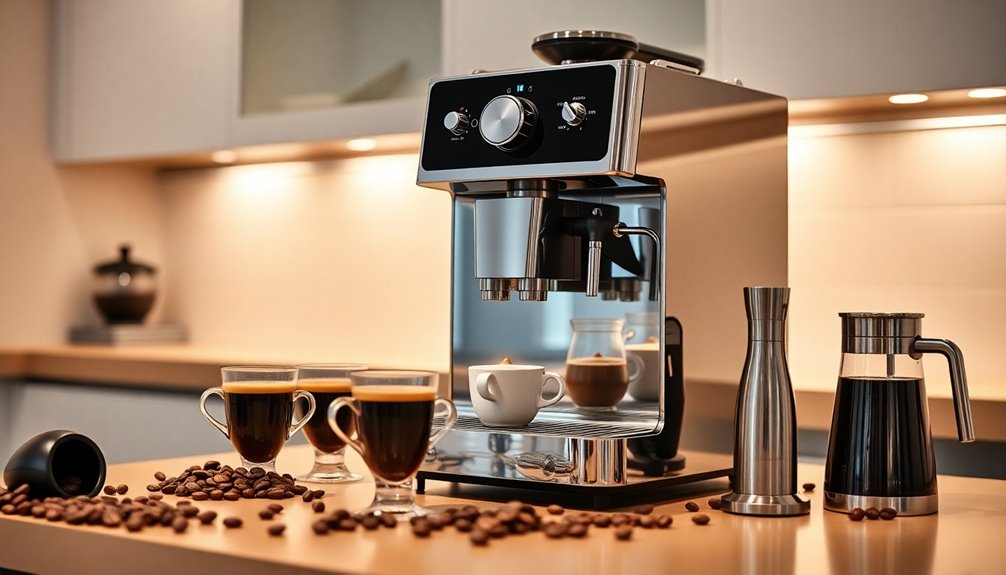
For latte art at home, I’d start with the Breville Barista Touch: its guided controls and steam wand make it the most approachable all-round choice in this lineup. The Gaggia Classic Evo Pro suits buyers who want more manual control, while the Breville Barista Express combines grinding and espresso preparation in one machine. The main tradeoff is between guidance and convenience on one side, and hands-on control over grinding, extraction, and milk texture on the other. Compact models can save counter space, but their steaming and workflow may ask more of the user. Read on for how I’d match each machine to the way you want to make latte art.

Get kitchen staples and gadgets delivered free with Prime
- Fast, free delivery on millions of items
- Prime Video, Amazon Music and more included
- Member-only deals all year
Complete the kit



Key Takeaways
- The Barista Touch is my best overall pick for buyers who want guided controls alongside a steam wand for practicing milk texture.
- The Gaggia Classic Evo Pro favors hands-on brewing; it makes more sense for buyers willing to build skill than for those seeking guided operation.
- The Barista Express bundles grinding and espresso-making, which can simplify a home setup, though an all-in-one workflow may be less flexible than separate equipment.
- Several compact picks include a milk frother or steam wand, but a small footprint alone says little about how much control you’ll have over milk texture.
- Touchscreens, pressure claims, and included grinders are not interchangeable advantages; for latte art, I’d weigh repeatable espresso preparation and controllable steaming against convenience.
| Breville BES880BSS Barista Touch Espresso Machine, Brushed Stainless Steel |  | Best Overall | Type: Semi-automatic with integrated grinder | Heating System: ThermoJet, 3-second heat-up | Temperature Control: PID digital regulation | VIEW ON AMAZON | See Our Full Breakdown |
| XIXUBX Cold Brew Espresso Machine with Milk Frother, Gray |  | Best for Iced Latte Drinkers | Type: Semi-automatic espresso machine | Pump Pressure: 20 bar | Power: 1350 W | VIEW ON AMAZON | See Our Full Breakdown |
| Gaggia Classic Evo Pro Espresso Machine (RI9380/46), Brushed Stainless Steel |  | Best for Learning Real Latte Art | Type: Semi-automatic espresso machine | Origin: Made in Italy | Pump Pressure: 9 bar | VIEW ON AMAZON | See Our Full Breakdown |
| AMZCHEF Espresso Machine with Grinder and Temperature Control |  | Best Value Bean-to-Cup | Type: Semi-automatic with integrated grinder | Grind Settings: 44 | Brewing Temperature: 190°F-201°F adjustable | VIEW ON AMAZON | See Our Full Breakdown |
| Gevi 20-Bar Compact Espresso Machine for Home, Latte and Cappuccino Coffee Maker | 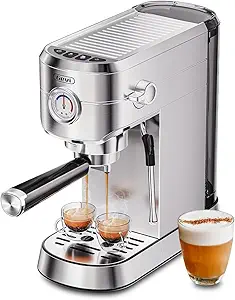 | Best Compact Pick | Type: Semi-automatic espresso machine | Pump Pressure: 20 bar | Temperature Control: NTC | VIEW ON AMAZON | See Our Full Breakdown |
| CASABREWS CM5418 Compact Espresso Machine with Milk Frothing Wand |  | Best Budget Entry Point | Model: CM5418 | Operation mode: Semi-automatic | Pump pressure: 20 bar | VIEW ON AMAZON | See Our Full Breakdown |
| EUHOMY Espresso Machine with Grinder and Milk Frother |  | Best All-in-One for Fresh-Grind Shots | Grind settings: 30 | Pump pressure: 20 bar | Portafilter size: 58 mm | VIEW ON AMAZON | See Our Full Breakdown |
| Chefman CraftBrew Digital Espresso Machine, 15-Bar Pump with Steam Wand – Stainless Black | 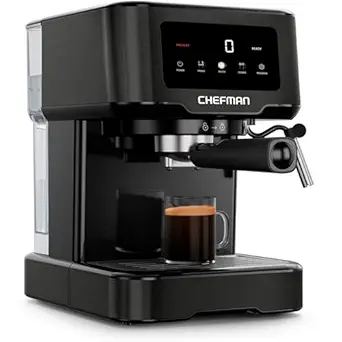 | Best for Set-and-Forget Shot Consistency | Model: RJ54-SS-15-D-BLK | Pump pressure: 15 bar | Power: 1350 W, 120 V | VIEW ON AMAZON | See Our Full Breakdown |
| Aromaster 1400W Espresso Machine with Milk Frother |  | Best Feature-Packed Compact Pick | Power: 1400 W | Pump pressure: 20 bar | Water tank: 37 oz, removable | VIEW ON AMAZON | See Our Full Breakdown |
| CASABREWS 3700 Essential Stainless Steel Espresso Machine with Steam Wand |  | Best for Volume and Refill Convenience | Operation mode: Semi-automatic | Pump pressure: 20 bar | Power: 1350 W, 120 V | VIEW ON AMAZON | See Our Full Breakdown |
| Breville Barista Express Espresso Machine, Brushed Stainless Steel |  | Best All-in-One for Serious Latte Art Practice | Model: BES870XL | Grinder: Integrated conical burr grinder | Bean Hopper Capacity: 1/2 lb | VIEW ON AMAZON | See Our Full Breakdown |
| Arecovas Espresso Machine with 20 Bar Pressure, Touch Screen, and Milk Frother |  | Best Compact Smart Pick | Pressure: 20 bar | Power: 1300 W, 120 V | Water Tank Capacity: 1.2 L / 41 oz removable | VIEW ON AMAZON | See Our Full Breakdown |
| Neretva 20 Bar Compact Espresso Machine |  | Best Budget Steamer for Art Practice | Pressure: 20 bar | Wattage: 1350 W, 120 V | Water Tank: 1.3 L removable | VIEW ON AMAZON | See Our Full Breakdown |
| home espresso machine for latte art | Water Tank | Power | Pump Pressure |
|---|---|---|---|
| Breville BES880BSS Barista Tou | 67 oz | 1680 W, 110-120 V | — |
| XIXUBX Cold Brew Espresso Mach | — | 1350 W | 20 bar |
| Gaggia Classic Evo Pro Espress | 2.1 liters | — | 9 bar |
| AMZCHEF Espresso Machine with | 60 oz | — | — |
| Gevi 20-Bar Compact Espresso M | — | — | 20 bar |
| CASABREWS CM5418 Compact Espre | 34 oz, removable | 1350 W | 20 bar |
| EUHOMY Espresso Machine with G | — | — | 20 bar |
| Chefman CraftBrew Digital Espr | 1.5 liters, removable | 1350 W, 120 V | 15 bar |
| Aromaster 1400W Espresso Machi | 37 oz, removable | 1400 W | 20 bar |
| CASABREWS 3700 Essential Stain | 43.9 oz, removable | 1350 W, 120 V | 20 bar |
| Breville Barista Express Espre | — | 1600 W, 120 V | — |
| Arecovas Espresso Machine with | — | 1300 W, 120 V | — |
| Neretva 20 Bar Compact Espress | 1.3 L removable | — | — |
More Details on Our Top Picks
Breville BES880BSS Barista Touch Espresso Machine, Brushed Stainless Steel
The Barista Touch earns the top spot because it solves the two hardest parts of latte art at once: consistent extraction and reliable microfoam. The automatic steam wand textures milk to a silky, paintable consistency with far less practice than the Gaggia Classic Evo Pro demands, and the ThermoJet heater goes from cold to brewing in about three seconds. Compared with the Breville Barista Express, the touchscreen guided workflow and auto milk texturing make this the friendlier choice for anyone whose priority is pouring hearts and rosettas rather than dialing in every variable manually.
The tradeoff is complexity and upkeep. The grinder, milk pathway, and touchscreen menus all need regular cleaning, and beginners may spend a few weeks learning the settings before drinks taste consistently great.
Pros:- Automatic steam wand produces latte-art-ready microfoam with minimal skill
- Integrated conical burr grinder delivers true bean-to-cup freshness
- ThermoJet heating reaches brewing temperature in about 3 seconds
- PID temperature control keeps espresso extraction consistent shot to shot
Cons:- Grinder, milk system, and touchscreen workflow require frequent cleaning and maintenance
- Customization menus present a learning curve for first-time espresso makers
Best for: Home baristas who want bean-to-cup convenience with automatic microfoam that makes latte art achievable without months of steaming practice
Not ideal for: Tinkerers who want full manual control over grind, temperature, and steaming — the guided automation removes variables some hobbyists enjoy manipulating
- Type:Semi-automatic with integrated grinder
- Heating System:ThermoJet, 3-second heat-up
- Temperature Control:PID digital regulation
- Steam Wand:Automatic microfoam auto steam wand
- Bean Hopper Capacity:1/2 lb
- Water Tank:67 oz
- Display:Touchscreen with 5 cafe favorites and 8 custom settings
- Power:1680 W, 110-120 V
- Warranty:2 years limited
Our verdict“If you want one machine that grinds, brews, and steams its way to pourable latte art with the least friction, this is the pick.”
XIXUBX Cold Brew Espresso Machine with Milk Frother, Gray
Most machines in this lineup, like the Gevi 20-Bar Compact, only pull hot shots — which means pouring over ice often yields bitter, melted drinks. The XIXUBX stands out for its one-touch cold brew mode, letting you build an iced latte base without shocking hot espresso with ice. The 1350W heater warms in roughly 30 seconds, and the included steam wand and frothing pitcher cover the hot-milk side when you want a warm cappuccino instead.
The compromise is precision. Unlike the AMZCHEF, which offers 44 grind settings and adjustable brew temperature, this machine gives you almost no control over pressure or temperature — you are trusting the presets. For latte art specifically, the manual steam wand is serviceable but not in the same class as the Gaggia Classic Evo Pro‘s commercial wand.
Pros:- One-touch cold brew mode is rare at this size and price tier
- Fast 30-second heat-up suits busy mornings
- Push-button controls remove guesswork for beginners
- Steam wand and included frothing pitcher handle hot milk drinks
Cons:- No user control over pressure or temperature settings
- Steam wand produces acceptable but not latte-art-grade microfoam
Best for: Iced-latte fans and small households who split their orders between cold brew and occasional hot espresso drinks
Not ideal for: Espresso hobbyists chasing dial-in precision or competition-grade microfoam — the locked-down settings cap how far you can develop your skills
- Type:Semi-automatic espresso machine
- Pump Pressure:20 bar
- Power:1350 W
- Heating Time:About 30 seconds
- Temperature Control:NTC sensor
- Beverage Options:Hot espresso and one-touch cold brew
- Included Accessory:Milk frothing pitcher
- Warranty:1 year
Our verdict“A sensible choice if iced drinks anchor your routine, but serious latte art demands a more capable wand.”
Gaggia Classic Evo Pro Espresso Machine (RI9380/46), Brushed Stainless Steel
If the goal is genuinely learning to pour latte art, not just making tasty lattes, the Classic Evo Pro is the machine that will grow with you. Its commercial steam wand delivers the dry, powerful steam pressure needed to texture glossy, swirlable microfoam — something the automatic wand on the Breville Barista Touch gets close to, but never quite matches for control. The 58mm commercial portafilter and three-way solenoid valve mirror what you would find in a cafe, so the techniques you build here transfer directly.
Unlike the Gevi, there is no grinder, no presets, and no forgiveness — expect a month or two of mediocre shots before things click. At 20 pounds of solid stainless steel, it also earns its counter space rather than fitting into it.
Pros:- Commercial steam wand textures true latte-art-quality microfoam
- 58mm commercial portafilter and three-way solenoid valve for cafe-style technique
- Solid stainless steel build with self-serviceable, repairable design
- Versatile with ground coffee, ESE pods, and pressurized baskets
Cons:- Fully manual workflow demands real practice before drinks improve
- Heavy at 20 pounds and requires a separate grinder for best results
Best for: Hobbyists willing to practice steaming and puck prep manually in exchange for cafe-grade components and microfoam that rewards skill
Not ideal for: Beginners who want push-button consistency or a first machine with an included grinder — this model assumes you already own a decent grinder or will buy one
- Type:Semi-automatic espresso machine
- Origin:Made in Italy
- Pump Pressure:9 bar
- Portafilter:58mm commercial stainless steel
- Steam Wand:Commercial style for latte art microfoam
- Water Tank:2.1 liters
- Wattage:1200 W, 120V
- Dimensions:8″D x 9.5″W x 14.2″H, 20 lb
Our verdict“The closest thing to a cafe trainer for your counter — buy it if the craft is the point, not just the coffee.”
AMZCHEF Espresso Machine with Grinder and Temperature Control
The AMZCHEF carves out a smart middle position: it offers the integrated grinder plus adjustable brew temperature combination that usually points you toward the Breville Barista Express, but at a friendlier budget. With 44 grind settings and a temperature range of 190°F to 201°F, it gives you genuine dial-in ability that the XIXUBX simply does not — you can taste a shot, nudge the grind or temperature, and actually change the result. The 8mm stainless steam wand steams milk well enough for basic latte art pours, and the one-touch cold brew mode is a bonus the Breville lacks.
Do not expect Gaggia Classic Evo Pro build quality or steam power. The touch screen is informative but the machine feels more appliance than instrument, and long-term durability is less proven than the Italian veteran.
Pros:- 44 grind settings and adjustable 190°F-201°F brew temperature give real dial-in control
- Integrated grinder delivers bean-to-cup freshness in one machine
- One-touch cold brew mode adds versatility beyond espresso
- Touch screen displays grind time, brew time, and temperature live
Cons:- Steam wand handles microfoam adequately but lacks the power for advanced latte art
- Build quality and long-term reliability less established than legacy brands
Best for: Budget-conscious buyers who want grind and temperature control without paying premium-brand prices for a bean-to-cup setup
Not ideal for: Buyers who prioritize long-term durability and parts availability — this is a newer brand without a service track record like Gaggia’s
- Type:Semi-automatic with integrated grinder
- Grind Settings:44
- Brewing Temperature:190°F-201°F adjustable
- Steam Wand:8 mm stainless steel
- Water Tank:60 oz
- Heating System:1350 W
- Display:IMD HD touch screen
- Modes:Espresso and one-touch cold brew
Our verdict“The most control you can get per dollar in this lineup, as long as café-grade microfoam is not your top priority.”
Gevi 20-Bar Compact Espresso Machine for Home, Latte and Cappuccino Coffee Maker
Where the Breville Barista Touch dominates a countertop, the Gevi earns its place by fitting almost anywhere — a studio kitchen, a dorm, an office nook — while still covering the latte-art basics. The pressure gauge and pre-infusion are genuinely useful here: watching the needle helps beginners learn proper grind and tamp without guessing, a feedback loop the similarly compact CASABREWS CM5418 doesn’t provide. The steam wand makes decent microfoam for simple pours, and the removable froth nozzle makes cleanup less of a chore than fixed-wand rivals.
Realistically, this is a one-drink-at-a-time machine. Entertaining guests means a queue at the wand, and the manual steaming demands more skill than the Barista Touch’s automatic system for the same pour quality.
Pros:- Compact footprint suits small kitchens, offices, and tight counters
- Pressure gauge and pre-infusion help beginners visualize proper extraction
- Removable froth nozzle simplifies steam wand cleaning
- Hot water function covers Americanos, tea, and cup pre-warming
Cons:- Manual steam wand requires practice to reach latte-art-quality foam
- Small capacity makes batch drink preparation slow
Best for: Small-space dwellers and office users who want steam-wand lattes without surrendering much counter space
Not ideal for: Households making multiple milk drinks back to back — the compact boiler and single wand slow things down quickly
- Type:Semi-automatic espresso machine
- Pump Pressure:20 bar
- Temperature Control:NTC
- Pre-infusion:Yes
- Pressure Gauge:Yes
- Steam Wand:Manual with removable froth nozzle
- Housing:Stainless steel
- Hot Water Function:Yes
- Warranty:12 months with lifetime technical support
Our verdict“A space-smart choice for solo latte drinkers who value the feedback of a gauge over the speed of a bigger machine.”
CASABREWS CM5418 Compact Espresso Machine with Milk Frothing Wand
CASABREWS CM5418 makes the list as the most affordable way to get a real steam wand in front of a beginner — and that wand is the whole point for latte art practice. The pressure gauge is a genuinely useful touch at this price, giving visual feedback on extraction that pricier compact rivals like the Neretva 20 Bar omit entirely. Compared with the CASABREWS 3700 from the same brand, this model trades tank capacity (34 oz vs 43.9 oz) for the gauge, which matters more if you’re dialing in shots. The tradeoff is patience: you must let the machine cool between frothing and brewing, which slows your workflow when pulling a shot after texturing milk. Foam quality is adequate for basic rosettas but falls short of the microfoam a Gaggia Classic Evo Pro produces.
Pros:- Pressure gauge provides real extraction feedback rare at this price
- Steam wand is adequate for basic latte art practice
- Compact stainless steel build fits small counters
- Removable 34 oz tank makes refills simple
Cons:- Must cool down after frothing before brewing again
- Hot water function can require troubleshooting
- Steam power limits microfoam quality compared to prosumer models
Best for: Beginners who want to practice latte art on a real steam wand without a big upfront commitment
Not ideal for: Anyone making multiple milk drinks back-to-back — the required cool-down between frothing and brewing kills your rhythm
- Model:CM5418
- Operation mode:Semi-automatic
- Pump pressure:20 bar
- Power:1350 W
- Water tank:34 oz, removable
- Milk frother:Steam wand
- Finish:Brushed stainless steel
- Includes:One- and two-cup filters, portafilter, tamper with spoon
Our verdict“A sensible low-risk first machine for learning milk texturing, as long as you accept slow drink-after-drink workflow.”
EUHOMY Espresso Machine with Grinder and Milk Frother
EUHOMY’s standout combination of a built-in grinder with 30 settings and a commercial-size 58 mm portafilter puts it in rare territory — that’s the same portafilter diameter as the Gaggia Classic Evo Pro, giving you standard accessories and more even extraction than the smaller baskets on the CASABREWS 3700. The PID control holding temperature within ±1°C translates directly to shot consistency, which matters when you’re trying to pour clean latte art lines on a repeatable base. Freshly ground coffee also beats pre-ground for crema, and crema stability helps art hold its shape. The tradeoff: an all-in-one grinder-and-brewer like this carries more failure points than a dedicated machine, and the Breville Barista Express offers a similar concept with a longer track record and stronger support ecosystem.
Pros:- 30 grind settings allow precise dialing-in for latte-art-worthy crema
- 58 mm commercial portafilter improves extraction evenness and accessory compatibility
- PID temperature stability within ±1°C supports repeatable shots
- High-pressure steam wand capable of microfoam
Cons:- No published dimensions or tank capacity makes kitchen planning a gamble
- Combined grinder-brewer design adds potential failure points versus dedicated units
- Brand has a shorter support track record than Breville or Gaggia
Best for: Buyers who want bean-to-cup convenience and café-style microfoam without buying a separate grinder
Not ideal for: Tinkerers who already own a quality burr grinder — the built-in grinder becomes dead weight and wasted cost
- Grind settings:30
- Pump pressure:20 bar
- Portafilter size:58 mm
- Temperature control:PID, stable within ±1°C
- Milk frother:High-pressure steam wand
- Operation mode:Semi-automatic with built-in grinder
Our verdict“The strongest choice here if you want one machine to grind and brew for art-ready espresso — just verify it fits your counter first.”
Chefman CraftBrew Digital Espresso Machine, 15-Bar Pump with Steam Wand – Stainless Black
Chefman’s CraftBrew earns its spot through programmable shot volume — once you dial in your ristretto, espresso, or lungo, the digital touch panel repeats it every time, removing the biggest variable for newer latte artists. That’s something neither CASABREWS model offers, and it pairs nicely with the descale alert after 500 cycles, which protects the steam system that latte art depends on. The 15-bar pump is lower on paper than the 20-bar claims elsewhere in this lineup, but pump pressure above 9 bar is largely marketing; extraction consistency matters more than the peak number. The real limitation is manual frothing skill: unlike the Breville Barista Touch with automated milk texturing, you’re fully in charge of the wand, and ground-coffee-only input means no capsule shortcuts.
Pros:- Programmable shot volume for ristretto, espresso, or lungo removes guesswork
- Digital touch panel with timer simplifies operation
- Automatic descale alert protects long-term steam performance
- Compact footprint at under 9 inches wide
Cons:- Manual steam wand demands practice before latte art looks good
- Ground coffee only — no pod or capsule compatibility
- 15-bar pump with plastic-favoring build feels less premium than stainless rivals
Best for: Consistency-focused beginners who want repeatable shot volumes while they learn manual milk frothing
Not ideal for: Anyone wanting automatic milk texturing or pod convenience — this machine demands hands-on frothing and ground coffee only
- Model:RJ54-SS-15-D-BLK
- Pump pressure:15 bar
- Power:1350 W, 120 V
- Water tank:1.5 liters, removable
- Dimensions:10.8″D x 8.9″W x 11.9″H
- Special features:Steam wand, touch controls, programmable shots, descale alert
- Warranty:1 year, cETL approved
Our verdict“A smart pick if repeatable shots are your priority and you’re willing to learn the wand yourself.”
Aromaster 1400W Espresso Machine with Milk Frother
The Aromaster packs an unusually long feature list into a compact body: pre-infusion, PID temperature control, fast heat-up, a 360° swivel steam wand, and a cup warmer. Pre-infusion is the sleeper feature for latte art — gently wetting the puck before full pressure reduces channeling, producing the stable crema that art needs to hold. The swivel wand also gives better pitcher-angle flexibility than the fixed wands on the CASABREWS CM5418, helping you find the sweet spot for rolling microfoam. Compared with the Gevi 20-Bar Compact, the Aromaster’s PID control and one-touch descaling make it the more complete package. The honest caveat: this is a newer, less proven brand, and the larger 37 oz tank adds counter height at 14 inches, so check your clearance under cabinets before committing.
Pros:- Pre-infusion improves puck saturation for stable, art-friendly crema
- 360° swivel steam wand offers better pitcher control for latte art
- PID control with fast heat-up shortens the shot-to-froth gap
- One-touch descaling and removable tank ease maintenance
Cons:- Newer brand with limited long-term reliability data
- 14-inch height may not fit under standard cabinets
- Semi-automatic operation still requires full manual technique
Best for: Small-kitchen buyers who want pre-infusion and PID temperature control without a prosumer footprint
Not ideal for: Buyers who prioritize brand track record and long-term parts availability — this is an unproven label
- Power:1400 W
- Pump pressure:20 bar
- Water tank:37 oz, removable
- Dimensions:13 × 7 × 14 in
- Operation mode:Semi-automatic
- Key features:Pre-infusion, PID control, 360° swivel steam wand, cup warmer, auto shut-off
- Material:Stainless steel
Our verdict“The most feature-dense compact option here, best for tinkerers comfortable betting on a lesser-known brand.”
CASABREWS 3700 Essential Stainless Steel Espresso Machine with Steam Wand
The CASABREWS 3700 is the workhorse version of its sibling — its 43.9 oz tank is the largest in this batch, meaning fewer refills when you’re steaming pitcher after pitcher practicing your pour. Compared with the CM5418, you give up the pressure gauge but gain roughly 30% more water capacity, a worthwhile trade for anyone hosting or making serial drinks. Against the EUHOMY, the 3700 skips the grinder and PID, so shot consistency rests entirely on your technique and grinder quality — pair it with a decent standalone burr grinder and it closes the gap. The steam wand produces serviceable microfoam for basic latte art, though it won’t match the texture from a Gaggia Classic Evo Pro. A first-use priming cycle and the missing pressure gauge keep it firmly in the value tier rather than the enthusiast tier.
Pros:- Class-leading 43.9 oz tank minimizes refill interruptions
- Steam wand handles microfoam for everyday latte art
- Removable tank and drip tray simplify cleaning
- Includes single- and double-cup filters plus tamper
Cons:- No pressure gauge for monitoring extraction
- Requires a first-use cycle before brewing
- Steam power is modest compared to prosumer machines
Best for: Households or small offices making multiple milk drinks daily who want fewer tank refills
Not ideal for: Dial-in-focused enthusiasts who want extraction feedback — there’s no pressure gauge to guide adjustments
- Operation mode:Semi-automatic
- Pump pressure:20 bar
- Power:1350 W, 120 V
- Water tank:43.9 oz, removable
- Coffee input:Ground coffee
- Milk frother:Steam wand
- Includes:One- and two-cup filters, portafilter, tamper with spoon
Our verdict“The pick for drink volume over feedback — ideal for frequent latte sessions where refilling constantly would drive you crazy.”
Breville Barista Express Espresso Machine, Brushed Stainless Steel
Of everything in this roundup, the Barista Express comes closest to a full café workflow on a home counter because it grinds beans on demand directly into the portafilter. That matters for latte art more than most buyers realize: fresh grounds produce thicker, more stable crema, and crema stability is half the battle when you’re pouring rosettas. The PID temperature control and low-pressure pre-infusion keep extraction consistent while you focus on your milk texturing, which is where the real learning curve lives. Compared with the Neretva 20 Bar Compact, you get dramatically better espresso fundamentals — the Neretva relies on pre-ground coffee, which stales fast and dulls both flavor and pour texture. The tradeoff is time and effort: this is a fully manual machine, and dialing in the grinder plus learning to steam milk properly can take weeks. The Gaggia Classic Evo Pro offers a similar hands-on ethos, but without an integrated grinder, so the Barista Express wins on convenience for beginners who want the whole package at once.
Pros:- Integrated conical burr grinder doses fresh grounds straight into the portafilter
- PID temperature control and pre-infusion deliver consistent, repeatable extraction
- Steam wand produces texturable micro-foam suitable for latte art
- Ships with tamper, milk jug, filter baskets, and cleaning kit so you can start immediately
Cons:- Manual operation demands a real learning curve before shots taste right
- Grinder dial-in and milk steaming both add several minutes per drink compared with touchscreen models like the Arecovas
Best for: Dedicated beginners who want fresh-ground espresso and a proper steam wand in one purchase and are willing to practice
Not ideal for: Anyone wanting push-button drinks — every shot and milk texture session here is hands-on work
- Model:BES870XL
- Grinder:Integrated conical burr grinder
- Bean Hopper Capacity:1/2 lb
- Water Tank Capacity:67 oz
- Power:1600 W, 120 V
- Portafilter:54 mm stainless steel
- Shot Options:Single or double
- Warranty:1 year limited
Our verdict“If you’re committing to latte art as a hobby and want the freshest possible foundation without buying a separate grinder, this is the machine to grow into.”
Arecovas Espresso Machine with 20 Bar Pressure, Touch Screen, and Milk Frother
The Arecovas earns its spot as the tech-forward option in this lineup, pairing a touchscreen interface with one-touch single, double, and Americano presets. For latte art specifically, the appeal is the real-time pressure gauge on the LED display — you can actually watch your shot pressure and learn what a good pull looks like, something no basic button machine in this roundup offers. Its 5.2-inch width makes it one of the slimmest machines here, far narrower than the Breville Barista Express, so it suits tight apartment counters. The steam wand produces genuinely workable micro-foam, keeping it legitimate for art rather than just cappuccino froth. The compromises are real though: a 1.2 L tank runs dry quickly if you’re making drinks for two, and programmable shot times cap how far you can push manual technique. Compared with the Neretva 20 Bar, you trade a slightly larger tank and physical buttons for smarter controls and a much lighter footprint.
Pros:- 20-bar pressure with PID control for consistent crema across shots
- Steam wand creates micro-foam fine enough for latte art pours
- One-touch presets for single, double, and Americano simplify the morning routine
- Real-time pressure display helps beginners visualize proper extraction
Cons:- 1.2 L water tank needs frequent topping up beyond one or two drinks
- Programmable shot times limit full manual control for advancing baristas
- Touchscreen can feel less responsive than physical buttons mid-brew
Best for: Tech-leaning urban dwellers in small kitchens who want guided presets plus a capable steam wand
Not ideal for: Households making multiple milk drinks back-to-back — the small tank means constant refills
- Pressure:20 bar
- Power:1300 W, 120 V
- Water Tank Capacity:1.2 L / 41 oz removable
- Control Interface:Touchscreen with LED display and real-time pressure gauge
- Operation Mode:Semi-automatic
- Body Material:Stainless steel
- Dimensions:12 in D x 5.2 in W x 11.9 in H
- Beverage Options:Espresso, Americano, latte, cappuccino, macchiato
Our verdict“This is the pick for small-space buyers who want smart feedback and decent micro-foam without the footprint or learning curve of a Breville.”
Neretva 20 Bar Compact Espresso Machine
Latte art lives or dies on milk texture, and the Neretva’s steam wand is surprisingly capable for a machine at this level — it stretches milk into pourable micro-foam rather than the dry bubbles cheaper wands produce. That makes it a smart low-risk practice machine: you can burn through gallons of milk learning hearts and tulips without the investment a Breville Barista Express demands. The temperature display and pre-infusion give you more feedback than bare-bones options like the CASABREWS 3700, and the included cup warmer is a genuine plus, since pouring into a cold cup kills foam definition. The catch is coffee input: it’s ground coffee only, so your ceiling on shot quality depends entirely on how fresh your beans are when ground. It’s also denser than it looks at 17 pounds, so ‘compact’ here means counter-efficient, not lightweight. If you already own a decent grinder, this pairing punches above its price; if you don’t, the grinder-less workflow will hold your espresso back.
Pros:- Powerful steam wand produces genuine micro-foam for latte art pours
- Temperature display and pre-infusion give useful shot feedback
- Cup warmer helps preserve crema and foam quality when pouring
- Reusable filters and removable 1.3 L tank keep running costs and cleanup low
Cons:- Ground coffee only — no grinder or pod option limits freshness and convenience
- Semi-automatic workflow still requires practice to get repeatable shots
- At 17 pounds it’s heavier than most machines this size
Best for: Buyers who already own a burr grinder and want an affordable machine dedicated to milk-texturing practice
Not ideal for: Anyone starting from zero — without a separate grinder, pre-ground coffee caps how good the shots can get
- Pressure:20 bar
- Wattage:1350 W, 120 V
- Water Tank:1.3 L removable
- Operation Mode:Semi-automatic
- Coffee Input:Ground coffee only
- Controls:Buttons with temperature display
- Special Features:Pre-infusion, cup warmer, single/double brewing, steam wand
- Dimensions:11 in D x 12 in W x 9.1 in H, 17 lb
Our verdict“A sensible budget entry into latte art if you can pair it with fresh-ground coffee, and the strongest steaming value among the compact picks here.”

How We Picked
I judged these machines by how well their described features support the two parts of latte art: preparing espresso and producing smooth, pourable milk. I gave weight to the available information about steam wands, frothers, integrated grinders, temperature controls, and guided interfaces, while treating headline pressure figures as limited evidence on their own. Usability, likely learning curve, counter footprint, and the number of separate steps or tools a buyer may need also informed the comparison.
The ranking favors machines whose listed features make the espresso-and-milk workflow more coherent for home use. The Barista Touch leads for its guided approach and steam wand; the Gaggia Classic Evo Pro ranks higher for buyers who prefer manual control, and the Barista Express stands out for its integrated grinder. Compact and less fully specified options remain useful for narrower needs, but I would not infer latte-art performance from a pressure number or product name alone. Where the product details provided little evidence about steaming control or workflow, I kept the recommendation more cautious.
Factors to Consider When Choosing Home Espresso Machine For Latte Art
Choosing a latte-art machine means planning for the whole routine, from dialing in coffee to pouring milk into a cup. I’d use these broader questions to decide which tradeoffs matter in your kitchen and how much practice you’re willing to put in.
Choose Your Level of Control
Latte art depends on milk with a fine, even texture, and making that texture repeatably takes practice. A guided interface can lower the barrier to preparing drinks, but it does not replace learning how steam changes milk. A more manual machine gives you room to shape your routine and diagnose mistakes, though it can make early attempts less consistent. Think about whether you want the machine to simplify steps or give you more direct control over them. A common mistake is buying for the feature list and then discovering that the daily workflow feels too involved. Pick the learning curve you’re likely to stick with.
Look at the Steam Wand or Frother
Product listings may use “milk frother” for different kinds of equipment, so check whether the machine has a steam wand and what the listing says about its operation. A wand generally calls for more hands-on technique, while a more automated frother may reduce effort but offer less direct control over texture. For latte art, milk needs to pour smoothly rather than sit in stiff, dry foam. Consider how often you’ll make milk drinks and whether you’re willing to practice positioning a pitcher and controlling the steam. Don’t assume that a machine can create latte-art-ready milk just because it includes a frother. If product details are sparse, treat that as uncertainty rather than proof of performance.
Decide Whether an Integrated Grinder Fits
A built-in grinder can keep the setup compact and make it easier to move from beans to espresso without another appliance. It also ties more of your routine to one machine, which can limit how you change or replace components later. A separate grinder adds counter space and another decision, but it lets you choose grinding equipment independently. Before choosing, consider how much room you have and whether you want to adjust your setup over time. The common mistake is treating an included grinder as an automatic sign of better espresso. For latte art, the useful question is whether you can prepare espresso consistently enough to build a repeatable drink routine.
Match the Footprint to Your Routine
Compact machines can be a practical fit for a small kitchen, but counter depth and clearance above the machine also matter. Measure the spot where you plan to brew, including room to fill a water tank, handle a portafilter, and position a milk pitcher. A machine that fits the counter but makes steaming awkward can turn practice into a chore. If you make several drinks at once, consider how the workflow feels between shots and milk preparation, not just the machine’s exterior size. Buyers often focus on width and overlook access for cleaning and refilling. Choose for the full routine you can comfortably repeat.
Spend on the Features You’ll Use
Paying more makes sense when the added controls or integrated equipment solve a problem you face every day. Guided operation can help a beginner get started, while a bundled grinder may suit someone who wants fewer separate appliances. Extra settings have less value if you prefer a simple routine or won’t use them. Conversely, choosing solely for a low footprint or a large pressure figure can leave important questions about steaming and control unanswered. Compare what each feature changes in your preparation, rather than counting features. When listings do not explain a feature’s effect on the workflow, avoid assuming it will improve latte art.
Frequently Asked Questions
Is a touchscreen espresso machine the easiest way to learn latte art?
A touchscreen can make drink preparation feel more guided, which may help a beginner get started. Latte art still depends on producing well-textured milk and pouring it with control, so an interface cannot do all the learning for you. Compare the touchscreen with the machine’s listed milk-steaming equipment, not just its drink presets. In this lineup, the Barista Touch is the clearest fit for guided operation, while a manual option suits someone who wants to practice each step directly. Choose the interface that makes you more likely to keep practicing.
Should I choose a built-in grinder or buy a separate one?
A built-in grinder can save space and reduce the number of separate steps in your setup. A separate grinder gives you more freedom to choose and change that part of your equipment, but it takes additional counter space. The right choice depends on whether a compact, unified workflow matters more to you than keeping components independent. The Barista Express and several other listed machines include grinders, but the presence of one does not by itself establish how well it will suit your coffee routine. Check the product details for the adjustments and operation you want before deciding.
Can a compact espresso machine make milk suitable for latte art?
Compact size does not by itself tell you whether a machine can produce milk suitable for latte art. Check whether its listing describes a steam wand or a different style of frother, and how much control you have over steaming. You will also need room to handle a pitcher comfortably, even if the machine takes little counter space. Several picks here are described as compact and include milk equipment, but their listings do not all provide the same level of detail. Treat limited information as a reason to verify the workflow before buying.
Does a higher bar-pressure claim mean better latte art?
A pressure figure alone does not tell you how easy it will be to prepare balanced espresso or texture milk for pouring. Latte art involves both the espresso base and the milk, so a single specification cannot answer the whole question. Some machines in this roundup advertise 20-bar pressure, but that claim does not make them automatically better choices than the Breville or Gaggia options. Look for clear information about temperature controls, the grinder, and the milk-steaming setup as well. If a listing emphasizes pressure while saying little about those parts of the routine, weigh the evidence carefully.
When is a manual machine a better choice than a guided one?
A manual machine may suit you better if you want to practice controlling espresso preparation and milk steaming yourself. That direct involvement can be rewarding, but it asks for more patience and attention than a guided routine. The Gaggia Classic Evo Pro is the lineup’s clearer fit for buyers who value manual control, while the Barista Touch better serves those who want guided operation. Consider how much time you want to spend learning before choosing. If you mainly want quick, repeatable drinks, a more guided workflow may be easier to live with.
Conclusion
For the best overall fit, I’d choose the Breville Barista Touch if guided operation and a steam wand match your routine. The Barista Express is my value-minded all-in-one pick for buyers who want an integrated grinder, while the Gaggia Classic Evo Pro is my premium-leaning choice for hands-on control. Beginners who want guidance should start with the Barista Touch; those who prefer to learn manually can look to the Gaggia. For specific needs, consider the listed compact machines when counter space is tight, or a grinder-equipped model when reducing separate appliances matters. Before choosing among those narrower options, check the product details for the milk-steaming controls you’ll need to practice latte art.
Halloween Picks
halloween
As an affiliate, we earn on qualifying purchases.