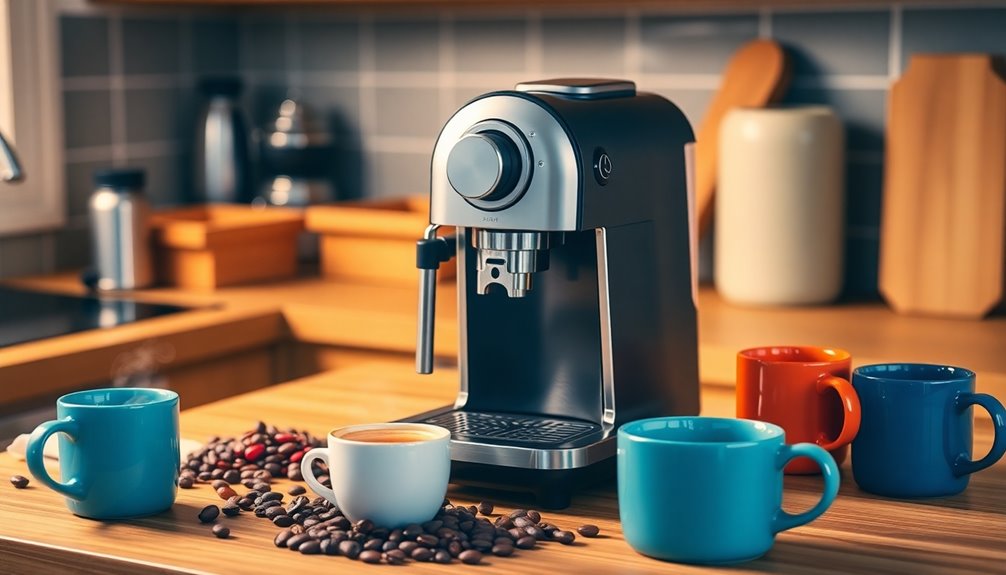

An inexpensive home espresso machine can make concentrated coffee and milk drinks without consuming the budget or counter space of a prosumer setup. My best overall pick is the Casabrews CM5418, which pairs a compact stainless-steel body with a 20-bar pump and manual milk frother. The CASABREWS 3700 Essential is my value choice for buyers who prefer simpler controls, while the SHARDOR 20 Bar Espresso Machine adds touchscreen convenience for a higher-tech experience. The main tradeoffs are pump versus steam pressure, manual control versus guided operation, reservoir capacity, and the amount of cleanup required after milk drinks. Continue reading for my full breakdown of all 15 options and the buyer types each one serves best.

Get kitchen staples and gadgets delivered free — and shop member deals
- Fast, free delivery on millions of items
- Access to Prime Big Deal Days deals on October 6–7
- Prime Video, Amazon Music and more included
Complete the kit


Key Takeaways
- Casabrews CM5418 ranks first because its compact footprint, 20-bar pump, stainless-steel construction, and steam wand form the most balanced package in this price-focused lineup.
- CASABREWS 3700 Essential offers the strongest value case, while the more interface-heavy SHARDOR and AMZCHEF touchscreen models justify extra cost through convenience rather than pressure claims alone.
- The 3.5-bar XIXUBX, HBN, IMUSA, and Mr. Coffee machines belong to a different class: they favor simple, larger servings but provide less control and a less café-like extraction than pump-driven models.
- AMZCHEF’s 50-ounce reservoir is the practical capacity leader, making it better suited to several daily drinks than machines with 34- or 39-ounce tanks.
- Twenty-bar branding did not decide the ranking; control layout, steaming workflow, water capacity, build confidence, and the likelihood of consistent daily use created clearer separation.



| inexpensive home espresso machine | Power | Water tank | Pump pressure |
|---|---|---|---|
| Spacekey Espresso Machine with | 1350 watts | 39 oz, removable | — |
| Chefman CraftBrew Espresso Mac | 1350 watts | — | 15 bar |
| XIXUBX Compact Espresso & Capp | 800 watts | — | — |
| IMUSA Electric Espresso Cappuc | — | — | — |
| XIXUBX Espresso Machine with M | — | — | — |
| Stainless Steel Espresso Machi | 1400W | 57.5 oz | 20 bar |
| SHARDOR 20 Bar Espresso Machin | 1350W | 45 oz | 20 bar |
| CASABREWS 3700 Essential Stain | 1350W | 43.9 oz | 20 bar |
| Mr. Coffee 4-Shot Steam Espres | 1200 watts | — | — |
| HBN Espresso Machine | 800W | — | — |
| Atatix Espresso Machine with M | 1350W | — | 20 bar |
| AMZCHEF Espresso Machine 20 Ba | 1350W | 50 oz, removable | 20 bar |
| Casabrews CM5418 Compact Espre | 1350W | 34 oz, removable | 20 bar |
| AMZCHEF Espresso Machine 20 Ba | 1350W | 41 oz, removable | — |
| 20 Bar Espresso Coffee Machine | 1450W | 34 oz, removable | 20 bar |
More Details on Our Top Picks
Spacekey Espresso Machine with Milk Frother
I rank the Spacekey Espresso Machine first because it offers the most balanced mix of speed, drink variety, and usable capacity for a modest home setup. Its 20-bar pump and 45-second preheating suit buyers who want espresso quickly without dropping to the gentler 3.5-bar extraction of the XIXUBX Compact Espresso & Cappuccino Machine. The 39-ounce removable tank is smaller than the Chefman CraftBrew’s 1.5-liter reservoir, but it remains practical for several drinks and takes up less counter space. An adjustable steam wand and Americano mode make this more flexible than basic steam-driven models. I would skip it if effortless automation is the goal: dosing, tamping, and frothing still demand attention, and the non-dishwasher-safe parts add cleanup. For the money, its strong all-around capability earns the lead position.
Pros:- 20-bar pump supports concentrated shots with fuller crema
- Preheats in about 45 seconds for faster morning preparation
- Adjustable steam wand broadens the range of milk drinks
- Removable 39-ounce tank simplifies filling and rinsing
Cons:- Semi-automatic workflow requires manual dosing, tamping, and frothing
- Components are not listed as dishwasher-safe
- Smaller reservoir than the Chefman CraftBrew
Best for: Budget-minded households that alternate between straight espresso, Americanos, cappuccinos, and lattes
Not ideal for: Buyers wanting push-button milk drinks or dishwasher-safe components, since brewing and cleanup require hands-on work
- Pressure:20 bars
- Power:1350 watts
- Voltage:120 volts
- Water tank:39 oz, removable
- Operation:Semi-automatic
- Coffee input:Ground coffee
- Material:Stainless steel
- Preheating time:About 45 seconds
Our verdict“This is my leading pick for buyers seeking a capable, versatile espresso setup without paying for automation.”
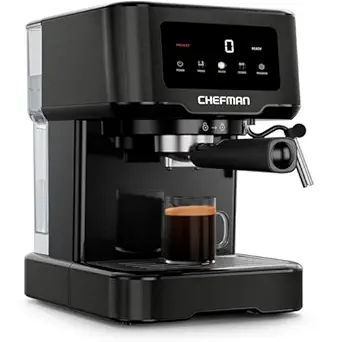
Chefman CraftBrew Espresso Machine
The Chefman CraftBrew makes the most sense when several people make drinks throughout the day. Its 1.5-liter reservoir and digital touch controls reduce refilling and make shot-volume adjustments more approachable than on the manually controlled Spacekey Espresso Machine. A 15-bar pump is ample for home espresso, even though shoppers may find the Spacekey’s advertised 20-bar figure more appealing. I place Chefman below that model because it lacks an Americano mode and focuses on espresso plus steamed-milk drinks. Regular descaling also matters more when the large tank encourages frequent brewing. Still, the combination of adjustable strength, a compact body, and cETL approval gives it a clear role. I favor this model for a busy coffee-drinking household, while a solo user may find its larger capacity unnecessary.
Pros:- Large 1.5-liter reservoir supports multiple drinks between refills
- Touch controls allow easier shot-volume and strength adjustments
- 15-bar pump is suited to conventional home espresso extraction
- Compact housing offers high capacity without an oversized footprint
Cons:- Requires routine descaling, especially under frequent use
- Drink selection centers on espresso and manually frothed milk
- Less compelling than the Spacekey for buyers wanting an Americano mode
Best for: Couples, families, or home offices preparing several customized espresso and milk drinks each day
Not ideal for: Solo occasional drinkers who do not need a large reservoir or want dedicated settings beyond espresso-based beverages
- Pump pressure:15 bar
- Water reservoir:1.5 L
- Power:1350 watts
- Voltage:120 volts
- Controls:Digital touch panel
- Milk system:Steam wand
- Safety certification:cETL approved
- Warranty:1 year
Our verdict“I recommend the Chefman to high-frequency households that value reservoir capacity and digital adjustment over broader drink presets.”
XIXUBX Compact Espresso & Cappuccino Machine
I would choose the XIXUBX Compact Espresso & Cappuccino Machine for a dorm, studio, or crowded kitchenette where every inch matters. At six inches wide and 3.3 pounds, it is far easier to place or store than the Chefman CraftBrew with its large reservoir. Its one-knob operation also presents a friendlier starting point than the semi-automatic 20-bar XIXUBX Espresso Machine. The tradeoff is the 3.5-bar system: it produces strong, smooth coffee, but buyers expecting pump-driven espresso with dense crema may be disappointed. Its 800-watt heater and limited capacity are also less suited to back-to-back drinks. The steam wand adds cappuccino capability, while the safety lock and BPA-free Tritan cup support simple daily handling. I see this as a space-saving starter machine, not a route to highly adjustable café-style extraction.
Pros:- Six-inch width fits narrow counters and small storage spaces
- One-knob control keeps the brewing process approachable
- Steam wand supports cappuccinos despite the compact footprint
- Light 3.3-pound body is easy to move
Cons:- 3.5-bar extraction cannot match the intensity of a pump espresso machine
- Limited controls leave little room for shot customization
- Lower power and small format are poorly suited to repeated servings
Best for: Students, apartment dwellers, and first-time users needing a lightweight machine for one or two simple drinks
Not ideal for: Espresso hobbyists seeking pump-level pressure, dense crema, or control over extraction variables
- Extraction pressure:3.5 bar
- Power:800 watts
- Dimensions:8.3″ D × 6″ W × 11.8″ H
- Weight:3.3 lb
- Controls:Single knob
- Cup material:BPA-free Tritan
- Milk system:Steam wand
- Warranty:1 year
Our verdict“This is my pick for beginners with very little space who accept steam-style coffee in exchange for simplicity.”
IMUSA Electric Espresso Cappuccino Maker
The IMUSA Electric Espresso Cappuccino Maker earns its place by brewing up to four cups in one cycle, a better fit for serving a small group than the single-drink-focused Spacekey Espresso Machine. Its permanent filter, removable drip tray, and straightforward frother keep ongoing costs and daily handling manageable. I also like that the compact body favors uncomplicated batch brewing rather than controls many occasional users may never touch. That simplicity sets its ceiling: there are no digital settings, temperature controls, or advanced extraction adjustments, and the plastic exterior feels less substantial than stainless-steel alternatives. Four cups also refers to modest espresso portions, not four full mugs. Compared with the XIXUBX 3.5-bar model, IMUSA emphasizes serving capacity rather than portability. I would reserve it for shoppers prioritizing quantity and low-fuss cleanup over shot precision.
Pros:- Four-cup capacity is useful when serving more than one person
- Permanent filter avoids recurring paper-filter purchases
- Removable drip tray makes routine cleanup easier
- Built-in frother supports cappuccinos and lattes
Cons:- No brewing controls for temperature, pressure, or shot volume
- Plastic exterior feels less durable than stainless-steel competitors
- Four-cup output represents small espresso servings rather than mug-size drinks
Best for: Casual coffee drinkers who want to prepare several small espresso portions or milk drinks for guests at once
Not ideal for: Buyers chasing precise extraction, programmable shots, or a more substantial stainless-steel build
- Capacity:4 cups
- Voltage:120 volts
- Color:Black
- Milk system:Built-in frother
- Filter:Permanent filter basket
- Drip tray:Removable
- Machine format:Compact countertop
Our verdict“I would buy the IMUSA for inexpensive small-batch entertaining, not for dialing in precise espresso shots.”
XIXUBX Espresso Machine with Milk Frother
The XIXUBX Espresso Machine is the performance-focused choice here, pairing a 20-bar system with PID temperature control. That controller matters because steadier brewing heat can produce more repeatable flavor than basic machines without active temperature management. It is a stronger choice for shot consistency than the 3.5-bar XIXUBX Compact Espresso & Cappuccino Machine, while its vertical body still suits an apartment counter. The included frothing pitcher adds value, and the stated 22-to-30-second brewing cycle suits rushed mornings. I rank it below the Spacekey for general buyers because the latter supplies a larger documented reservoir and Americano mode. This model also requires ground coffee, manual puck preparation, and practice with the steam wand; beginners should expect uneven milk texture at first. I favor it for buyers willing to learn in exchange for greater brewing precision.
Pros:- PID controller promotes more consistent brewing temperature and flavor
- 20-bar pressure system supports concentrated espresso extraction
- 22-to-30-second brew cycle suits time-sensitive mornings
- Compact vertical design and included pitcher add value for small kitchens
Cons:- No built-in grinder, so ground coffee or a separate grinder is required
- Semi-automatic preparation has a learning curve
- Manual frothing may produce inconsistent texture for beginners
Best for: Budget espresso enthusiasts who want steadier shot temperatures and will practice manual preparation and milk frothing
Not ideal for: Buyers wanting a built-in grinder, automatic milk handling, or a nearly hands-off morning routine
- Pressure:20 bar
- Temperature control:PID controller
- Brewing time:22–30 seconds
- Operation:Semi-automatic
- Milk system:Steam frother
- Frothing pitcher:Included
- Design:Compact vertical
- Noise reduction:Yes
- Warranty:1 year
Our verdict“This is my choice for value-minded buyers who prioritize temperature consistency and accept a hands-on workflow.”
Stainless Steel Espresso Machine with Steam Wand
I give the Stainless Steel Espresso Machine with Steam Wand this role because it combines features rarely grouped together at the inexpensive end: PID temperature control, a 45-second warm-up, and separate cold-brew and hot-water functions. Compared with the CASABREWS 3700, its 57.5-ounce tank holds more water and its 5.3-inch width claims less counter space. That makes it the stronger choice for buyers who want drink variety without a wide appliance. The 360-degree wand also offers more control over milk texture than an automatic frother. Still, this is not a push-button machine. Manual steaming requires practice, and the single boiler limits how smoothly users can move between extraction and milk preparation. Its metal construction may also feel cumbersome if the machine must be stored after each use.
Pros:- PID control provides better temperature management than basic steam machines
- 45-second heating time suits rushed morning routines
- 57.5-ounce tank exceeds the capacities of several compact rivals
- Cold-brew and hot-water functions broaden its usefulness
Cons:- Manual operation and steaming demand practice
- Single-boiler design can slow preparation of several milk drinks
- Stainless steel construction may be inconvenient for frequent storage
Best for: Space-conscious home baristas who want temperature control, manual milk steaming, and several drink modes in one machine
Not ideal for: Buyers seeking one-touch milk drinks or rapid back-to-back brewing and steaming with little technique
- Power:1400W
- Boiler:Single boiler
- Heating time:45 seconds
- Pump pressure:20 bar
- Temperature control:PID
- Steam wand:Manual, 360-degree rotating
- Water tank:57.5 oz
- Dimensions:11.4 x 5.3 x 11.4 inches
- Voltage:120 volts
Our verdict“This is my pick for buyers who value broad functionality and a narrow footprint more than automated operation.”
SHARDOR 20 Bar Espresso Machine with Milk Frother and Touchscreen
The SHARDOR 20 Bar Espresso Machine makes the most sense for buyers who find buttons and dials unclear but still want control over extraction and milk texture. I rank it above the CASABREWS 3700 for interface convenience: its touchscreen and adjustable temperature make changing settings more direct, while both machines pair 1350W power with a 20-bar pump. The SHARDOR remains semi-automatic, though, so the screen does not remove the need to grind, dose, tamp, and steam correctly. Its 45-ounce removable tank is adequate for a few daily drinks but smaller than the 57.5-ounce reservoir on the Stainless Steel Espresso Machine with Steam Wand. Buyers also need to budget time for descaling, particularly in hard-water areas. This is a friendly control layout, not full automation.
Pros:- Touchscreen presents brewing controls in an approachable format
- Adjustable temperature supports experimentation with different roasts
- 20-bar pump and 1350W heating system match several costlier-looking rivals
- Removable tank simplifies filling and cleaning
Cons:- Semi-automatic workflow still requires grinding and tamping skills
- 45-ounce tank trails the largest reservoir in this group
- Regular descaling is needed to preserve performance
Best for: Newer espresso hobbyists who prefer touchscreen settings but still want to learn manual milk steaming
Not ideal for: Buyers who expect the touchscreen to grind beans, tamp coffee, or prepare milk drinks automatically
- Pump pressure:20 bar
- Power:1350W
- Water tank:45 oz
- Material:Stainless steel
- Interface:Touchscreen
- Temperature:Adjustable
- Safety feature:Auto shutoff
- Milk system:Manual steam wand
Our verdict“I recommend the SHARDOR to buyers who want modern controls without paying for a fully automatic machine.”
CASABREWS 3700 Essential Stainless Steel Espresso Machine with Steam Wand
I see the CASABREWS 3700 Essential as the uncomplicated choice among the 20-bar machines here. It keeps the useful basics—a 1350W heating system, removable tank, and powerful steam wand—without making a touchscreen or extra drink modes the central attraction. Compared with the SHARDOR, it gives up adjustable-temperature controls and a more guided interface, which makes SHARDOR better for buyers who like visible customization. The CASABREWS counters with a direct, traditional semi-automatic setup suited to someone who wants espresso and textured milk without paying for feature breadth. Its 43.9-ounce reservoir is slightly smaller than SHARDOR’s and far below the 57.5-ounce tank on the Stainless Steel Espresso Machine with Steam Wand. There is also a real learning curve: good results depend on grind, dose, tamping, and steaming technique rather than the 20-bar figure alone.
Pros:- 20-bar pump provides ample pressure for a semi-automatic home setup
- Powerful wand supports manually textured milk and latte art practice
- Removable reservoir and components simplify routine cleaning
- Compact stainless steel body suits kitchens and small offices
Cons:- Lacks the touchscreen and temperature adjustment offered by SHARDOR
- 43.9-ounce tank requires more refills than the largest compact alternatives
- Shot quality depends heavily on the user’s preparation technique
Best for: Budget-minded buyers who want a conventional pump machine for espresso, cappuccinos, and lattes without touchscreen controls
Not ideal for: Drinkers who want guided settings, adjustable temperature, or minimal practice before making consistent shots
- Pump pressure:20 bar
- Power:1350W
- Water tank:43.9 oz
- Tank design:Removable
- Material:Stainless steel
- Steam wand:Manual, high-power
- Supported drinks:Espresso, cappuccino, latte
- Form factor:Compact
Our verdict“The CASABREWS 3700 is my straightforward recommendation for buyers who want core pump-machine functions without paying for interface extras.”
Mr. Coffee 4-Shot Steam Espresso Cappuccino and Latte Maker
The Mr. Coffee 4-Shot Steam Espresso Maker earns its place by brewing up to four shots at once and including both a frothing wand and stainless steel pitcher. I would choose it over the HBN when serving several cappuccinos in one sitting, since its extra-large portafilter is explicitly designed for a four-shot batch. It is less compelling for espresso purists. Unlike the pump-driven CASABREWS 3700, this model uses steam-pressure brewing, which offers less control over extraction and may produce a different body and crema than buyers expect from café espresso. The semi-automatic process still involves measuring, loading, and frothing by hand. At 15 inches tall, it also needs more vertical clearance than many compact machines. Most seriously, the listed 240-volt requirement may make it incompatible with standard outlets in some regions, so buyers should verify power compatibility before ordering.
Pros:- Portafilter can brew up to four shots in one batch
- Frothing wand supports cappuccinos and lattes
- Stainless steel milk pitcher is included
- Marked water pitcher helps users measure repeatable batches
Cons:- Steam brewing offers less extraction control than a 20-bar pump machine
- Listed 240-volt requirement may be incompatible with local household power
- Fifteen-inch height may conflict with low cabinets
Best for: Households that make several cappuccinos or lattes together and value a four-shot batch plus an included milk pitcher
Not ideal for: Espresso-focused buyers who want pump extraction, or households without a compatible 240-volt outlet
- Brewing method:Steam brewing
- Portafilter capacity:Up to 4 shots
- Power:1200 watts
- Voltage:240 volts
- Operation:Semi-automatic
- Milk frother:Integrated steam wand
- Filter:Reusable, size #4
- Dimensions:11.2 x 11.2 x 15 inches
- Measurement capacity:1.3 pounds
Our verdict“I would pick this for batch milk drinks only after confirming that its steam-brewed style and 240-volt requirement fit the household.”
HBN Espresso Machine, 3.5Bar Cappuccino & Latte Maker, 2-4 Cup Stainless Steel Coffee Machine with Milk Frother, 800W
I include the HBN 3.5-Bar Espresso Machine for buyers who want a small, simple appliance for an occasional espresso-style drink rather than a new coffee hobby. Its one-knob control and 800W power make it less elaborate than the SHARDOR touchscreen model, while the two-to-four-cup capacity fits one person or a couple. The milk steamer adds cappuccino and latte flexibility without requiring another appliance. Expectations need to match the brewing system, however. At 3.5 bar, the HBN is a steam machine, not a substitute for the 20-bar pump system and PID control of the Stainless Steel Espresso Machine with Steam Wand. It also calls for a medium-coarse grind, so buyers seeking finely dialed-in café-style shots may find it restrictive. Lower power can mean slower recovery during repeated drink preparation, and the small batch capacity is a poor fit for entertaining.
Pros:- One-knob control keeps the brewing workflow simple
- Compact form suits small kitchens, offices, and limited counters
- Milk steamer expands the machine beyond straight coffee
- Stainless steel construction supports straightforward cleanup
Cons:- 3.5-bar steam brewing cannot match the extraction control of pump machines
- Two-to-four-cup capacity is limiting for groups
- Medium-coarse grind requirement provides less room for espresso dialing
Best for: Solo drinkers and couples who make occasional milk-based coffee and want one-knob operation in a compact machine
Not ideal for: Espresso enthusiasts or frequent hosts who need pump extraction and fast preparation of repeated drinks
- Pressure:3.5 bar
- Power:800W
- Capacity:2-4 cups
- Material:Stainless steel
- Milk system:Steam frother
- Control:One knob
- Recommended grind:Medium-coarse
- Supported drinks:Espresso, cappuccino, latte
Our verdict“The HBN is my choice for occasional, small-batch milk drinks when simplicity matters more than pump-driven espresso.”
Atatix Espresso Machine with Milk Frother, 20 Bar Pressure
I rank the Atatix Espresso Machine as the space-saving pick because its 5-inch-wide body occupies less counter frontage than the Casabrews CM5418 while retaining a 20-bar pump and steam wand. That narrow footprint suits apartments, dorm-style kitchens, and compact office stations where every inch matters. Its detachable tank and drip tray also reduce cleanup friction. The compromise is a more hands-on brewing process: manual extraction and milk texturing demand practice, and the modest tank is less convenient than the AMZCHEF B0FCF8331R’s 50-ounce reservoir. I place it below that AMZCHEF for frequent drink making, but ahead of bulkier alternatives when space is the deciding factor. Buyers should also budget for a separate grinder despite the listed whole-bean input specification.
Pros:- Five-inch width preserves valuable counter space
- 20-bar system supports concentrated espresso with crema
- Steam wand expands the menu to lattes and cappuccinos
- Detachable tank and drip tray simplify routine cleaning
Cons:- Manual extraction has a learning curve
- Smaller water capacity means more frequent refilling
- No built-in grinder is listed despite the whole-bean input specification
Best for: Apartment dwellers or office users who need a very narrow semi-automatic machine for one or two milk drinks at a time
Not ideal for: High-volume households that want automatic dosing or a large reservoir with fewer refills
- Operation mode:Semi-automatic
- Pump pressure:20 bar
- Power:1350W
- Voltage:120V
- Capacity:2.8 lb
- Dimensions:12 × 5 × 11 inches
- Weight:7.5 lb
- Material:Brushed stainless steel
Our verdict“Choose the Atatix when counter width matters more than automation or high-volume convenience.”
AMZCHEF Espresso Machine 20 Bar with 50oz Water Tank
The AMZCHEF B0FCF8331R earns its position through a feature rarely specified this clearly at the inexpensive end: PID temperature control rated to ±2°C. More consistent heat can reduce sour or bitter swings between shots, making this a stronger choice for buyers willing to refine grind and dose. Its 50-ounce tank also holds considerably more water than the 34-ounce Casabrews CM5418, so it better suits several daily drinks. A 30-second heating claim keeps the routine moving, while the steam wand covers cappuccinos and lattes. The drawback is that more control does not mean less technique; newcomers may find the interface and manual frothing less approachable than a basic steam-driven model such as the IMUSA 4-Cup. I rank it highly for repeatability, though it remains a household machine rather than a party-volume workhorse.
Pros:- PID system offers specified temperature accuracy of ±2°C
- 50-ounce reservoir reduces refill frequency
- 30-second heating claim supports quicker morning preparation
- Steam wand handles espresso-based milk drinks
Cons:- Manual extraction and frothing may overwhelm first-time users
- Not designed for commercial-volume service
- A larger tank adds more bulk than the narrow Atatix
Best for: Budget-minded espresso hobbyists who make several drinks daily and want tighter temperature consistency without buying a premium machine
Not ideal for: Complete beginners seeking a minimal-control appliance or hosts who need commercial-level back-to-back output
- Pump pressure:20 bar
- Power:1350W
- Water tank:50 oz, removable
- Heating time:30 seconds
- Temperature control:PID, ±2°C accuracy
- Frother:Stainless steel steam wand
Our verdict“Pick this AMZCHEF when temperature stability and fewer refills outweigh absolute simplicity.”
Casabrews CM5418 Compact Espresso Machine with Milk Frother
I give the Casabrews CM5418 the learning-focused role because its built-in pressure gauge provides feedback that the similarly sized Atatix lacks. That visual cue can help a developing home barista connect grind, dose, and tamping changes with extraction pressure instead of relying only on taste. The 20-bar pump, stainless steel body, and steam wand make it versatile for straight shots and milk drinks, while the 34-ounce removable tank keeps the footprint manageable. Yet its workflow carries a real interruption: the machine must cool after steaming before brewing again, which makes multiple cappuccinos slower than on the 50-ounce AMZCHEF B0FCF8331R. Milk texture also takes practice. I rank it for buyers who want useful brewing feedback, not for households that value rapid back-to-back service above hands-on control.
Pros:- Pressure gauge gives useful extraction feedback
- 20-bar pump supports espresso with concentrated flavor
- Compact stainless steel body suits smaller kitchens
- Removable 34-ounce tank is easy to refill
Cons:- Requires cooling after frothing before the next extraction
- Steam-wand technique takes practice
- 34-ounce tank is less convenient than AMZCHEF’s 50-ounce reservoir
Best for: Aspiring home baristas who want a pressure gauge to guide dialing-in while working with limited counter space
Not ideal for: Households preparing several milk drinks consecutively, because the post-steaming cooldown slows the workflow
- Pump pressure:20 bar
- Power:1350W
- Water tank:34 oz, removable
- Pressure gauge:Built in
- Frothing system:Steam wand
- Material:Stainless steel
Our verdict“The CM5418 makes sense for learners who value pressure feedback and can accept a slower milk-drink routine.”
AMZCHEF Espresso Machine 20 Bar with LED Touch Screen
The AMZCHEF B0FMR5QPHW is my interface-first choice for buyers who prefer LED touch controls over more traditional buttons and dials. Its stated 30-to-40-second preheat is well matched to rushed mornings, and the 41-ounce removable tank strikes a middle ground between the Atatix’s smaller capacity and the other AMZCHEF model’s 50-ounce tank. Compared with the Casabrews CM5418, it trades the useful pressure gauge for a cleaner control surface, so it favors convenience over feedback while dialing in espresso. The 20-bar Italian pump and steam wand cover the expected café-style menu, but milk texturing remains manual and requires coordination. Heavy users may also tire of refilling the reservoir. I place this model behind the PID-equipped AMZCHEF for temperature-focused buyers, yet ahead of plainer machines for people who value a modern, readable interface.
Pros:- LED touch screen offers a clear modern interface
- 30-to-40-second preheating suits time-sensitive routines
- 41-ounce removable tank balances capacity and compactness
- Steam wand supports cappuccinos, lattes, and manual microfoam
Cons:- No pressure gauge is specified for extraction feedback
- Manual latte-art foam requires practice
- Reservoir may need frequent refilling under heavy use
Best for: Busy home or small-office users who want quick startup and a modern touch interface for a few daily espresso drinks
Not ideal for: Espresso tinkerers who want a pressure gauge or high-volume users who dislike frequent water refills
- Pump:20-bar Italian pump
- Power:1350W
- Water tank:41 oz, removable
- Preheating time:30–40 seconds
- Controls:LED touch screen
- Frother:Steam wand
- Material:Stainless steel
Our verdict“Choose this AMZCHEF for fast, touch-based operation rather than advanced brewing feedback.”
20 Bar Espresso Coffee Machine with Milk Frother and 34oz Water Tank
This 20 Bar Espresso Coffee Machine claims the high-power compact role because its 1450W heating system exceeds the 1350W rating of both featured AMZCHEF machines. That extra rated power may support brisk heating, while the 5.3-inch width keeps it close to the ultra-narrow Atatix in counter friendliness. The 20-bar pump and steam wand provide the core tools for espresso and milk drinks without premium pricing. Power does not erase workflow limits, though: the 34-ounce tank needs more attention than the AMZCHEF B0FCF8331R’s 50-ounce reservoir, and the machine still requires preheating. Users must also follow the post-frothing procedure carefully because overheat protection can interrupt brewing. I place it below the gauge-equipped Casabrews CM5418 for learning and below AMZCHEF for specified temperature precision, but it suits shoppers prioritizing wattage and a slim body.
Pros:- 1450W rating is higher than the other featured compact models
- Slim 5.3-inch width fits constrained counters
- 20-bar pump supports concentrated espresso
- Steam wand adds latte and cappuccino capability
Cons:- 34-ounce tank requires regular refilling
- Preheating is required before brewing
- Overheat protection may pause the workflow after frothing if procedures are not followed
Best for: Small-kitchen buyers who want a higher-wattage heating system and make only a few espresso or milk drinks per session
Not ideal for: Large households that need uninterrupted back-to-back drinks or a reservoir larger than 34 ounces
- Pump pressure:20 bar
- Power:1450W
- Water tank:34 oz, removable
- Dimensions:5.3 × 12.2 × 11.5 inches
- Frothing system:Steam wand
- Exterior material:Stainless steel
- Heat protection:Overheat protection
Our verdict“Buy this model for high rated power in a slim frame, provided its small tank and heat-management routine fit your habits.”

How We Picked
I ranked these machines through the lens of affordable everyday ownership, not by treating the highest advertised pressure as an automatic win. My evaluation weighted brewing format and control, milk-steaming usefulness, warm-up convenience, reservoir size, footprint, construction, and cleanup. I also examined whether each feature changes the daily routine: a removable tank reduces refill friction, for example, while a touchscreen may help a new owner repeat settings. Products rose when they offered a balanced workflow and fell when a low price came with narrow drink options or limited control.
I separated pump machines from 3.5-bar steam machines because they produce different styles of coffee and should not be judged as direct equivalents. Among pump models, I favored manageable controls, a useful steam wand, and a size that fits a typical kitchen over pressure numbers beyond what espresso brewing needs. I gave added credit to clear buyer value, which could mean stronger versatility, a larger reservoir, or simpler operation at a lower price. The final order reflects how broadly each machine fits budget-minded buyers, followed by more specialized picks for touch controls, capacity, compactness, or steam-style brewing.
Factors to Consider When Choosing Inexpensive Home Espresso Machine
The right machine depends on the drink style and routine a buyer wants, not merely the lowest listed price. I would choose the brewing system first, then compare workflow, milk capability, and upkeep. A feature that saves two minutes every morning can matter more than another pressure claim. These five factors explain where paying more helps and where a simpler model may be the smarter purchase.
Choose Between Pump Espresso and Steam Brewing
A pump-driven machine is the better match for buyers seeking concentrated shots with a café-style texture. Models advertised at 15 or 20 bar use a pump, although the maximum number does not describe the pressure applied throughout extraction. A 3.5-bar steam machine pushes hot water using steam and usually produces a larger, less intense serving. That style can suit sweet cappuccinos or households moving from drip coffee, but it offers less control over extraction. Buyers expecting a traditional espresso base should place pump models higher on the list. Those who prize low cost and uncomplicated multi-cup brewing may find the steam-powered group sufficient.
Budget for a Grinder, Not Just the Machine
Fresh, evenly ground coffee can improve results more than moving from one inexpensive 20-bar machine to another. Most models here lack a built-in grinder, so the real setup price may include a burr grinder and basic accessories. Pre-ground coffee is convenient, especially with a pressurized basket, but it limits control over shot speed and freshness. A buyer starting from zero may get better results by pairing a modest machine with a capable grinder instead of spending the entire budget on touch controls or decorative stainless steel. Pods are easier but reduce bean choice and may raise the cost per drink. I would reserve part of the budget for the coffee-preparation tools the chosen basket requires.
Match the Steam Wand to Your Milk-Drink Habits
A steam wand adds flexibility, yet it also adds the messiest part of the routine. Buyers making daily lattes should favor easy wand access and usable steam control, since weak positioning can make a compact machine frustrating. Small boilers may require a pause between brewing and steaming, which matters more when preparing several drinks. Occasional cappuccino drinkers can accept that delay, while a busy household may prefer greater water capacity and faster recovery. Every wand needs wiping and purging immediately after use because dried milk can block the tip. If espresso or Americanos dominate the menu, paying extra for milk-focused features brings little benefit.
Balance Counter Space Against Water Capacity
Compact dimensions help only when the machine still fits the household’s refill pattern. A 34- or 39-ounce tank is manageable for one or two regular users, but frequent milk drinks consume extra water through steaming and cleaning. A 50-ounce or 1.5-liter reservoir reduces interruptions, although the larger machine may occupy more depth beneath cabinets. Removable tanks are easier to fill at a sink, while rear-mounted designs may require pulling the machine forward. Cup clearance also matters because some compact bodies leave little room for a tall mug or scale. I would measure the intended space and overhead access before letting small footprint claims decide the purchase.
Pay More for Repeatability and Support
The lowest purchase price can become poor value if controls are inconsistent or replacement parts are hard to find. Digital buttons and touchscreens may provide repeatable shot timing, but they add electronics that basic dial-operated machines avoid. Stainless-steel panels can improve appearance and surface durability without proving that the internal components are equally robust. I would compare warranty terms, manual clarity, basket availability, and customer-service access before choosing an unfamiliar brand. Established accessory sizes also make it easier to replace a portafilter, basket, or tamper later. Spending more makes sense when it buys a smoother daily workflow and stronger ownership support, not merely a larger pressure figure.
Frequently Asked Questions
Is a 20-bar machine automatically better than a 15-bar machine?
No. The advertised figure is usually the pump’s maximum output, while espresso is brewed at a lower working pressure. Temperature stability, grind quality, dose, and flow control have a greater effect on the cup than the difference between 15 and 20 bar. A well-designed 15-bar machine can outperform a poorly controlled 20-bar model. I treat 20-bar labeling as a category signal, not proof of better espresso.
Should I buy a 3.5-bar steam machine or a pump espresso machine?
I would choose a pump machine for espresso-style shots, stronger crema potential, and more control over extraction. A 3.5-bar steam model works better for buyers who want inexpensive, concentrated coffee for sweet milk drinks or several small servings at once. It is simpler, but the result will differ from coffee made with a café-style pump system. The decision rests on expectations rather than one format being right for everyone. Buyers sensitive to texture and shot balance should spend the extra money on a pump-driven model.
Do I need a separate grinder for these machines?
Most buyers will get better results with a separate burr grinder, especially when using whole beans in a pump machine. Grind size controls how quickly water passes through the coffee, so inconsistent grounds can create weak or bitter shots. Pressurized baskets are more tolerant of pre-ground coffee and suit beginners who value convenience. A grinder also adds cost, space, and another cleaning task, making pre-ground coffee a reasonable starting point. I would prioritize consistent grounds over extra machine features when dividing a limited budget.
How large should the water reservoir be for two people?
A tank near 34 to 40 ounces can serve two people when each makes one or two drinks daily and does not mind regular refilling. Milk steaming and wand purging use more water than the espresso shots alone suggest. A 50-ounce or 1.5-liter reservoir is more convenient for repeated drinks, guests, or households that rinse the group between shots. Larger tanks can also leave water sitting longer, so capacity is not always an advantage for occasional users. I would choose easy removal over maximum volume when refilling access is awkward.
Are touchscreen espresso machines easier for beginners?
A touchscreen can make functions easier to identify and may reduce uncertainty during the first week. It does not automate grinding, dosing, tamping, or milk texturing on the semi-automatic models in this roundup. Simple physical buttons may be just as approachable and can provide clearer tactile feedback with wet hands. Touch controls make the most sense for buyers who value a modern interface and repeatable programmed commands. Beginners focused on learning technique may get better value from straightforward controls and a good grinder.
Conclusion
For the broadest mix of price, compactness, pump brewing, and milk capability, I recommend the Casabrews CM5418 as the best overall. The CASABREWS 3700 Essential is my best-value choice for buyers who want a simpler stainless-steel pump machine without paying for a touchscreen. Beginners who prefer labeled digital operation should start with the Chefman CraftBrew, while the SHARDOR 20 Bar is the premium pick for shoppers who place interface convenience high on the list. The AMZCHEF 20 Bar model with the 50-ounce tank makes the most sense for several daily drinks, and the compact XIXUBX pump model better serves crowded counters. For low-cost, steam-style coffee in small batches, I would choose the IMUSA 4-Cup, while buyers seeking café-like shot control should skip the 3.5-bar group. That division makes the final choice clear: select the Casabrews CM5418 for balance, CASABREWS 3700 for savings, Chefman for approachability, SHARDOR for touch control, or AMZCHEF for capacity.
Halloween Picks
halloween
As an affiliate, we earn on qualifying purchases.