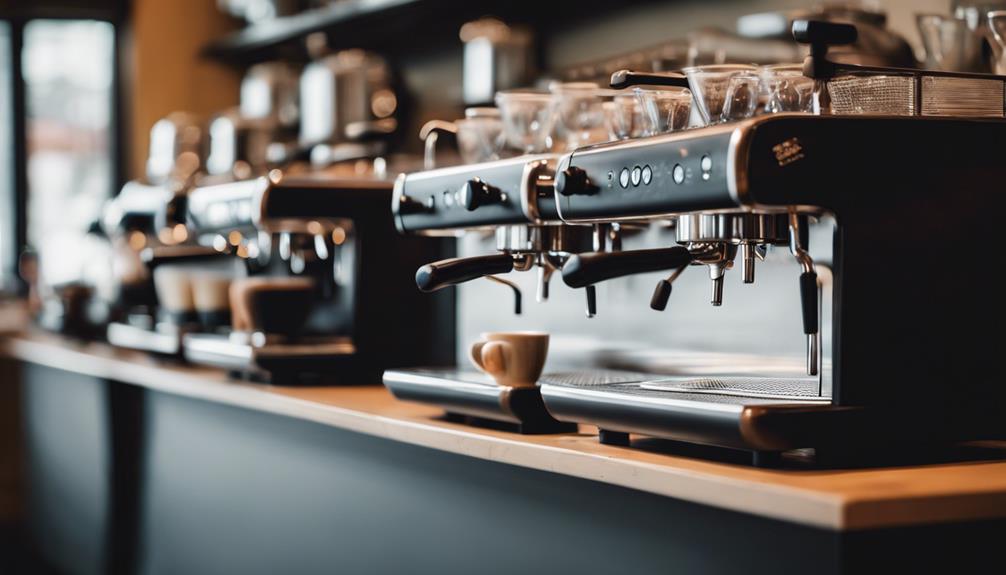
Choosing an espresso machine for commercial use means matching output, workflow, and installation needs—not just picking the machine with the most features. I rank the Nuova Simonelli Appia Life Auto Volumetric first for its programmable dosing and café-focused workflow, while the Nuova Simonelli Appia Volumetric is a strong alternative for shops that value a large boiler and proven automatic operation. For buyers who want manual control in a smaller footprint, the Rocket Espresso R58 Tune makes a very different kind of case.

Get kitchen staples and gadgets delivered free with Prime
- Fast, free delivery on millions of items
- Prime Video, Amazon Music and more included
- Member-only deals all year
The main tradeoff is clear: two-group machines are built to serve multiple orders at once, but require more space, plumbing, and electrical capacity. The Rocket and Breville are easier to fit into a small operation, yet they lack the group capacity and hands-off service workflow of the commercial Nuova Simonelli models. I’ve ranked these picks by commercial suitability, day-to-day workflow, stated capabilities, and the practical limitations a buyer should resolve before installation.
Complete the kit


Key Takeaways
- The Nuova Simonelli Appia Life is my leading café pick because programmable dosing and automated backflushing support repeatable service and routine cleaning.
- The Appia Volumetric has an 11-liter boiler and automatic boiler filling, making it a sensible alternative for busy shops that want high-volume capacity.
- AMIBAOFU pairs two groups with a rotary pump and a 1.6-gallon boiler, but its limited review history makes independent service and parts checks especially prudent.
- Rocket’s dual boilers, rotary pump, and adjustable pre-infusion suit a smaller, hands-on operation better than a café expecting two-group throughput.
- Breville’s built-in grinder and 120-volt power make it accessible for low-volume service, but manual workflow and a single group limit its commercial role.
| Nuova Simonelli Appia Life Auto Volumetric 2-Group Espresso Machine |  | Best Overall: café workflow with programmable dosing | Machine type: Automatic espresso machine | Groups: 2 | Dosing: Programmable volumetric; 4 shot volumes per group | VIEW ON AMAZON | See Our Full Breakdown |
| Nuova Simonelli Appia Volumetric 2-Group Espresso Machine |  | Best for high-volume capacity: large boiler, automatic filling | Group configuration: 2 groups | Operation: Fully automatic | Dosing: Volumetric | VIEW ON AMAZON | See Our Full Breakdown |
| AMIBAOFU Semi-Automatic 2-Group Commercial Espresso Machine |  | Best semi-automatic value in format: two groups and manual shot control | Model: SSAC102 | Operation: Semi-automatic | Groups: 2 | VIEW ON AMAZON | See Our Full Breakdown |
| Rocket Espresso R58 Tune Espresso Machine, Black |  | Best for small, hands-on service: dual boilers and detailed control | Operation: Semi-automatic | Boilers: 0.58 L brew; 1.8 L steam | Pump: Rotary | VIEW ON AMAZON | See Our Full Breakdown |
| Breville BES870XL Barista Express Espresso Machine, Brushed Stainless Steel |  | Best for low-volume service: integrated grinder in a compact package | Type: Manual espresso machine | Grinder: Integrated precision conical burr grinder | Water tank: 67 oz | VIEW ON AMAZON | See Our Full Breakdown |
| espresso machine for commercial use | Power | Operation | Weight | Dimensions |
|---|---|---|---|---|
| Nuova Simonelli Appia Life Aut | 3,400 watts; 240 volts | — | — | — |
| Nuova Simonelli Appia Volumetr | — | Fully automatic | 165 pounds | — |
| AMIBAOFU Semi-Automatic 2-Grou | — | Semi-automatic | — | 20.5 × 21.65 × 20.5 in (D × W × H) |
| Rocket Espresso R58 Tune Espre | 1,600 watts; 120 volts | Semi-automatic | 80 lb | 19 × 16 × 16.8 in |
| Breville BES870XL Barista Expr | 1,600 watts; 120 volts | — | 22.1 lb | 13.8 × 12.5 × 15.9 in |
More Details on Our Top Picks
Nuova Simonelli Appia Life Auto Volumetric 2-Group Espresso Machine
The Appia Life Auto Volumetric is my first choice for a café that needs two groups and a repeatable shot routine. Each group can store four programmable shot volumes, so staff can trigger a defined dose rather than relying on timing each extraction by hand. Compared with the semi-automatic AMIBAOFU, that can help standardize service across a team with different experience levels. It also has automated backflushing and a cool-touch steam wand, pairing day-to-day usability with routine cleaning and handling considerations.
Its commercial fit comes with real infrastructure demands: this machine requires a 240-volt supply, cold water connection, drain, and water softener. That is a more involved installation than the Rocket R58 Tune, which is listed at 120 volts and can be plumbed in, though it offers only one group. The Appia Life is also specified at 3,400 watts, so an operator should have an electrician confirm the circuit before ordering. The water softener requirement is especially important because the provided information says it is needed to maintain the warranty.
I place it ahead of the older Appia Volumetric because its listed workflow details are stronger: programmable volumes per group, push-pull steam controls, cool-touch wand, and automated backflushing. It is not automatically the right choice for every shop, though. A small operation with modest volume may not use the two groups enough to justify the space and utility work, while a buyer seeking hands-on control over every shot may prefer the semi-automatic AMIBAOFU or Rocket. Its two-year warranty is specified, but I would confirm installation and water-treatment terms with the seller.
Pros:- Two groups and programmable four-volume dosing support repeatable service.
- Cool-touch steam wand and push-pull controls suit frequent milk steaming.
- Automated backflushing simplifies a recurring cleaning task.
- Stainless steel, brass, and steel-frame construction is specified for commercial use.
Cons:- Needs dedicated 240-volt power, cold water, a drain, and a water softener.
- Its installation and footprint can be excessive for a small or occasional-use setup.
Best for: Cafés and restaurant bars that need two-group service, repeatable volumetric shots, and staff-friendly cleaning features.
Not ideal for: Home users, low-volume counters, or businesses unable to provide 240-volt power, a drain, plumbed cold water, and a water softener.
- Machine type:Automatic espresso machine
- Groups:2
- Dosing:Programmable volumetric; 4 shot volumes per group
- Power:3,400 watts; 240 volts
- Materials:Stainless steel, ABS, brass, and steel
- Steam wand:Cool-touch
- Cleaning:Automated backflushing
- Water setup:Cold water connection, drain, and water softener required
- Warranty:2 years
Our verdict“I’d choose the Appia Life for a café that can support its installation and wants two-group service with the clearest workflow features in this lineup.”
Nuova Simonelli Appia Volumetric 2-Group Espresso Machine
The Appia Volumetric is the straightforward high-capacity pick in this group. Its 11-liter boiler, two-group configuration, programmable volumetric dosing, and automatic boiler filling are all relevant to a shop that serves orders continuously. Volumetric controls can make shot portions more consistent without asking every barista to stop and manually time each pull. Compared with the Appia Life, this model’s supplied description emphasizes boiler capacity and automatic filling more than staff-facing touches such as a cool-touch wand or automated backflushing.
That difference makes the choice between the two Nuova Simonelli machines less about basic commercial capability and more about workflow priorities. I’d favor the Appia Life when cleaning convenience and a safer-feeling steam wand are central to the team’s routine. I’d consider this Appia Volumetric when the stated 11-liter boiler and automatic filling are the bigger draw, especially for sustained service. The product information lists a 165-pound weight, so delivery, counter support, and installation access deserve advance planning.
The listing does not provide a voltage, wattage, water-connection requirement, or detailed service information. That omission does not prove a limitation, but it means I would confirm utilities and installation requirements before treating it as ready for a particular site. It is clearly more machine than a home user or tiny counter needs; the Rocket R58 Tune is a more compact, single-group route for lower throughput, while the Appia remains the more appropriate shape for café service.
Pros:- Two groups support parallel drink preparation.
- The 11-liter boiler is suited to sustained commercial service.
- Volumetric dosing supports more repeatable shot portions.
- Automatic boiler filling reduces a manual operating task.
Cons:- At 165 pounds, it requires careful delivery and counter planning.
- The supplied listing does not state voltage, wattage, or water-installation requirements.
Best for: Busy cafés that want a two-group machine, a large stated boiler, and volumetric operation with automatic boiler filling.
Not ideal for: Home users, small counters with limited installation space, or buyers who need fully specified electrical and plumbing requirements before choosing.
- Group configuration:2 groups
- Operation:Fully automatic
- Dosing:Volumetric
- Boiler capacity:11 liters
- Weight:165 pounds
- Materials:Brass; stainless steel exterior
- Coffee input:Ground coffee
- Power source:AC adapter
Our verdict“I’d shortlist the Appia Volumetric when boiler capacity and automatic filling matter more than the extra workflow details specified for the Appia Life.”
AMIBAOFU Semi-Automatic 2-Group Commercial Espresso Machine
AMIBAOFU takes a different route from the automatic Nuova Simonelli models: its two groups and rotary pump are paired with semi-automatic controls, letting the barista adjust extraction time rather than depend on preset volumetric doses. That can appeal to an experienced team that wants direct control over shot length. The 1.6-gallon (6-liter) boiler is listed for continuous operation, and two groups allow simultaneous brewing—useful when several drinks arrive together.
Compared with the Appia Life, this is the more hands-on choice, and the supplied feature set does not include programmable dose volumes or automated backflushing. It does list a cup warmer and milk frother, but buyers should ask the supplier how those components are implemented and what routine service entails. The stainless-steel construction and rotary pump sound appropriate to a commercial format on paper; I would still verify parts availability, installation support, and operating requirements directly before placing it in a business that cannot tolerate downtime.
The machine measures 20.5 × 21.65 × 20.5 inches, making it a substantial counter appliance rather than a casual home upgrade. It could fit a small café that prefers manual extraction control, but its available customer feedback is very limited in the supplied details. That is not a performance verdict; it is a reason to do more supplier due diligence than I would for a model with clearer installation and workflow documentation. For predictable one-touch dosing, the Appia Life is the safer match. For lower-volume service and a smaller footprint, the Rocket is easier to place, though it gives up the second group.
Pros:- Two groups allow simultaneous brewing.
- Rotary pump and 1.6-gallon boiler are specified for continuous operation.
- Semi-automatic controls let baristas adjust extraction time.
- Stainless-steel body suits frequent commercial cleaning.
Cons:- The supplied product information gives limited installation and service detail.
- Available customer feedback is very limited, so supplier support merits careful checking.
- Manual timing offers less standardized one-touch workflow than the Nuova Simonelli volumetric models.
Best for: Small cafés or restaurants with trained baristas that want two groups and semi-automatic control over extraction time.
Not ideal for: Businesses that need detailed published setup guidance, preset volumetric dosing, or a compact machine for a home kitchen.
- Model:SSAC102
- Operation:Semi-automatic
- Groups:2
- Boiler capacity:1.6 gallons (6 liters)
- Pump:Rotary
- Material:Stainless steel
- Dimensions:20.5 × 21.65 × 20.5 in (D × W × H)
- Included component:Milk frother
Our verdict“I’d consider AMIBAOFU for a trained team that wants a two-group semi-automatic, after confirming parts, service, and utility requirements with the seller.”
Rocket Espresso R58 Tune Espresso Machine, Black
The Rocket Espresso R58 Tune is the compact, control-oriented alternative to the three two-group machines above. It has a 0.58-liter brew boiler and 1.8-liter steam boiler, so brewing and steaming have separate boilers rather than competing for one shared source. Programmable 3-bar pre- and post-infusion gives a barista more control over the start and finish of extraction, while the detachable touchscreen PID adds temperature and scheduling adjustments. Those tools make it better suited to a small specialty counter than to a high-throughput café line.
Its single group is the key limitation. Compared with the Appia Life or AMIBAOFU, it cannot offer the same simultaneous two-group workflow, so service can bottleneck when drink orders stack up. The R58 is also listed at 120 volts and 1,600 watts, which may simplify power planning versus the Appia Life’s 240-volt, 3,400-watt requirement. It weighs 80 pounds and measures 19 × 16 × 16.8 inches, so it is smaller than the two-group options but still requires a stable counter and a thoughtful installation.
The rotary pump supports connection to a home water line, and the included plumb-in and waste hoses make that capability relevant to a small commercial setup. Still, the supplied information does not establish the machine’s suitability for a particular business’s service volume or local requirements. It uses ground coffee and requires hands-on preparation, unlike the volumetric Nuova Simonelli picks. I’d choose it for a shop where drink quality control and a smaller footprint matter more than rapid parallel output; a busy café should put a two-group machine ahead of it.
Pros:- Separate brew and steam boilers let both tasks run independently.
- Programmable pre- and post-infusion supports hands-on extraction adjustment.
- Detachable touchscreen PID includes scheduling and machine controls.
- Rotary pump supports plumb-in installation.
Cons:- Single-group design limits throughput against the three two-group options.
- At 80 pounds, it still needs a strong counter and planned installation.
- Ground coffee and semi-automatic operation require hands-on preparation.
Best for: Small specialty cafés, tasting counters, or low-volume hospitality settings that want dual boilers and hands-on extraction control.
Not ideal for: Busy cafés that need two groups, high parallel output, or a more automated staff workflow.
- Operation:Semi-automatic
- Boilers:0.58 L brew; 1.8 L steam
- Pump:Rotary
- Infusion:Programmable 3-bar pre- and post-infusion
- Power:1,600 watts; 120 volts
- Dimensions:19 × 16 × 16.8 in
- Weight:80 lb
- Material and color:Stainless steel; black
Our verdict“I’d pick the R58 Tune for a small service operation that values dual-boiler control more than the throughput of a two-group commercial machine.”
Breville BES870XL Barista Express Espresso Machine, Brushed Stainless Steel
The Breville Barista Express is the easiest machine here to understand as a low-volume or startup option: it combines a conical burr grinder with a manual espresso machine, so whole beans can be ground directly into the portafilter. PID temperature control and low-pressure pre-infusion support more controlled extraction, while the steam wand can texture milk for café-style drinks. Compared with the Rocket R58 Tune, it is lighter at 22.1 pounds and includes a grinder, but it gives up the Rocket’s dual boilers, rotary pump, and plumbing option.
For a small office, pop-up, or food business offering occasional espresso, the integrated grinder can reduce counter clutter and the need to buy a separate grinder. That convenience does not make it a match for the two-group Nuova Simonelli machines. It is a single-group, manual workflow: staff grind, prepare the portafilter, pull the shot, and texture milk. During a rush, that sequence limits output and demands more operator attention than programmable volumetric dosing.
The 67-ounce water tank avoids a required plumbed water connection in the supplied specifications, and the 120-volt power is easier to accommodate than the Appia Life’s stated 240-volt supply. The tradeoff is tank refilling and closer attention to service pace. Its one-year limited warranty is shorter than the Appia Life’s stated two-year warranty, and this is not a heavy-duty two-group café machine. I’d include it only when low throughput, a built-in grinder, and simpler placement matter more than commercial speed or automation.
Pros:- Integrated conical burr grinder delivers fresh grounds directly into the portafilter.
- PID temperature control and low-pressure pre-infusion support controlled extraction.
- 120-volt operation and a water tank can simplify placement.
- Includes core accessories such as portafilter, baskets, tamper, and milk jug.
Cons:- Manual grinding, extraction, and milk texturing slow service compared with volumetric two-group machines.
- Single-group format is a poor fit for sustained café rushes.
- One-year limited warranty is shorter than the Appia Life’s stated coverage.
Best for: Low-volume cafés, small offices, or food businesses that need occasional espresso and want an integrated grinder.
Not ideal for: Busy cafés, restaurants with sustained espresso orders, or operators seeking two groups, plumbing, or automated shot dosing.
- Type:Manual espresso machine
- Grinder:Integrated precision conical burr grinder
- Water tank:67 oz
- Bean hopper:1/2 lb
- Power:1,600 watts; 120 volts
- Dimensions:13.8 × 12.5 × 15.9 in
- Weight:22.1 lb
- Warranty:1-year limited
Our verdict“I’d choose the Barista Express for occasional, low-volume espresso where an integrated grinder matters, not as a substitute for a commercial café workhorse.”

How We Picked
I ranked these machines for commercial use, not as interchangeable home coffee makers. The strongest signals were group count, boiler capacity, dosing control, pump type, and whether the stated features help staff maintain consistent service across repeated orders. I also weighed setup demands—power, water line, drain, footprint, and weight—because a machine that cannot be installed or supported properly is not a practical café choice.
That approach puts the two Nuova Simonelli machines at the top: both are two-group machines with volumetric operation intended to reduce repetitive barista input. The Appia Life takes the lead for its combination of programmable shot volumes, cool-touch steam wand, and automated backflushing. The Appia Volumetric follows closely, with an especially large stated 11-liter boiler, though its listing gives fewer workflow details. AMIBAOFU earns a place as a two-group semi-automatic alternative, but I treat its limited review history as a reason to check supplier support rather than as evidence of performance.
Rocket and Breville occupy narrower roles. The R58 Tune offers serious control and dual boilers but is a single-group, 120-volt machine; that makes it more suitable for a small service setting than a busy café line. Breville combines grinder and espresso machine in a compact package, which can simplify a low-volume setup, but it is not a direct substitute for a commercial two-group machine. I do not infer reliability, certification, or service-network quality beyond the supplied product information, so buyers should verify those details with the seller and an installer.
| espresso machine for commercial use | Operation |
|---|---|
| Nuova Simonelli Appia Life Aut | — |
| Nuova Simonelli Appia Volumetr | Fully automatic |
| AMIBAOFU Semi-Automatic 2-Grou | Semi-automatic |
| Rocket Espresso R58 Tune Espre | Semi-automatic |
| Breville BES870XL Barista Expr | — |
Factors to Consider When Choosing Espresso Machine For Commercial Use
I would start with the workload and site, then compare automation and control. A commercial machine only earns its place if its output and installation requirements match the operation.Match group count to the rush
Two groups matter when staff need to prepare more than one espresso at a time. The Appia Life, Appia Volumetric, and AMIBAOFU all list two groups, giving them a clear throughput advantage over the single-group Rocket and Breville. That does not guarantee a specific number of drinks per hour; grinder capacity, staff skill, drink complexity, and workflow all affect service. For occasional espresso, a single group can be adequate. For a busy café, I would begin with the two-group options and only choose a single-group machine if the business can accept slower output during peaks.
Choose automation or barista control
Volumetric dosing helps staff repeat shot portions with less manual timing. The Appia Life allows four programmed shot volumes per group, while the Appia Volumetric is also described as programmable and volumetric. AMIBAOFU is semi-automatic, so the barista adjusts extraction time. Rocket adds programmable pre- and post-infusion pressure, giving a skilled operator another point of control. These approaches serve different teams: choose automation for consistency across shifts, or manual control when staff training and recipe adjustment are part of the operation’s priorities.
Check power, plumbing, and water treatment before ordering
Installation can decide the shortlist before machine features do. The Appia Life specifically requires 240-volt power, a cold water connection, a drain, and a water softener. The Rocket and Breville list 120-volt operation, while Rocket includes hoses for plumbing and Breville lists a water tank. The Appia Volumetric and AMIBAOFU descriptions do not supply full utility requirements, so ask the seller and a qualified installer rather than assuming. Check circuit capacity, water quality, drainage, counter support, and access through doors before delivery.
Think about boiler capacity and steaming demand
Boiler details shape busy service, but published capacity is not a promise of a particular output. The Appia Volumetric lists an 11-liter boiler, and AMIBAOFU lists a 1.6-gallon (6-liter) boiler. Rocket separates brewing and steaming into 0.58-liter and 1.8-liter boilers, respectively, which supports independent tasks in a smaller machine. The Appia Life’s supplied information does not state boiler capacity. Consider how many milk drinks the team expects to prepare in succession, and ask the seller for recovery and operating information relevant to that workload.
Plan cleaning, repair access, and supplier support
Daily maintenance is part of the workflow, not an afterthought. Appia Life lists automated backflushing and a cool-touch steam wand; those features can make routine upkeep and handling easier. For the other machines, the supplied descriptions do not give the same cleaning detail, so request the cleaning schedule, recommended supplies, and parts information before committing. A business should also confirm who handles installation and repairs, what warranty conditions apply, and whether a water-treatment plan is required. I would give clear support arrangements more weight than a feature list alone.
Budget counter space and staff time, not just machine dimensions
Footprint and workflow go together. AMIBAOFU lists dimensions of 20.5 × 21.65 × 20.5 inches, while Rocket is 19 × 16 × 16.8 inches and Breville is 13.8 × 12.5 × 15.9 inches. The Nuova Simonelli models also require room for service access, plumbing, and safe handling; the Appia Volumetric weighs 165 pounds. Smaller machines can free counter space but require more hands-on steps or offer fewer groups. Map the grinder, knock box, milk storage, cups, and staff movement around the espresso machine before deciding that a model fits.
Frequently Asked Questions
Which machine is the best fit for a busy café?
I rank the Nuova Simonelli Appia Life first for a busy café that can support its installation. Two groups, programmable shot volumes, automated backflushing, and a cool-touch wand create a useful combination for repeatable service and routine upkeep. The Appia Volumetric is a close alternative if its 11-liter boiler and automatic filling better suit the operation. I would confirm utilities, water treatment, and local service support before choosing either.
Can a single-group machine serve a commercial setting?
Yes, a single-group machine can fit a low-volume commercial setting, such as a small office café, tasting counter, or business that serves espresso occasionally. The Rocket R58 Tune offers dual boilers and adjustable infusion, while the Breville includes a grinder and a water tank. Neither matches the parallel output of a two-group machine, so I would not select either for a café that expects frequent order surges.
What is the difference between volumetric and semi-automatic operation?
Volumetric machines use programmed volumes to stop a shot at a selected amount, helping reduce manual timing and support consistency across staff. Semi-automatic machines leave more of the extraction timing to the barista. In this lineup, the Appia models provide volumetric dosing, while AMIBAOFU and Rocket give the operator more direct control. I would prioritize volumetric dosing for a team that wants a repeatable routine and manual operation for trained staff who value active recipe control.
Do these machines need a plumbed water line?
Requirements vary by model. The Appia Life explicitly requires a cold water connection, drain, and water softener; Rocket supports plumbing and includes hoses, while Breville lists a 67-ounce water tank. The supplied details for Appia Volumetric and AMIBAOFU do not fully specify their water connections. I would confirm plumbing, drainage, filtration, and water-treatment needs with the seller or installer before purchase, particularly where warranty conditions may depend on water quality.
Is the Breville Barista Express a commercial espresso machine?
The Barista Express can suit occasional, low-volume commercial use, but I would not treat it as equivalent to a two-group café machine. Its integrated grinder, 120-volt power, and water tank can simplify placement, yet its manual workflow and single group limit service capacity. A café serving espresso throughout the day is better matched to one of the two-group options, while the Breville makes more sense for modest demand and a compact setup.
Conclusion
For a café that needs repeatable two-group service, I’d choose the Nuova Simonelli Appia Life Auto Volumetric, provided the site can meet its power, plumbing, drain, and water-softening requirements. If boiler capacity and automatic filling are the main priorities, I’d compare it with the Appia Volumetric and verify that model’s installation details. For a trained team seeking semi-automatic control in a two-group format, AMIBAOFU is worth investigating, with supplier support and parts availability checked first.
For a small specialty operation with lower volume and a preference for hands-on control, the Rocket R58 Tune offers dual boilers and infusion adjustments in a single-group package. For occasional espresso in a small business or office, the Breville Barista Express is the compact grinder-and-machine choice, not a rush-hour café workhorse. My final decision would follow expected order volume, staff workflow, utilities, and repair support—not the machine’s feature list alone.
Halloween Picks
halloween
As an affiliate, we earn on qualifying purchases.