TL;DR

Get kitchen staples and gadgets delivered free with Prime
- Fast, free delivery on millions of items
- Prime Video, Amazon Music and more included
- Member-only deals all year
A moka pot brews strong, concentrated coffee at roughly 1–2 bar of steam pressure, while modern espresso is normally brewed near 9 bar with tightly controlled temperature, grind, and extraction time. Upgrade only if you specifically want café-style espresso and milk drinks, and budget for an espresso-capable grinder — not just the machine. If you love your moka pot’s flavor and want minimal fuss, keep it: the two brewers are complementary, not competing.
The moka pot sitting on your stovetop has been faithfully producing strong, aromatic coffee for decades — it’s the sound of Italian mornings, the gurgle that means the day is starting. So when you stand at a café counter in Bologna watching a barista pull a syrupy double shot with tiger-striped crema, a question starts to nag: is it time to upgrade?
Here’s the honest answer most shopping guides won’t tell you upfront: an espresso machine and a moka pot make different styles of coffee, not better and worse versions of the same one. The moka works at roughly 1–2 bar of steam pressure. Modern espresso is normally brewed near 9 bar, with tightly controlled temperature, grind, dose, and extraction time. That’s a different drink, and a more demanding way of making it.
In this guide, you’ll learn what the upgrade actually involves — the taste differences, the hidden costs, the grinder problem nobody warns you about, and the honest signs that you’re ready (or not). No product roundups. Just the decision, made clear.
A moka pot brews at roughly 1–2 bar; espresso is normally brewed near 9 bar — they produce different drinks, not better and worse versions of the same one.
Budget for an espresso-capable grinder alongside the machine; a modest machine-and-grinder pairing beats a premium machine with a poor grinder.
Upgrade when you want café-style espresso and milk drinks, enjoy tweaking technique, and can absorb the maintenance routine — not merely when you want ‘better…
Ignore ’15-bar’ and ’20-bar’ pump claims; stable 9-bar extraction, temperature control, and grinder quality are what actually determine results.
Keep the moka pot either way — the two brewers are complementary, and the moka remains ideal for larger servings, travel, and low-effort days.
The Espresso Machine Question: Is It Time to Upgrade from the Moka?
A moka pot brews strong, concentrated coffee at roughly 1–2 bar of steam pressure. Modern espresso is brewed near 9 bar with tightly controlled temperature, grind, and extraction time. These are different drinks — not better and worse versions of the same one. This guide covers the taste differences, hidden costs, and the grinder problem nobody warns you about. No product roundups. Just the decision, made clear.
What the Moka Actually Makes — and Why It Isn’t Espresso
The moka pot produces concentrated, full-bodied coffee using steam pressure, typically around 1–2 bar — roughly one-fifth the pressure of true espresso. Despite decades of “stovetop espresso maker” marketing, the drink rising through that little column is its own category: closer to a very strong, rich filter coffee than to a café shot. Think of it this way: a moka pot and an espresso machine are related the way a bicycle and a motorcycle are related. Both get you down the road, but the experience, cost, and maintenance schedule are completely different. Moka coffee is strong, rich, sometimes slightly bitter — what it lacks is the syrupy texture, concentrated sweetness, and stable crema of a well-made espresso shot. In an Italian household this isn’t a flaw; it’s simply breakfast. The upgrade question isn’t “will the coffee be better?” It’s “do I want a different drink?”
Complementary, Not Competing
Neither brewer wins on “coffee quality” — that depends entirely on which style of coffee you prefer and how you drink it.
The Moka Pot
Keep It If…- You love the intense, almost chocolatey depth of moka coffee
- You dilute with hot water or milk — or drink long blacks
- You want a simple, durable, inexpensive brewer
- You prefer minimal cleaning and zero dial-in process
- You need larger servings, travel, and low-effort days
The Espresso Machine
Upgrade If…- You crave true espresso texture, not a punchier cup
- You want cappuccinos, flat whites, and lattes at home
- Dialing in a new bag of beans sounds fun, not tedious
- You’re ready to budget for a proper grinder
- You make several drinks in a session
The Grinder Matters as Much as the Machine
That’s the realistic share of your machine budget you should spend on an espresso-capable grinder. Espresso demands fine, precisely adjustable, consistent grounds — and dialing in means moving the grind by fractions of a millimeter. A $700 machine paired with a $60 blade grinder yields sour, muddy shots. The machine is fine; the grinder isn’t. A modest machine-and-grinder pairing beats a premium machine with a poor grinder — every time.
- 1Espresso-capable grinder with stepped or stepless fine adjustment
- 20.1 g scale for dosing and beverage yield
- 3Tamper that fits your basket, if the stock one is flimsy
- 4Cleaning products and backflushing detergent
- 5Water filters or suitable brewing water
- 6Fresh beans, bought more often — espresso punishes stale coffee
Moka Pot vs. Espresso Machine
The moka wins on simplicity and cost; the machine wins on control and milk-drink capability. Note on milk: entry-level single-boilers make you wait between brewing and steaming — thermoblock, heat-exchanger, and dual-boiler designs are faster, but prices climb quickly.
| Factor | Moka Pot | Espresso Machine |
|---|---|---|
| Coffee style | Strong, concentrated brewed coffee | True espresso |
| Pressure | ~1–2 bar | ~9 bar at extraction |
| Grinder demands | Moderate | High |
| Learning curve | Low to moderate | Moderate to high |
| Milk drinks | Requires separate frother | Steam wand often included |
| Cost | Low ($20–50) | Moderate to very high |
| Maintenance | Rinse and occasional gasket swap | Regular cleaning, backflushing, possible servicing |
| Counter space | Minimal | Significant |
| Flavor control | Limited | Extensive |
| Speed | Simple but stovetop-dependent | Fast after warm-up |
6 Signs You’re Actually Ready to Upgrade
An espresso machine is likely worthwhile if several of these describe you — not just one.
You regularly buy café drinks
Four mornings a week at the counter? The machine pays for itself eventually — timeline depends on beans, milk, and maintenance.
You want true espresso
You crave the texture and intensity of a proper shot — not merely a punchier morning cup.
You enjoy tweaking technique
Dialing in a new bag of beans is fun for you, not a chore. Espresso rewards this temperament and punishes its absence.
You’ll buy a proper grinder
Non-negotiable. Espresso-capable grinders belong in the budget before the machine does.
You have space & time for upkeep
Backflushing, steam-wand wiping, descaling — these are part of ownership, not optional extras.
You make several drinks per session
Multiple cappuccinos for the family? Steam power may matter more than subtle espresso differences.
It May Not Be Time — and That’s Fine
Love Your Moka?
Keep it. It stays ideal for larger servings, travel, and low-effort mornings.
Budget Realistically
Machine + grinder + scale + maintenance — the machine price is only the start.
Want Milk Drinks?
Cappuccinos and lattes at home are the strongest reason to upgrade.
Keep Both
The two brewers are complementary, not competing. The best answer is often both.
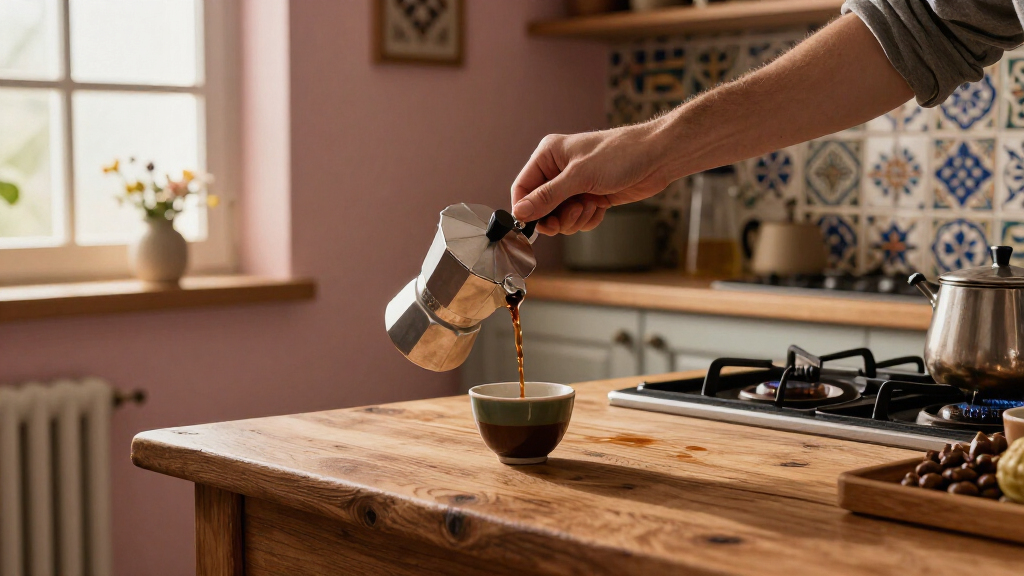
What the Moka Actually Makes (and Why It Isn’t Espresso)
The moka pot produces concentrated, full-bodied coffee using steam pressure, typically around 1–2 bar. That’s roughly one-fifth the pressure of true espresso. Despite decades of marketing that calls it a “stovetop espresso maker,” the drink that rises through that little column in your kitchen is its own category — closer to a very strong, rich filter coffee than to the shot a barista serves you.
Think of it like this: a moka pot and an espresso machine are related the way a bicycle and a motorcycle are related. Both get you down the road. Both involve two wheels and balance. But the experience, the cost, and the maintenance schedule are completely different, and one does not prepare you for the other.
Moka coffee is strong, rich, and sometimes slightly bitter. What it lacks is the syrupy texture, the concentrated sweetness, and the stable crema of a well-made espresso shot. In an Italian household — from Naples, where the moka was invented in 1933 by Alfonso Bialetti, to Turin — this is not a flaw. It’s simply breakfast. Nonna pours it into a large cup, adds hot milk, and gets on with her day.
The upgrade question, then, is not “will the coffee be better?” It’s “do I want a different drink?” If you love the intense, almost chocolatey depth of moka coffee — especially cut with hot water or milk — an espresso machine may actually take you somewhere you don’t want to go.
Products Worth Considering

Samsung 85-Inch M70H Series Mini LED 4K Smart TV (2026)

Philips Hue Bridge Pro Smart Lighting Hub

Dyson Cyclone V10 Origin Cordless Vacuum
As an affiliate, we earn on qualifying purchases.
The Hidden Cost Nobody Mentions: The Grinder
If you remember one thing from this article, make it this: the grinder matters as much as the machine, and most first-time buyers under-budget for it badly. Espresso requires very fine, precisely adjustable, consistent grounds — tolerances that most general-purpose burr grinders simply cannot hit.
Here’s a concrete scenario. You spend $700 on a well-reviewed semi-automatic machine and keep using your $60 blade grinder, or even a decent entry-level burr grinder meant for drip coffee. The shots come out sour, then muddy, then sour again, no matter how you tamp. You blame the machine. The machine is fine — your grinder cannot make the tiny, repeatable adjustments that espresso demands. Dialing in espresso means moving the grind by fractions of a millimeter, and you need stepped or stepless adjustment fine enough to do that.
A modest machine-and-grinder combination can outperform a costly machine paired with a poor grinder. This is the single most common trap in home espresso, and madtasting.com has watched it empty wallets and discourage more aspiring home baristas than any equipment failure ever has.
So when you calculate your budget, the realistic number includes:
- An espresso-capable grinder (often 40–60% of your machine budget)
- A 0.1g scale for dosing and yield
- A tamper that fits your basket, if the stock one is flimsy
- Cleaning products and backflushing detergent
- Water filters or suitable brewing water
- More frequent purchases of fresh beans — espresso punishes stale coffee
Skip this math and the machine price becomes a down payment on frustration.
Moka Pot vs. Espresso Machine: The Honest Side-by-Side
Comparing the two brewers directly reveals where the tradeoffs actually live. The moka wins on simplicity and cost; the machine wins on control and milk-drink capability. Neither wins on “coffee quality” — that depends entirely on which style of coffee you prefer.
| Factor | Moka pot | Espresso machine |
|---|---|---|
| Coffee style | Strong, concentrated brewed coffee | True espresso |
| Pressure | ~1–2 bar | ~9 bar at extraction |
| Grinder demands | Moderate | High |
| Learning curve | Low to moderate | Moderate to high |
| Milk drinks | Requires separate frother | Steam wand often included |
| Cost | Low ($20–50) | Moderate to very high |
| Maintenance | Rinse and occasional gasket swap | Regular cleaning, backflushing, possible servicing |
| Counter space | Minimal | Significant |
| Flavor control | Limited | Extensive |
| Speed | Simple but stovetop-dependent | Fast after warm-up |
Read that table with your own routine in mind. If you make one coffee in the morning and drink it black, the moka’s row reads like a feature list. If you make three cappuccinos every Sunday for your family, the steam-wand row starts doing heavy lifting — because for milk-based drinks, steam power may matter more than subtle differences in espresso quality.
One more honest note on milk: entry-level single-boiler machines make you wait when switching between brewing and steaming. Thermoblock, heat-exchanger, and dual-boiler designs handle milk drinks faster, but performance varies widely and price climbs quickly.
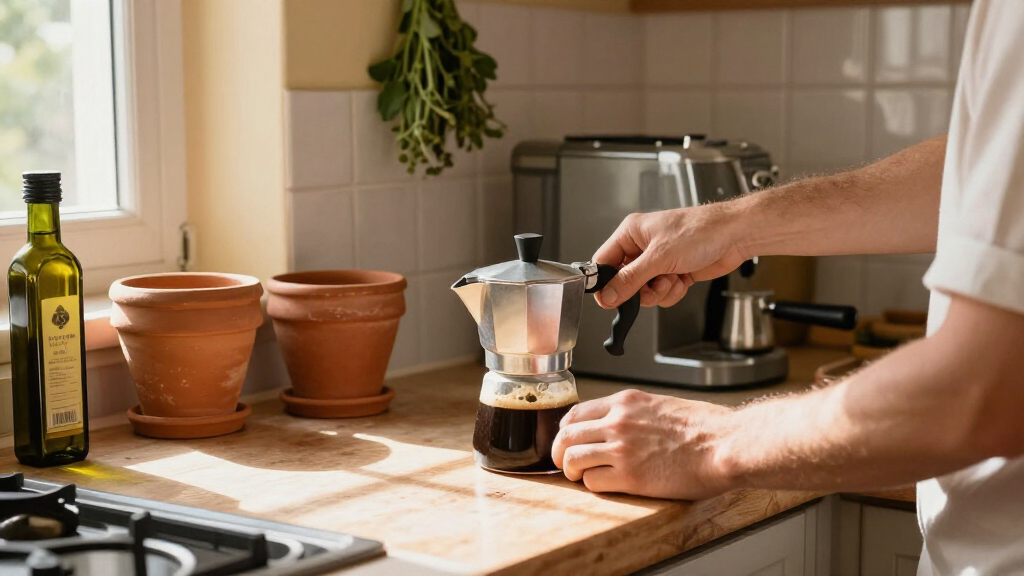
6 Signs You’re Actually Ready to Upgrade
Knowing when to upgrade is simpler than knowing what to buy. An espresso machine is likely worthwhile if several of these describe you:
- You regularly buy espresso or milk drinks from cafés. If you’re at the counter four mornings a week, the machine pays for itself eventually — though the timeline depends on beans, milk, and maintenance.
- You want true espresso, not just strong coffee. You crave the texture and intensity of a proper shot, not merely a punchier morning cup.
- You enjoy adjusting recipes and learning technique. Dialing in a new bag of beans is fun for you, not a chore. Espresso rewards this temperament and punishes its absence.
- You’re willing to buy an appropriate grinder. Non-negotiable. See above.
- You have the counter space and time for maintenance. Backflushing, steam-wand wiping, descaling — these are part of ownership.
- You make several drinks in a session. Households and hosts get far more value from a machine than solo, one-cup drinkers.
Now the flip side. It may not be time to upgrade if you already enjoy the moka’s flavor, mostly drink long black coffee, want a simple and durable brewer, or plan to use pre-ground supermarket coffee. And if you expect an entry-level machine alone to reproduce specialty-café results, the moka will disappoint you less.
There’s no shame in either answer. In Italy, plenty of serious coffee people own both — the machine for the ritual shot, the moka for the lazy Sunday afternoon caffè lungo.

What Kind of Machine Fits Your Life (Without the Hype)
Machine categories have real tradeoffs, and matching the category to your personality matters more than brand loyalty. Here’s the landscape, stripped of marketing.
Manual lever machines are quiet and highly controllable — the purist’s choice, and increasingly fashionable among low-energy brewing enthusiasts. But they’re technique-intensive, and some models require a separate method for steaming milk. Beautiful, demanding, unforgiving.
Semi-automatic machines are the usual choice for enthusiasts. You grind, dose, tamp, start, and stop the shot yourself. This is where the learning curve lives, and where the rewards live too.
Automatic volumetric machines work like semi-automatics but stop at a programmed water volume — a small convenience that removes one variable from your morning.
Bean-to-cup superautomatics grind and brew at the press of a button. Convenient, especially for households, but you trade away control and coffee choice, and they need internal cleaning.
Capsule machines are compact and consistent with nearly no learning curve. The tradeoffs: capsule cost, waste, limited coffee choice, and a result that differs from traditional espresso.
Two marketing traps to sidestep while you shop:
A “15-bar” or “20-bar” pump claim does not mean the coffee should be brewed at that pressure. Good espresso is commonly extracted around 9 bar. Maximum pump pressure is a marketing figure, not a quality indicator.
Also ignore crema worship. Crema is not, by itself, proof of quality — freshness, roast level, pressure, and gas content all affect it. A thick blonde crema on stale dark beans proves nothing.
The Maintenance Reality Check Before You Buy
Espresso machines accumulate coffee oils and minerals the way a kitchen sponge accumulates everything — quietly, steadily, and with consequences. Before you buy, understand what ownership asks of you.
Water quality is the silent variable. Hard water causes scale, which restricts flow, damages heating components, and flattens flavor. But very soft or distilled water can also be unsuitable unless remineralized. Check your local water hardness and the manufacturer’s recommendations before choosing a machine.
Daily, the routine looks like this: knock out the puck, rinse the basket, wipe and purge the steam wand. Weekly to monthly, depending on use, you’ll backflush with detergent, clean the group head, and possibly descale. Compare that to the moka pot, which asks for a rinse and an occasional gasket replacement and rewards decades of loyalty — a well-cared-for aluminum Bialetti routinely outlives its owner’s kitchen renovations.
The workflow difference matters too. A moka pot needs filling, stovetop heating, and rinsing — five unhurried minutes. Espresso adds warm-up, grinding, dosing, tamping, brewing, and cleanup. Newer thermoblock machines warm up rapidly; traditional boiler machines may still benefit from longer heating and stabilization. If your mornings move at a sprint, be honest about which routine fits.
Finally, investigate repairability before buying: replaceable seals, available parts, and local service support. A growing number of manufacturers now publish parts availability — a trend worth rewarding with your money. The moka pot set that standard; expect your machine to meet it.
Frequently Asked Questions
Will an espresso machine make noticeably better coffee than a moka pot?
It can make a more concentrated, balanced, and textured drink — but only when paired with fresh beans, a capable grinder, suitable water, and sound technique. Whether it’s “better” depends entirely on which style of coffee you prefer. If you love moka coffee, an espresso machine won’t improve it; it will replace it.
Can I use my existing grinder with a new espresso machine?
Only if it’s designed for espresso and offers fine, closely spaced adjustments — ideally stepped or stepless at espresso range. Many general-purpose grinders cannot dial in espresso reliably, and an unsuitable grinder is the most common cause of disappointing first shots.
Should I spend more on the grinder or the machine?
Both matter, but buyers commonly under-budget for the grinder. A strong grinder with a modest machine usually outperforms a premium machine with an inconsistent grinder. A reasonable rule of thumb is to allocate 40–60% of your machine budget to the grinder.
Are machines with more bars of pressure better?
No. A “15-bar” or “20-bar” pump claim is a marketing figure — good espresso is commonly extracted around 9 bar. Stable brewing pressure, temperature control (such as PID), and overall design matter far more than the maximum pressure number on the box.
How long does it take to learn to make good espresso at home?
Basic competence can come within a week or two of daily practice; consistently excellent results often take weeks or months. Assisted and automatic machines shorten the learning curve, but the variables — grind, dose, distribution, yield, and temperature — still reward attention.
Can I use pre-ground coffee in an espresso machine?
Yes, especially with a pressurized filter basket, which makes entry-level machines more tolerant. But the result will usually be less fresh and less adjustable. Traditional espresso with a non-pressurized basket works best when ground immediately before brewing.
Should I keep my moka pot after buying an espresso machine?
Absolutely. The two brewers are complementary. The moka remains ideal for larger servings, travel, guests who prefer a long coffee, and mornings when the full espresso workflow feels excessive. Many Italian households use both daily.
Conclusion
Upgrade when the goal is true espresso and café-style milk drinks — and when the budget, counter space, grinder, and maintenance all feel acceptable. If the goal is simply strong, satisfying coffee with minimal expense and fuss, the moka pot remains one of the most practical brewers ever made. Neither answer is a compromise; they’re two different relationships with coffee.
And if you do buy the machine, keep the moka on the stove. Somewhere down the line — a rainy Sunday, a power outage, a crowded counter at your own kitchen’s morning rush — you’ll reach for that little aluminum octagon, hear the familiar gurgle, and remember that in Italy, the espresso bar and the moka pot have always shared the same day.