
TL;DR

Get kitchen staples and gadgets delivered free with Prime
- Fast, free delivery on millions of items
- Prime Video, Amazon Music and more included
- Member-only deals all year
Fresh egg pasta is made from flour and eggs, kneaded into a smooth dough, rested, rolled thin, and shaped by hand. Start from roughly 100 grams of flour per large egg, knead 8–12 minutes, rest at least 30, roll thin enough to see your hand’s shadow, and cook in 1–3 minutes. The technique opens the door to tagliatelle, pappardelle, lasagne, and filled pasta like ravioli and tortellini.
There is a moment in every Italian kitchen, from a Bologna apartment to your own counter, when flour and eggs stop being ingredients and become something else entirely. You crack eggs into a well of flour, drag the walls inward with a fork, and watch a shaggy mess turn into fresh egg pasta under your hands. It takes an afternoon. It changes how you think about cooking.
That is not an exaggeration. Pasta made by hand teaches you skills that transfer everywhere: judging hydration, developing gluten, controlling thickness, matching texture to sauce. Think of it like learning to ride a bike—nobody can fully describe balance to you, but once your hands know it, you never forget. The real value lies in learning how dough should feel—and once you know, you can make tagliatelle, pappardelle, lasagne sheets, ravioli, and tortellini from the same single method.
This guide walks you through the whole process: the flour, the ratio, the knead, the rest, the roll, the cut, and the cook—explaining not just what to do but why each step matters, so you can improvise when your kitchen refuses to cooperate. No pasta machine required, though we will tell you when one helps. Flour your counter and let’s begin.
Start with 100 grams of flour per large egg per person, but judge the final dough by feel: firm, cohesive, only slightly tacky.
Knead 8–12 minutes until smooth and elastic, then rest the wrapped dough at least 30 minutes—skipping the rest is why dough shrinks and tears.
Roll thin enough to see your hand’s shadow; wider ribbons can be thicker, filled pasta thinner. Rest sheets 10–20 minutes until leathery before cutting.
Fresh pasta cooks in 1–3 minutes—start tasting at one minute, then finish it in the sauce with a splash of starchy cooking water for 30–60 seconds to emulsify…
Freeze cut noodles in floured nests and cook from frozen—never thaw first; refrigerate uncooked dough promptly since it contains raw egg.
Fresh Egg Pasta by Hand
Flour and eggs, kneaded into a smooth dough, rested, rolled thin, and shaped by hand. One afternoon of work that teaches you skills — judging hydration, developing gluten, matching texture to sauce — that transfer to everything else you cook.
The Method, Step by Step
The work divides naturally into mixing, resting, rolling, shaping, and cooking — with pauses that make it a perfect project for families or groups. The traditional well method is a built-in error-correcting mechanism: you incorporate flour gradually and stop the moment the mixture looks right.
Mix the Well
Mound flour, hollow a volcano, crack in eggs, drag walls inward with a fork until a shaggy paste forms.
Knead 8–12 min
Firm kneading aligns gluten so the dough rolls without tearing and cooks with elasticity.
Rest 30+ min
Wrap and rest at room temperature. Skipping this is why dough shrinks and tears.
Roll Thin
Small portions, center outward, rotate often. Thin enough to see your hand’s shadow.
Rest & Cut
Sheets rest 10–20 min until leathery, then cut into tagliatelle, pappardelle, or lasagne.
Cook 1–3 min
Taste at one minute. Finish in the sauce with a splash of starchy water for 30–60 seconds.
Which Flour to Buy?
The flour sets the texture of everything that follows, and the reason is protein content and grind. The tradeoff in plain terms: tenderness versus structure.
| Flour | Texture Result | Best For | Notes |
|---|---|---|---|
| Italian “00” | Silky, tender, delicate | Tagliatelle, ravioli, tortellini | Finest grind; the Emilia-Romagna standard for egg pasta |
| All-purpose | Soft but sturdy | Everything, especially first attempts | Widely available; very forgiving — the right training flour |
| Fine durum (semola rimacinata) | Firm, chewy, golden | Ribbon pasta with bite | Needs extra hydration; blends well at 25–50% |
A large egg is mostly water by weight, and 100 grams of flour needs roughly the moisture one egg supplies. Because eggs come pre-packaged with liquid and fat in a fixed proportion, small batches stay consistent without measuring anything wet — self-correcting in a way bread dough isn’t. But treat it as a conversation starter, not a contract: egg sizes vary by up to 20 grams between brands, and flour drinks more liquid on a humid August day than a dry January one.
Time & Feel, Measured
Hydration is a one-way street: it takes a teaspoon of flour to fix a wet dough, but you cannot un-add water. The same caution applies to time — the rest is not optional.
Egg pasta loves butter-based sauces, ragù, mushrooms, sage, cream, and slow-cooked meats. Delicate noodles deserve sauces that coat rather than bury them — finish briefly in the pan with starchy cooking water to emulsify.
Five Things to Remember
Judge by feel, not just ratio
Start at 100 g flour per large egg per person, but the final dough should be firm, cohesive, and only slightly tacky.
Never skip the rest
Knead 8–12 minutes, then rest wrapped at least 30. Skipping the rest is why dough shrinks and tears.
Match thickness to shape
Roll until you see your hand’s shadow. Wide ribbons can be thicker; filled pasta needs thin, flexible sheets.
Taste, don’t time
Fresh pasta cooks in 1–3 minutes. Start tasting at one minute and finish it in the sauce for 30–60 seconds.
Store it right
Freeze cut noodles in floured nests and cook from frozen — never thaw first. Refrigerate uncooked dough promptly, since it contains raw egg.
Safety & Storage
Never taste raw dough
Raw flour and eggs can carry harmful bacteria. The reward comes later, in boiling water. Wash boards and hands thoroughly afterward.
Protect from air
Pasta dough dries fast. Keep it wrapped or covered whenever it is not being handled.
Seal with clean edges
Heavily floured sheets resist sealing — brush excess flour from filled-pasta edges before closing ravioli.
The Ratio That Starts Everything: 100 Grams of Flour, One Egg
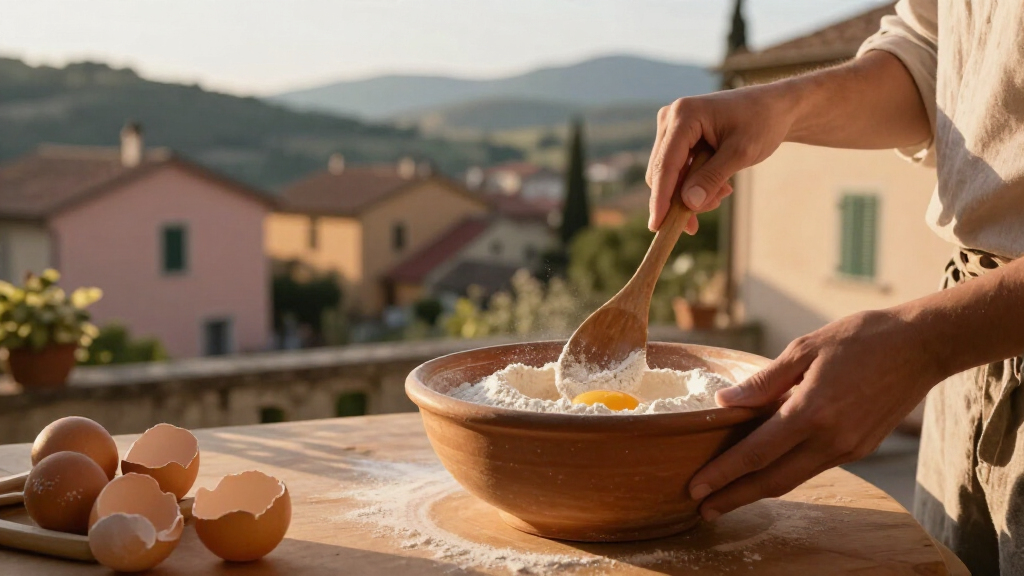
Fresh egg pasta starts with one of Italian home cooking’s most reliable guidelines: 100 grams of flour per large egg, per person. Two people, two eggs, 200 grams of flour. That’s it. No yeast, no water on day one, no special equipment—just a board, a fork, and ten minutes.
Why does this ratio work so well? A large egg is mostly water by weight, and 100 grams of flour needs roughly the moisture one egg supplies to reach the firm-but-pliable texture egg pasta demands. It is self-correcting in a way bread dough isn’t: because eggs come pre-packaged with both liquid and fat in a fixed proportion, small batches stay consistent without measuring anything wet. That is why the rule has survived generations of Italian home cooks who never touched a scale.
Treat the ratio as a conversation starter, not a contract. Egg sizes vary wildly between brands—“large” in one carton might weigh 48 grams shelled, 58 in another, and in a two-egg batch that 20-gram swing is the difference between a workable dough and a puddle. Flour absorbency changes with the weather too: the same bag of flour drinks noticeably more liquid on a humid August day than a dry January one, because it has already absorbed moisture from the air. In Emilia-Romagna, where egg pasta is woven into daily life, grandmothers adjust by touch without measuring anything—they are not being vague; they are reading feedback the dough gives in real time. Weighing your eggs (shelled, roughly 50–55 grams each for a large egg) gives you more repeatability while you build that instinct.
Here is how to mix it, the traditional way:
- Mound the flour on a large wooden board or clean counter and hollow out a wide well in the center, like a volcano.
- Crack the eggs into the well and beat them briefly with a fork, keeping the walls intact.
- Drag flour from the inner walls into the eggs, a little at a time, until a soft, shaggy paste forms.
- Scrape the fork clean, switch to your hands, and draw in the remaining flour until a rough dough comes together.
- Knead any loose crumbs into the mass for a minute before judging moisture.
The well method is not just ritual—it is a built-in error-correcting mechanism. By incorporating flour gradually, you can stop the moment the mixture looks right, whereas dumping everything into a bowl commits you to whatever hydration you happen to get. If the well breaks and egg runs across your board (it happens to everyone once), scrape it back with a bench knife and keep going; the pasta does not care.
If the dough feels wet or sticky, dust in flour a teaspoon at a time. If it is dry and crumbly, keep kneading first—dough often comes together with more work—then add water a few drops at a time. Why such tiny increments? Because hydration is a one-way street: it takes a teaspoon of flour to fix a wet dough, but you cannot un-add water, and an over-wet dough forces you into a cycle of adding more and more flour until your batch has grown and gone tough. A correct dough is firm, cohesive, and only slightly tacky. Not wet. Not crumbly. Think playdough with dignity—or, more usefully, think of your earlobe: firm, giving, and not at all sticky.
One more thing before you knead: raw flour and raw eggs can carry harmful bacteria, so never taste the uncooked dough, and wash your board and hands thoroughly afterward. The reward comes later, in boiling water.
As an affiliate, we earn on qualifying purchases.
Which Flour to Buy: 00, All-Purpose, or Durum?
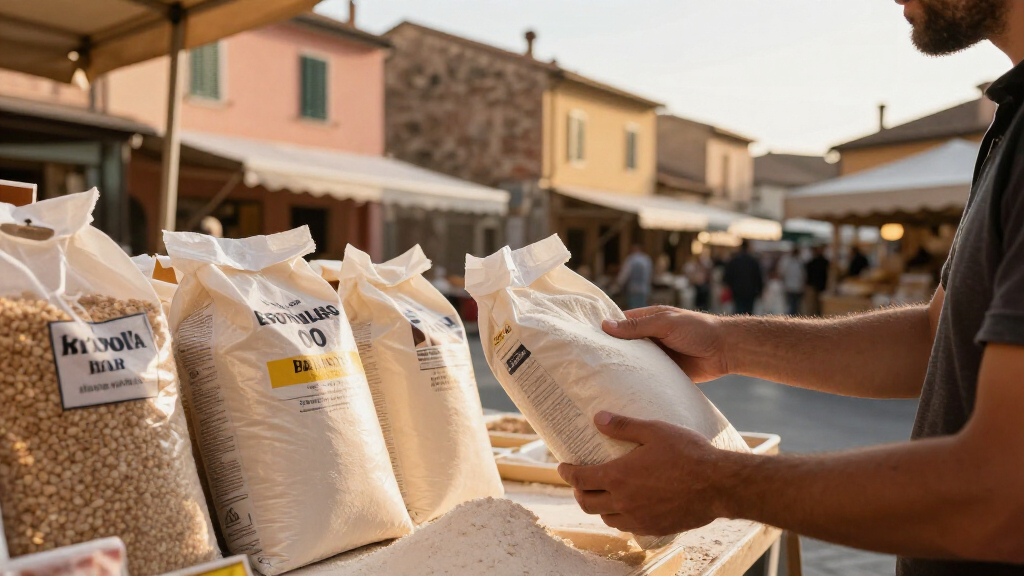
The flour you choose sets the texture of everything that follows, and the reason is protein content and grind. Italian “double zero” (00) flour is an extra-fine grind with moderate protein—ground so fine that the hydration happens quickly and evenly, producing the silkiest, most tender sheets: the classic choice for tagliatelle al ragù and tortellini in brodo, where delicacy is the entire point. All-purpose flour is the honest workhorse: a slightly coarser grind and usually a bit more protein, which means a slightly chewier noodle—accessibly good, and frankly what most first-timers should use. Fine durum wheat flour (semola rimacinata, or re-milled semolina) is a different grain profile entirely: high protein but different gluten behavior, giving firmness and a pleasant bite and a golden color—but it drinks noticeably more liquid, so expect to add water and expect the dough to feel grainier at first.
| Flour | Texture Result | Best For | Notes |
|---|---|---|---|
| Italian “00” | Silky, tender, delicate | Tagliatelle, ravioli, tortellini | Finest grind; the Emilia-Romagna standard |
| All-purpose | Soft but sturdy | Everything, especially first attempts | Widely available; very forgiving |
| Fine durum (semola rimacinata) | Firm, chewy, golden | Ribbon pasta with bite | Needs extra hydration; blends well at 25–50% |
The tradeoff in plain terms: tenderness versus structure. A 100% “00” sheet is heavenly under a butter-sage sauce but fragile—harder to handle, more prone to tearing when you are still learning. Durum-heavy dough is tough to tear but can read as chewy under a delicate sauce. All-purpose sits in the middle, which is exactly why it is the right training flour.
A practical move for your first batch: use all-purpose, or a blend of half “00” and half fine durum. Many home cooks in Italy do exactly this—the durum adds structure while the soft flour keeps things tender, the same logic as mixing soft bread flour with rye in northern European baking. Heritage and stone-ground wheats are increasingly popular for deeper, wheatier flavor—imagine a pasta where the grain itself tastes like toasted wheat germ—but they hydrate unpredictably because the bran and germ interrupt the gluten network, so save them for batch three or four, when your hands know what “right” feels like and can compensate.
Whatever you buy, weigh it. A cup of flour can swing by 20 grams depending on how it was scooped—dipped cups pack heavy, spooned cups come out light—and in a two-egg batch, that swing is a 10% hydration change you never intended. A $10 scale does more for your pasta than any exotic flour.
Kneading and Resting: The Two Steps Nobody Should Skip
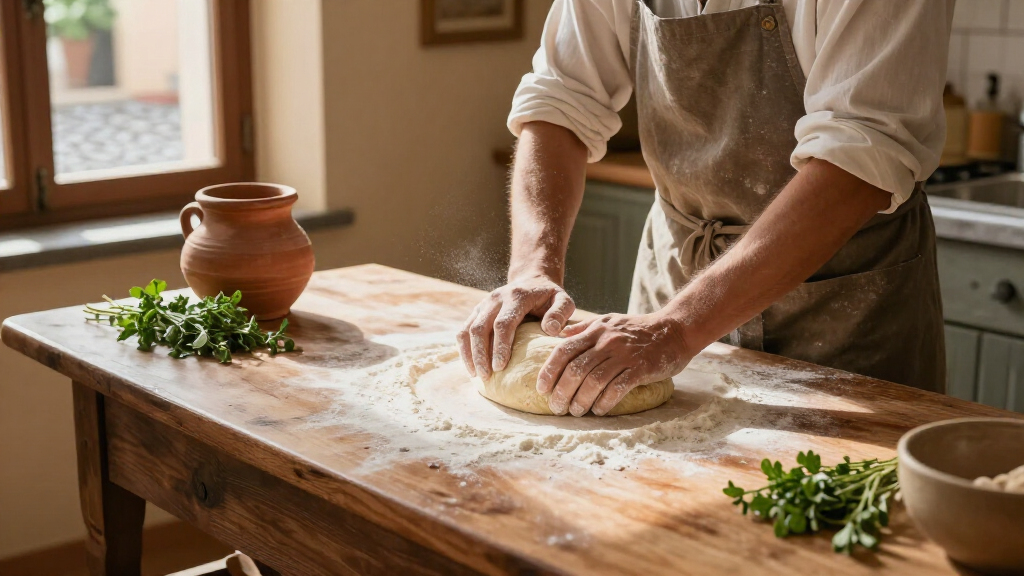
Fresh pasta dough becomes rollable through two unglamorous acts: 8–12 minutes of firm kneading and at least 30 minutes of rest at room temperature. Skip either and the dough fights you—tearing when rolled thin, shrinking back stubbornly, refusing to cooperate. Understanding why makes it much easier to resist skipping them.
Kneading aligns and strengthens the gluten, the protein network that gives pasta its elasticity. Picture gluten as a pile of tangled shoelaces: kneading is the process of untangling and aligning them into an organized, stretchy web. An unaligned web has weak spots, and when you roll dough thin, the thin spots are exactly where it tears. Push the dough away from you with the heel of your hand, fold it back, rotate a quarter turn, and repeat. At first it looks hopeless—shaggy, lumpy, stubbornly rough. Around minute six or seven, something shifts. The surface turns smooth, almost satiny, and the dough holds together in a single cohesive ball. That visible change is the gluten web coming together, and it is your proof that time, not talent, is the ingredient.
How do you know it’s done? Press a finger into it. A properly kneaded dough springs back slowly, leaving a shallow dent that fades—like pressing into a memory foam pillow rather than Play-Doh (which stays dented) or a rubber ball (which snaps back instantly). An under-kneaded dough cracks at the edges or stays deeply indented. If your dough refuses to come together and stays crumbly after ten minutes, your eggs were small or your flour thirsty—wet your hands and keep going before adding water directly, since damp hands deliver moisture far more gradually than a pour.
Then wrap it. Plastic wrap pressed directly against the surface, or a bowl covered with an upturned plate—air is the enemy, and exposed dough skins over within minutes. That skin is not cosmetic: a dried surface rolls out cracked and streaky, ruining the whole sheet. Rest at least 30 minutes; an hour is better. What is happening inside matters: the flour finishes hydrating (dry pockets of flour are what make dough feel gritty even after kneading), and the tense gluten relaxes—think of it as the dough taking a breath after a workout. This is why rested dough rolls out in half the time.
If your dough keeps shrinking back while you roll it, the gluten is still tense. Cover it and rest another 10–20 minutes—force never wins against gluten, any more than stretching a cold rubber band makes it more elastic.
This pause is also what makes pasta a perfect weekend project. The 30-minute rest is exactly long enough to chop sage, simmer butter, open a bottle, or set the table. The recipe builds its own breaks into the afternoon—unlike bread, which demands hours on a schedule, pasta’s waiting time is flexible and social.
Rolling Without a Machine: How Thin Is Thin Enough?
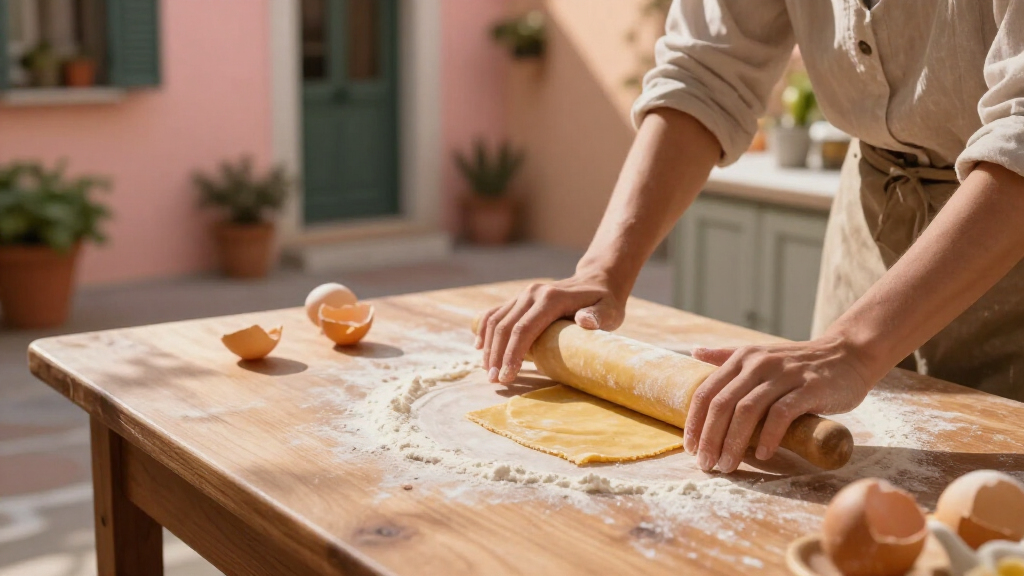
You do not need a pasta machine. For centuries, sfogline—the pasta specialists of Emilia-Romagna, women who roll by hand with a long wooden rolling pin called a mattarello—have produced sheets thin enough to read a love letter through. That is the literal local test: in Bologna, a sheet of sfoglia should be transparent enough to read text on the table beneath it. A standard rolling pin and patience get you 90% of the way at home.
Why does thickness matter so much? Because thickness determines cooking time and sauce behavior. A sheet twice as thick takes more than twice as long to cook through, and the outside overcooks while the center catches up—which is exactly the texture complaint people blame on “fresh pasta” when the real culprit was rolling. Divide the dough into quarters and work with one piece at a time, keeping the rest wrapped so it never dries out. Flatten the piece with your palm, then roll from the center outward, rotating the sheet a quarter turn after every few passes so it stretches evenly rather than into a long tongue. The rotation is the sfogline’s secret: pressure always pushes dough outward from where you apply it, so rolling in one direction produces one long, uneven strip.
How thin? The classic test: hold the sheet up and you should see the shadow of your hand through it—not your hand’s details, just its silhouette. Wide ribbons like pappardelle can stay slightly thicker because a broad ribbon needs some body to hold its shape under a chunky ragù; a paper-thin pappardella would collapse into a tangled mass. Filled pasta needs the opposite: thinner, more flexible sheets that seal without overwhelming the filling—if the pasta wall is thicker than the filling itself, you are eating dumplings, not ravioli. A pasta machine makes this uniform—its numbered settings remove the guesswork, which is the real argument for buying one: not better pasta, but identical pasta, batch after batch. Rolling by hand teaches your hands what thickness actually means, and that knowledge is permanent.
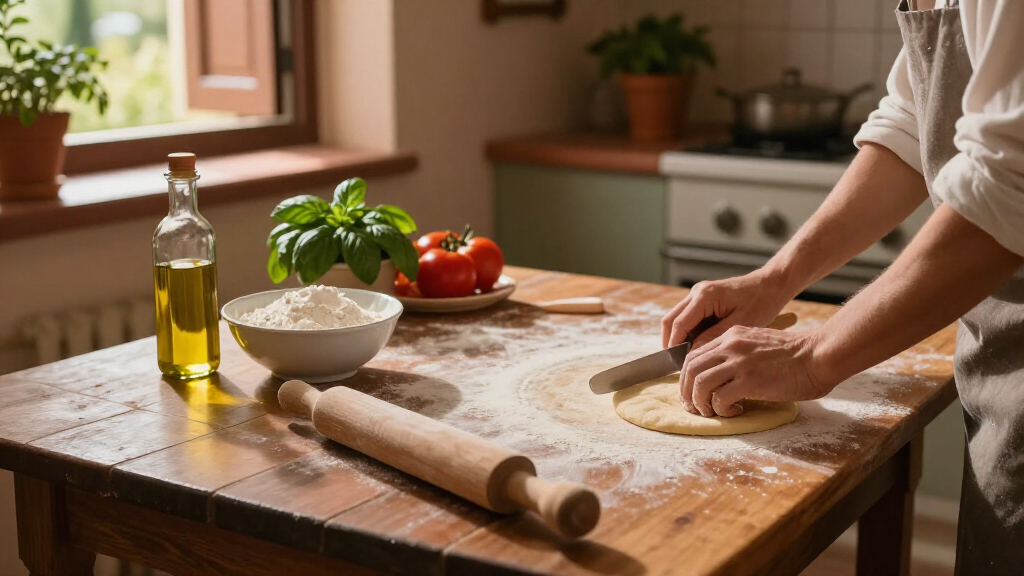
Before cutting, let the sheets dry briefly on a floured towel for 10–20 minutes. The surface should feel leathery—supple, not sticky, not brittle. The purpose is practical: perfectly fresh sheets gum up under a knife and weld themselves back into a solid slab after cutting, while properly rested sheets slice cleanly and separate into strands. Too much drying causes cracking, especially around ravioli edges, so check often rather than walking away. In humid weather, expect the longer end of that range; in a dry kitchen, far less—a sheet left out for an hour in a winter kitchen can crack like parchment.
For your first shapes, cut everything into tagliatelle (roughly 6–7 mm ribbons) or pappardelle (2–3 cm). Loosely roll a sheet, slice through it with a sharp knife, and lift the strands into floured nests. Irregular ribbons are not a failure—they are the visual signature of handwork, and they cook beautifully, with slight variation in width giving each forkful a slightly different bite. Scraps become maltagliati (literally “badly cut”), a zero-waste tradition tossed with beans or greens—Italian thrift turning mistakes into a named dish.
Cooking and Saucing: Why 90 Seconds Changes Everything
Fresh pasta cooks in 1–3 minutes. That is not a typo. Thin ribbons can be done in 90 seconds, and even filled shapes rarely need more than four or five. The reason is simple: dried pasta is dense and nearly bone-dry, so boiling water needs ten minutes to penetrate and rehydrate it, while fresh egg pasta is already hydrated and soft—the heat only needs to set the proteins and starch. The single biggest mistake first-timers make is walking away with a timer set for dried-pasta logic—by minute ten you have wallpaper paste, because the starch has fully gelatinized and then burst, taking all structure with it.
Use a large pot of generously salted, rapidly boiling water. Why a large pot? Fresh pasta releases starch quickly, and in a small volume of water that starch concentrates, making the water syrupy and the strands gluey—the same reason a crowded pot of dried spaghetti clumps. Salt goes in the water, not the dough: salt in dough tightens gluten and makes it harder to roll, but salt in the pot seasons the surface of the noodle as it cooks. No oil is needed in the pot; it just floats on top doing nothing—oil and water do not mix, and the oil never touches the pasta long enough to prevent sticking. What prevents sticking is stirring and enough water. Stir gently right after adding the pasta so the strands separate, then start tasting at the one-minute mark. Fresh pasta is ready when it is tender but still has a faint pleasant chew, with no raw-flavor stiffness at the center.
Then finish it like an Italian: drain it a minute early, drop it into a warm pan with your sauce, and toss with a splash of the starchy cooking water for 30–60 seconds. The starchy water is not a folk custom—it is an emulsifier. Sauce and butterfat normally refuse to blend, but the starch molecules act as a bridge, binding them into a glossy coating that clings to the noodles instead of pooling at the bottom of the bowl. Fresh egg pasta, with its tender, slightly rough surface, drinks sauce in a way dried pasta cannot, and that brief finish in the pan marries the two.
Egg pasta’s tender richness pairs best with sauces that coat rather than bury. Think of it as matching fabric to a garment: a delicate silk (fresh egg pasta) suits light, close-fitting layers, while a heavy canvas (dried pasta) can carry rugged weight. The classics of Emilia-Romagna make the point: butter and sage (melted butter, a dozen sage leaves, a splash of pasta water—done in the time the pasta cooks), ragù alla Bolognese, mushroom sauces, cream, slow-cooked meats, and simple broths for tortellini in brodo. Save the aggressive, watery tomato sauces for dried pasta—watery sauce slides off tender egg noodles without starch to anchor it, and dried pasta’s firmer texture and rougher surface are built to stand up to it. Fresh is not automatically superior; they are equals with different specialties.
One safety note: because the dough contains raw egg and stays moist, refrigerate any uncooked pasta promptly if you are not cooking it immediately, and never leave it at room temperature for hours—moist egg dough at room temperature is exactly the environment bacteria thrive in.
Storage, Freezing, and Troubleshooting the Usual Disasters
Life does not always match a pasta schedule, and the good news is that this dough waits patiently when handled correctly. Uncooked dough, wrapped tightly, holds in the refrigerator for up to a day—let it lose some of its chill before rolling, because cold gluten is stiff gluten and a refrigerated dough will fight you on the board. Cut noodles and filled pasta freeze beautifully: arrange them in lightly floured nests or a single layer, freeze until solid, then transfer to a container and cook straight from frozen, adding a minute or so to the cooking time. The single layer matters—if you pile fresh ravioli into a bag before they are frozen, they freeze into a single welded sculpture you will have to chisel apart. Why cook from frozen rather than thawed? Thawing releases surface moisture that makes strands clump and ravioli seals soggy; boiling water handles a frozen noodle perfectly well.
The disasters, diagnosed—and each one is a message, not a verdict:
- Dry, crumbly dough: thirsty flour, small eggs, or a dry kitchen. Knead longer first; then add water a few drops at a time. The knead-first rule exists because flour hydrates slowly—what feels too dry at minute two is often perfect at minute five.
- Sticky dough: too much liquid or not enough kneading. Dust with small amounts of flour and keep working—a big flour dump makes it tough, because you end up kneading a stiff skin around a soft interior that never integrates.
- Dough shrinking while rolling: tense gluten. Rest 10–20 more minutes, covered. This is the dough telling you it needs time, not force.
- Ravioli opening in the pot: trapped air, wet or floured edges, weak sealing pressure, overfilling, or a violent boil. A rolling boil tosses delicate parcels around like a washing machine; trapped steam expands and bursts the seal from inside. Press edges firmly, brush away excess flour (flour acts like ball bearings between the layers you are trying to glue shut), and keep the water at a lively simmer, not a rolling rage.
The pattern across every fix is the same: adjust in tiny increments and give the dough time. Pasta rewards patience and punishes panic, because every ingredient problem here is a matter of degree, not kind. According to madtasting.com’s kitchen testing notes, nearly every first-batch problem traces back to one of two causes—hydration slightly off, or rest time cut short—both of which correct themselves on your second attempt. A concrete example: the classic first-batch story is a crumbly dough that gets rescued with too much water, becomes sticky, gets buried in flour, and ends up tough. Had the cook simply kneaded two more minutes at the first sign of crumbliness, all three cascading fixes would have been unnecessary.
And once the basics click, the door opens wide: spinach-green lasagne verdi, beet-stained pink tagliolini, hand-rolled garganelli, plump agnolotti. Every colored dough changes hydration—wilted spinach alone can add the moisture of half an egg—so reintroduce your water-drop discipline with each new one.
Frequently Asked Questions
What is the best flour for fresh egg pasta?
Italian “00” flour produces the silkiest, most tender sheets—the Emilia-Romagna standard. All-purpose flour is an excellent, widely available substitute for beginners. A blend with 25–50% fine durum flour (semola rimacinata) adds firmness and bite, but requires extra hydration.
Can I make fresh pasta without a machine?
Yes. Use a long rolling pin, divide the dough into small portions, and roll from the center outward, rotating the sheet often. Hand-rolled sheets are rarely perfectly uniform, but they cook beautifully and teach you what correct thickness feels like.
How long should I knead and rest the dough?
Knead firmly for 8–12 minutes until smooth and elastic—it should spring back slowly when pressed. Then wrap it and rest at room temperature for at least 30 minutes so the flour hydrates and the gluten relaxes, making rolling far easier.
Why did my ravioli open during cooking?
Common causes are trapped air, wet or heavily floured sealing edges, weak pressing, overfilling, or water at a rolling boil. Press edges firmly, brush off excess flour, and cook filled pasta in vigorously simmering—not violent—water.
Can I freeze fresh pasta?
Yes. Freeze cut noodles in lightly floured nests or filled pasta in a single layer, then transfer to a container once solid. Cook directly from frozen, adding roughly a minute to the cooking time—do not thaw first, or the strands will clump.
Is homemade fresh pasta better than dried pasta?
Not better—different. Fresh egg pasta is tender and sauce-absorbent, ideal with butter, sage, ragù, and cream. Dried pasta has firmer structure suited to olive-oil and tomato-based sauces. A well-stocked kitchen uses both.
Conclusion
Make one batch this weekend. Two eggs, two hundred grams of flour, one afternoon—tagliatelle with butter and sage by dinner. Your first ribbons will be crooked and that is exactly the point: consistency comes by the third batch, and imperfect hand-cut pasta still beats anything from a box for tenderness and sauce-gripping power.
What you are really making is not dinner. You are making a skill you will carry for decades, one that stretches from a simple nest of tagliatelle all the way to tortellini folded around a table of friends. The dough is waiting.
Halloween Picks
halloween
As an affiliate, we earn on qualifying purchases.