TL;DR

Get kitchen staples and gadgets delivered free — and shop member deals
- Fast, free delivery on millions of items
- Access to Prime Big Deal Days deals on October 6–7
- Prime Video, Amazon Music and more included
Saltimbocca alla romana is a traditional Italian dish originating in 19th-century Rome: thin veal scaloppine topped with prosciutto and sage, sautéed in butter and white wine in about 20 minutes. Its name means ‘jumps in the mouth,’ and its success depends entirely on ingredient quality — real prosciutto, fresh sage, thin meat — rather than technique. Chicken or pork work as substitutes; Frascati is the classic wine to drink alongside.
Roman trattorias run on a handful of dishes that have barely changed in 150 years, and saltimbocca alla romana sits near the top of that list. The name means ‘jumps in the mouth’ — saltare in bocca — and one bite tells you why. Tender veal, salty prosciutto, and fried sage in a buttery wine sauce, done before your pasta water even boils.
This is an introduction to saltimbocca for anyone who assumes real Roman cooking takes all day. It doesn’t. What it takes is good shopping: the right cut of veal, real cured ham, fresh sage. The cooking itself is maybe four minutes per side.
Here you’ll get the history, the technique, the shortcuts that work, and the mistakes that ruin the dish — plus what to serve alongside and what to pour in the glass. Consider it your overview for a twenty-minute trip to Testaccio without the airfare.
Saltimbocca alla romana is four ingredients — veal scaloppine, Prosciutto di Parma DOP, fresh sage, and white wine — done in about 20 minutes.
Cook the prosciutto side down first over medium heat; cured ham burns above medium and turns the whole dish bitter.
Pound cutlets to an even 1/8 inch; uneven thickness is the reason some pieces overcook while others stay raw.
Veal needs 145°F (63°C) internal, chicken substitutes need 165°F (74°C); thin cutlets reach these temperatures almost instantly.
Pair with Frascati Superiore DOCG and quiet sides like roasted potatoes or polenta — the dish is rich and wants support, not competition.
Saltimbocca alla Romana
The Twenty-Minute Roman Classic
Saltimbocca alla romana is thin veal scaloppine topped with prosciutto and fresh sage, sautéed in butter and white wine in about twenty minutes. Its name means “jumps in the mouth” — and its success depends entirely on ingredient quality, not technique.
Four ingredients, no garlic, no tomatoes, no cheese. Maximum flavor from minimum intervention: the Roman philosophy on a plate.
“It Jumps in the Mouth” — Saltare in Bocca
Food historians trace the dish to at least the 19th century, and some argue its roots run north to Brescia in Lombardy before Rome adopted it and made it famous. Today it belongs to Rome the way cacio e pepe and carbonara do — chalked on every trattoria board from Trastevere to Testaccio. The veal is topped with ham and sage, secured with a toothpick, sautéed briefly, and finished with wine. That’s the whole dish.
“Romans are not a people given to culinary hyperbole — so when they name a dish ‘it leaps into your mouth,’ you listen.”
The Best Review Any Dish Has ReceivedThe Four Ingredients That Do All the Work
Saltimbocca succeeds or fails at the shop, not the stove. Each ingredient carries so much weight that substituting carelessly collapses the whole structure.
Veal Scaloppine
Top round or leg, sliced a quarter inch thick, pounded between parchment until nearly translucent — thin enough to cook in ninety seconds.
Prosciutto DOP
Prosciutto di Parma DOP or San Daniele DOP. It’s your only salt source — deli ham is too wet and too sweet; it steams instead of crisping.
Fresh Sage
Fresh only — dried sage tastes like dust and regret. The leaf goes under the prosciutto so its oils perfume the veal rather than scorch.
Wine & Butter
A dry white — Frascati is the Roman answer — plus a knob of butter. Marsala gives a sweeter, nuttier finish; both are legitimate.
| Ingredient | Traditional Choice | Acceptable Substitute | Avoid |
|---|---|---|---|
| Meat | Veal scaloppine | ✓ Chicken or pork cutlets | ✗ Thick-cut chops |
| Cured ham | Prosciutto di Parma DOP | ✓ San Daniele DOP | ✗ Deli ham, bacon |
| Herb | Fresh sage leaf | ~ Nothing — it’s essential | ✗ Dried sage |
| Liquid | Dry white wine (Frascati) | ✓ Marsala | ✗ Sweet cooking wine |
Six Steps, Twenty Minutes
Most of the time is pounding and assembling. Follow the sequence in the order Roman home cooks do.
Pound the Veal
Between parchment sheets to an even 1/8 inch. Evenness matters more than thinness.
Season Lightly
A whisper of black pepper only — the prosciutto brings all the salt you need.
Layer & Secure
Sage leaf on veal, prosciutto on top, one toothpick. A light flouring helps the sauce cling.
Sear Ham-Side First
Medium heat, butter and oil. About two minutes until amber, then flip for 90 seconds.
Build the Sauce
Deglaze with half a glass of wine, scrape the browned bits, reduce by half, swirl in cold butter.
Return & Glaze
Thirty seconds in the pan to soak up the sauce. Serve immediately.
Veal should reach 145°F (63°C) internal, chicken substitutes 165°F (74°C), with a three-minute rest. Cutlets this thin reach temperature almost instantly — if yours cook longer than three minutes per side, they’re too thick.
Why Prosciutto Burns — and Four Other Mistakes
Cured ham contains sugar and dries out quickly, so above medium heat it blackens before the veal underneath is done. Moderate heat, patient browning. The other four failures show up constantly in home kitchens.
Heat Too High
Burnt prosciutto turns the whole dish bitter. Keep it at medium and add patience, not flame.
Thick Cutlets
Anything over a quarter inch won’t cook through in the time the prosciutto needs. Pound more, not longer.
Skipping the Toothpick
The prosciutto curls and separates. One toothpick holds the stack — just warn your guests, Roman-style.
Crowding the Pan
Four cutlets maximum in a twelve-inch skillet. More means steaming, and no browning means no sauce.
Sweet Wine
“Cooking wine” makes a cloying sauce. Use a dry white you’d actually drink — Frascati, Verdicchio, or a light Chardonnay.
What to Serve Alongside — and What to Pour
The dish is rich and wants support, not competition. Quiet sides and a crisp Roman white.
Frascati Superiore DOCG
The classic glass — dry, mineral, Roman hills. Verdicchio or a light Italian Chardonnay also work.
Roasted Potatoes
Quiet, starchy support that soaks up the buttery pan sauce.
Soft Polenta
A Roman-adjacent partner for catching every drop of the glaze.
Simple Greens
A light salad or sautéed vegetables — nothing that competes with the main event.
“This is Roman cooking’s whole philosophy on one plate: quality ingredients handled barely at all.”
Maximum Flavor · Minimum InterventionWhat Saltimbocca Actually Is — and Why the Name Says Everything
Saltimbocca alla romana is a traditional Italian dish originating in Rome, built from exactly four elements: paper-thin veal scaloppine, a slice of prosciutto, a fresh sage leaf, and a quick pan sauce of butter and white wine. The veal is topped with the ham and sage, secured with a toothpick, sautéed briefly, and finished with wine. That’s the whole dish. No garlic, no tomatoes, no cheese.
The name is the best review any dish has ever received. Saltare in bocca — to jump in the mouth — because that’s what the flavor does. Romans are not a people given to culinary hyperbole, so when they name a dish ‘it leaps into your mouth,’ you listen.
Food historians trace the dish back to at least the 19th century, and some argue its roots run north to Brescia in Lombardy before Rome adopted it and made it famous. If that’s true, it’s a bit like a musician who was born elsewhere but became the voice of a city. Today saltimbocca belongs to Rome the way cacio e pepe and carbonara do — part of the holy trinity you’ll find chalked on every trattoria board from Trastevere to Testaccio.
What makes it distinctly Roman is the philosophy: maximum flavor from minimum intervention. Roman cooking prizes quality ingredients handled barely at all. Saltimbocca is that principle on a plate.
As an affiliate, we earn on qualifying purchases.
The Four Ingredients That Do All the Work
Saltimbocca succeeds or fails at the shop, not the stove. Each of the four ingredients carries so much weight that substituting carelessly collapses the whole structure.
Veal: Ask your butcher for scaloppine — top round or leg, sliced about a quarter inch thick, then pounded thinner between parchment until it’s nearly translucent. You want it thin enough that it cooks in ninety seconds. Chicken breast or pork loin cutlets are honest substitutes; the technique transfers perfectly, and plenty of Roman home cooks make the swap.
Prosciutto: Use Prosciutto di Parma DOP or Prosciutto San Daniele DOP. The DOP designation guarantees traditional curing and a specific region, and it matters here because the ham is your only salt source. Standard deli ham is too wet and too sweet — it steams instead of crisping.
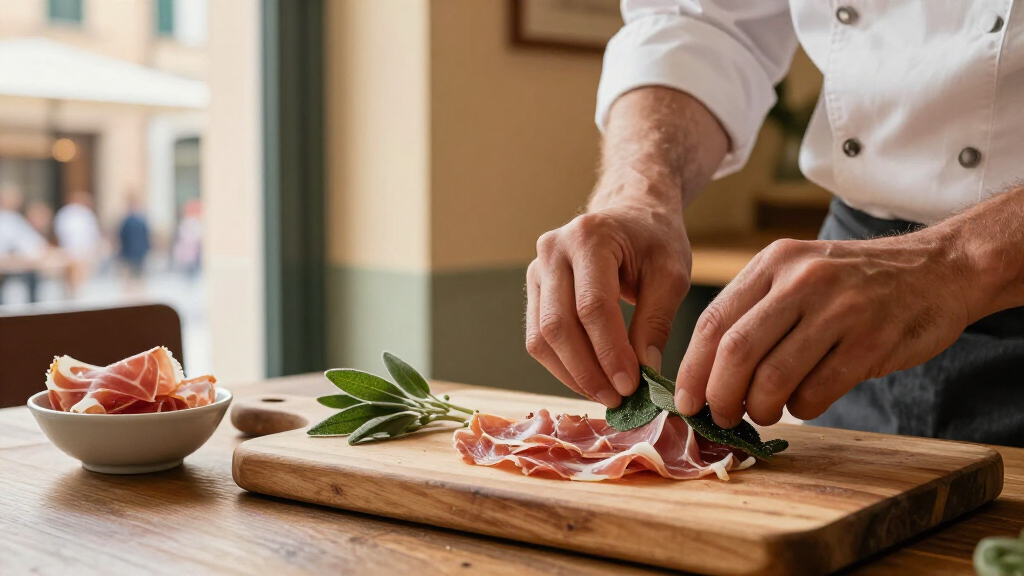
Sage: Fresh only. Dried sage tastes like dust and regret. The leaf goes under the prosciutto, pressed onto the meat, so its oils perfume the veal rather than scorching in the pan.
Wine and butter: A dry white — Frascati is the Roman answer — plus a knob of butter for the sauce. Some cooks use Marsala for a sweeter, nuttier finish; both are legitimate.
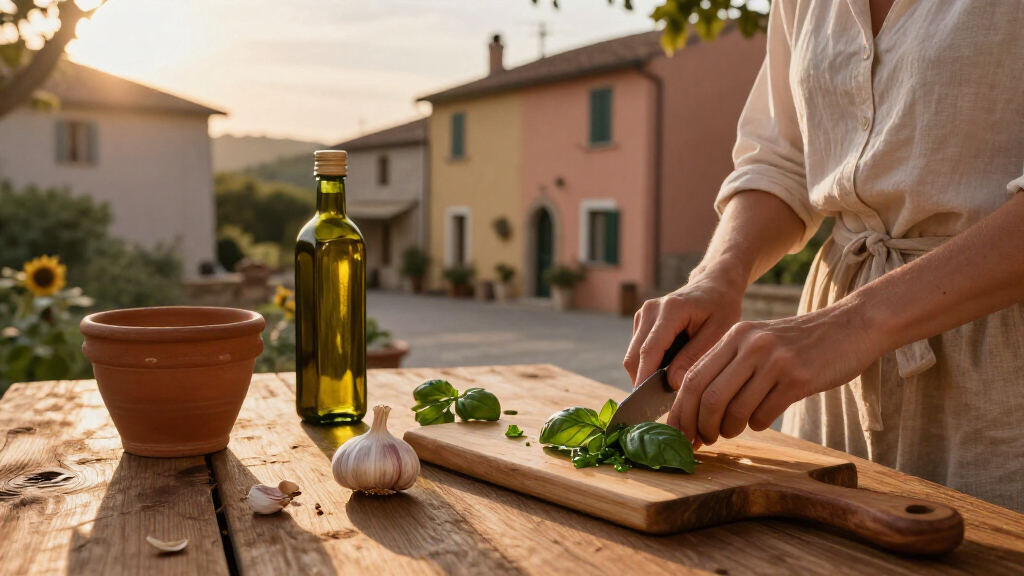
| Ingredient | Traditional Choice | Acceptable Substitute | Avoid |
|---|---|---|---|
| Meat | Veal scaloppine | Chicken or pork cutlets | Thick-cut chops |
| Cured ham | Prosciutto di Parma DOP | San Daniele DOP | Deli ham, bacon |
| Herb | Fresh sage leaf | Nothing — it’s essential | Dried sage |
| Liquid | Dry white wine (Frascati) | Marsala | Sweet cooking wine |
How to Make Saltimbocca in Six Steps (Twenty Minutes, Start to Finish)
The entire process takes about twenty minutes, and most of that is pounding and assembling. Here is the sequence, in the order Roman home cooks follow.
- Pound the veal. Place each scaloppine between two sheets of parchment and pound to an even eighth of an inch. Evenness matters more than thinness — uneven cutlets cook unevenly.
- Season lightly. A whisper of black pepper only. The prosciutto brings all the salt you need; adding more makes the dish briny.
- Layer and secure. Lay one sage leaf on the veal, cover with a slice of prosciutto trimmed to fit, and fasten with a single toothpick. Some cooks flour the veal side lightly first — it helps the sauce cling.
- Sear prosciutto-side down first. Heat butter and a little oil in a wide pan over medium heat. Cook the prosciutto side about two minutes until it crisps and turns amber, then flip for another minute and a half.
- Build the sauce. Remove the meat, pour in half a glass of white wine, and scrape the browned bits with a wooden spoon. Let it reduce by half, then swirl in a knob of cold butter off the heat.
- Return and glaze. Put the saltimbocca back in the pan for thirty seconds to soak up the sauce, then serve immediately.
Food safety note: veal and chicken scaloppine should reach an internal temperature of 145°F (63°C) for veal and 165°F (74°C) for chicken, with a three-minute rest. Because the cutlets are so thin, this happens almost instantly — if yours are cooking longer than three minutes per side, they’re too thick.
The most common failure is heat that’s too high. Prosciutto burns fast, and burnt prosciutto turns bitter. Moderate heat, patient browning. The second failure is overcooking the veal, which goes from silk to shoe leather in under a minute.
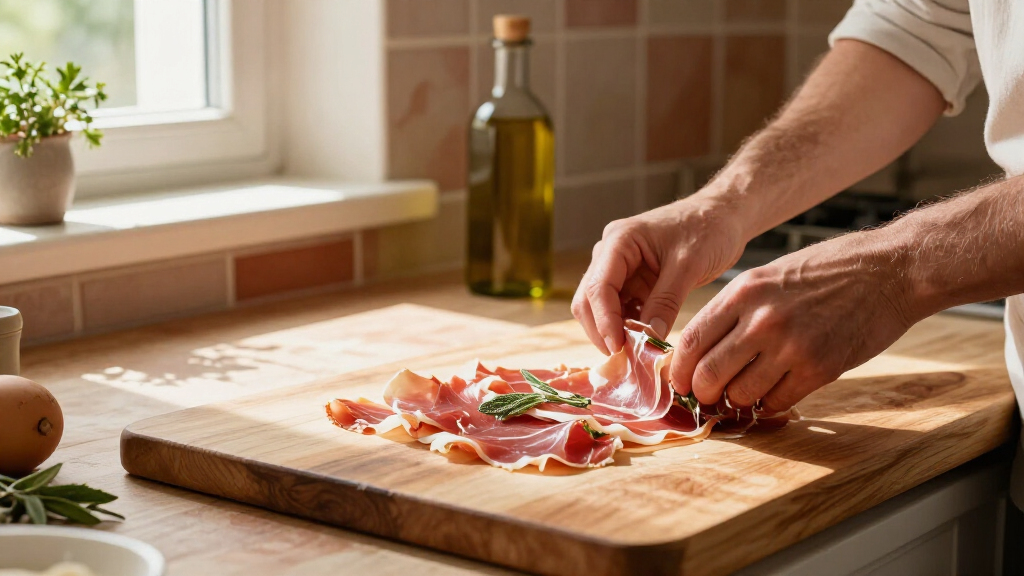
Why Prosciutto Burns and Four Other Mistakes to Dodge
Cook prosciutto over moderate heat and add patience, not flame — that’s the short answer to the most-asked question about this dish. Cured ham contains sugar and dries out quickly, so above medium heat it blackens before the veal underneath is done.
The other four mistakes show up constantly in home kitchens.
Mistake one: thick cutlets. Anything over a quarter inch won’t cook through in the time the prosciutto needs. Pound more, not longer.
Mistake two: skipping the toothpick. The prosciutto curls and separates as it cooks. One toothpick holds the stack together and pulls out cleanly at the table — just warn your guests, Roman-style.
Mistake three: crowding the pan. Four cutlets maximum in a twelve-inch skillet. More than that and the temperature drops, the meat steams, and the sauce never forms because there’s no browning.
Mistake four: sweet wine. ‘Cooking wine’ from the supermarket is salted and sweetened and will throw the sauce off balance. Use something you’d drink — and if you’d drink Frascati or Verdicchio, so much the better.
Mistake five: making it ahead. Assembled, uncooked saltimbocca holds in the fridge for a few hours, covered. Cooked saltimbocca does not reheat well; the veal tightens and the sauce breaks. This is a dish of the moment, which is rather the point of its name.
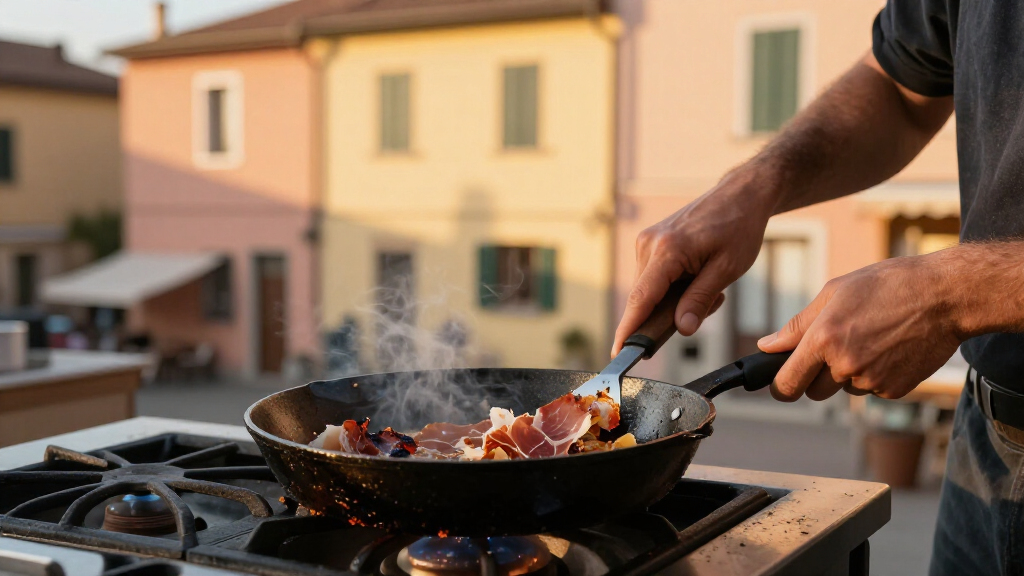
What to Serve With It and What to Pour
Keep the sides quiet. Saltimbocca is rich and savory, and it wants starch or green vegetables, not competition. In Rome you’ll typically find it beside patate al forno (roasted potatoes), simply sautéed spinach, or a bitter green like escarole to cut the butter.
My favorite pairing is soft polenta — it drinks up every drop of the pan sauce, acting as an edible mop. Buttered rice works too. Avoid pasta as a side dish; serving two starch-heavy courses back to back is a tourist tell, and the dish deserves better framing.
For wine, stay regional. Frascati Superiore DOCG, from the hills just southeast of Rome, is the historical match — crisp, subtly floral, and made for this food. Verdicchio from Le Marche or a light, unoaked Chardonnay also works. If you prefer red, a young Montepulciano d’Abruzzo has enough acidity to keep pace.
- Classic sides: roasted potatoes, sautéed spinach, escarole, soft polenta
- Classic wines: Frascati Superiore DOCG, Verdicchio, Montepulciano d’Abruzzo
- Allergen note: the dish contains dairy (butter) and sometimes wheat (a light flouring); use cornstarch for a gluten-free version
Wine note, of course: alcoholic pairings are for adults, and the quarter-glass that goes into the sauce mostly cooks off but not entirely — worth knowing if you’re cooking for anyone avoiding alcohol. Substitute chicken stock with a squeeze of lemon.
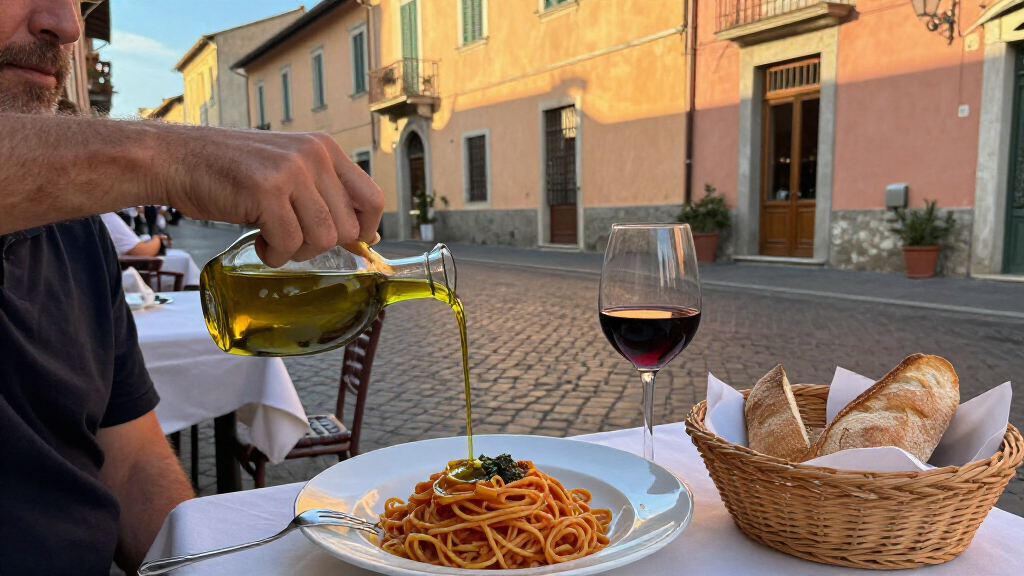
Eating It Where It Was Born: A Roman Trattoria Shortlist
If a Rome trip is on your calendar, saltimbocca is a reliable litmus test for a trattoria. A kitchen that nails this dish — veal thin enough to cut with a fork, prosciutto crisp at the edges, sauce glossy not greasy — will likely nail everything else too. Think of it as the Roman equivalent of ordering roast chicken in a French bistro: simple enough that there’s nowhere to hide.
The neighborhoods to target are Testaccio, the old slaughterhouse district and spiritual home of Roman working-class cooking, and Trastevere, where you should walk two blocks past the tourist front line to find the rooms full of locals. In Testaccio, Flavio al Velavevodetto — built into the old Monte dei Cocci amphora mound — serves a saltimbocca with cutlets so thin they seem translucent, and Checco er Carettiere, a Trastevere institution on Via Benedetta since 1936, does a version finished with a muscular hit of white wine in the sauce. Near Campo de’ Fiori, Da Enzo al 29 in Trastevere’s back streets is the small-room archetype: eight tables, chalkboard menu, and a saltimbocca that arrives sizzling.
Order saltimbocca as your secondo (main course) after a pasta course, the way Romans sequence a meal. A typical Roman lunch looks like this: a plate of cacio e pepe first, then the saltimbocca with roasted potatoes, a carafe of house Frascati, and an espresso to finish. Ordering the saltimbocca as a solo starter with a cocktail would earn you a polite raised eyebrow — the courses exist for a reason.
Season matters less than you’d think — the dish appears year-round — but autumn is lovely, when new-vintage Frascati arrives and sage is at its most fragrant in the markets at Campo de’ Fiori. That market is also where you can buy the components yourself: the prosciutto stand near the southwest corner will hand-slice Parma DOP to whatever thickness you ask, the butcher a few stalls down cuts scaloppine to order while you wait, and bundles of fresh sage go for under a euro.
A practical itinerary: shop Campo de’ Fiori at 9 a.m. before the tour groups arrive, lunch at 1 p.m. in Testaccio, and if the weather holds, walk off lunch along the Tiber toward the Aventine hill for the view from the Giardino degli Aranci. Rome rewards the unhurried, and so does this dish.
Frequently Asked Questions
What is the best cut of veal for saltimbocca?
Thinly sliced veal scaloppine from the top round or leg is ideal — cut about a quarter inch thick, then pounded to an eighth of an inch. The thinness is what lets the meat cook in under two minutes per side while staying tender. Ask your butcher to cut it for you; slicing it evenly at home is genuinely difficult without a deli slicer.
Can I make saltimbocca without veal?
Yes. Chicken breast cutlets and pork loin cutlets are the standard substitutes, and the technique transfers without changes — pound thin, layer with prosciutto and sage, sear, sauce. Cook chicken to an internal temperature of 165°F (74°C). Turkey cutlets work too. What you shouldn’t substitute is the prosciutto or the fresh sage; those define the dish.
How do I keep the prosciutto from burning?
Cook over medium heat, never high, and start the cutlets prosciutto-side down so the ham crisps while the veal cooks through. Add a little olive oil to the butter to raise its smoke point. If the prosciutto is browning too fast, lift the pan off the burner for thirty seconds — cured ham goes from amber to burnt in under a minute.
What wine should I cook with and drink alongside?
Cook with a dry Italian white — Frascati is the Roman choice, and Verdicchio is a fine alternative. The rule is simply: don’t cook with anything you wouldn’t drink. Pour the same bottle at the table. For a sweeter, nuttier sauce, some cooks use Marsala instead. Alcohol in the sauce partially cooks off but not fully; offer a non-alcoholic option for guests who avoid it.
Can I assemble saltimbocca ahead of time?
Yes — assemble the veal, sage, prosciutto, and toothpicks up to a day ahead and refrigerate, covered. Cook just before serving, because reheated saltimbocca turns tough and the butter sauce breaks. The assembled cutlets also freeze well for up to a month; thaw fully in the refrigerator before cooking.
Is there a vegetarian version of saltimbocca?
Non-traditional versions exist using eggplant or large zucchini rounds in place of veal, topped with prosciutto and sage and cooked the same way — or with a smoked cheese standing in for the ham to keep it meatless. They can be delicious, but they’re adaptations, not saltimbocca in the Roman sense. The dish’s identity rests on veal, prosciutto, and sage together.
Conclusion
Cook saltimbocca once and you’ll understand why Rome built a cuisine on this kind of restraint. Four ingredients, twenty minutes, and a plate that tastes like a trattoria on a Tuesday night in Testaccio. The only non-negotiables: real prosciutto, fresh sage, and moderate heat.
The name told you everything before you took a bite. Make it this week and see if the dish doesn’t live up to it — if the flavor doesn’t, in fact, jump.
Fall Picks
fall essentials
As an affiliate, we earn on qualifying purchases.