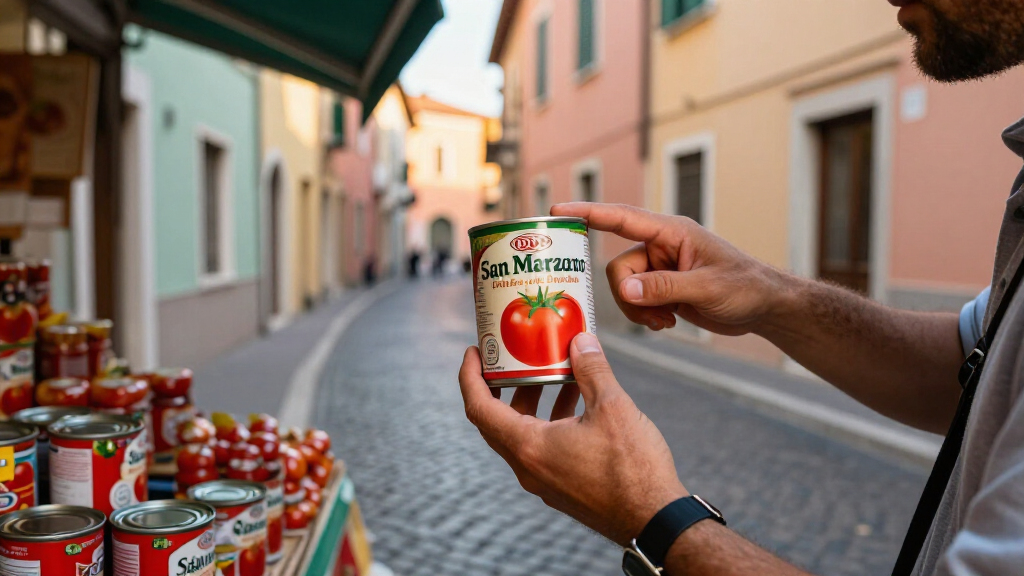
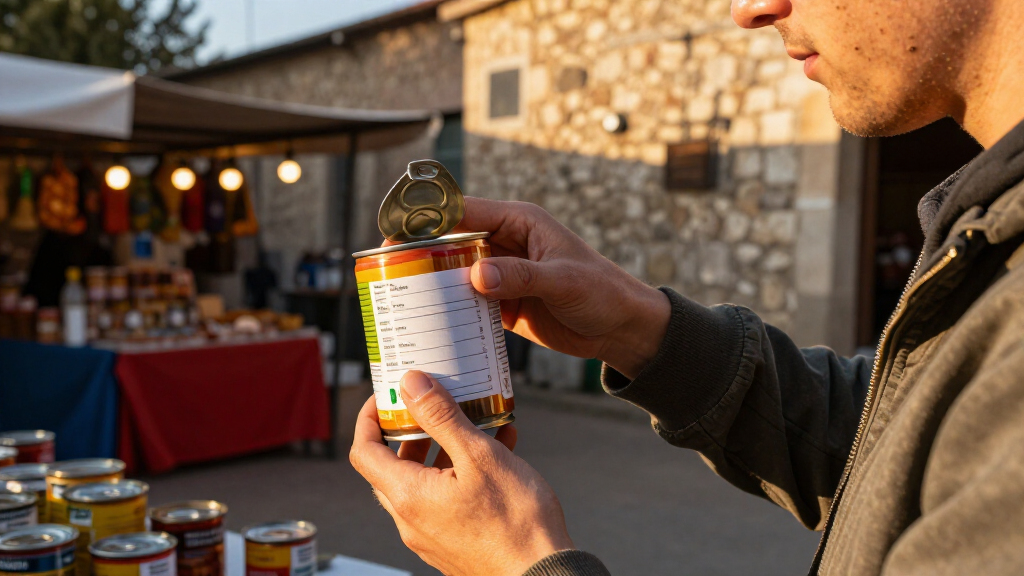
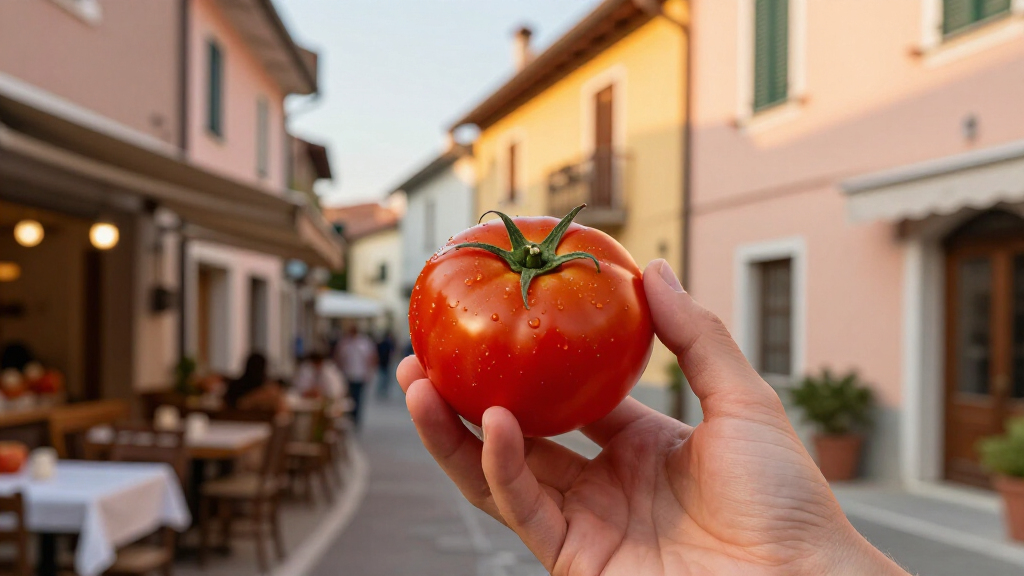
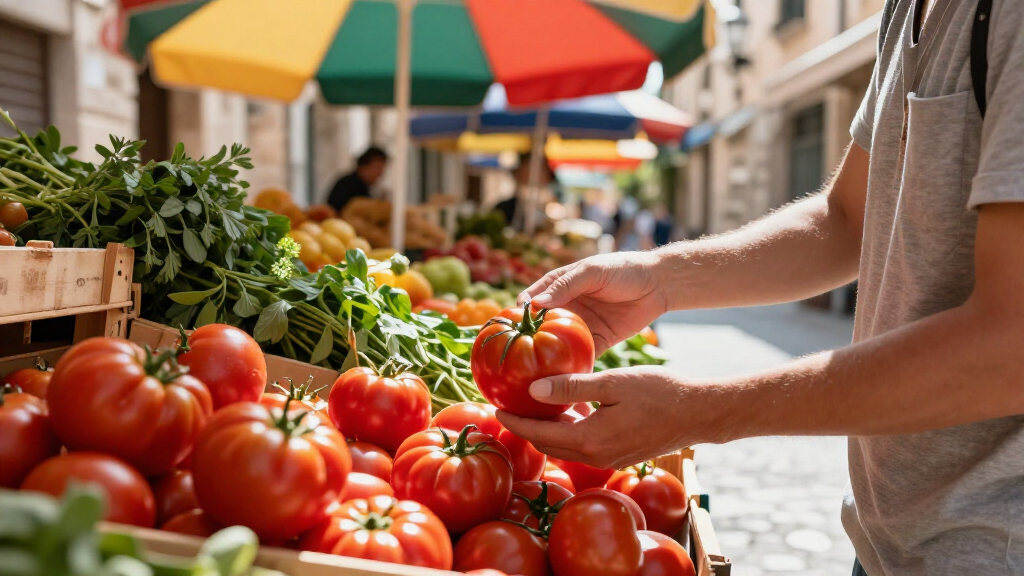
Real San Marzano tomatoes carry the complete name Pomodoro San Marzano dell’Agro Sarnese-Nocerino DOP, the red-and-yellow EU DOP or PDO symbol, Italian origin information, and supporting certification details. Check the physical can rather than trusting a retailer title, premium price, Italian flag, or the words “San Marzano” printed alone.
A can can look thoroughly Italian and still contain no protected San Marzano tomatoes. A painted Mount Vesuvius, a green-white-red ribbon, and the words “Product of Italy” create a convincing little stage set. None of those details, alone or together, proves that you are holding real San Marzano tomatoes from the protected production zone in Campania.
The confusion begins with the name itself. “San Marzano” can mean either a tomato variety grown almost anywhere or Pomodoro San Marzano dell’Agro Sarnese-Nocerino DOP, a regulated product tied to designated areas near Naples and Salerno. It is rather like the difference between a grape variety and a protected wine appellation: the plant matters, but place, production rules, and traceability complete the identity.
You do not need to memorize brands or become an Italian-label detective. You need a repeatable check that works in a grocery aisle, an Italian market, or an online shop whose product title may be looser than the label. This guide shows you what to read, which logo to find, what claims to ignore, and when DOP is worth paying for, so the tomatoes you buy match both your expectations and the dish simmering on your stove.
At a glance
Real San Marzano Tomatoes: Spot Genuine DOP Cans
Key insight
“San Marzano” can mean either a tomato variety grown almost anywhere or the protected Campanian product; only Pomodoro San Marzano dell’Agro Sarnese-Nocerino DOP certifies the regulated origin and pr…
Key takeaways
1
Look for the exact name Pomodoro San Marzano dell’Agro Sarnese-Nocerino DOP; “San Marzano,” “style,” and “type” alone do not establish protected status.
2
Confirm the red-and-yellow EU DOP or PDO logo, Italian origin, certification information, and a peeled whole or permitted fillet-style presentation.
3
Ignore shortcuts such as a high price, Italian flag, Vesuvius illustration, barcode prefix, basil leaf, or “Product of Italy” claim.
4
Pay the DOP premium when tomatoes lead the dish, but consider a good non-DOP whole peeled tomato for long-cooked, strongly seasoned, or large-batch recipes.
5
Check the current physical package and official EU records instead of relying on retailer titles or old brand lists.
Step by step
1
Use This Four-Step Label Check Before the Can Reaches Your Cart
Real San Marzano tomatoes reveal themselves through four matching label details: the complete protected name , the red-and-yellow EU DOP or…
Real San Marzano Tomatoes: How to Spot the Genuine DOP Cans
DOP
Grocery aisle field guide
Real San Marzano Tomatoes: Spot the Genuine DOP Cans
A flag, Mount Vesuvius, a premium price, or “Product of Italy” can create a convincing stage set. Genuine status comes from a matching chain of protected-name, origin, certification, and product-form evidence on the physical can.
01
Read the complete protected name
Pomodoro San Marzano dell’Agro Sarnese-Nocerino DOP
02
Find the red-and-yellow emblem
DOP in Italian and PDO in English refer to the EU Protected Designation of Origin category.
03
Check the quiet details
Italian origin, authorized control information, traceability, and a permitted peeled presentation should agree.
4Core label checks
1Protected identity
2Meanings of “San Marzano”
0Shortcuts that prove DOP
The four-step can check
Proof works as a system
Do not treat one logo, slogan, sticker, or serial number as a magic test. Genuine DOP cans present a coherent set of details that points to the regulated Campanian product.
01Identity
Read every word
Look for Pomodoro San Marzano dell’Agro Sarnese-Nocerino DOP. “San Marzano,” “style,” “type,” or “Italian-style” alone describes a variety or approach—not protected status.
Exact wording matters02EU designation
Find DOP or PDO
Confirm the red-and-yellow EU Protected Designation of Origin symbol. Do not confuse it with the blue-and-yellow IGP or PGI category.
Red + yellow category03Control trail
Verify origin and oversight
The package should identify Italy and provide an authorized certification or control reference, supported by practical traceability details such as a lot code.
Origin + certification04Product form
Match the presentation
Expect peeled whole tomatoes or a permitted fillet-style form, commonly packed in tomato juice or purée. Treat diced, crushed, flavored, or sauced claims with extra care.
Whole or permitted fillets
🌱Approved tomato type
📍Defined Campanian area
🧺Regulated harvest
🏭Compliant processing
🔎Certified traceability
Evidence versus theater
What the label detail really tells you
Packaging can suggest Italy without establishing the protected identity. The strongest result comes when the complete designation and certification trail agree.
Label detail
What it tells you
DOP value
Complete protected Italian name
Claims the regulated product from the designated Agro Sarnese-Nocerino area.
✓ Strong
Red-and-yellow EU DOP/PDO symbol
Identifies the Protected Designation of Origin category.
✓ Required
Control organization and lot details
Supports certification, oversight, and traceability.
~ Support
“San Marzano” alone
May name a tomato variety grown outside the protected production zone.
✗ No
“Product of Italy”
States an Italian connection under applicable labeling rules.
✗ No
Premium price or imported status
Reflects positioning, supply, transport, or retailer margin.
✗ No
×Italian flag artwork
×Mount Vesuvius image
×Volcanic-soil claim
×Italian barcode prefix
×Basil leaf illustration
×Retailer “DOP” title
Variety is not appellation
“San Marzano” has two valid uses. It can refer to a tomato variety grown almost anywhere, or to the protected Italian product whose place, specification, processing, and traceability are regulated.
San MarzanoVariety or description
VS
Full DOP nameProtected identity
Value on the stove
When the DOP premium earns its place
DOP tomatoes are typically elongated, meaty, relatively low in seeds, tender, and easy to crush. Their balanced sweetness matters most when the tomato remains clearly visible in the finished dish.
Choose genuine DOP
Best when a short ingredient list and light cooking allow the tomato’s texture and balance to lead.
Pizza sauce96
Quick sugo91
Tomato soup77
Choose a good non-DOP can
A quality whole peeled tomato can be the smarter value when long cooking or strong seasoning softens origin-specific differences.
Long braise93
Spiced stew89
Large batch97
Decision 01
Does tomato lead?
Pay closer attention to DOP when tomato flavor and texture define the dish.
Decision 02
Can you see the can?
Inspect every label panel. Online product titles and cropped images are secondary evidence.
Decision 03
Do all signs match?
Name, emblem, Italian origin, control trail, and product form should tell one story.
Decision 04
Still uncertain?
Request current package photographs and check the official EU geographical-indication record.
The can is the evidence. Not the costume.
Buy the regulated identity, not the atmosphere. The complete protected name is the starting point; the EU symbol, origin, certification trail, and permitted product form complete the check.
A non-DOP San Marzano-type tomato may still be honest and delicious. It simply should not be mistaken for Pomodoro San Marzano dell’Agro Sarnese-Nocerino DOP.
The Full Protected Name Tells You What the Can Actually Contains
Real San Marzano tomatoes are the protected product called Pomodoro San Marzano dell’Agro Sarnese-Nocerino DOP, not every tomato carrying the shorter varietal name. DOP means Denominazione di Origine Protetta, or Protected Designation of Origin, and links the tomatoes to an official place, specification, and control system.
The protected area lies in Campania, across qualifying parts of the Agro Sarnese-Nocerino territory near Naples and Salerno. It is broader than the town of San Marzano sul Sarno, so a genuine tomato does not need to come from that town alone. The official specification governs approved tomato types, cultivation, harvesting, processing, physical characteristics, and traceability [2].
Campania’s warm summers and volcanic-influenced soils help shape the fruit, but geography alone does not grant DOP status. A farmer cannot grow the right variety near Vesuvius, place it in a handsome can, and skip the rest of the rules. Think of the specification as a railway line: seed type, field, harvest, processor, and certification all have to stay on the same track.
Here is a common grocery-store scenario. One can says “San Marzano Style Tomatoes” in letters tall enough to read from five feet away; another uses smaller type for the complete protected Italian name. The first may hold perfectly good tomatoes, but “style” describes an approach. The second makes a regulated identity claim that you can check against the EU geographical-indication record [1].
The short name identifies a variety or style. The complete protected name, backed by certification, identifies the DOP product.
Use This Four-Step Label Check Before the Can Reaches Your Cart
Real San Marzano tomatoes reveal themselves through four matching label details: the complete protected name, the red-and-yellow EU DOP or PDO logo, Italian origin with certification information, and a permitted peeled presentation. No single sticker, serial number, slogan, or decorative image replaces this combined check.
Read the complete name. Find Pomodoro San Marzano dell’Agro Sarnese-Nocerino DOP. Large “San Marzano” lettering without the rest of the designation is not enough.
Find the red-and-yellow EU symbol. The DOP or PDO emblem is red and yellow. Do not confuse it with the blue-and-yellow IGP or PGI symbol, which represents a different geographical-indication category.
Check origin and control details. Look for Italy as the origin, plus a reference to an authorized control or certification organization and useful traceability information such as a lot code.
Match the product form. Expect peeled whole tomatoes or a permitted fillet-style presentation, commonly packed in tomato juice or purée. Treat diced, flavored, crushed, or ready-made sauce claims with extra care.
Suppose you are shopping for Friday-night pizza and find two nearly identical red cans. One has an Italian flag and “Imported” across the front; the other carries the full protected name, the DOP symbol, and control information in smaller print on the back. Turn both cans around. That quiet block of regulated language carries more weight than the louder artwork.
Online shopping adds another wrinkle because sellers sometimes crop the label, reuse an old photograph, or place “DOP” in a title that does not match the physical package. Before ordering a case, look for clear images of every label panel. If the listing hides the complete designation or certification details, ask the seller for current photographs rather than relying on an “authentic” badge.
QR codes and digital traceability tools can support your check, especially as packaging changes. Still, a QR code is like a doorbell: its presence tells you little until you see who answers. Start with the protected name and official emblem, then use digital information to confirm the producer, lot, and control trail.
This Comparison Separates DOP Proof From Clever Packaging
Real San Marzano tomatoes depend on regulated evidence, while ordinary varietal or style cans depend only on an accurate description of their contents. A flag, premium price, barcode, or Vesuvius illustration may suggest Italy, but only a coherent set of DOP details supports the protected identity.
Label detail
What it tells you
Does it prove DOP status?
Complete protected Italian name
Claims the regulated Campanian product
Strong evidence when matched with certification
Red-and-yellow EU DOP/PDO logo
Identifies the protected designation category
Required supporting sign
“San Marzano” alone
Can mean either the variety or a descriptive name
No
“Product of Italy”
States an Italian connection under applicable labeling rules
No
“Grown in volcanic soil”
Makes a geographical or farming claim
No
Italian barcode prefix
May identify where a company registered its barcode
No
High price or premium retailer
Reflects positioning, supply, or import costs
No
The contrast becomes clear when you imagine a can labeled “California-Grown San Marzano Tomatoes.” The producer may have cultivated a tomato variety with San Marzano characteristics, and the description may be honest. Those tomatoes are simply outside the protected Italian production system, so they cannot become Pomodoro San Marzano dell’Agro Sarnese-Nocerino DOP.
Likewise, “Product of Italy” does not close the case. Italy produces many excellent canned tomatoes across Campania, Puglia, Emilia-Romagna, and other regions. Italian origin answers one question, while DOP answers a narrower set of questions about the protected zone, approved production methods, controls, and traceability.
Price can mislead you in both directions. Genuine DOP cans usually cost more because restricted production, processing rules, certification, and import expenses add up. Yet a costly gift-shop can may still trade mainly on romantic artwork and scarcity cues, while a plainly designed DOP can may sit quietly on the bottom shelf.
Marketing creates a mood; certification creates a traceable claim. Read the legal name before you read the scenery.
The Tomato’s Shape and Texture Give You a Useful Second Check
Genuine DOP cans typically contain elongated, peeled tomatoes with meaty flesh, relatively few seeds, and a tender texture that yields under your fingers. Their flavor tends to feel sweet and balanced, with moderate acidity, though appearance and taste support the label check rather than replacing certification.
Open a can over a wide bowl and notice the sound: a soft slide rather than the rattle of hard, under-ripe fruit. A typical tomato feels supple enough to split with your thumb, releasing dense scarlet flesh and a modest pocket of juice. For pizza, that texture lets you hand-crush the fruit into uneven pieces that melt across the dough without flooding it.
Contrast that with a heavily firmed canned plum tomato. It may keep a neat shape through shipping, but it can bounce beneath a wooden spoon and break into rubbery cubes rather than a silky pulp. That difference matters in pasta al pomodoro, where the sauce has few places to hide: tomatoes, olive oil, garlic or onion, salt, and perhaps basil.
Natural agricultural variation still exists. One harvest may taste brighter; another may lean sweeter, and packing liquid can change the way a particular can behaves. DOP is an origin and production guarantee, not a promise that every can tastes identical or defeats every non-DOP tomato in a blind tasting.
The ingredient list offers another supporting clue. You will commonly see peeled tomatoes, tomato juice or purée, and perhaps salt or a permitted acidity regulator. Basil is not automatic evidence of fraud, and the absence of calcium chloride does not prove DOP status; check the actual label instead of leaning on either shortcut.
If a can claims that diced tomatoes, spicy sauce, or concentrated purée is itself DOP San Marzano, pause. A sauce can truthfully say it was made with DOP tomatoes without making the finished sauce a DOP-certified product. The distinction resembles a wool sweater made with protected-origin fiber: the ingredient keeps its story, but the finished object does not automatically inherit the same certification.
Spend More on DOP When the Tomato Has Nowhere to Hide
Choose real San Marzano tomatoes when the dish places tomato flavor and texture at center stage, especially Neapolitan-style pizza, quick tomato sauce, and pasta al pomodoro. Choose a good non-DOP whole peeled tomato when long cooking, strong seasoning, quantity, or budget will soften the difference.
For a simple pizza inspired by Naples, every ingredient speaks at full volume. You may use only crushed tomatoes, dough, mozzarella, basil, olive oil, and salt. A tomato that is sweet, meaty, and not excessively watery gives you a sauce that clings like red velvet rather than soaking the center into a pale, floppy patch.
A fast weeknight sauce offers the same logic. Warm olive oil with a lightly crushed garlic clove, add hand-crushed tomatoes, and simmer for roughly 15 to 20 minutes. When the ingredient list is that short, the DOP tomato’s soft texture and balanced acidity can remain recognizable from the first fragrant hiss to the last streak left in your bowl.
Now imagine a large beef ragù simmering for three hours with wine, meat, soffritto, herbs, and stock. DOP tomatoes will work, but their finer differences share the stage with a crowded cast. A reliable non-DOP whole peeled tomato may give you an equally satisfying result at a lower cost, especially when you need four or six cans.
Worth the premium: pizza, marinara, pasta al pomodoro, tomato soup with minimal seasoning, or side-by-side tastings.
Good place to economize: long braises, chili-like dishes, heavily spiced sauces, large-batch cooking, or recipes where tomato plays a supporting role.
Best budget strategy: compare whole peeled tomatoes for flavor, seed content, texture, and packing liquid rather than choosing by designation alone.
Taste still gets the final vote. Excellent Italian tomatoes with other designations, or none at all, can outperform a mediocre can from a less expressive harvest. DOP works like a verified address, not a restaurant score: it tells you where the product belongs and how it was made, while your recipe and palate decide whether it earns a return visit.
Once opened, move unused tomatoes and juice into a clean covered glass or food-safe container rather than leaving them in the can. Refrigerate them promptly at 40°F or colder and use them within about 3 to 4 days, or freeze portions for later sauce. Discard tomatoes that develop mold, an off smell, bubbling unrelated to heating, or a swollen or leaking unopened can.
A Current Label Beats Any Old List of Approved Brands
The physical label on the can is your best current evidence because brands, importers, packaging, certification references, and online listings can change. Use official records and producer information to confirm what you see, but do not treat an old blog list or familiar brand name as permanent proof of DOP status.
Suppose a friend sends you a five-year-old “approved brands” screenshot before you visit an Italian grocery in Boston. The brand may now sell several lines: one genuine DOP product, one organic Italian plum tomato, and one domestically grown San Marzano variety. The name on the front cannot tell those lines apart; the complete designation and certification details can.
Start with the European Union’s official geographical-indication database, which records the protected name Pomodoro San Marzano dell’Agro Sarnese-Nocerino [1]. You can also compare the producer, packer, protected name, and control references with information from the relevant certification body or protection consortium. Treat a retailer description as a signpost, not the destination.
Modern lot codes, QR codes, tamper-resistant marks, and digital traceability pages can help you follow a can back through the supply chain. Their formats vary among producers, so there is no universal bottom-can code that lets every shopper declare a can real or fake in five seconds. A code supports a coherent label; it does not repair a missing protected name.
Legal language also deserves care. Tomatoes grown outside the DOP zone are not automatically counterfeit simply because the cultivar is known as San Marzano. Problems arise when packaging falsely claims the protected DOP identity, copies protected labeling, or misleads shoppers about geographical origin under the rules of the market where it is sold.
When you face an uncertain can, take photographs of the front, back, ingredients, origin statement, EU logo, and lot information. That gives a producer, importer, retailer, or certification organization something concrete to examine. It also turns a vague question—“Is this real?”—into a useful one: “Does this current package carry the complete protected designation and valid control details?”
Frequently Asked Questions
Are all San Marzano tomatoes DOP?
No. San Marzano is also a tomato variety grown almost anywhere, including the United States and other parts of Italy. Only tomatoes meeting the protected specification and carrying the complete name Pomodoro San Marzano dell’Agro Sarnese-Nocerino DOP qualify as the DOP product.
Does “Product of Italy” prove that a can contains genuine DOP tomatoes?
No. “Product of Italy” provides origin information under applicable labeling rules, but it does not prove the protected San Marzano production system. Look for the complete protected name, EU DOP symbol, certification details, and appropriate product form.
Can crushed or diced tomatoes be San Marzano DOP?
The protected product is associated chiefly with regulated peeled presentations, including whole tomatoes and permitted fillet-style forms. A crushed product or sauce may say it was made with DOP tomatoes, but that wording does not automatically make the finished product DOP-certified.
Is DOP the same as organic certification?
No. DOP protects a product’s geographical identity and regulated production system, while organic certification addresses farming inputs and related agricultural standards. A can can be DOP, organic, both, or neither, so look for each certification separately.
Are genuine DOP San Marzano tomatoes always better?
Not for every cook or recipe. DOP provides confidence about origin, identity, and production rules, but harvest quality, packing liquid, storage, and personal taste still shape the result. In a three-hour braise, a good non-DOP whole peeled tomato may perform just as well and cost less.
Does basil or calcium chloride reveal whether a can is genuine?
Neither ingredient provides a reliable authenticity test. Basil may appear in some commercial packs, while many cooks prefer tomatoes without firming agents because they crush more easily. Read the full ingredient list, but base your DOP check on the protected name, official logo, origin, and certification trail.
What is the fastest way to check a can in the store?
Confirm four things: the exact protected Italian name, the red-and-yellow EU DOP or PDO logo, Italian origin with control details, and a peeled product form consistent with the specification. If the can offers only large “San Marzano” lettering and rustic Italian artwork, treat it as a varietal or style product.
Conclusion
Read the legal name before you buy the Italian story. The most reliable can pairs Pomodoro San Marzano dell’Agro Sarnese-Nocerino DOP with the red-and-yellow EU symbol, Italian origin, credible control details, and the right peeled presentation. If those pieces do not line up, treat “San Marzano” as a variety or style claim and judge the tomatoes on flavor, texture, price, and usefulness.
Then choose the can for the dish in front of you. Save DOP tomatoes for the pizza whose sauce meets the heat almost naked, or the quick pomodoro that perfumes your kitchen with sweet red fruit and olive oil. Four careful label checks can carry that Campanian identity from a crowded grocery shelf to the center of your plate.
A new sandwich featuring goat cheese, fresh tomatoes, and prosciutto crudo is gaining popularity among food enthusiasts. Details on ingredients and availability inside.