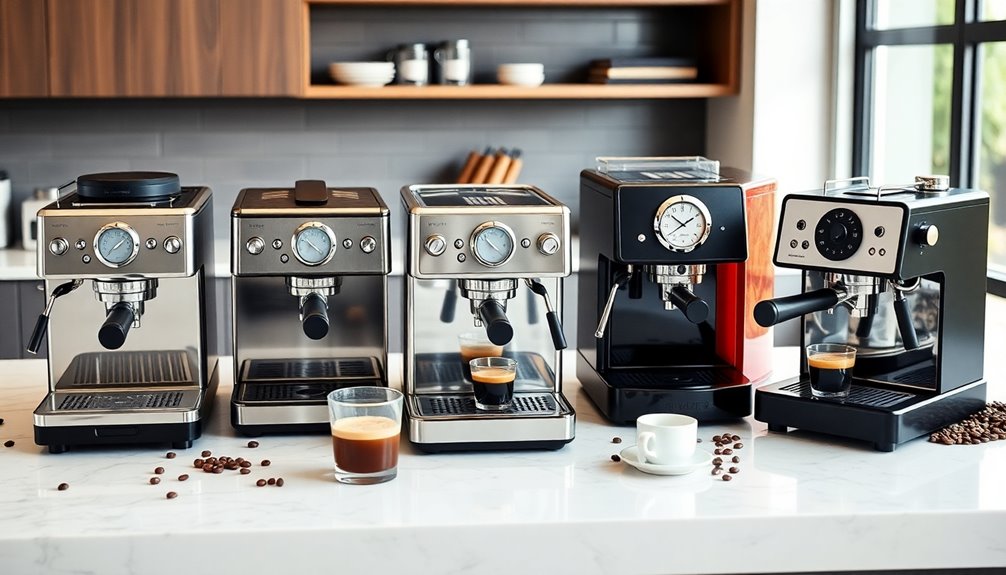

When people ask what the espresso machine brands are, they are usually trying to find a machine style and maker that match their routine. My best overall pick is the Breville Bambino for buyers who want hands-on espresso in a compact form; the De’Longhi Magnifica Duo stands out for automatic drinks, while the Nespresso Vertuo Up keeps preparation simple with capsules. The main tradeoff is control versus convenience: manual machines ask for more skill and cleanup, while automatic and capsule models limit some choices in exchange for easier drinks. I compare these 10 options by brewing approach, milk handling, usability, upkeep, and versatility. Read on for the full breakdown and help matching a machine to your needs.

Get kitchen staples and gadgets delivered free with Prime
- Fast, free delivery on millions of items
- Prime Video, Amazon Music and more included
- Member-only deals all year
Key Takeaways
- Breville’s Bambino and Barista Express suit different hands-on buyers: the Bambino keeps the setup compact, while the Barista Express adds an integrated grinder and more control at the cost of extra steps.
- De’Longhi covers several levels of convenience: its Classic models are manual, while the Magnifica Duo automates more of the drink-making process.
- The Nespresso Vertuo Up prioritizes ease over open-ended brewing: capsules reduce preparation work, but tie the buyer to a capsule-based system.
- Milk options vary as much as brewing styles: automatic milk systems reduce hands-on frothing, while manual frothers offer more direct control and practice.
- Compact and budget-minded machines involve different compromises: the IMUSA and CHULUX focus on accessible, space-conscious use, while premium fully automatic models offer broader drink choices and more automation.
| IMUSA Electric Espresso Cappuccino Maker 4-Cup Capacity with Milk Frother, Black |  | Best for Small-Batch Sharing | Capacity: 4 cups | Color: Black | Operation voltage: 120V | VIEW ON AMAZON | See Our Full Breakdown |
| De’Longhi Classic Matte Black Espresso Machine with Milk Frother |  | Best for Guided Espresso and Milk Drinks | Pressure: 9 bar | Frother: Steam wand with adjustable settings | Design: Matte black stainless steel | VIEW ON AMAZON | See Our Full Breakdown |
| CHULUX Slim Espresso Machine with Milk Frother, 20 Bar Professional Italian Pump, Stainless Steel, Silver |  | Best Compact Ground-Coffee Machine | Pump pressure: 20 bar | Power: 1350 watts | Material: Food-grade stainless steel | VIEW ON AMAZON | See Our Full Breakdown |
| SHARDOR 20 Bar Espresso Machine with Milk Frother and Touchscreen |  | Best for Touchscreen Customization | Pressure: 20 bar | Power: 1350W | Water tank capacity: 45 oz | VIEW ON AMAZON | See Our Full Breakdown |
| Nespresso Vertuo Up Coffee and Espresso Maker by DeLonghi |  | Best for Capsule Convenience and Multiple Cup Sizes | Cup sizes: 5, 8, 12, and 18 oz; single and double espresso | Water tank capacity: 47 oz | Start-up time: 3 seconds | VIEW ON AMAZON | See Our Full Breakdown |
| De’Longhi Magnifica Duo Fully Automatic Espresso Machine with Milk Frother, Silver |  | Best for One-Touch Drink Variety | Model: ECAM33080SXB | Machine type: Fully automatic espresso machine | Drink recipes: 20 preset hot and iced recipes | VIEW ON AMAZON | See Our Full Breakdown |
| Breville Bambino Espresso Machine, Brushed Stainless Steel |  | Best Compact Semi-Automatic | Operation mode: Semi-automatic | Heating system: ThermoJet | Heat-up time: 3 seconds | VIEW ON AMAZON | See Our Full Breakdown |
| De’Longhi Classic Signature Espresso Machine with Adjustable Milk Frother |  | Best Simple Ground-Coffee Pick | Coffee maker type: Espresso machine | Pump pressure: 15 bar | Operation mode: Fully automatic | VIEW ON AMAZON | See Our Full Breakdown |
| Breville Barista Express Manual Espresso Machine with Built-In Grinder |  | Best for Hands-On Home Baristas | Machine type: Manual espresso machine | Grinder: Integrated precision conical burr grinder | Water tank capacity: 67 ounces | VIEW ON AMAZON | See Our Full Breakdown |
| KitchenAid Fully Automatic Espresso Machine KF3 with 15+ Hot and Iced Coffee Options, Built-In Grinder, Auto Milk System, Black Matte |  | Best Compact Automatic Option | Model: KES8453 | Machine type: Fully automatic espresso machine | Drink options: Over 15 hot and iced coffee options | VIEW ON AMAZON | See Our Full Breakdown |
| what are theespresso machine brand | Water tank capacity |
|---|---|
| IMUSA Electric Espresso Cappuc | — |
| De’Longhi Classic Matte Black | — |
| CHULUX Slim Espresso Machine w | 40 oz |
| SHARDOR 20 Bar Espresso Machin | 45 oz |
| Nespresso Vertuo Up Coffee and | 47 oz |
| De’Longhi Magnifica Duo Fully | — |
| Breville Bambino Espresso Mach | — |
| De’Longhi Classic Signature Es | — |
| Breville Barista Express Manua | 67 ounces |
| KitchenAid Fully Automatic Esp | 1.8 liters |
More Details on Our Top Picks
IMUSA Electric Espresso Cappuccino Maker 4-Cup Capacity with Milk Frother, Black
The IMUSA suits households that want a straightforward way to make several small servings at once. Its four-cup capacity and included milk frother cover basic espresso-style drinks without the more involved controls found on the De’Longhi Classic or SHARDOR touchscreen machine. A removable drip tray and permanent filter basket also keep routine cleanup simple. The tradeoff is a less flexible brewing setup: there are no advanced settings, and the plastic body feels less substantial than the stainless-steel construction on the CHULUX Slim or SHARDOR. Its four-cup limit is useful for sharing, but less suited to repeated rounds for a group. I’d choose it for uncomplicated home use, not for dialing in espresso or building a more hands-on coffee routine.
Pros:- Brews up to four cups in one batch for sharing
- Includes a milk frother for cappuccinos and lattes
- Removable drip tray simplifies cleanup
- Permanent filter basket avoids disposable filters
Cons:- Four-cup capacity may not cover larger groups or repeated servings
- Plastic exterior is less substantial than the stainless-steel CHULUX and SHARDOR
- No advanced brewing options for adjusting drinks
Best for: Households that want to prepare a few small espresso-style servings together and value a simple setup over adjustable brewing.
Not ideal for: Espresso hobbyists seeking control over extraction, or buyers who want a metal-bodied machine with more durable-feeling construction.
- Capacity:4 cups
- Color:Black
- Operation voltage:120V
- Material:Plastic
- Milk frother:Included
- Filter:Permanent filter basket
- Drip tray:Removable
Our verdict“Choose the IMUSA for simple, small-batch drinks at home, but pick the De’Longhi Classic or SHARDOR if you want more brewing control.”
De’Longhi Classic Matte Black Espresso Machine with Milk Frother
The De’Longhi Classic is a strong fit for buyers who want a traditional espresso-machine workflow without a long list of settings. Its single- and double-shot presets give everyday brewing a clear starting point, while Thermoblock temperature control is designed to bring the machine up to temperature quickly. Compared with the touchscreen SHARDOR, the De’Longhi offers a more straightforward control scheme; compared with the IMUSA, it gives buyers specified pressure and temperature features rather than a basic batch-oriented setup. The adjustable steam wand adds room to practice milk texture, but it still requires technique, and there is no built-in grinder. That means buyers need ground coffee or a separate grinder. I’d favor it for a compact, repeatable espresso routine, not for someone seeking an all-in-one machine or automatic milk preparation.
Pros:- Single- and double-espresso presets make routine brewing simpler
- Thermoblock temperature control is designed for fast heat-up
- Adjustable steam wand supports different milk-frothing approaches
- Matte black stainless-steel design offers a compact alternative to bulkier setups
Cons:- No built-in grinder, so coffee must be ground separately
- Milk frothing takes practice
- Functions are focused on espresso and milk drinks rather than broader coffee styles
Best for: Home espresso drinkers who want preset single and double shots, a steam wand, and a compact machine without touchscreen-heavy controls.
Not ideal for: Buyers who want an integrated grinder, automatic milk frothing, or a machine that makes drinks without learning steam-wand technique.
- Pressure:9 bar
- Frother:Steam wand with adjustable settings
- Design:Matte black stainless steel
- Temperature control:Thermoblock technology
- Preset recipes:Single and double espresso
- Adjustable tray:Yes
Our verdict“Pick the De’Longhi Classic for a compact, guided espresso-and-steaming routine, and choose the SHARDOR if touchscreen customization matters more.”
CHULUX Slim Espresso Machine with Milk Frother, 20 Bar Professional Italian Pump, Stainless Steel, Silver
At 5.5 inches wide, the CHULUX Slim is the space-conscious choice in this group for buyers who still want a steam wand and hands-on espresso preparation. Its 40-ounce tank and 1350-watt power rating support home or office use, while the pressure gauge and pre-infusion offer more visible brewing cues than the basic IMUSA. The SHARDOR also provides a 20-bar pump and milk frother, but adds a touchscreen and adjustable temperature; CHULUX keeps the setup narrower and simpler instead. That compact footprint comes with limits: it uses ground coffee only, and its auto shut-off may interrupt a longer session if the machine sits idle. The listed tank capacity is useful, though frequent drink-makers may still need to refill it. I’d pick it where counter width is scarce, not for capsule convenience or extensive customization.
Pros:- 5.5-inch width fits tight counter spaces
- 1350-watt power and quick heat-up support convenient home use
- Pressure gauge and pre-infusion provide useful brewing cues
- Steam wand lets users make milk-based drinks
Cons:- Accepts ground coffee rather than pods
- Auto shut-off after 25 minutes may interrupt longer sessions
- Water tank may require frequent refilling for heavier use
Best for: Apartment dwellers or office users with narrow counters who want a compact ground-coffee machine with a steam wand.
Not ideal for: Capsule users, buyers who want touchscreen controls and temperature adjustment, or anyone who needs uninterrupted operation through long brewing sessions.
- Pump pressure:20 bar
- Power:1350 watts
- Material:Food-grade stainless steel
- Water tank capacity:40 oz
- Width:5.5 inches
- Coffee format:Ground coffee
- Features:Pressure gauge, pre-infusion, steam wand
Our verdict“Choose the CHULUX when counter width is the priority; opt for the SHARDOR if you want touchscreen settings and adjustable temperature.”
SHARDOR 20 Bar Espresso Machine with Milk Frother and Touchscreen
The SHARDOR is aimed at home users who want more settings at hand than the De’Longhi Classic’s preset-focused approach. Its touchscreen and adjustable temperature make customization more direct, while the 20-bar pump and professional-style steam wand support espresso drinks and milk frothing. A removable 45-ounce tank is larger than the CHULUX’s 40-ounce reservoir, which can mean fewer refills during a typical home routine, though it remains a home machine rather than commercial equipment. That added interface and flexibility are not a free upgrade: the stainless-steel machine needs descaling, and buyers still manage the semi-automatic brewing process rather than relying on a built-in grinder or automatic drink system. I’d choose it over the De’Longhi Classic when temperature adjustment and touchscreen controls are priorities, but not when minimal maintenance or a narrow footprint matters most.
Pros:- Touchscreen controls make settings more accessible
- Adjustable temperature allows more control than the De’Longhi Classic’s preset-led setup
- 45-ounce removable water tank supports convenient refilling
- Steam wand supports cappuccinos, lattes, and milk-texturing practice
Cons:- Requires descaling as part of ongoing maintenance
- Semi-automatic operation still calls for user involvement
- Not designed for commercial-grade use
Best for: Home espresso makers who want touchscreen controls, adjustable temperature, and a removable tank for regular milk-drink preparation.
Not ideal for: Buyers seeking a low-maintenance capsule setup, a built-in grinder, or a machine designed for commercial service.
- Pressure:20 bar
- Power:1350W
- Water tank capacity:45 oz
- Material:Stainless steel
- Interface:Touchscreen
- Temperature:Adjustable
- Features:Milk frother, auto shutoff, removable water tank
Our verdict“Choose the SHARDOR if touchscreen access and temperature adjustment outweigh maintenance and hands-on brewing.”
Nespresso Vertuo Up Coffee and Espresso Maker by DeLonghi
The Nespresso Vertuo Up takes a different route from the ground-coffee machines here: it uses Nespresso-compatible capsules and offers coffee as well as espresso-sized servings. Its listed options include several larger cup sizes plus single and double espresso, making it more versatile for drink volume than the IMUSA’s four-cup batch format or the espresso-focused De’Longhi Classic. A 47-ounce water tank reduces how often many users will need to refill, and a three-second start-up is suited to quick daily brewing. The tradeoff is a capsule-based routine rather than the hands-on preparation available with CHULUX or SHARDOR. Full customization also depends on a smartphone app, which may be an unwelcome extra step for buyers who prefer on-machine controls. I’d select it for easy, varied cup sizes, not for grinding beans or practicing manual espresso technique.
Pros:- Offers both espresso servings and larger coffee cup sizes
- 47-ounce tank reduces refill frequency compared with smaller-capacity options
- Three-second start-up supports quick brewing
- App customization adds control beyond a basic capsule routine
Cons:- Limited to Nespresso-compatible capsules
- Full customization requires a smartphone app
- Does not offer the ground-coffee workflow or steam wand listed for the CHULUX and SHARDOR
Best for: Busy households that want quick capsule-made coffee and espresso in varied cup sizes, with app controls available for customization.
Not ideal for: Buyers who want to use ground coffee, avoid capsule dependence, or control brewing without a smartphone app.
- Cup sizes:5, 8, 12, and 18 oz; single and double espresso
- Water tank capacity:47 oz
- Start-up time:3 seconds
- Coffee format:Nespresso-compatible capsules
- Customization:Smart app
- Iced coffee:Bold iced coffee options
Our verdict“Choose the Vertuo Up for fast capsule convenience and flexible cup sizes, but select a CHULUX or SHARDOR for a hands-on ground-coffee setup.”
De’Longhi Magnifica Duo Fully Automatic Espresso Machine with Milk Frother, Silver
Among these brands, De’Longhi’s Magnifica Duo is the pick for households that want the machine to handle most of the work. Its 20 preset hot and iced recipes range from espresso and drip coffee to cold brew, while the built-in grinder and LatteCrema Hot and Cool systems cover dairy and plant-based milk. Cold Extraction Technology makes cold brew in under three minutes, a broader menu than the more hands-on Breville Barista Express offers. The tradeoff is size: at nearly 20 inches deep, it needs more counter space than the compact Breville Bambino. Its touchscreen, auto-clean function, removable tank, and water filter support a more automated routine, but buyers seeking direct control over each extraction may prefer a manual machine.
Pros:- Offers 20 preset recipes across espresso, drip coffee, and cold brew.
- Integrated grinder and hot-and-cold milk systems reduce manual drink preparation.
- Cold brew is prepared in under three minutes.
- Auto-clean function, removable tank, and water filter support routine upkeep.
Cons:- Its nearly 20-inch depth and 20.8-pound weight make it a substantial countertop appliance.
- Automatic presets offer less hands-on brewing control than the Breville Barista Express.
- The 120-volt specification may not suit regions with different mains voltage.
Best for: Households that want bean-to-cup convenience, hot and iced recipes, and automatic milk drinks without preparing each shot by hand.
Not ideal for: Small kitchens or espresso hobbyists who want a compact machine and hands-on control over grinding and extraction.
- Model:ECAM33080SXB
- Machine type:Fully automatic espresso machine
- Drink recipes:20 preset hot and iced recipes
- Grinder:Integrated conical burr grinder
- Milk frothing:LatteCrema Hot and Cool; dairy and plant-based milk
- Cold brew time:Under 3 minutes
- Dimensions:19.69 x 12.2 x 16.14 inches (D x W x H)
- Weight:20.8 pounds
- Voltage:120 volts
Our verdict“Choose the Magnifica Duo if you want a wide range of mostly automatic hot and iced drinks and have room for a large machine.”
Breville Bambino Espresso Machine, Brushed Stainless Steel
The Breville Bambino suits buyers who want to make espresso themselves without giving up much counter space. Its 3-second ThermoJet heat-up means less waiting between switching the machine on and pulling a shot, while PID temperature control and low-pressure pre-infusion support more consistent extraction. The automatic steam wand also lets users adjust milk temperature and texture, giving it a stronger milk-preparation focus than the button-and-dial De’Longhi Classic Signature. Unlike the Breville Barista Express, though, the Bambino has no built-in grinder, so ground coffee or a separate grinder is needed. Its semi-automatic workflow also asks the user to prepare and tamp each shot. I’d favor it for a small kitchen and a buyer willing to trade one-touch convenience for more involvement in brewing.
Pros:- ThermoJet system reaches extraction temperature in 3 seconds.
- PID temperature control and low-pressure pre-infusion support even extraction.
- Automatic steam wand offers adjustable milk temperature and texture.
- Compact 6.3-inch width fits tighter counter spaces.
Cons:- Requires ground coffee and does not include a built-in grinder.
- Semi-automatic brewing requires hands-on preparation and cleanup.
- The 1-year limited warranty is shorter than the coverage listed for the De’Longhi Magnifica Duo.
Best for: Apartment dwellers and beginner home baristas who want a compact espresso machine with adjustable milk steaming and are comfortable using ground coffee.
Not ideal for: Buyers who want an integrated grinder or fully automatic drinks with minimal preparation.
- Operation mode:Semi-automatic
- Heating system:ThermoJet
- Heat-up time:3 seconds
- Water capacity:47 fluid ounces
- Portafilter size:54 mm
- Portafilter dose:19 grams
- Dimensions:13.7 x 6.3 x 12 inches
- Weight:10.9 pounds
- Warranty:1-year limited product warranty
Our verdict“Pick the Bambino if counter space and quick startup matter more than an integrated grinder or one-touch automation.”
De’Longhi Classic Signature Espresso Machine with Adjustable Milk Frother
The De’Longhi Classic Signature is a straightforward option for buyers who want espresso presets and milk frothing without the cost or counter commitment of a bean-to-cup system. Its single- and double-shot buttons simplify repeat drinks, while the dual-mode frother handles dairy and plant-based milk. A visual pressure gauge gives more feedback than the compact Breville Bambino, though this machine uses ground coffee rather than an integrated grinder. That keeps the workflow simpler than the Breville Barista Express, but leaves grinding and dosing to the user. The adjustable drip tray helps accommodate different cups, and Thermoblock temperature control supports quick brewing. Its 120-volt corded setup and limited manual inputs make it a practical, uncomplicated choice rather than a platform for fine-tuning every shot.
Pros:- One-touch single and double espresso presets simplify routine brewing.
- Dual-mode frother works with dairy and plant-based milk.
- Visual pressure gauge gives feedback during brewing.
- Adjustable drip tray accommodates different cup heights.
Cons:- Uses ground coffee and has no built-in grinder.
- Button-and-dial controls offer less brewing adjustment than the Breville Barista Express.
- 120-volt corded operation may limit use in regions with different mains voltage.
Best for: Casual espresso drinkers who want simple shot presets, a milk frother, and a visual pressure gauge while using pre-ground coffee.
Not ideal for: Buyers who want freshly ground beans from an integrated grinder or detailed control over espresso preparation.
- Coffee maker type:Espresso machine
- Pump pressure:15 bar
- Operation mode:Fully automatic
- Coffee input:Ground coffee
- Temperature control:Thermoblock
- Controls:Buttons and dial
- Dimensions:11.22 x 13.98 x 15.94 inches
- Weight:9.3 pounds
- Voltage:120 volts
Our verdict“Choose the Classic Signature for uncomplicated espresso presets and milk frothing if you are happy to supply ground coffee.”
Breville Barista Express Manual Espresso Machine with Built-In Grinder
The Barista Express is the strongest fit here for buyers who want to manage the espresso process, starting with whole beans. Its integrated conical burr grinder doses directly into the portafilter, avoiding the separate-grinder setup required by the Breville Bambino. PID temperature control and low-pressure pre-infusion support a more deliberate extraction, and the steam wand can create microfoam for milk drinks. That control comes with work: users must grind, dose, tamp, and manage the shot, unlike the one-touch De’Longhi Magnifica Duo. At 22.1 pounds, it is also much heavier than the Bambino and takes a more committed place on the counter. I’d choose it for the brewing process, not for speed or minimal cleanup.
Pros:- Integrated conical burr grinder doses freshly ground beans into the portafilter.
- PID temperature control and low-pressure pre-infusion support controlled extraction.
- Steam wand can create microfoam for lattes and cappuccinos.
- Includes a portafilter, filter baskets, milk jug, tamper, and cleaning tools.
Cons:- Manual grinding, dosing, tamping, and brewing require time and practice.
- At 22.1 pounds, it is heavier than the compact Breville Bambino.
- The 67-ounce water tank may require frequent refilling in heavier-use households.
Best for: Home baristas who want an all-in-one grinder-and-espresso setup and are willing to learn manual dosing, tamping, and steaming.
Not ideal for: People seeking fast one-touch drinks, low-effort cleanup, or a lightweight machine that can be moved easily.
- Machine type:Manual espresso machine
- Grinder:Integrated precision conical burr grinder
- Water tank capacity:67 ounces
- Bean hopper capacity:0.5 pounds
- Power:1600 watts
- Voltage:120 volts
- Dimensions:13.8 x 12.5 x 15.9 inches
- Weight:22.1 pounds
- Warranty:1-year limited
Our verdict“Choose the Barista Express if you want a built-in grinder and hands-on control, rather than the convenience of automatic drinks.”
KitchenAid Fully Automatic Espresso Machine KF3 with 15+ Hot and Iced Coffee Options, Built-In Grinder, Auto Milk System, Black Matte
KitchenAid’s KF3 targets buyers who want automatic drinks but prefer a more space-conscious machine than the large De’Longhi Magnifica Duo. Its built-in burr grinder, auto milk system, and more than 15 hot and iced options reduce the number of steps between choosing a drink and serving it. A quiet grinding system may also suit kitchens where appliance noise is a concern. Compared with the manual Breville Barista Express, the KF3 puts convenience ahead of hands-on brewing adjustments; buyers have less control over the process. There is also a practical extra to plan for: the milk container is sold separately, so the automatic milk setup is not complete from the listed package alone. Its compact design is a good fit where counter space is limited, provided the buyer accepts that compromise.
Pros:- More than 15 hot and iced drink options support varied daily preferences.
- Built-in burr grinder and auto milk system reduce hands-on preparation.
- Compact design is intended to save counter space.
- Quiet grinding system can be more kitchen-friendly during drink preparation.
Cons:- The milk container for the auto milk system must be purchased separately.
- Limited manual brewing control may frustrate users who want to adjust extraction.
- Regular cleaning and maintenance are needed for the grinder and milk system.
Best for: Busy households with limited counter space that want one-touch hot and iced drinks with integrated grinding and automatic milk preparation.
Not ideal for: Buyers who want extensive manual brewing adjustments or expect an included milk container for the auto milk system.
- Model:KES8453
- Machine type:Fully automatic espresso machine
- Drink options:Over 15 hot and iced coffee options
- Water tank capacity:1.8 liters
- Grinder:Built-in burr grinder
- Milk system:Auto milk system; container sold separately
- Color:Black matte
- Special feature:Quiet grinding system
Our verdict“Choose the KF3 if you want compact, one-touch variety and are comfortable buying the milk container separately.”

How We Picked
I compared these machines by the daily decisions buyers face: how much control they want over brewing, how much preparation and cleanup they will accept, whether they need milk drinks, and how much counter space they can give up. I also considered the practical value of built-in grinders, automatic drink programs, capsule brewing, and adjustable frothers. These features matter because they shape the routine as much as the espresso itself.
The ranking favors machines with a clear fit for a broad set of buyers, then separates options by convenience, control, and specialized needs. The Breville Bambino leads as a compact manual choice with room to build skill; the Magnifica Duo and Vertuo Up rank strongly for buyers who value automation or simplicity. Models lower in the order are not poor choices, but their narrower approach, added learning curve, or more limited flexibility makes them a better match for specific routines.
Factors to Consider When Choosing What Are Theespresso Machine Brands
Brand names can point you toward a machine style, but the most useful choice starts with your own routine. I would decide how much work you want to do before comparing feature lists: the same machine can feel convenient to one household and fussy to another.
Choose Your Preferred Level of Control
Manual machines suit buyers who want to adjust the process and are willing to learn how grinding, dosing, and tamping affect a shot. They also make it easier to experiment with beans, but that flexibility comes with a learning curve and more cleanup. Fully automatic machines handle more of the sequence for you, which is useful when several people want drinks without learning espresso technique. Capsule systems simplify preparation even further, though they narrow the brewing format and coffee choices. A common mistake is buying a manual machine for its potential while having no interest in the daily steps. Match the machine to the routine you expect to keep, not the hobby you might take up later.
Decide How Much Milk Automation You Need
Milk features can change the pace and consistency of a morning routine. A manual frother gives you control over texture, but it requires practice and an extra step after brewing. An automatic milk system can make repeat drinks easier, especially when multiple household members prefer milk-based coffee. If you mostly drink espresso straight, paying for elaborate milk functions may add complexity without much benefit. Think about cleaning too: milk-contact parts need regular care, and a more automated setup does not remove that responsibility. Choose based on how often you make milk drinks rather than treating a frother as a must-have feature.
Factor in the Grinder and Your Coffee Habits
A built-in grinder can reduce counter clutter and make a manual workflow feel more complete, but it also adds another component to maintain. If you already own a grinder you like, a machine without one may be the cleaner fit. Buyers who want fresh-ground coffee but prefer fewer separate purchases may value an integrated grinder, while capsule users avoid grinding altogether. The common pitfall is focusing on grinder inclusion without asking whether the machine’s overall workflow suits you. Consider how often you change beans, how much control you want over the grind, and whether you are comfortable cleaning grounds from the machine. Your coffee habits matter more than a single feature on the box.
Measure Counter Space and Daily Access
Check the machine’s footprint alongside the space needed to use it, not just the shelf or counter area it occupies. You may need room to lift a water tank, fill beans, position a cup, and open a service panel. A compact machine can be a better daily choice than a larger feature-rich one if it fits naturally into your kitchen. At the same time, a narrow design may require more frequent refilling or limit how you arrange accessories nearby. Measure the clearance under cabinets and around outlets before buying. This small check can prevent a machine from becoming inconvenient even when its drinks suit you.
Compare Cleaning Work, Not Just Brewing Speed
Fast drink preparation does not always mean a low-maintenance machine. Manual espresso equipment leaves you with used grounds and parts to rinse, while automatic machines may require routine care for internal components and milk pathways. Capsule brewing reduces loose grounds but still involves used capsules and periodic machine cleaning. Before choosing, look at which parts come off for cleaning and how often the maker recommends maintenance. A frequent buyer mistake is treating cleanup as an occasional task rather than part of every week’s routine. The best fit is the machine whose care requirements you will realistically follow.
Pay for Features You Will Use Often
More drink programs, touchscreen controls, and automated functions can be useful when they solve a real routine problem. They are less compelling if you make one drink the same way every day or prefer to control each step yourself. A simpler model may deliver better value for someone who wants a straightforward espresso setup, while a household with varied drink preferences may benefit from wider automation. Avoid choosing by feature count alone; each added function can bring more parts and care requirements. Ask which task you want the machine to remove or improve. That answer is a better guide to value than a long list of capabilities.
Frequently Asked Questions
Which machine makes the most sense if I am new to espresso?
Start by deciding whether you want to learn the manual process or avoid it. The Breville Bambino is a strong fit for a beginner who wants a compact manual machine and is open to practicing; the Nespresso Vertuo Up is easier for someone who values a simple capsule routine over shot adjustments. A fully automatic option such as the De’Longhi Magnifica Duo reduces hands-on preparation further. Beginners often underestimate the extra work of grinding and cleaning, so be honest about how much time you want to spend. Choose the workflow you will enjoy repeating, rather than the one that seems most impressive.
Should I choose a capsule machine or a traditional espresso machine?
A capsule machine is a good match if quick preparation and predictable operation matter more than experimenting with beans and extraction. A traditional machine gives you more direct control and works with a wider range of coffee, but it asks for more skill and cleanup. The Vertuo Up represents the capsule path in this group, while the Breville and De’Longhi manual models offer a more hands-on approach. Also factor in how you feel about keeping capsules on hand and disposing of them. The right choice depends on whether convenience or flexibility matters more in your regular routine.
Is a built-in grinder worth choosing over a separate grinder?
A built-in grinder can simplify your counter setup and reduce the number of separate purchases, which makes it appealing in an all-in-one machine such as the Breville Barista Express or KitchenAid KF3. A separate grinder gives you more freedom to choose or replace that part independently. If you already own a grinder, an integrated one may duplicate equipment rather than add useful value. Think about how much control you want over grind settings and whether you are willing to clean another part of the machine. The convenience is most worthwhile when it fits your existing habits.
Do I need an automatic milk system if I make lattes?
Not necessarily. A manual frother can suit buyers who make milk drinks occasionally or want more control over the process, while an automatic system can make frequent drinks easier to repeat. Consider how many milk drinks you prepare in a typical week and whether you are comfortable washing milk-contact parts. For households with different drink preferences, automation may save time; for occasional use, it may add complexity without enough payoff. Also remember that milk-system convenience does not remove the need for regular cleaning. Pick the approach that matches your actual frequency, not an occasional special drink.
How should I choose between a compact machine and a more feature-rich model?
Start with the space you can spare, including clearance for filling, cleaning, and removing parts. A compact machine is often the more practical choice for a small kitchen or a simple espresso routine, while a larger automatic model can make sense if multiple people want different drinks. More functions can reduce hands-on work, but they may also mean more components and maintenance. List the drinks you make most often and the steps you want to avoid before comparing features. If a feature will rarely be used, it may not justify giving up counter space or accepting extra upkeep.
Conclusion
For the best overall balance, I recommend the Breville Bambino to buyers who want hands-on espresso in a compact machine. The best value for a simple, space-conscious setup is the IMUSA, while the best premium choice for broad automation is the KitchenAid KF3. For beginners who prioritize an easy routine, I would choose the Nespresso Vertuo Up; for buyers who want automated espresso and milk drinks, the De’Longhi Magnifica Duo is the more fitting pick. Choose the Breville Barista Express if an integrated grinder and manual control matter most, or a De’Longhi Classic or CHULUX model if you want a more straightforward manual setup. The right brand is the one whose daily workflow you will keep using, not simply the one with the longest feature list.