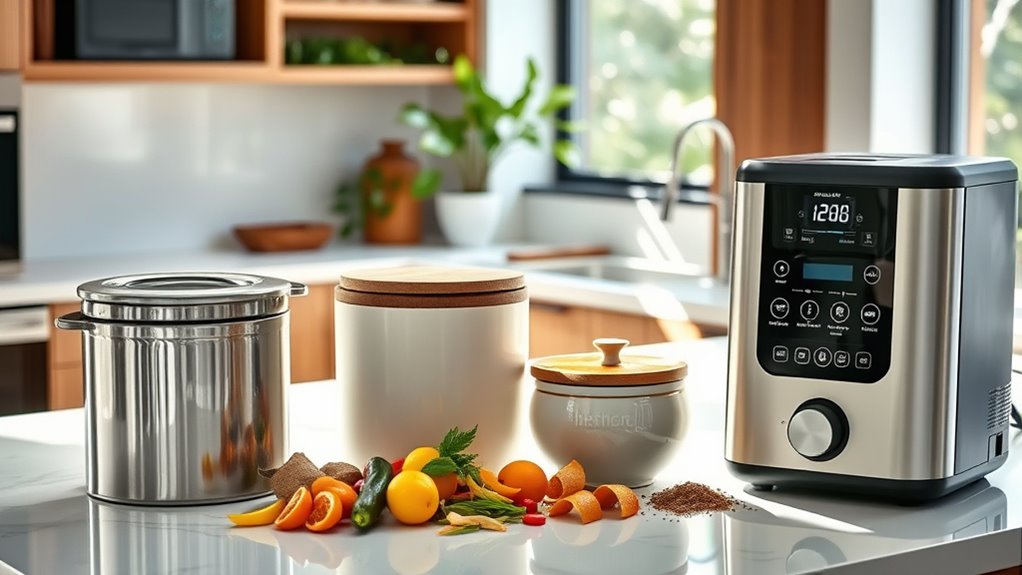
Kitchen composters and food cyclers can reduce the volume of food scraps at home, but they vary in capacity, footprint, controls, and how much upkeep they ask of you. My best overall pick is the Reencle Prime, whose 14L capacity makes it a stronger match for steady, larger volumes than the compact countertop models. The FoodCycler Eco 5 stands out for households that want a larger batch size, while the Growell 3.2L offers a smaller-capacity alternative for kitchens with limited space. The central tradeoff is whether you value capacity and convenience more than counter space, simplicity, and maintenance. Read on for the full comparison, selection criteria, and advice on matching a machine to your household’s food-scrap habits.

Get kitchen staples and gadgets delivered free with Prime
- Fast, free delivery on millions of items
- Prime Video, Amazon Music and more included
- Member-only deals all year
Key Takeaways
- Capacity separates the lineup: the Reencle Prime’s 14L bin is in a different class from the many countertop models around 2.5–5.5L, making it the clearest fit for households that generate more scraps.
- The FoodCycler Eco 5 and Eco 3 serve different routines: the 5L model suits larger batches, while the 3.5L Eco 3 takes up less space and better fits smaller kitchens.
- Smart features are a preference, not a requirement: GoveeLife and Airthereal Revive R800 offer connected controls, but shoppers who want fewer settings may prefer a more straightforward model.
- Cleaning design deserves attention: the Natridy‘s detachable blade is a distinct convenience feature, while any model with a fixed or hard-to-reach food-contact area may take more effort to maintain.
- Several brands offer overlapping compact sizes: NutriChef, Ouaken, Airthereal R500, Assark, and KEEPEEZ compete for smaller-batch use, so compare usable capacity, odor management, and cleaning rather than size alone.
| Growell 3.2L Electric Kitchen Composter |  | Best for Flexible Cycle Control | Capacity: 3.2 L | Power: 500 W | Energy use: 0.2 kWh per hour | VIEW ON AMAZON | See Our Full Breakdown |
| GoveeLife Upgraded Smart Electric Kitchen Composter |  | Best for App and Voice Control | Capacity: 3 L | Dimensions: 15.59 × 13.66 × 19.88 inches | Weight: 29.6 pounds | VIEW ON AMAZON | See Our Full Breakdown |
| NutriChef Electric Kitchen Composter, 3-Quart, White |  | Best for Beginners | Capacity: 3 quarts (3 liters) | Processing time: 6–10 hours | Dimensions: 11.02 × 13.5 × 12.5 inches | VIEW ON AMAZON | See Our Full Breakdown |
| FoodCycler Eco 3 Compact Electric Kitchen Food Recycler, 3.5 L, Grey |  | Best Compact Pick | Capacity: 3.5 L | Dimensions: 11 in H × 9 in W × 13 in D | Color: Grey | VIEW ON AMAZON | See Our Full Breakdown |
| Airthereal R500 Electric Kitchen Composter, 2.5 L, Pearl White |  | Best for Shorter Processing Cycles | Capacity: 2.5 liters | Cycle time: About 4 hours | Waste volume reduction: Up to 90% | VIEW ON AMAZON | See Our Full Breakdown |
| FoodCycler Eco 5 Indoor Food Recycler, 5L, Gray |  | Best for Large-Batch Food Recycling | Brand: Food Cycler | Model: Eco 5 | Capacity: 5 liters | VIEW ON AMAZON | See Our Full Breakdown |
| NutriChef 4-Quart Electric Kitchen Composter with Dual Carbon Filters |  | Best for Quiet, Easy-Clean Operation | Capacity: 4 quarts | Processing time: 2–6 hours | Waste reduction: Up to 90% | VIEW ON AMAZON | See Our Full Breakdown |
| Ouaken 2.5L Indoor Electric Composter |  | Best Compact Pick | Brand: Ouaken | Model: JF6011A | Capacity: 2.5 liters | VIEW ON AMAZON | See Our Full Breakdown |
| Reencle Prime Electric Composter, 14L, Silver |  | Best for Microbial Composting | Brand: Reencle | Model: Reencle Prime | Capacity: 14 L | VIEW ON AMAZON | See Our Full Breakdown |
| Ouaken OK-255 Electric Kitchen Composter, 5.5 L |  | Best for Flexible Cycle Choices | Brand: Ouaken | Model: OK-255 | Capacity: 5.5 L | VIEW ON AMAZON | See Our Full Breakdown |
| Airthereal Revive R800 5L Smart WiFi Electric Kitchen Composter, Gray |  | Best for Connected Monitoring | Capacity: 5 liters | Dimensions: 14 x 12.4 x 14.4 inches | Weight: 25 pounds | VIEW ON AMAZON | See Our Full Breakdown |
| Natridy Electric Kitchen Composter with Detachable Blade, 100 oz |  | Best for Easier Interior Cleaning | Capacity: 100 oz; item capacity stated as 6.3 pounds | Dimensions: 11.8 x 9.8 x 14.3 inches | Weight: 19.2 pounds | VIEW ON AMAZON | See Our Full Breakdown |
| Assark 3L Electric Kitchen Composter |  | Best for Small Households | Capacity: 3 L | Processing time: 4–6 hours | Waste volume reduction: Up to 90% | VIEW ON AMAZON | See Our Full Breakdown |
| KEEPEEZ 1-Gallon Electric Kitchen Composter |  | Best for Quiet, Quick Cycles | Capacity: 1 gallon | Processing time: 2–10 hours | Noise level: 28 dB | VIEW ON AMAZON | See Our Full Breakdown |
| Ouaken 4L Electric Countertop Composter |  | Best for Fast, Low-Fuss Batches | Capacity: 4 L | Processing time: About 3 hours | Waste reduction: Up to 90% | VIEW ON AMAZON | See Our Full Breakdown |
| kitchen composters and food cycler | Capacity | Noise level | Model | Dimensions |
|---|---|---|---|---|
| Growell 3.2L Electric Kitchen | 3.2 L | As low as 50 dB | — | — |
| GoveeLife Upgraded Smart Elect | 3 L | 40 dB | — | 15.59 × 13.66 × 19.88 inches |
| NutriChef Electric Kitchen Com | 3 quarts (3 liters) | — | NCVK9112BWH.5 | 11.02 × 13.5 × 12.5 inches |
| FoodCycler Eco 3 Compact Elect | 3.5 L | — | FC-200-0 | 11 in H × 9 in W × 13 in D |
| Airthereal R500 Electric Kitch | 2.5 liters | — | — | 12.5 × 16 × 14.8 inches |
| FoodCycler Eco 5 Indoor Food R | 5 liters | — | Eco 5 | 10.3 × 13.8 × 13.8 inches |
| NutriChef 4-Quart Electric Kit | 4 quarts | Less than 48 dB | — | — |
| Ouaken 2.5L Indoor Electric Co | 2.5 liters | Below 40 dB | JF6011A | 11.6 × 9.4 × 12 inches |
| Reencle Prime Electric Compost | 14 L | As low as 28 dB | Reencle Prime | — |
| Ouaken OK-255 Electric Kitchen | 5.5 L | Below 45 dBA | OK-255 | — |
| Airthereal Revive R800 5L Smar | 5 liters | — | — | 14 x 12.4 x 14.4 inches |
| Natridy Electric Kitchen Compo | 100 oz; item capacity stated as 6.3 pounds | 40 dB | CYF01-500CD5 | 11.8 x 9.8 x 14.3 inches |
| Assark 3L Electric Kitchen Com | 3 L | Under 40 dB | HQD-260C | — |
| KEEPEEZ 1-Gallon Electric Kitc | 1 gallon | 28 dB | — | — |
| Ouaken 4L Electric Countertop | 4 L | Below 40 dBA | JF6001A | — |
More Details on Our Top Picks
Growell 3.2L Electric Kitchen Composter
The Growell 3.2L earns its place for buyers who want more control than a single-button composter provides. Auto mode handles routine batches, while manual cycles from 1 to 10 hours let you adjust processing for scraps with different moisture levels. Its 3.2-liter capacity is slightly larger than the NutriChef’s 3-quart capacity, and the sealed storage mode can hold scraps for 12 or 24 hours before processing. A water-assisted cleaning mode also helps with upkeep. The tradeoff is time: Auto mode can run for up to eight hours, and odor control depends on replacing activated-carbon filter refills. Choose it over the simpler NutriChef if adjustable cycles matter more than straightforward one-button use.
Pros:- Manual and automatic cycles accommodate scraps with different moisture levels
- Sealed 12- or 24-hour storage helps collect scraps between cycles
- Water-assisted cleaning mode supports easier maintenance
- Reduces food scrap volume by up to 90%
Cons:- Auto processing can take up to eight hours
- Activated-carbon filter refills are needed for odor control
Best for: Households that want adjustable processing and short-term sealed storage for daily food scraps
Not ideal for: Buyers seeking quick batches or filter-free odor control, since Auto mode can take up to eight hours and the carbon filter needs refills
- Capacity:3.2 L
- Power:500 W
- Energy use:0.2 kWh per hour
- Processing time:Up to 8 hours in Auto mode; 1–10 hours in Manual mode
- Waste volume reduction:Up to 90%
- Noise level:As low as 50 dB
- Storage mode:12 or 24 hours
- Warranty:3 years
Our verdict“Choose the Growell if you value adjustable cycles and sealed storage more than the NutriChef’s simpler one-button operation.”
GoveeLife Upgraded Smart Electric Kitchen Composter
The GoveeLife Upgraded Smart Composter is the pick for households that want to manage a food cycler through an app or voice assistant rather than at the counter. Its processing history tracking adds useful visibility, while composting, storage, and cleaning modes cover more than just the main cycle. At a rated 40 dB, it is quieter on paper than the Growell, which lists noise as low as 50 dB. The capacity is similar at 3 liters, so smart controls do not bring a larger batch size. Its dual carbon filters are rated for up to 2,160 hours, and a self-cleaning cycle reduces hands-on care, but the unit weighs 29.6 pounds and takes up a sizable footprint. I’d favor the lighter NutriChef for basic countertop use; GoveeLife makes more sense when connected controls are the priority.
Pros:- App and voice controls include processing history tracking
- Three modes cover processing, storage, and cleaning
- Dual carbon filters are rated for up to 2,160 hours
- Rated at 40 dB
Cons:- Three-liter capacity limits batch size
- At 29.6 pounds, it is heavy to move
- Listed dimensions make it less suited to tight counters
Best for: Smart-home users who want app or voice control, cycle tracking, and built-in storage and cleaning modes
Not ideal for: People with limited counter space or who need to move the appliance often, given its listed dimensions and 29.6-pound weight
- Capacity:3 L
- Dimensions:15.59 × 13.66 × 19.88 inches
- Weight:29.6 pounds
- Noise level:40 dB
- Waste reduction:Up to 90%
- Modes:Composting, storage, and cleaning
- Odor control:Dual carbon filters; rated for up to 2,160 hours
- Controls:App and voice control
Our verdict“Choose GoveeLife over the simpler NutriChef if app and voice control are worth a heavier, more space-demanding appliance.”
NutriChef Electric Kitchen Composter, 3-Quart, White
The NutriChef 3-Quart is the straightforward choice in this group: add suitable scraps, press one button, and let it process them into pre-compost material. That one-button operation avoids the settings and app controls found on the GoveeLife, making it a better fit for beginners who want a simple routine rather than remote monitoring. Its removable, dishwasher-safe components also give cleanup a practical advantage over models whose product details don’t specify dishwasher-safe parts. The tradeoff is a 6–10-hour processing window, so it won’t suit anyone expecting quick results. Capacity is listed at 3 quarts (3 liters), a little less than the FoodCycler Eco 3’s 3.5 liters. I’d pick NutriChef for ease of use and easier component cleaning, but not for larger batches or faster turnaround.
Pros:- One-button operation keeps the routine simple
- Removable components are dishwasher-safe
- Odor filtration and quiet operation suit indoor use
- Processes common scraps such as vegetable peels, coffee grounds, and eggshells
Cons:- Processing takes 6–10 hours
- Three-quart capacity is smaller than the FoodCycler Eco 3’s 3.5-liter capacity
Best for: First-time food-cycler owners who want simple button operation and removable dishwasher-safe parts
Not ideal for: Households that regularly process larger volumes or want a shorter cycle than the listed 6–10 hours
- Capacity:3 quarts (3 liters)
- Processing time:6–10 hours
- Dimensions:11.02 × 13.5 × 12.5 inches
- Materials:PP and ABS
- Operation:One-button
- Features:Odor filtration, quiet operation, removable dishwasher-safe components
- Color:White
- Model:NCVK9112BWH.5
Our verdict“Choose NutriChef over the more feature-rich GoveeLife if easy operation and dishwasher-safe removable parts matter more than smart controls.”
FoodCycler Eco 3 Compact Electric Kitchen Food Recycler, 3.5 L, Grey
The FoodCycler Eco 3 stands out for a defined footprint: at 11 inches high, 9 inches wide, and 13 inches deep, it offers a 3.5-liter bucket in a compact countertop format. That capacity exceeds the Growell and GoveeLife while keeping the listed width narrow, which can help in kitchens where counter space is limited. A removable bucket makes it easier to collect scraps away from the machine, and one-touch controls with progress LEDs keep operation simple. Its reusable, refillable carbon filter supports odor control, though it still needs attention over time. Unlike the Airthereal R500, the Eco 3’s provided details don’t specify cycle duration or how much the scraps shrink, making planning less predictable. It suits buyers prioritizing compact dimensions and a removable bucket over quantified performance details.
Pros:- Compact listed dimensions with a narrow 9-inch width
- 3.5-liter capacity exceeds the Growell and GoveeLife
- Removable bucket supports convenient scrap collection
- Reusable, refillable carbon filter helps reduce odors
Cons:- Processing time is not specified
- Finished-product volume or waste-reduction figure is not specified
- Carbon filter requires maintenance or replacement
Best for: Small-kitchen households that want a narrow countertop unit with a removable bucket and a 3.5-liter capacity
Not ideal for: Buyers who need a stated processing time or reduction figure to plan batches and set expectations
- Capacity:3.5 L
- Dimensions:11 in H × 9 in W × 13 in D
- Color:Grey
- Operation:One-touch button with progress LEDs
- Odor control:Reusable, refillable carbon filter
- Grinding system:Vortech system
- Model:FC-200-0
Our verdict“Choose the Eco 3 over the larger-footprint GoveeLife if compact dimensions and a removable bucket matter more than app controls or published cycle details.”
Airthereal R500 Electric Kitchen Composter, 2.5 L, Pearl White
The Airthereal R500 is the clearest choice here for buyers who want a stated cycle time: its cycle takes about four hours, shorter than the Growell’s Auto cycle of up to eight hours and the NutriChef’s 6–10-hour range. One-button operation keeps the process uncomplicated, and the dishwasher-safe cast-aluminum bucket makes cleanup more direct than on models without a specified dishwasher-safe component. Its 2.5-liter capacity is the smallest among these five, so it trades batch size for a shorter stated cycle. The carbon filters help reduce odors but still require upkeep, and the 16.8-pound unit is not especially light to move. I’d choose it over the larger FoodCycler Eco 3 when cycle timing matters more than capacity or a removable scrap-collection bucket.
Pros:- About four-hour cycle is shorter than the listed Growell and NutriChef processing windows
- One-button operation requires little setup
- Dishwasher-safe cast-aluminum bucket simplifies cleaning
- Reduces waste volume by up to 90%
Cons:- 2.5-liter capacity is smaller than the other four products in this batch
- Weighs 16.8 pounds
- Carbon filters require maintenance for odor reduction
Best for: Small households that want a simple food cycler with a stated cycle of about four hours and dishwasher-safe bucket cleanup
Not ideal for: Families processing larger batches or buyers who prioritize a lighter appliance, given the 2.5-liter capacity and 16.8-pound weight
- Capacity:2.5 liters
- Cycle time:About 4 hours
- Waste volume reduction:Up to 90%
- Blade design:SHARKSDEN Tri-blade
- Bucket material:Cast aluminum
- Dimensions:12.5 × 16 × 14.8 inches
- Weight:16.8 pounds
- Warranty:3 years
Our verdict“Choose the R500 over the higher-capacity FoodCycler Eco 3 if a shorter stated cycle and dishwasher-safe bucket matter more than batch size.”
FoodCycler Eco 5 Indoor Food Recycler, 5L, Gray
The FoodCycler Eco 5 suits households that want a larger bucket and a simple routine: add scraps, use the one-touch operation, and let the machine reduce their volume over a few hours. Its 5-liter capacity gives it an advantage over the smaller Ouaken 2.5L Indoor Electric Composter when several people cook regularly. The removable bucket also makes loading and emptying less awkward than working around a fixed chamber, while the refillable carbon filter is intended to limit odors. The tradeoff is its 13.6 kg weight, which makes it a poor fit if you plan to move it between counters or store it after each cycle. It also uses electricity during operation, and its output is reduced food material rather than a claim of finished garden compost.
Pros:- 5-liter removable bucket accommodates larger batches than the Ouaken 2.5L
- One-touch operation keeps the routine straightforward
- Refillable carbon filter is designed to help reduce odors
- Reduces food scraps to a much smaller volume
Cons:- At 13.6 kg, it is cumbersome to move or store
- Requires electricity during processing
Best for: Households that generate regular kitchen scraps and can leave a heavier 5-liter appliance in one countertop spot
Not ideal for: Small-kitchen users who need a lightweight, easy-to-store appliance or want a non-electric composting method
- Brand:Food Cycler
- Model:Eco 5
- Capacity:5 liters
- Dimensions:10.3 × 13.8 × 13.8 inches
- Weight:13.6 kg
- Material:Plastic
- Filter:Refillable carbon filter
- Warranty:3-year limited
Our verdict“Choose the FoodCycler Eco 5 if you want a roomy, simple electric recycler and have a permanent place for a heavy appliance.”
NutriChef 4-Quart Electric Kitchen Composter with Dual Carbon Filters
The NutriChef 4-Quart makes a strong case for buyers who want specific controls and straightforward cleanup rather than the largest capacity. Its three capacity modes let you match a cycle to a small, medium, or large load, and the stated 2–6-hour processing window offers a useful sense of timing. Compared with the FoodCycler Eco 5, it has a smaller stated capacity, but the dishwasher-safe ceramic-coated bucket can make routine maintenance easier. Dual carbon filters, a replacement alert, and operation below 48 dB add odor and noise management, while overheat, overload, and auto-shutoff protections address basic operating safeguards. The main ongoing drawback is filter upkeep: the alert arrives after 600 hours, so this is not a filter-free solution. Buyers seeking microbial decomposition should look instead at the Reencle Prime.
Pros:- Three modes let users select a setting for different load sizes
- Dishwasher-safe ceramic-coated inner bucket simplifies cleaning
- Dual carbon filters and a replacement alert support odor management
- Below-48 dB operation with overheat, overload, and auto-shutoff protections
Cons:- Filter replacement is indicated after 600 hours of operation
- Its 4-quart capacity is smaller than the FoodCycler Eco 5’s 5-liter bucket
Best for: Home cooks who want adjustable batch settings, quieter operation, and a removable bucket that can go in the dishwasher
Not ideal for: People seeking microbial composting or a larger batch capacity than a 4-quart chamber provides
- Capacity:4 quarts
- Processing time:2–6 hours
- Waste reduction:Up to 90%
- Modes:Small, Medium, Large
- Noise level:Less than 48 dB
- Filters:2 activated carbon filters
- Filter alert:After 600 hours
- Inner bucket:Ceramic-coated and dishwasher-safe
Our verdict“Pick the NutriChef if adjustable cycles and easy bucket cleanup matter more to you than maximum capacity or microbial processing.”
Ouaken 2.5L Indoor Electric Composter
For a small kitchen or a one- or two-person household, the Ouaken 2.5L is the lineup’s space-conscious choice. Its 11.6 × 9.4 × 12-inch footprint and 11-pound weight make it easier to place or move than the heavier FoodCycler Eco 5, though that convenience comes with a much smaller batch size. The below-40 dB noise level is a useful fit for kitchens near living areas, and Crush, Ferment, and Clean modes give it more than a basic grind-and-dry cycle. Its removable bucket and blade assembly also help with cleaning. However, Ferment mode produces pre-compost that needs further composting, so it does not replace a full composting setup for that use. Larger households should look at the 5-liter FoodCycler Eco 5 instead.
Pros:- Compact dimensions and 11-pound weight suit limited counter space
- Below-40 dB operation is quieter than the stated level of the FoodCycler Eco 5 is available for comparison
- Removable bucket and blade assembly ease cleaning
- Crush, Ferment, and Clean modes provide distinct functions
Cons:- 2.5-liter capacity can require frequent cycles in a larger household
- Ferment mode creates pre-compost that needs further composting
- Carbon filter life is listed as up to five months
Best for: Apartment dwellers, solo cooks, and couples who need a quieter, lighter appliance for modest daily scraps
Not ideal for: Families producing large batches or buyers who expect Ferment mode to deliver finished compost without further composting
- Brand:Ouaken
- Model:JF6011A
- Capacity:2.5 liters
- Dimensions:11.6 × 9.4 × 12 inches
- Weight:11 pounds
- Noise level:Below 40 dB
- Modes:Crush, Ferment, Clean
- Carbon filter life:Up to 5 months
Our verdict“Choose the Ouaken 2.5L for a quiet, compact countertop recycler if your household generates small batches and you understand that Ferment output needs further composting.”
Reencle Prime Electric Composter, 14L, Silver
The Reencle Prime stands apart from the lineup’s grind-and-dry machines by using microbial decomposition to process scraps. That makes it the clearest choice here for buyers who want a composting approach rather than simply reducing waste volume. Its 14-liter capacity is substantially larger than the Ouaken 2.5L, while a three-layer filter is designed to manage odors and the stated noise level starts as low as 28 dB. The included starter pack and shovel also provide useful accessories for getting the system going. The tradeoff is variable processing time: the listed 2–24-hour range is broad, so it offers less predictable timing than NutriChef’s stated 2–6-hour cycles. Buyers should also distinguish its nutrient-rich compost claim from the dried, ground output of electric recyclers.
Pros:- Microbial decomposition differentiates it from grind-and-dry models such as the FoodCycler Eco 5
- 14-liter capacity is larger than the Ouaken 2.5L
- Three-layer filter is designed to reduce odors
- Includes a carbon filter, compost starter pack, and shovel
Cons:- Processing time varies widely from 2 to 24 hours
- The microbial composting approach differs from the simpler drying and grinding process of many countertop food recyclers
Best for: Households seeking a larger-capacity indoor unit that uses microbial decomposition and can tolerate variable processing times
Not ideal for: Buyers who need predictable cycle timing or specifically want food scraps dried and ground into a reduced-volume material
- Brand:Reencle
- Model:Reencle Prime
- Capacity:14 L
- Processing capacity:Up to 2.2 lbs of food scraps
- Processing time:2–24 hours
- Noise level:As low as 28 dB
- Filter system:Three-layer filter
- Included accessories:Carbon filter, compost starter pack, and shovel
Our verdict“Choose the Reencle Prime if you want microbial composting and generous capacity, but not if a predictable cycle time is your priority.”
Ouaken OK-255 Electric Kitchen Composter, 5.5 L
The Ouaken OK-255 is a good match for households that want to adapt how they handle scraps, rather than use a single processing setting every time. Its five modes include Standard, Quick, Crush, Clean, and Store, giving it a wider stated range of tasks than the three-mode Ouaken 2.5L. A 5.5-liter capacity also gives it more room than the FoodCycler Eco 5, while the transparent flip-top lid lets you check the chamber without opening it. The unit is rated below 45 dBA and includes an activated carbon filter and moisture collection tray. The tradeoff is that the filter is recommended for replacement about every five months, adding routine upkeep. Its stated reduction of up to 90% is about volume, not a claim that every cycle produces finished garden compost.
Pros:- 5.5-liter capacity exceeds the FoodCycler Eco 5’s stated 5 liters
- Five modes cover processing, cleaning, and storage tasks
- Transparent flip-top lid allows a quick view of the chamber
- Below-45 dBA noise rating, activated carbon filter, and moisture collection tray
Cons:- Filter replacement is recommended approximately every five months
- Up to 90% reduction refers to waste volume and does not establish that output is finished compost
Best for: Households wanting a larger-capacity electric recycler with separate quick, storage, crush, and cleaning modes
Not ideal for: Buyers who want minimal filter maintenance or need a clear promise of finished compost rather than reduced-volume scraps
- Brand:Ouaken
- Model:OK-255
- Capacity:5.5 L
- Modes:Standard, Quick, Crush, Clean, Store
- Noise level:Below 45 dBA
- Food waste reduction:Up to 90%
- Filter replacement interval:Approximately 5 months
- Odor and moisture features:Activated carbon filter and moisture collection tray
Our verdict“Pick the Ouaken OK-255 if you want a large chamber and several operating modes, and are comfortable maintaining its filter.”
Airthereal Revive R800 5L Smart WiFi Electric Kitchen Composter, Gray
The Airthereal Revive R800 pairs a roomy 5-liter capacity with WiFi and app monitoring, making it a fit for households that want to check progress without hovering over the appliance. Its three modes—Eco Pre-Compost, Bio Compost, and Self-Clean—give it more operating flexibility than the simpler two-mode KEEPEEZ 1-Gallon Electric Kitchen Composter. A biodegradable carbon filter helps limit kitchen odors, while the self-clean mode can reduce hands-on cleanup. The tradeoff is its 25-pound weight: this is better kept in a regular countertop spot than moved in and out of storage. Buyers should also account for replacing the specified filter. Choose it for app access and larger batch capacity; skip it if portability or minimal upkeep matters more.
Pros:- 5-liter capacity accommodates larger batches than compact 3-liter models such as the Assark.
- WiFi and app connectivity allow remote progress monitoring.
- Three modes include Eco Pre-Compost, Bio Compost, and Self-Clean.
- Biodegradable carbon filter helps manage food-scrap odors.
Cons:- At 25 pounds, it is cumbersome to move or store between uses.
- Requires replacement biodegradable carbon filters.
- Its 14-inch dimensions call for a dedicated countertop area.
Best for: Households wanting a larger countertop composter with app-based progress monitoring and multiple processing modes.
Not ideal for: People who need to move their appliance often or want to avoid purchasing replacement biodegradable carbon filters.
- Capacity:5 liters
- Dimensions:14 x 12.4 x 14.4 inches
- Weight:25 pounds
- Modes:Eco Pre-Compost, Bio Compost, Self-Clean
- Connectivity:WiFi and mobile app
- Materials:Metal and plastic
- Warranty:3 years
Our verdict“Choose the R800 if you want app monitoring and a 5-liter working capacity; choose a lighter, simpler composter if you value portability more.”
Natridy Electric Kitchen Composter with Detachable Blade, 100 oz
The Natridy CYF01-500CD5 makes cleanup its clearest distinction: a detachable blade and auto-flush system are designed to make residue easier to deal with than in a unit without those features, such as the KEEPEEZ 1-Gallon Electric Kitchen Composter. Its ceramic-coated bucket and stated 40 dB operation also suit kitchens where noise and stuck-on scraps are concerns. The 800 g of activated carbon supports odor control, while the brushless motor is rated for 10,000 hours. The key gap is information: the product data does not specify its cycle time or clearly describe its processing modes, so buyers cannot compare turnaround as confidently as they can with the Ouaken 4L. Its 19.2-pound weight also makes it more of a stay-put appliance than a portable bin.
Pros:- Detachable blade and auto-flush system are designed to simplify cleaning.
- Ceramic-coated bucket offers a smooth interior surface.
- Stated operating noise is 40 dB.
- 800 g activated-carbon odor-control system and brushless motor rated for 10,000 hours.
Cons:- Product details do not state cycle duration or explain the processing cycle.
- At 19.2 pounds, it is heavy to move frequently.
- The 100 oz capacity is not directly described in liters, making size comparisons less straightforward.
Best for: Home cooks who prioritize accessible cleaning parts, a coated bucket, and quiet operation in a countertop composter.
Not ideal for: Buyers who need a clearly stated processing time or plan to lift and store their composter regularly.
- Capacity:100 oz; item capacity stated as 6.3 pounds
- Dimensions:11.8 x 9.8 x 14.3 inches
- Weight:19.2 pounds
- Noise level:40 dB
- Activated carbon:800 g
- Bucket:Ceramic-coated
- Motor lifespan:Rated for 10,000 hours
- Model:CYF01-500CD5
Our verdict“Pick the Natridy if cleaning access matters more than knowing an exact cycle time, and compare its batch size carefully with the clearly specified 4-liter Ouaken.”
Assark 3L Electric Kitchen Composter
The Assark 3L suits buyers who want a defined cycle time in a smaller appliance: its automatic drying-and-crushing cycle takes 4–6 hours, with stated waste-volume reduction of up to 90%. That makes planning easier than with the Natridy, whose product information does not list a processing duration. Its removable non-stick bucket and Auto Clean mode also give cleanup a more explicit place in the design. Capacity is the compromise. At 3 liters, it holds less than the 4-liter Ouaken and 5-liter Airthereal R800, so frequent cooks may need to run it more often. The carbon filter is specified to last up to three months, adding a recurring replacement task, and the 12-month limited warranty is shorter than the R800’s three-year coverage.
Pros:- Stated 4–6 hour drying and crushing cycle helps buyers plan use.
- Removable non-stick bucket and Auto Clean mode support easier cleanup.
- Operating noise is specified as under 40 dB.
- Claims to reduce waste volume by up to 90%.
Cons:- 3-liter capacity is smaller than the Ouaken 4L and Airthereal R800 5L.
- Carbon filter life is stated as up to three months, so replacement is a recurring task.
- 12-month limited warranty is shorter than the R800’s stated three-year warranty.
Best for: One- or two-person households that want a compact electric composter with a stated cycle duration and built-in cleaning mode.
Not ideal for: Larger households or frequent meal-preppers who need room for bigger batches or want longer stated warranty coverage.
- Capacity:3 L
- Processing time:4–6 hours
- Waste volume reduction:Up to 90%
- Noise level:Under 40 dB
- Modes:3
- Carbon filter life:Up to 3 months
- Warranty:12-month limited warranty
- Model:HQD-260C
Our verdict“The Assark is a practical fit for smaller kitchens and modest scrap volumes, but frequent cooks may prefer the larger Ouaken or R800.”
KEEPEEZ 1-Gallon Electric Kitchen Composter
The KEEPEEZ FWD-301 stands out for quiet operation and a flexible 2–10 hour processing window. At a stated 28 dB, it is quieter on paper than the Assark and Ouaken, both listed below 40 dB, which may matter in an open-plan kitchen. Dual sensors adjust the cycle, and the sealed lid, 760 g three-layer carbon filter, and child safety lock address everyday household use. A self-cleaning mode reduces some cleanup effort. The tradeoff is its 1-gallon capacity, which is modest beside the 4-liter Ouaken and 5-liter Airthereal R800. Its output also needs to be mixed with soil before use, so this is not a direct substitute for a bin that produces finished garden compost. Energy use is listed at up to 0.5 kWh per cycle.
Pros:- Stated 28 dB operation is quieter than the under-40 dB Assark and Ouaken.
- Dual sensors adjust the cycle within a 2–10 hour processing range.
- Sealed lid, three-layer carbon filter, and child safety lock support household use.
- Includes a self-cleaning mode.
Cons:- 1-gallon capacity is smaller than the 4-liter Ouaken and 5-liter Airthereal R800.
- Processed biomass needs to be mixed with soil before use.
- Energy use is listed as up to 0.5 kWh per cycle.
Best for: Noise-sensitive households with children that process modest amounts of scraps and can mix the output into soil.
Not ideal for: Large households seeking high batch capacity or buyers expecting finished compost ready to use without mixing.
- Capacity:1 gallon
- Processing time:2–10 hours
- Noise level:28 dB
- Energy use:Up to 0.5 kWh per cycle
- Filter:760 g, 3-layer activated carbon
- Composting modes:2
- Cleaning mode:1 auto-cleaning mode
- Warranty:3 years
Our verdict“Choose KEEPEEZ for quieter operation and household safety features if a one-gallon batch size and soil-mixing step suit your routine.”
Ouaken 4L Electric Countertop Composter
The Ouaken 4L is the speed-focused choice in this group: its high-temperature drying, grinding, and cooling cycle takes about three hours, faster than the Assark’s stated 4–6 hours and the KEEPEEZ’s 2–10-hour range. Its 4-liter capacity also offers more room than the Assark’s 3-liter unit without reaching the 5 liters of the Airthereal R800. The detachable, dishwasher-safe bucket is a practical advantage for buyers who want cleaning to be straightforward rather than relying only on an auto-clean mode. Three modes cover crushing, fermenting, and cleaning, and noise is listed below 40 dBA. The main limits are its smaller-than-5-liter capacity and a carbon filter that lasts up to five months, after which replacement may be needed. The stated waste reduction is up to 90%.
Pros:- About three-hour processing time is shorter than the Assark’s stated 4–6 hour cycle.
- 4-liter capacity sits between the Assark 3L and Airthereal R800 5L.
- Detachable bucket is dishwasher safe.
- Three modes include Crush, Ferment, and Clean; operation is listed below 40 dBA.
Cons:- 4-liter capacity may be limiting for larger households.
- Carbon filter may need replacement after up to five months.
- Waste reduction is stated as up to 90%, not a guarantee for every type of food scrap.
Best for: Households seeking a mid-size countertop composter with a short stated cycle and a bucket that can go in the dishwasher.
Not ideal for: Large families with high daily scrap volumes or buyers who do not want to track and replace a carbon filter.
- Capacity:4 L
- Processing time:About 3 hours
- Waste reduction:Up to 90%
- Noise level:Below 40 dBA
- Modes:Crush, Ferment, Clean
- Carbon filter life:Up to 5 months
- Bucket:Detachable and dishwasher safe
- Model:JF6001A
Our verdict“Pick the Ouaken for a relatively fast, mid-size cycle and dishwasher-safe bucket; choose the R800 if you need more capacity and app monitoring.”

How We Picked
I compared these 15 kitchen composters and food cyclers by the factors that shape everyday use: capacity, counter or floor footprint, control complexity, odor-management features, and access to parts that need cleaning. I also considered build and design details that can affect a buyer’s routine, such as a detachable blade, dual carbon filters, and app or Wi-Fi controls. Since these machines vary in size and operating approach, I treated the published capacity and features as evidence of intended use—not as proof that every model handles every type of food scrap equally well.
The ranking favors a clear fit for a common household need, useful features, and a credible balance of convenience and upkeep. That puts the Reencle Prime first for buyers prioritizing capacity, with the FoodCycler Eco 5 close behind for larger countertop batches. Compact choices rank better for tight spaces and smaller households, while connected models and feature-specific designs earn attention when those details match a buyer’s routine. No single machine is right for every kitchen, so the list gives each product a distinct role rather than treating the largest or most feature-packed model as an automatic winner.
Factors to Consider When Choosing Kitchen Composters And Food Cyclers
Before choosing a machine, I would start with the scraps your household produces and where the appliance will live. Capacity, cycle timing, noise, and cleaning demands all affect whether a composter becomes a regular part of your kitchen routine or an awkward appliance that gets used less often.
Match Capacity to Your Actual Scrap Routine
Capacity labels can make models look easy to compare, but the useful question is how often you want to empty or run the machine. A smaller bin may work well if you cook for one or two people, save scraps in batches, or have limited counter space. A larger vessel can reduce how often you manage scraps, though it needs more room and may encourage you to collect food for longer before processing. Avoid choosing by household size alone: meal habits, produce intake, and how much food you discard matter just as much. If you are unsure, track your scraps for several days before buying. That small check can prevent paying for capacity you will not use—or buying a compact unit that fills too quickly.
Understand What the Output Is—and Is Not
Many electric countertop appliances process scraps by drying and reducing their volume, while some indoor composters use a different approach. The resulting material should not automatically be treated as finished garden compost. Check the manufacturer’s guidance and local rules before adding it to a garden, compost pile, or municipal collection stream. A common mistake is assuming every machine accepts the same ingredients or produces material with the same use. If your main goal is diverting scraps from the trash, ask how the product handles your typical mix and what you will do with the output. Buyers who need finished compost may prefer a conventional composting method or a system specifically designed for that purpose.
Plan for Odor, Noise, and Placement
Carbon filters can help manage odors, but they are maintenance items rather than a permanent fix. Check how often filters need attention, whether replacements are easy to obtain, and whether the machine needs clearance around vents. Noise can matter if the unit will run near a dining area, bedroom, or open-plan living space, so look for operating-noise information from the manufacturer rather than assuming a countertop appliance is quiet. Placement also affects convenience: a machine that is hard to reach may make loading and cleaning less appealing. Keep it near food preparation if that suits your layout, while leaving the required ventilation space. Think through these details before committing to a spot.
Choose Controls You Will Actually Use
Smart controls and Wi-Fi connectivity can suit buyers who like remote status checks or scheduled operation, but they add complexity that not everyone wants. A simpler control panel may be easier for multiple household members to use without an app or account. Consider whether the connected features solve a real problem in your routine or simply add another setup step. Also check what happens if the network goes down and whether the appliance can still run manually. Avoid paying for features that do not change how you handle scraps. The best control scheme is the one that makes regular use straightforward for everyone who shares the kitchen.
Look Beyond Capacity When Comparing Cleaning
Food-contact parts, blades, filters, and lids determine how much routine upkeep a machine may require. A detachable blade can make access easier, but it also creates a part that must be removed and reinstalled correctly. Before buying, check which components can be washed, which must stay dry, and whether the manual calls for hand cleaning. Do not assume a removable bucket means the entire unit is dishwasher-safe. A model that is easy to clean may be more useful over time than one with a larger bin but awkward access. If several people will use the appliance, choose a cleaning routine that does not depend on one person handling all the maintenance.
Decide When More Capacity or Features Are Worth It
Paying for a larger unit makes the most sense when smaller bins would fill too quickly or require more frequent attention. Smart controls, multiple filters, and distinctive blade designs are worth extra complexity only when they address a real need, such as remote monitoring or easier cleaning. A compact model may be the better choice if counter space is scarce, even if it means running smaller batches. Check the appliance dimensions, lid clearance, and power requirements against the actual location—not just a product photo. Also account for ongoing filter replacements and cleaning supplies in your ownership plan. A good match is the model whose size and upkeep fit your kitchen, not simply the one with the longest feature list.
Frequently Asked Questions
Can an electric kitchen composter replace a backyard compost pile?
Not necessarily. Many electric food recyclers reduce scraps through processing, but their output may not be finished compost ready to use in the same way as mature material from a compost pile. Check the specific model’s instructions for accepted foods and recommended use of the processed output. If you want to produce garden-ready compost, a traditional composting system or a product designed for that outcome may be a better fit. If your main aim is making scraps smaller and easier to handle, an electric unit may still suit your routine.
Is a 2.5–3.5L machine large enough for a household?
It can be, especially for one or two people who cook modestly or are willing to run batches more often. Capacity needs depend on how much produce, leftovers, and preparation waste your household generates—not just the number of people. A compact model is easier to fit on a counter, but it can become inconvenient if it fills before you are ready to run it. Track your typical scraps for a few days and compare that amount with the machine’s stated capacity. Larger households or frequent home cooks may prefer a 5L-class model or the substantially larger Reencle Prime.
Do carbon filters eliminate food odors completely?
Carbon filters are intended to help control odors, but they should not be treated as a guarantee of an odor-free kitchen. Results depend on the appliance design, what goes into it, how promptly it is run, and whether filters are maintained according to instructions. Check replacement availability and the recommended service interval before buying. A lid, suitable placement, and regular cleaning also contribute to odor management. If smell sensitivity is a concern, compare the full maintenance routine rather than relying on a filter feature alone.
Should I choose a smart model if I only want basic food-scrap processing?
Probably not unless remote controls or status updates would change how you use the appliance. Connected models such as the GoveeLife and Airthereal Revive R800 may suit buyers who want app-based functions, but a basic model can be easier to set up and share with other household members. Check whether the appliance remains usable without Wi-Fi and whether the app adds functions you would regularly use. If your routine is simple, prioritize capacity, cleaning access, and placement over connectivity. Smart features are most valuable when they remove a real point of friction.
What should I check before deciding where to put a countertop composter?
Measure the appliance footprint and the space needed to open the lid, remove the bucket, and clean the unit. Check the manual for ventilation clearance and keep the appliance away from areas where heat or noise would be disruptive. Consider how close it is to food preparation, since convenience can affect whether household members use it consistently. Confirm that the surface is stable and that the power cord can reach an outlet without crossing a busy walkway. A suitable spot should allow both daily loading and occasional cleaning without moving other kitchen equipment.
Conclusion
For the widest capacity, I recommend the Reencle Prime as the best overall choice, particularly for households that generate scraps steadily and have room for a larger unit. The FoodCycler Eco 5 is a strong alternative for buyers who want a larger batch size in a countertop food recycler, while the FoodCycler Eco 3 makes more sense when counter space is tighter. For value-minded shoppers, I would compare the compact NutriChef, Ouaken, Airthereal R500, Assark, and KEEPEEZ models by cleaning access, filters, and controls rather than choosing on capacity alone. Beginners who want a smaller, simpler footprint can start with a compact model such as the Growell 3.2L; buyers who value app controls can look at the GoveeLife or Airthereal Revive R800. If easier blade access is your priority, the Natridy stands apart. Choose based on how much you process, the space you have, and the upkeep you will actually follow.