For a coffee cart, my best overall pick is the Breville Barista Express, which combines espresso preparation and a built-in grinder in one machine. The Breville Bambino is a more compact choice for carts where counter space matters, while the AMZCHEF Espresso Machine with Built-In Grinder suits operators who want an integrated setup. The main tradeoffs are speed, drink consistency, machine footprint, and how much work the operator must do between orders. A home-oriented machine may be easy to move but struggle with a busy service pace or limited power. Read on for the full comparison and guidance on matching a machine to your cart’s menu and workload.

Get kitchen staples and gadgets delivered free with Prime
- Fast, free delivery on millions of items
- Prime Video, Amazon Music and more included
- Member-only deals all year
Complete the kit


Key Takeaways
- The Breville Barista Express leads for an all-in-one cart setup because its built-in grinder reduces the need for separate counter equipment, though its larger footprint may not suit the smallest carts.
- The Bambino favors compactness over an integrated workflow; operators still need a grinder, but can reserve more cart space for other tools.
- Most of the lineup consists of compact, semi-automatic or entry-level machines, so buyers should check service capacity and duty expectations rather than treating advertised pressure figures as proof of commercial readiness.
- Milk drinks make steaming capacity and recovery time important; a machine that handles occasional cappuccinos at home may slow a cart with a steady latte queue.
- Capsule and automatic milk systems trade control for convenience, while manual and semi-automatic options give operators more control but require training and a repeatable workflow.
| AMZCHEF Espresso Machine with Built-In Grinder |  | Best for a Flexible, Bean-to-Cup Cart | Model: CM1626 | Operation: Semi-automatic | Grind settings: 44 | VIEW ON AMAZON | See Our Full Breakdown |
| Breville Bambino Espresso Machine, Brushed Stainless Steel |  | Best Compact Pick for Quick Service | Model: BES450BSS | Operation: Semi-automatic | Heating system: ThermoJet | VIEW ON AMAZON | See Our Full Breakdown |
| Chefman CraftBrew Semi-Automatic Espresso Machine with Steam Wand | 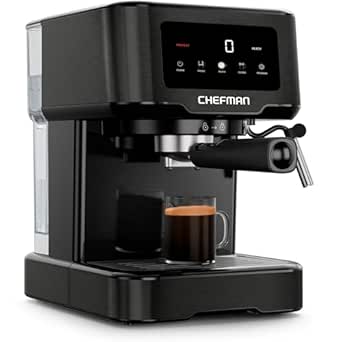 | Best for Straightforward Shot Control | Model: RJ54-SS-15-D-BLK | Operation: Semi-automatic | Coffee input: Ground coffee | VIEW ON AMAZON | See Our Full Breakdown |
| Mr. Coffee Café Barista Espresso, Cappuccino, and Latte Maker |  | Best for One-Touch Milk Drinks | Model: BVMCECMP1000RB | Operation: Semi-automatic | Pump pressure: 15 bar | VIEW ON AMAZON | See Our Full Breakdown |
| NEWBULIG Compact 20-Bar Espresso Machine with Steam Wand |  | Best Lightweight Budget-Space Pick | Model: AH-KFJ52YS-02SR | Operation: Semi-automatic | Pump pressure: 20 bar | VIEW ON AMAZON | See Our Full Breakdown |
| Gevi 20-Bar Compact Espresso Machine with Milk Frother |  | Best for a Lightweight Cart Setup | Operation: Semi-automatic | Pump pressure: 20 bar | Power: 1350 watts | VIEW ON AMAZON | See Our Full Breakdown |
| Breville Barista Express Espresso Machine with Built-In Grinder, Brushed Stainless Steel |  | Best for Fresh Grinding on the Cart | Model: BES870XL | Operation: Manual | Grinder: Integrated precision conical burr grinder | VIEW ON AMAZON | See Our Full Breakdown |
| Neretva 20-Bar Compact Espresso Machine |  | Best for a Larger Water Reserve | Operation: Semi-automatic | Pressure: 20 bar | Power: 1350 watts | VIEW ON AMAZON | See Our Full Breakdown |
| XIXUBX Compact Espresso Machine with Milk Frother, White |  | Best Compact Pick | Operation: Semi-automatic | Pressure: 20 bar | Power: 1100 watts | VIEW ON AMAZON | See Our Full Breakdown |
| De’Longhi Stilosa Compact Manual Espresso Machine with Milk Frother |  | Best for a Simple Espresso Menu | Model: EC260BK | Operation: Manual | Pump pressure: 15 bar | VIEW ON AMAZON | See Our Full Breakdown |
| Ninja Espresso & Coffee Barista System, Nespresso Capsule Compatible, Black, CFN601 |  | Best for a Cart Serving Both Espresso and Batch Coffee | Operation: Semi-automatic | Coffee input: Nespresso Original capsules and coffee grounds | Espresso pressure: 19 bar | VIEW ON AMAZON | See Our Full Breakdown |
| Spacekey Espresso Machine with Grinder and Milk Frother |  | Best for Fresh-Bean Workflow | Operation: Semi-automatic | Coffee input: Whole beans or ground coffee | Grinder: Built-in conical burr grinder with 30 settings | VIEW ON AMAZON | See Our Full Breakdown |
| AMZCHEF 20-Bar Espresso Machine with Self-Cleaning, Steam Wand, and 44 oz Tank |  | Best for Simplified Cleanup | Operation: Semi-automatic | Coffee input: Ground coffee | Pump pressure: 20 bar | VIEW ON AMAZON | See Our Full Breakdown |
| SECPOEDR 20-Bar Espresso Machine with Milk Frother and Cold Brew |  | Best for a Narrow Cart Footprint | Operation: Semi-automatic | Coffee input: Ground coffee | Pump pressure: 20 bar | VIEW ON AMAZON | See Our Full Breakdown |
| BYESHOP 20-Bar Compact Espresso Machine with Milk Frother |  | Best for Visible Brewing Adjustments | Operation: Semi-automatic | Coffee input: Ground coffee | Output pressure: 20 bar | VIEW ON AMAZON | See Our Full Breakdown |
| espresso machine for a coffee cart | Operation | Dimensions | Weight | Water tank |
|---|---|---|---|---|
| AMZCHEF Espresso Machine with | Semi-automatic | 12.5 × 10.82 × 13.38 in | 13.9 lb | 60 oz |
| Breville Bambino Espresso Mach | Semi-automatic | 13.7 × 6.3 × 12 in | 10.9 lb | — |
| Chefman CraftBrew Semi-Automat | Semi-automatic | 10.8 × 8.9 × 11.9 in | — | 1.5 L |
| Mr. Coffee Café Barista Espres | Semi-automatic | 8.86 × 11.22 × 12.6 in | 9 lb | — |
| NEWBULIG Compact 20-Bar Espres | Semi-automatic | 11.73 × 6.02 × 11.22 in | 6 lb | 34 oz |
| Gevi 20-Bar Compact Espresso M | Semi-automatic | 12.3 × 5.5 × 12 inches | 8.6 pounds | 1 liter (34 oz) |
| Breville Barista Express Espre | Manual | 13.8 × 12.5 × 15.9 inches | 22.1 pounds | 67 oz |
| Neretva 20-Bar Compact Espress | Semi-automatic | 11 × 12 × 9.1 inches | 17 pounds | 1.3 liters |
| XIXUBX Compact Espresso Machin | Semi-automatic | 11.4 × 6.7 × 11.8 inches | 7 pounds | — |
| De’Longhi Stilosa Compact Manu | Manual | 12.13 × 9.45 × 14.17 inches | 8.6 pounds | — |
| Ninja Espresso & Coffee Barist | Semi-automatic | 11.89 × 14.84 × 17.4 inches | 13.6 pounds | — |
| Spacekey Espresso Machine with | Semi-automatic | Listed as 11.6 × 9 × 14 inches and 12 × 10 × 14 inches | 15 pounds | 61 oz, removable |
| AMZCHEF 20-Bar Espresso Machin | Semi-automatic | 12.1 × 13 × 6.5 inches | 8.5 pounds | 44 oz, removable |
| SECPOEDR 20-Bar Espresso Machi | Semi-automatic | 13.2 × 6.65 × 12 inches | 9 pounds | 45 fluid ounces, removable |
| BYESHOP 20-Bar Compact Espress | Semi-automatic | — | — | 37 oz (1.1 L), removable |
More Details on Our Top Picks
AMZCHEF Espresso Machine with Built-In Grinder
For a cart that needs to switch between beans and drink styles without adding a separate grinder, the AMZCHEF CM1626 is my most adaptable pick. Its 44 grind settings and adjustable brewing temperature let an operator tune shots for different roasts, while the 60-ounce tank offers more refill headroom than the NEWBULIG’s 34-ounce tank. The touchscreen and cold brew mode add range, though more settings also mean more decisions during a busy service. This is a semi-automatic machine, so it still calls for hands-on preparation rather than the push-button workflow of the Mr. Coffee Café Barista. At 13.9 pounds, it is manageable to move, but it is not the lightest option here. I’d choose it for a cart prioritizing menu flexibility over the simplest possible routine.
Pros:- Built-in grinder with 44 settings reduces the need to pack a separate grinder.
- Adjustable brewing temperature supports dialing in different beans and roasts.
- 60-ounce water tank provides more capacity than the NEWBULIG’s 34-ounce tank.
- Cold brew mode and steam wand allow a broader menu from one machine.
Cons:- Semi-automatic preparation requires more operator attention than the Mr. Coffee Café Barista’s one-touch drink controls.
- The listed 6-ounce capacity may limit serving size or require frequent brewing for larger drinks.
- Its many adjustment options can slow service when recipes are not already set.
Best for: Coffee-cart operators who want an integrated grinder, adjustable extraction, and espresso plus cold brew options without carrying a separate grinder.
Not ideal for: High-volume carts that need fast, repeatable service with minimal barista input, or operators who want a machine designed specifically for commercial duty.
- Model:CM1626
- Operation:Semi-automatic
- Grind settings:44
- Brewing temperature:190°F–201°F
- Water tank:60 oz
- Heating system:1350 W
- Dimensions:12.5 × 10.82 × 13.38 in
- Weight:13.9 lb
Our verdict“Choose the AMZCHEF if a cart needs an integrated grinder and a varied menu more than it needs the fastest, simplest drink workflow.”
Breville Bambino Espresso Machine, Brushed Stainless Steel
The Breville Bambino suits a cart where counter space and short gaps between orders matter. Its 3-second ThermoJet heat-up means less waiting after powering on than a workflow built around a slower warm-up, and its 6.3-inch width takes up less room than the AMZCHEF CM1626. PID temperature control and low-pressure pre-infusion are useful for steadier extraction, while the automatic steam wand makes milk drinks less dependent on manual frothing technique. The tradeoff is that it uses ground coffee, so a cart needs a separate grinder and an organized dosing routine. Its 47-ounce tank is also smaller than AMZCHEF’s 60-ounce reservoir. I’d pick the Bambino when compact dimensions and quick heat-up outweigh the convenience of an all-in-one grinder.
Pros:- ThermoJet system reaches extraction temperature in 3 seconds.
- Compact 6.3-inch width leaves more cart space than the AMZCHEF CM1626.
- PID temperature control and low-pressure pre-infusion support more consistent extraction.
- Automatic steam wand reduces the skill needed to texture milk.
Cons:- Requires a separate grinder and ground-coffee workflow, unlike the AMZCHEF.
- The 47-ounce water capacity is smaller than the AMZCHEF’s 60-ounce tank.
- Semi-automatic preparation still takes practice and operator involvement.
Best for: Mobile coffee-cart operators with tight counter space who already have a grinder and want quick startup with assisted milk steaming.
Not ideal for: Carts that need an all-in-one grinder setup or larger water capacity for longer service periods between refills.
- Model:BES450BSS
- Operation:Semi-automatic
- Heating system:ThermoJet
- Heat-up time:3 seconds
- Water capacity:47 fl oz
- Portafilter size:54 mm
- Dimensions:13.7 × 6.3 × 12 in
- Weight:10.9 lb
Our verdict“Pick the Bambino for a space-limited cart that values fast heat-up and assisted steaming and can accommodate a separate grinder.”
Chefman CraftBrew Semi-Automatic Espresso Machine with Steam Wand
The Chefman CraftBrew keeps the cart workflow focused on single and double espresso shots, with touch controls and a timer for adjusting shot volume. That makes it a more direct fit for an espresso-led menu than the Mr. Coffee Café Barista, which adds automatic milk frothing and one-touch latte and cappuccino options. The Chefman’s removable 1.5-liter tank is practical when a cart’s water source is not close by, and its compact footprint is easier to place than the wider AMZCHEF. The tradeoff is a fully manual steam wand, which asks for more skill and attention during milk orders. It also accepts ground coffee only, so the cart must supply a grinder separately. I’d choose this model for operators who want basic shot-volume control without paying for a broader drink automation setup.
Pros:- Touch controls and timer allow adjustment of shot volume.
- Brews single or double shots for a simple espresso menu.
- Removable 1.5-liter tank makes filling and cleaning more convenient.
- Built-in steam wand supports milk drinks without a separate frother.
Cons:- Ground-coffee-only operation requires a separate grinder.
- Manual milk frothing takes practice and adds work compared with the Mr. Coffee Café Barista.
- The listed package includes only the espresso machine, limiting the included setup accessories.
Best for: Small-cart operators serving espresso and a limited range of milk drinks who want adjustable shot volume and a removable tank.
Not ideal for: New operators seeking automated milk preparation, or carts that need a built-in grinder to keep the setup compact.
- Model:RJ54-SS-15-D-BLK
- Operation:Semi-automatic
- Coffee input:Ground coffee
- Pump pressure:15 bar
- Water tank:1.5 L
- Wattage:1350 W
- Dimensions:10.8 × 8.9 × 11.9 in
- Warranty:1 year
Our verdict“Choose the CraftBrew for a compact cart focused on controllable espresso shots, provided the operator is comfortable grinding separately and steaming milk by hand.”
Mr. Coffee Café Barista Espresso, Cappuccino, and Latte Maker
For a cart that expects cappuccino and latte orders from an operator who would rather not steam every pitcher manually, the Mr. Coffee Café Barista offers the most guided drink workflow in this group. Its one-touch controls and automatic milk frother contrast with the Chefman CraftBrew’s manual steam wand, which gives more direct control but demands more technique. Single- and double-shot filters cover common serving sizes, while the 8.86-inch width is relatively cart-friendly. The compromise is less hands-on control over milk texture than a manual wand provides, and the machine still requires some preparation despite its automated drink buttons. The listed 15-liter capacity is difficult to reconcile with the machine’s compact form, so I would not use that figure to plan service. This pick fits a convenience-led menu better than a barista-training setup.
Pros:- Automatic milk frother reduces the hands-on work of making milk drinks.
- One-touch controls simplify routine drink preparation.
- Single- and double-shot filters support common drink sizes.
- Compact 8.86-inch width is easier to fit on a narrow cart than the AMZCHEF.
Cons:- Automatic frothing offers less direct control than the Chefman’s manual steam wand.
- Some manual preparation remains despite the one-touch drink controls.
- The listed 15-liter capacity appears inconsistent with the compact machine and should not guide cart planning.
Best for: Coffee-cart operators serving familiar espresso, cappuccino, and latte drinks who prioritize simple controls and automatic milk frothing.
Not ideal for: Baristas who want precise manual control of milk texture, or cart planners relying on the listed tank capacity for service calculations.
- Model:BVMCECMP1000RB
- Operation:Semi-automatic
- Pump pressure:15 bar
- Beverages:Espresso, cappuccino, latte
- Milk frother:Automatic
- Shot options:Single or double
- Dimensions:8.86 × 11.22 × 12.6 in
- Weight:9 lb
Our verdict“Choose the Café Barista if easy, repeatable milk drinks matter more to your cart than manual steaming control or a clearly stated water capacity.”
NEWBULIG Compact 20-Bar Espresso Machine with Steam Wand
At 6 pounds, the NEWBULIG is the easiest model here to lift and reposition, a real advantage for a cart that gets packed away or moved between locations. Its narrow 6.02-inch width also takes up less counter space than the Chefman CraftBrew. A pressure gauge and temperature control give the operator feedback while dialing in shots, and hot-water and steam modes add flexibility beyond basic espresso. Against the AMZCHEF, though, it lacks a built-in grinder and has a much smaller 34-ounce tank, so it calls for more separate equipment and more frequent refills. The 20-bar pump figure does not remove the need for a capable grinder and consistent preparation. I’d treat this as a portable, small-footprint option for modest service rather than a cart’s choice for extended rushes.
Pros:- At 6 pounds, it is lighter to move than the other listed machines.
- Narrow 6.02-inch width suits carts with limited counter space.
- Pressure gauge and temperature control provide useful shot-adjustment feedback.
- Hot-water and steam modes expand its use beyond espresso.
Cons:- The 34-ounce tank is smaller than the AMZCHEF’s 60-ounce tank and may need frequent refilling.
- Ground-coffee operation requires a separate grinder.
- Plastic and stainless-steel construction may be less reassuring for frequent transport than a heavier all-metal setup.
Best for: Operators running a small or frequently transported cart who value low weight, a narrow footprint, and basic shot feedback.
Not ideal for: Busy carts needing fewer refills, an integrated grinder, or a setup intended for extended service without frequent operator attention.
- Model:AH-KFJ52YS-02SR
- Operation:Semi-automatic
- Pump pressure:20 bar
- Power:1350 W
- Water tank:34 oz
- Dimensions:11.73 × 6.02 × 11.22 in
- Weight:6 lb
- Features:Cup warmer, pressure gauge, temperature control, removable tank
Our verdict“Choose the NEWBULIG for a lightweight, narrow cart setup with modest drink volume, but skip it if tank capacity or an integrated grinder matters more.”
Gevi 20-Bar Compact Espresso Machine with Milk Frother
For a coffee cart where equipment needs to stay compact and easy to move, the Gevi ECMG0-SS0A1 is a practical pick. At 8.6 pounds and 5.5 inches wide, it takes up less counter space than the Breville Barista Express, though it lacks that machine’s integrated grinder. Its pre-infusion, temperature control, and pressure gauge give an operator useful brewing feedback, while the steam wand and hot-water function support milk drinks and Americanos from one machine.
The tradeoff is workflow: this is a semi-automatic machine for ground coffee, so staff must prepare and tamp each dose, and the 1-liter tank may need frequent refills during a rush. I’d choose it for a low-volume cart that values portability over built-in grinding or high-volume capacity.
Pros:- Light 8.6-pound body is easier to transport than the 17-pound Neretva.
- Pre-infusion and a pressure gauge provide useful control and feedback during extraction.
- Steam wand and hot-water function cover milk drinks and Americanos.
- Removable tank and compact 5.5-inch width help conserve cart space.
Cons:- The 1-liter tank may require frequent refills during a service period.
- No built-in grinder, so the operator must bring and manage ground coffee or separate grinding equipment.
- Semi-automatic preparation takes practice and hands-on time.
Best for: A low-volume mobile cart operator who needs a lightweight machine with a steam wand and hot-water function.
Not ideal for: Busy carts serving a steady line, since the 1-liter tank and manual ground-coffee workflow can slow service and require frequent attention.
- Operation:Semi-automatic
- Pump pressure:20 bar
- Power:1350 watts
- Water tank:1 liter (34 oz)
- Dimensions:12.3 × 5.5 × 12 inches
- Weight:8.6 pounds
- Material:Stainless steel
- Notable features:Pre-infusion, temperature control, pressure gauge, adjustable shot volume, hot-water function
Our verdict“Choose the Gevi for a lighter, narrow cart setup where portability matters more than integrated grinding or sustained high-volume service.”
Breville Barista Express Espresso Machine with Built-In Grinder, Brushed Stainless Steel
The Breville Barista Express earns its place for carts where fresh grinding and drink quality matter more than a small footprint. Its integrated conical burr grinder doses beans into the portafilter, reducing the need to carry a separate grinder and helping keep the coffee workflow together. PID temperature control and low-pressure pre-infusion offer more extraction control than the simpler Gevi, while the steam wand is suited to making microfoam for milk drinks.
That capability comes with a real space and labor cost: at 22.1 pounds and nearly 16 inches tall, it is harder to transport and fit on a compact counter than the Gevi or XIXUBX. It is also fully manual, so the grinder does not remove the need for staff skill. I’d select it for a cart with room to work and an operator prepared to manage each shot.
Pros:- Integrated conical burr grinder handles fresh grinding at the machine.
- PID temperature control and low-pressure pre-infusion support more controlled extraction.
- Steam wand produces microfoam for lattes and cappuccinos.
- 67-ounce water tank reduces refill frequency compared with the smaller Gevi tank.
Cons:- At 22.1 pounds, it is substantially heavier than the compact Gevi and XIXUBX.
- Manual grinding, dosing, tamping, and brewing require trained staff and take time.
- Its 13.8 × 12.5 × 15.9-inch footprint can crowd a small cart.
Best for: A specialty-leaning cart operator with counter space who wants fresh grinding and hands-on control over espresso and milk texture.
Not ideal for: A small or frequently relocated cart, or a team seeking a quick, low-skill workflow; its weight, footprint, and manual preparation work against those needs.
- Model:BES870XL
- Operation:Manual
- Grinder:Integrated precision conical burr grinder
- Water tank:67 oz
- Bean hopper:1/2 lb
- Power:1600 watts
- Dimensions:13.8 × 12.5 × 15.9 inches
- Weight:22.1 pounds
Our verdict“Pick the Barista Express when fresh grinding and extraction control justify a heavier, larger machine and a hands-on service routine.”
Neretva 20-Bar Compact Espresso Machine
The Neretva stands out among these compact semi-automatic options for combining a 1.3-liter removable tank with a temperature display and pre-infusion. That capacity gives it more breathing room between refills than the Gevi’s 1-liter tank, a useful advantage when cart access to water is limited. The display also gives the operator a visible reference while preparing drinks, and the steam wand supports milk-based orders.
It is not the easiest machine to move: at 17 pounds, it weighs more than the Gevi and XIXUBX, despite its compact dimensions. Its supplied pressurized filters may also limit the control that experienced baristas want over grind and extraction. Compared with the more feature-rich Breville Barista Express, it skips an integrated grinder; I’d reserve it for a cart needing a larger tank and basic semi-automatic functions, not a high-volume specialty workflow.
Pros:- The 1.3-liter tank holds more water than the Gevi’s 1-liter tank.
- Temperature display and pre-infusion provide useful brewing feedback.
- Steam wand supports milk-based menu items.
- Removable tank and compact dimensions help fit limited counter space.
Cons:- At 17 pounds, it is heavier to move than the Gevi and XIXUBX.
- Pressurized filters offer less control for operators dialing in coffee than a more flexible setup.
- No integrated grinder, so grinding and dosing require separate equipment or advance preparation.
Best for: A small cart operator who prioritizes fewer water refills and wants a temperature display without bringing a large machine.
Not ideal for: Operators who need easy frequent transport or want the grind and extraction flexibility of a non-pressurized setup with an integrated grinder.
- Operation:Semi-automatic
- Pressure:20 bar
- Power:1350 watts
- Water tank:1.3 liters
- Dimensions:11 × 12 × 9.1 inches
- Weight:17 pounds
- Material:Stainless steel
- Included filters:Two pressurized filters
Our verdict“Choose the Neretva if a larger built-in water reserve matters more than light weight, integrated grinding, or advanced shot control.”
XIXUBX Compact Espresso Machine with Milk Frother, White
For a cart with especially tight counter space, the XIXUBX is the lightest option in this group at 7 pounds, and its 6.7-inch width makes it easier to place beside other service equipment than the wider Breville Barista Express. Its PID temperature control and pre-infusion offer more brewing guidance than a bare-bones manual machine, while single- and double-shot settings and an included frothing pitcher make it ready for a short espresso-and-milk menu.
The compact body does not solve the labor demands of semi-automatic brewing. It uses ground coffee, so staff still need a suitable grind and consistent tamping; unlike the Breville, it has no built-in grinder. Its 34-ounce tank is also modest for cart service. I’d choose it where every inch and pound count, but skip it for a busy cart expecting long stretches between refills.
Pros:- At 7 pounds and 6.7 inches wide, it is the lightest and narrowest machine in this batch.
- PID temperature control and pre-infusion support more consistent preparation.
- Single- and double-shot brewing accommodates basic espresso orders.
- Included stainless steel pitcher supports milk steaming without a separate accessory purchase.
Cons:- The 34-ounce tank is small for sustained cart service.
- Ground coffee and hands-on tamping require a separate grinder and trained preparation.
- No integrated grinder, unlike the Breville Barista Express.
Best for: A solo operator running a small cart with limited counter space and a focused menu of single and double espresso drinks.
Not ideal for: High-volume carts or operators who need integrated grinding and a larger water supply for longer service runs.
- Operation:Semi-automatic
- Pressure:20 bar
- Power:1100 watts
- Water capacity:34 fluid ounces
- Dimensions:11.4 × 6.7 × 11.8 inches
- Weight:7 pounds
- Coffee input:Ground coffee
- Notable features:PID temperature control, pre-infusion, single- and double-shot brewing, removable tank
Our verdict“Pick the XIXUBX when minimal weight and counter width matter most and the cart’s volume can accommodate frequent refills.”
De’Longhi Stilosa Compact Manual Espresso Machine with Milk Frother
The De’Longhi Stilosa is the straightforward choice here for a cart that needs single and double espresso with a manual milk wand, but does not need the extra controls found on the Gevi or Neretva. Its 15-bar pump, stainless steel boiler, and included single- and double-shot filters cover the basics, while the two-level cup holder gives some flexibility for different cup heights. At 8.6 pounds, it is also easier to carry than the Neretva or Breville Barista Express.
The simpler feature set is also the limitation: the listed specifications do not include pre-infusion, a temperature display, or a built-in grinder. Staff must prepare ground coffee and steam milk by hand, so this is not a fast, low-effort service solution. I’d favor it over the more feature-heavy options for a compact cart with a short menu, but not for operators seeking precise extraction adjustments.
Pros:- Single- and double-shot filters support the core espresso menu.
- Stainless steel boiler is designed for durability.
- Manual steam wand can prepare milk for lattes and cappuccinos.
- At 8.6 pounds, it is lighter than the Neretva and Breville Barista Express.
Cons:- No listed pre-infusion or temperature display for added extraction control.
- Ground coffee preparation and milk steaming both require hands-on work.
- No integrated grinder, so a cart needs separate grinding equipment or prepared grounds.
Best for: A small cart serving straightforward single and double espresso drinks, with an operator comfortable preparing ground coffee and steaming milk manually.
Not ideal for: A specialty-focused or high-throughput cart that needs temperature feedback, pre-infusion, a built-in grinder, or a less hands-on workflow.
- Model:EC260BK
- Operation:Manual
- Pump pressure:15 bar
- Power:1100 watts
- Water capacity:1000 ml
- Dimensions:12.13 × 9.45 × 14.17 inches
- Weight:8.6 pounds
- Coffee input:Ground coffee
Our verdict“Choose the Stilosa for a basic, compact espresso-and-milk menu if you can accept manual preparation and fewer brewing controls.”
Ninja Espresso & Coffee Barista System, Nespresso Capsule Compatible, Black, CFN601
For a cart that needs to cover more than espresso drinks, the Ninja CFN601 is the most versatile choice in this group: it handles Nespresso Original capsules and ground coffee, including a 12-cup carafe for batch service. That mix can help a small operation offer quick capsule espresso alongside larger brewed servings, while the fold-away frother supports cappuccinos and lattes. Compared with the Spacekey, it avoids grinder upkeep and gives you a carafe option, but it relies on capsules for espresso rather than freshly ground beans. Its 17.4-inch height also asks for more clearance than the narrower SECPOEDR. I’d shortlist it for a cart with varied drink demand, not a tight espresso-only setup; capsule supply and counter space are real operational tradeoffs.
Pros:- Brews espresso from Nespresso Original capsules and coffee from grounds
- Makes up to a 12-cup carafe for batch coffee service
- Fold-away frother supports milk drinks
- Used-capsule bin holds up to 20 capsules
Cons:- Espresso depends on separately sourced compatible capsules rather than freshly ground beans
- Its 17.4-inch height can be awkward beneath low cart shelving
- Offering both brewing modes adds equipment and workflow complexity compared with a dedicated espresso machine
Best for: Coffee-cart operators who want to serve capsule espresso drinks and larger batches of ground coffee from one machine.
Not ideal for: Espresso-focused carts that need fresh-bean grinding, or compact carts with limited counter height and storage.
- Operation:Semi-automatic
- Coffee input:Nespresso Original capsules and coffee grounds
- Espresso pressure:19 bar
- Ground coffee brew sizes:9 sizes
- Carafe capacity:12 cups
- Water reservoir:Removable
- Dimensions:11.89 × 14.84 × 17.4 inches
- Weight:13.6 pounds
Our verdict“Choose the Ninja if your cart needs both capsule espresso and batch coffee, but skip it if fresh-ground espresso and compact dimensions matter more.”
Spacekey Espresso Machine with Grinder and Milk Frother
The Spacekey’s defining advantage for a coffee cart is its built-in conical burr grinder with 30 settings, which lets an operator work with whole beans without carrying a separate grinder. Its PID temperature control, pre-infusion, and steam wand give it a more involved espresso workflow than the capsule-based Ninja CFN601, and the cold brew function adds a menu option. The tradeoff is that an integrated grinder creates another part to clean and maintain during a busy shift; it may also slow service when staff are changing settings or dosing. Its 61-ounce tank is larger than the SECPOEDR’s, which can reduce refill interruptions, though the listed dimensions vary between product sections. I’d favor it for carts prioritizing fresh-ground drinks over batch coffee, provided there is room for grinder cleaning and hands-on prep.
Pros:- Built-in conical burr grinder offers 30 grind settings
- PID temperature control and pre-infusion support a more controlled brewing workflow
- Steam wand and cold brew function broaden the drink menu
- 61-ounce removable tank holds more water than the SECPOEDR’s 45-ounce tank
Cons:- The grinder and steam wand add cleaning and maintenance between service periods
- Published dimensions differ between listing sections
- Semi-automatic brewing requires hands-on preparation and workflow training
Best for: Small-cart operators who want whole-bean espresso and milk drinks without packing a separate grinder.
Not ideal for: High-throughput carts that need the simplest cleanup routine, or buyers who need dependable published dimensions for a tight equipment layout.
- Operation:Semi-automatic
- Coffee input:Whole beans or ground coffee
- Grinder:Built-in conical burr grinder with 30 settings
- Pump pressure:20 bar
- Water tank:61 oz, removable
- Motor power:1350 W
- Weight:15 pounds
- Dimensions:Listed as 11.6 × 9 × 14 inches and 12 × 10 × 14 inches
Our verdict“Pick the Spacekey when fresh-bean flexibility and a larger tank matter more than minimal cleaning and a simpler service routine.”
AMZCHEF 20-Bar Espresso Machine with Self-Cleaning, Steam Wand, and 44 oz Tank
The AMZCHEF’s strongest cart-specific case is its self-cleaning function paired with a removable 44-ounce tank: those features can make end-of-shift care and refilling less burdensome than on the Spacekey, whose built-in grinder adds its own cleaning routine. The touchscreen controls, temperature control, and manual steam wand cover the basics for espresso and milk drinks, while dry-burn protection and overpressure safeguards add practical safeguards in a shared workspace. Its 8.5-pound weight may help when equipment needs to be moved, but the machine still requires manual dosing, tamping, and milk steaming. The 44-ounce tank is also smaller than Spacekey’s 61-ounce reservoir, so a busy cart may need more frequent refills. I’d place this ahead of feature-heavy alternatives for operators who value simpler upkeep over grinder integration or broader brewing options.
Pros:- Self-cleaning function can reduce routine cleanup effort
- Removable 44-ounce tank supports multiple drinks before refilling
- Manual swivel steam wand gives the operator control over milk texture
- Dry-burn protection and overpressure safeguards are included
Cons:- Ground coffee input means a separate grinder is needed for whole-bean service
- Smaller tank than the Spacekey may require more frequent refills during a rush
- Semi-automatic preparation and manual steaming require operator time
Best for: A small cart or pop-up where removable-tank access and a self-cleaning feature matter more than built-in grinding.
Not ideal for: Busy espresso carts that need a larger water supply or want an integrated grinder to speed up bean-to-shot prep.
- Operation:Semi-automatic
- Coffee input:Ground coffee
- Pump pressure:20 bar
- Power:1350 watts
- Heating system:Thermoblock
- Water tank:44 oz, removable
- Dimensions:12.1 × 13 × 6.5 inches
- Weight:8.5 pounds
Our verdict“Choose the AMZCHEF for a compact, ground-coffee workflow with cleanup features, not for high-volume service or built-in grinding.”
SECPOEDR 20-Bar Espresso Machine with Milk Frother and Cold Brew
The SECPOEDR is the lineup’s strongest fit for a narrow counter: its listed 6.65-inch width is much slimmer than the Ninja CFN601, while the removable 45-ounce tank and detachable drip tray suit a compact service station. PID temperature control and pre-infusion give it more brewing adjustments than a basic semi-automatic machine, and the touchscreen supports customizable volume. A steam wand plus a cold brew function can stretch a small cart’s menu without adding another brewer. In exchange, it uses ground coffee only, so whole-bean service needs a separate grinder, and its tank is smaller than Spacekey’s 61-ounce reservoir. I’d choose it when every inch of counter space counts, but not when refill frequency or an all-in-one grinder setup is the main concern.
Pros:- Listed width of 6.65 inches suits narrow cart counters
- PID temperature control and pre-infusion support more controlled brewing
- Touchscreen allows customizable coffee volume
- Steam wand and cold brew function expand drink options
Cons:- 45-ounce tank is smaller than the Spacekey’s 61-ounce tank
- Ground-coffee input requires a separate grinder for whole-bean service
- Semi-automatic operation and manual milk steaming take operator attention
Best for: Operators building a narrow cart who want espresso, steamed milk drinks, and a cold brew option in one machine.
Not ideal for: Carts with heavy continuous drink demand that need a large water reserve, or operators who want a built-in grinder.
- Operation:Semi-automatic
- Coffee input:Ground coffee
- Pump pressure:20 bar
- Water tank:45 fluid ounces, removable
- Power:1350 watts
- Controls:Touchscreen
- Dimensions:13.2 × 6.65 × 12 inches
- Weight:9 pounds
Our verdict“Choose the SECPOEDR when a slim footprint and varied menu matter more than a large tank or integrated grinder.”
BYESHOP 20-Bar Compact Espresso Machine with Milk Frother
The BYESHOP is aimed at an operator who wants brewing feedback at a glance: its dual pressure and temperature displays pair with customizable shot volume and extraction time, giving more visible control than the SECPOEDR’s touchscreen-led interface. Smart memory can keep a preferred one- or two-cup setup ready, which may help when a cart has a repeatable menu. The steam wand and removable 37-ounce tank cover core espresso-cart needs, but that tank is smaller than both the SECPOEDR’s and Spacekey’s, so refill planning matters. It also takes ground coffee, requiring a separate grinder for whole beans. I’d treat it as a control-focused compact option, not an obvious choice for heavy service; the listed dimensions are unusually small for a countertop machine and should be verified before planning the cart layout.
Pros:- Dual displays show pressure and temperature during brewing
- Customizable shot volume and extraction time with smart memory
- Steam wand supports milk drinks
- Removable water tank and detachable drip tray simplify routine access
Cons:- 37-ounce tank is smaller than the SECPOEDR’s 45-ounce tank
- Ground coffee input means whole-bean service requires a separate grinder
- Listed dimensions appear unusually small for a countertop espresso machine and may complicate cart planning
Best for: Operators who prefer visible pressure and temperature feedback and want programmable shot settings for a small menu.
Not ideal for: High-volume carts that need a larger tank, or buyers who cannot verify the machine’s unusually small listed dimensions before purchasing.
- Operation:Semi-automatic
- Coffee input:Ground coffee
- Output pressure:20 bar
- Water tank:37 oz (1.1 L), removable
- Displays:Dual pressure and temperature displays
- Controls:LED touchscreen with customizable shot settings and smart memory
- Milk frother:High-pressure steam wand
- Housing:Stainless steel
Our verdict“Pick the BYESHOP for visible brewing controls and saved shot settings, but verify its dimensions and plan for more frequent refills.”

How We Picked
I ranked these machines for the constraints of a coffee cart, not for general home use. My criteria include footprint, whether a grinder is built in, the amount of hands-on work each drink requires, milk-steaming capability, water capacity, cleaning demands, and how easily an operator can repeat drinks during a rush. I also weighed menu flexibility: a machine meant for espresso and milk drinks serves a different cart than a capsule system designed to reduce preparation steps.
The ranking favors practical workflow and flexibility over headline pressure claims or a long feature list. The Barista Express ranks first because it combines key parts of the espresso workflow; the Bambino and grinder-equipped AMZCHEF offer different space and setup compromises. Compact and budget-oriented models follow where capacity, controls, or service suitability are less clear, while the Ninja system stands apart for capsule convenience rather than traditional espresso-cart control. These are consumer machines, so I would verify the maker’s guidance on continuous use, electrical draw, and warranty coverage before putting any model into sustained commercial service.
| espresso machine for a coffee cart | Operation | Coffee input |
|---|---|---|
| AMZCHEF Espresso Machine with | Semi-automatic | — |
| Breville Bambino Espresso Mach | Semi-automatic | — |
| Chefman CraftBrew Semi-Automat | Semi-automatic | Ground coffee |
| Mr. Coffee Café Barista Espres | Semi-automatic | — |
| NEWBULIG Compact 20-Bar Espres | Semi-automatic | — |
| Gevi 20-Bar Compact Espresso M | Semi-automatic | — |
| Breville Barista Express Espre | Manual | — |
| Neretva 20-Bar Compact Espress | Semi-automatic | — |
| XIXUBX Compact Espresso Machin | Semi-automatic | Ground coffee |
| De’Longhi Stilosa Compact Manu | Manual | Ground coffee |
| Ninja Espresso & Coffee Barist | Semi-automatic | Nespresso Original capsules and coffee grounds |
| Spacekey Espresso Machine with | Semi-automatic | Whole beans or ground coffee |
| AMZCHEF 20-Bar Espresso Machin | Semi-automatic | Ground coffee |
| SECPOEDR 20-Bar Espresso Machi | Semi-automatic | Ground coffee |
| BYESHOP 20-Bar Compact Espress | Semi-automatic | Ground coffee |
Factors to Consider When Choosing Espresso Machine For A Coffee Cart
A machine that fits a cart is not automatically a machine that fits a coffee business. I would plan around the menu, expected orders per hour, available power, water handling, and the operator’s skill level before choosing a model. These broader checks can prevent a compact machine from becoming the bottleneck during service.
Match Capacity to Your Rush, Not Your Average
Estimate the busiest 15-minute stretch of service rather than relying on daily drink totals. Espresso machines need time to heat, recover, and switch between brewing and steaming, so a modest queue can expose limits that are invisible during a quiet setup. Count milk drinks separately because steaming and cleaning the wand add work beyond pulling shots. A second group of hands can improve throughput, but only if the machine’s workflow supports it. If the maker describes the unit for home use, ask about continuous operation and warranty terms before relying on it for paid service. A slower menu with batch-brewed alternatives can be a better business choice than promising more espresso drinks than the machine can deliver.
Check Cart Power Before Choosing a Machine
Power availability can rule out a machine before its features matter. Check the machine’s electrical requirements against the cart’s outlet, generator, inverter, and any other equipment running at the same time. Pumps, heaters, grinders, refrigerators, and hot-water devices can compete for limited capacity. A machine that works on a standard household circuit may still be a poor fit if the cart shares that circuit with high-draw equipment. Ask an electrician or equipment supplier to check the complete load rather than planning from one appliance’s label alone. Build in room for safe cable routing and access to the plug, since cramped electrical setups are harder to inspect and maintain.
Treat Grinder Choice as a Workflow Decision
A built-in grinder saves counter space and simplifies setup, but it also ties the grinder and espresso machine together if one part needs service. A separate grinder takes more room and adds another item to power and clean, yet it can be replaced or adjusted independently. For a cart serving several coffees or changing beans, grinder adjustment and repeatability matter more than a bundled accessory list. Pre-ground coffee reduces equipment needs but can limit freshness and shot consistency. Before choosing, map where beans, grinder, dosing tools, and waste will sit during service. A crowded layout can slow every drink even when the machine itself is capable.
Plan Water, Waste, and Cleaning From the Start
A small onboard tank can be convenient for pop-ups, but frequent refills interrupt service and require a clean, accessible water source. Work out how the cart will carry drinking water, dispose of wastewater, and manage grounds without creating spills near food or electrical equipment. Hard water can lead to scale buildup, so learn the manufacturer’s water and descaling guidance before use. Milk residue also needs prompt attention; a steam wand that is not wiped and purged after each use can affect hygiene and performance. Compact models often leave less space for cleaning tools and knock boxes, so include those items in the layout plan. Maintenance time belongs in the operating schedule, not just on a future checklist.
Choose a Menu the Machine Can Repeat
Every extra drink style adds steps, ingredients, and chances for service to stall. A menu centered on espresso and a few milk drinks places different demands on steaming than one focused on iced or capsule-based options. Decide whether staff need manual control over each shot or whether simpler buttons and preset processes matter more. Training should cover dose consistency, shot timing, milk texture, and cleaning between orders. A machine with many modes is not automatically useful if operators cannot reproduce results during a rush. Start with a small menu that suits the equipment, then expand only when the workflow remains manageable.
Compare the Full Setup, Not Just the Machine
The machine is one part of a cart system, and a lower-complexity purchase can still demand extra equipment. Add the cost and space of a separate grinder, tamper, scale, milk pitchers, water treatment, waste containers, and backup supplies when comparing setups. A built-in grinder may reduce counter clutter, while a capsule system can cut dosing steps but narrow coffee choice and create capsule waste. Check whether replacement parts and service are accessible where the cart operates. Confirm the warranty’s limits on commercial use instead of assuming a consumer warranty covers daily vending. The best fit is the setup that meets the menu and operating conditions without adding avoidable stops or service gaps.
Frequently Asked Questions
Can a home espresso machine handle a coffee cart’s daily service?
Some consumer machines may suit occasional pop-ups or a low-volume cart, but I would not assume they can withstand continuous commercial service. Check the manufacturer’s intended use, duty guidance, warranty terms, and parts support before buying. A machine may produce good drinks yet slow down when it must brew and steam repeatedly. Test your expected order sequence, including milk drinks and cleaning breaks, rather than judging capacity from a single shot. If service reliability is central to your business, compare commercial equipment and plan for a backup option.
Is a built-in grinder worth the extra space on a mobile cart?
A built-in grinder can reduce equipment count and simplify setup, which is useful when counter space is tight. It also means the grinder and machine share one footprint and may be harder to service independently. A separate grinder gives more flexibility to replace or upgrade one component, but needs its own space, power, and cleaning routine. I would sketch the full workflow before deciding, including room for beans, dosing, tamping, and used grounds. If the integrated setup leaves no working area, the space saving may not translate into faster service.
What matters more for a cart: a high pressure number or fast drink output?
For service, repeatable shots and a manageable pace matter more than a large pressure figure by itself. Pressure claims do not explain how quickly a machine can recover, steam milk, or handle a sequence of orders. Look for clear operating guidance and judge the complete workflow, including grinder use and cleanup. Ask the seller or manufacturer about repeated use and avoid treating a pump specification as proof of commercial durability. If possible, evaluate the machine with the drink sequence your cart plans to serve.
Should I choose a capsule system for a coffee cart?
A capsule system can reduce training and preparation steps, which may help a small operation with a narrow menu. It usually offers less control over coffee selection and shot preparation than a grinder-and-portafilter setup. Capsule storage and used-capsule disposal also need space and a waste plan. Check that the system can support the drink sizes and milk options your customers expect. It makes the most sense when convenience and a simple workflow matter more than broad espresso customization.
How much water capacity should I plan for during a pop-up?
There is no single tank size that suits every event, because water use depends on drink volume, drink size, rinsing, and milk-steaming habits. Estimate expected orders and bring a safe reserve rather than planning around the tank’s stated capacity alone. Confirm that refills can be made with potable water and without disrupting service. You will also need a separate plan for wastewater and grounds, which are easy to overlook when focusing on the clean-water tank. For longer events, a refill routine or external water arrangement can matter more than a small difference in onboard capacity.
Conclusion
For the broadest all-in-one setup in this lineup, I recommend the Breville Barista Express as best overall, provided its footprint and consumer-machine limitations fit your cart. The Breville Bambino is my best choice for a compact cart with room for a separate grinder, while the AMZCHEF Espresso Machine with Built-In Grinder is a strong alternative for buyers who value an integrated layout. For beginners prioritizing simpler drink preparation, the Mr. Coffee Café Barista offers a more guided approach, though it gives up some manual control. If capsule convenience suits a narrow menu, choose the Ninja Espresso & Coffee Barista System; if your service is expected to be busy or continuous, consider stepping beyond this consumer-focused lineup and checking commercial equipment. Before ordering, verify power, water, warranty, and service requirements against the actual conditions of your cart.