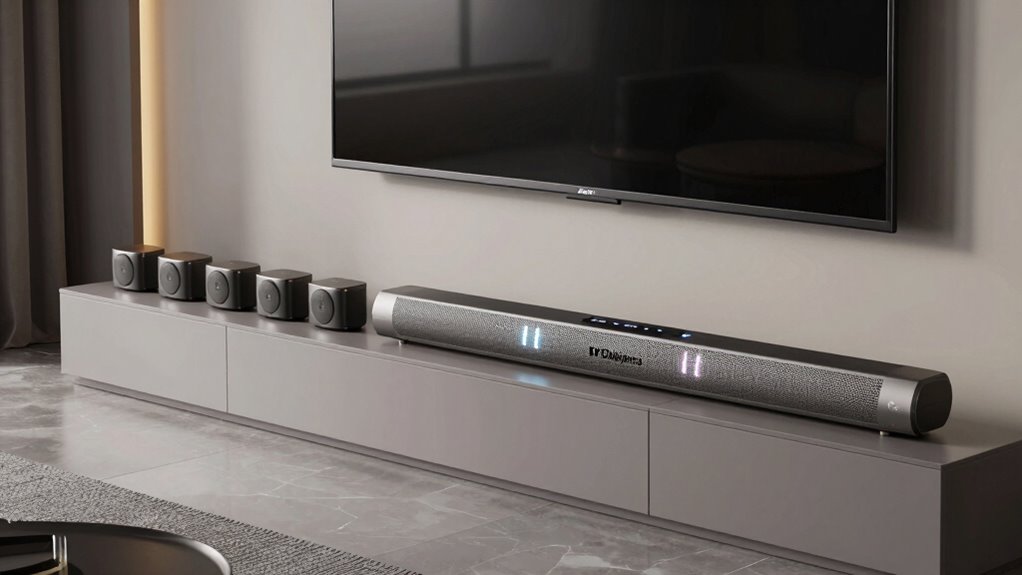

A Dolby Atmos soundbar can make films and games sound more spacious, but the experience depends on speaker layout, room shape, and how much equipment you want around your TV. My best overall pick is the Sonos Arc Ultra for buyers seeking a premium, single-bar setup, while the JBL Bar 800 stands out for detachable rear speakers and the Polk Audio Signa S4 for a straightforward bar-and-subwoofer system. Across these 15 options, the main tradeoffs are immersive effects versus easy placement, bass depth versus compact size, and surround performance versus setup complexity. Some models use upward-firing or rear speakers, while others create a more virtual Atmos effect from the bar itself. Read on for the full breakdown and guidance on matching a soundbar to your room, TV, and listening habits.

Get kitchen staples and gadgets delivered free with Prime
- Fast, free delivery on millions of items
- Prime Video, Amazon Music and more included
- Member-only deals all year
Key Takeaways
- The strongest Atmos ambitions come with extra hardware: the JBL Bar 800 and JBL Bar 1300XMK2 use detachable surround speakers, while the Sonos Arc Ultra keeps the system centered on a single bar.
- Separate subwoofers are a recurring value in this lineup: models such as the Polk Signa S4 and TCL S60K include wireless subs, but compact and built-in-subwoofer designs trade some placement flexibility for fewer boxes.
- Channel count alone does not settle the choice: room layout, speaker direction, and the location of listening seats affect how convincingly overhead and rear effects come across.
- Entry-level Atmos labels cover different experiences: the TCL S45H is a 2.0 design with virtual processing, while systems with dedicated height or surround speakers have more physical channels to work with.
- Smart features and sound format support are separate buying decisions: app ecosystems, voice control, streaming, and TV connections can matter as much as Atmos when choosing between premium and simpler systems.
| TCL S60K 3.1-Channel Soundbar with Dolby Atmos and Wireless Subwoofer |  | Best for Dialogue and Room Tuning | Audio channels: 3.1 | Maximum output power: 340 watts | Subwoofer driver: 6.5 inches | VIEW ON AMAZON | See Our Full Breakdown |
| Bose Smart Dolby Atmos Soundbar with Alexa |  | Best Compact All-in-One | Audio format: Dolby Atmos | Audio technology: Bose TrueSpace | Drivers: Five transducers, including two upward-firing | VIEW ON AMAZON | See Our Full Breakdown |
| Sonos Beam Gen 2 Soundbar with Dolby Atmos, Black |  | Best for Sonos Streaming and Multiroom | Audio channels: 2 | Audio output mode: Surround | Maximum output power: 200 watts | VIEW ON AMAZON | See Our Full Breakdown |
| Sonos Arc Ultra Soundbar with Dolby Atmos, Black |  | Best Premium Atmos Upgrade | Audio channels: 9.1.4 | Connectivity: HDMI eARC, Wi-Fi, Bluetooth | Audio features: Dolby Atmos, Speech Enhancement, Trueplay | VIEW ON AMAZON | See Our Full Breakdown |
| Polk Audio Signa S4 Dolby Atmos Soundbar with 5.9-Inch Wireless Subwoofer |  | Best Value for Dedicated Height Channels | Channels: 3.1.2 | Audio format: Dolby Atmos | Subwoofer: 5.9-inch wireless | VIEW ON AMAZON | See Our Full Breakdown |
| ULTIMEA 5.1.2-Channel Dolby Atmos Soundbar System |  | Best for App-Based Sound Tuning | Channels: 5.1.2 | Audio format: Dolby Atmos | Surround speakers: 2 | VIEW ON AMAZON | See Our Full Breakdown |
| TCL S65K 5.1-Channel Soundbar System with Dolby Atmos and Wireless Surround Speakers |  | Best for Flexible Surround Placement | Audio channels: 5.1 | Maximum output power: 630 watts | Audio technologies: Dolby Atmos, DTS:X, DTS Virtual:X | VIEW ON AMAZON | See Our Full Breakdown |
| Amazon Fire TV Soundbar Plus 3.1 Channel Soundbar with Built-In Subwoofer |  | Best All-in-One for Dialogue | Speaker channels: 3.1 with built-in subwoofer | Audio formats: Dolby Atmos, DTS:X | Dimensions: 37 × 5.2 × 2.5 inches | VIEW ON AMAZON | See Our Full Breakdown |
| JBL Bar 800 5.1.2 Channel Soundbar with Detachable Surround Speakers, Dolby Atmos, 10-inch Wireless Subwoofer, Wi-Fi, AirPlay, Alexa Multi-Room Music & Chromecast – Black |  | Best for Wire-Free Physical Surround | Channels: 5.1.2 | Dolby Atmos drivers: Two up-firing drivers | Surround speakers: Detachable, battery-powered | VIEW ON AMAZON | See Our Full Breakdown |
| LG S70TY 3.1.1-Channel Soundbar with Wireless Subwoofer |  | Best for LG TV Integration | Channels: 3.1.1 | Audio technologies: Dolby Atmos and DTS | Center channel: Up-firing | VIEW ON AMAZON | See Our Full Breakdown |
| Yamaha SR-B30A Dolby Atmos Soundbar with Built-In Subwoofers, Bluetooth, Black |  | Best All-in-One for Simple Setup | Audio formats: Dolby Atmos, Dolby TrueHD 7.1, Dolby Digital Plus | Connectivity: HDMI eARC/ARC, Bluetooth | Bluetooth range: 10 meters | VIEW ON AMAZON | See Our Full Breakdown |
| JBL Bar 1300XMK2 Dolby Atmos Soundbar with Detachable Speakers, Black |  | Best for a Full Surround-Sound Upgrade | Audio channels: 11.1.4 | Maximum output power: 1570 watts | Subwoofer: 12-inch wireless | VIEW ON AMAZON | See Our Full Breakdown |
| ULTIMEA Poseidon M60 5.1-Channel Dolby Atmos Soundbar System |  | Best for Sound Customization | Audio channels: 5.1 | Peak power: 300 W | Drivers: 6 total: five built-in speakers and one subwoofer driver | VIEW ON AMAZON | See Our Full Breakdown |
| TCL S45H 2.0 Sound Bar with Dolby Atmos, DTS Virtual:X, and Bluetooth |  | Best Compact Entry Point | Channel configuration: 2.0 | Total output power: Up to 100 W | Audio formats: Dolby Atmos, DTS Virtual:X | VIEW ON AMAZON | See Our Full Breakdown |
| TCL S55H 2.1 Soundbar with Wireless Subwoofer |  | Best for Added Bass in a Small-to-Medium Room | Audio channels: 2.1 | Total power output: Up to 220 W | Audio formats: Dolby Atmos, DTS Virtual:X | VIEW ON AMAZON | See Our Full Breakdown |
| dolby atmos soundbar | Connectivity |
|---|---|
| TCL S60K 3.1-Channel Soundbar | Bluetooth, USB, Wi-Fi, HDMI |
| Bose Smart Dolby Atmos Soundba | — |
| Sonos Beam Gen 2 Soundbar with | HDMI, Wi-Fi, Ethernet, AirPlay 2 |
| Sonos Arc Ultra Soundbar with | HDMI eARC, Wi-Fi, Bluetooth |
| Polk Audio Signa S4 Dolby Atmo | HDMI eARC, Bluetooth |
| ULTIMEA 5.1.2-Channel Dolby At | HDMI eARC, Bluetooth 5.4 |
| TCL S65K 5.1-Channel Soundbar | Bluetooth, USB, Wi-Fi, HDMI |
| Amazon Fire TV Soundbar Plus 3 | — |
| JBL Bar 800 5.1.2 Channel Soun | HDMI eARC, Wi-Fi |
| LG S70TY 3.1.1-Channel Soundba | — |
| Yamaha SR-B30A Dolby Atmos Sou | HDMI eARC/ARC, Bluetooth |
| JBL Bar 1300XMK2 Dolby Atmos S | Bluetooth, Ethernet, HDMI, Optical, USB, Wi-Fi |
| ULTIMEA Poseidon M60 5.1-Chann | HDMI eARC, Bluetooth 5.4 |
| TCL S45H 2.0 Sound Bar with Do | HDMI eARC/ARC, optical, Bluetooth, AUX |
| TCL S55H 2.1 Soundbar with Wir | HDMI eARC/ARC, optical, Bluetooth 5.2, AUX |
More Details on Our Top Picks
TCL S60K 3.1-Channel Soundbar with Dolby Atmos and Wireless Subwoofer
The TCL S60K is a strong fit for viewers who want dialogue-focused sound and a separate subwoofer without stepping up to a large, expandable system. Its 3.1-channel layout gives voices a dedicated center channel, while AI Sonic room calibration can adapt playback to the space. Dolby Atmos and DTS:X support add format flexibility, though those formats alone do not guarantee the more convincing height effects offered by systems with dedicated upward-firing channels, such as the Polk Audio Signa S4.
The wireless 6.5-inch subwoofer and Bass Boost give this TCL a fuller low end than the all-in-one Bose Smart Dolby Atmos Soundbar. The tradeoff is that some features, including ChoruSound, depend on a compatible TCL TV. I would choose it for a TCL-centered setup, but buyers seeking a brand-neutral compact bar or a clearly specified height-channel layout should compare alternatives.
Pros:- Dedicated center channel helps keep dialogue distinct from effects.
- Supports Dolby Atmos, DTS:X, and DTS Virtual:X.
- Wireless 6.5-inch subwoofer adds bass without a cable running to the bar.
- AI Sonic room calibration can tailor sound to the listening space.
Cons:- Some features, including ChoruSound, require a compatible TCL TV.
- No dedicated height-channel count is specified, unlike the Polk Audio Signa S4’s 3.1.2 layout.
Best for: TCL TV owners who prioritize clearer dialogue, room calibration, and a wireless subwoofer for movies and everyday viewing.
Not ideal for: Buyers who want a Dolby Atmos system with specified up-firing channels or who do not want selected features tied to a compatible TCL TV.
- Audio channels:3.1
- Maximum output power:340 watts
- Subwoofer driver:6.5 inches
- Audio formats:Dolby Atmos, DTS:X, DTS Virtual:X
- Connectivity:Bluetooth, USB, Wi-Fi, HDMI
- Room calibration:AI Sonic
- Mounting type:Wall mount
- Control method:Remote
Our verdict“Choose the S60K if dialogue clarity, room calibration, and a wireless subwoofer matter more than a specified height-speaker layout.”
Bose Smart Dolby Atmos Soundbar with Alexa
The Bose Smart Dolby Atmos Soundbar suits buyers who want an uncomplicated, compact bar with streaming and voice control built in. Five transducers, including two upward-firing drivers, work with Bose TrueSpace to create a more enveloping presentation from one enclosure; A.I. Dialogue Mode gives voices extra emphasis when mixes get busy. Its 27.34-inch width makes it easier to place than the much wider Polk Audio Signa S4, which also comes with a separate subwoofer.
That compactness comes with limits: the Bose is an all-in-one design, so it does not include the dedicated wireless subwoofer found with the TCL S60K. It offers broad streaming support, including AirPlay 2 and Chromecast, but rear surround sound requires separately sold Bose Ultra Open Earbuds. I would pick it for a tidy, connected setup, not for buyers seeking a conventional multi-speaker system or a straightforward path to rear speakers.
Pros:- Two upward-firing drivers and TrueSpace support immersive playback from a compact bar.
- A.I. Dialogue Mode helps voices stand out in busy scenes.
- Supports Wi-Fi, Bluetooth, AirPlay 2, Spotify Connect, and Chromecast.
- Alexa is built in, with voice, app, and remote controls.
Cons:- No separate subwoofer is included, unlike the TCL S60K and Polk Audio Signa S4.
- Rear surround sound requires separately sold Bose Ultra Open Earbuds.
- Its all-in-one design offers less conventional system expansion than the Sonos Arc Ultra.
Best for: Apartment dwellers and streaming-focused viewers who want a compact Dolby Atmos bar with built-in voice assistance and minimal separate equipment.
Not ideal for: Listeners who want a bundled subwoofer, conventional rear speakers, or a multi-speaker system they can expand with standard surround components.
- Audio format:Dolby Atmos
- Audio technology:Bose TrueSpace
- Drivers:Five transducers, including two upward-firing
- Dialogue feature:A.I. Dialogue Mode
- Streaming:Wi-Fi, Bluetooth, Apple AirPlay 2, Spotify Connect, Chromecast
- Voice assistants:Amazon Alexa; Google Assistant capabilities
- Dimensions:4.09 × 27.34 × 2.21 inches (D × W × H)
- Mounting type:Shelf mount
Our verdict“Pick the Bose for compact Atmos playback and flexible streaming, but choose a subwoofer-equipped system if deeper bass is a priority.”
Sonos Beam Gen 2 Soundbar with Dolby Atmos, Black
The Sonos Beam Gen 2 is a sensible choice when music and multiroom listening matter alongside TV sound. It supports Dolby Atmos, streaming through the Sonos app and AirPlay 2, and control through a TV remote or voice. Setup uses two cables, and Trueplay tuning offers a way to tailor playback to the room. Compared with the more compact Bose Smart Dolby Atmos Soundbar, the Beam is especially appealing to buyers already invested in Sonos speakers and services.
Its stated two-channel configuration makes this a less explicitly height-focused pick than the Polk Audio Signa S4’s 3.1.2 layout or the Sonos Arc Ultra‘s 9.1.4 design. The Beam can deliver a panoramic presentation, but it does not include a separate subwoofer, and the supplied specs do not detail dedicated upward-firing drivers. I would choose it for a connected Sonos home, not for shoppers whose main goal is the most clearly specified Atmos channel arrangement.
Pros:- Dolby Atmos support and panoramic surround presentation.
- Works with the Sonos app, TV remote, AirPlay 2, and voice control.
- Supports music, podcast, and multiroom listening when the TV is off.
- Trueplay tuning and two-cable setup support straightforward installation.
Cons:- The listed two-channel configuration is less explicit about height playback than the Polk Audio Signa S4’s 3.1.2 layout.
- No separate subwoofer is listed, unlike the TCL S60K.
- A one-year warranty is specified.
Best for: Sonos households that want one bar for TV, music, podcasts, and multiroom streaming in a compact living room.
Not ideal for: Atmos-focused buyers who want a stated height-channel configuration or a bundled wireless subwoofer for stronger bass.
- Audio channels:2
- Audio output mode:Surround
- Maximum output power:200 watts
- Frequency response:50.4 hertz
- Connectivity:HDMI, Wi-Fi, Ethernet, AirPlay 2
- Control methods:App, remote, voice
- Mounting type:Shelf mount
- Warranty:1 year
Our verdict“Choose the Beam Gen 2 if Sonos streaming and multiroom use matter as much as TV audio, rather than dedicated height channels or included deep-bass hardware.”
Sonos Arc Ultra Soundbar with Dolby Atmos, Black
The Sonos Arc Ultra is the lineup’s clearest choice for buyers who want a high-channel-count Dolby Atmos bar and room to build a larger system later. Its 9.1.4 spatial audio configuration gives it a more ambitious stated layout than the two-channel Sonos Beam Gen 2 or the 3.1.2 Polk Audio Signa S4. Speech Enhancement addresses a common movie-night frustration by helping dialogue cut through effects, while Trueplay can tune sound for the room.
Wi-Fi, Bluetooth, AirPlay 2, Spotify Connect, and several control options make it useful beyond TV playback. The main tradeoff is that the described expanded surround setup requires a separate Sonos Sub or Era 300 speakers, so the bar alone is not the complete multi-speaker system. Its 46.18-inch size also calls for enough space beneath the TV. I would choose it for a premium Sonos-centered setup, not a small stand or a ready-to-go surround package.
Pros:- Specified 9.1.4 spatial audio layout for an ambitious Atmos presentation.
- Speech Enhancement helps dialogue remain clear.
- Supports Wi-Fi, Bluetooth, AirPlay 2, and Spotify Connect.
- Can expand with Sonos Sub and Era 300 speakers.
Cons:- The described expanded surround setup requires separately purchased Sonos components.
- Its 46.18-inch width may not suit narrow TV stands.
- The supplied specifications do not list a bundled subwoofer.
Best for: Sonos users with a wide TV area who want a premium Atmos soundbar and plan to add a Sub or Era 300 speakers for expanded surround.
Not ideal for: Buyers with limited shelf width or those who want a complete subwoofer-and-rear-speaker system included from the outset.
- Audio channels:9.1.4
- Connectivity:HDMI eARC, Wi-Fi, Bluetooth
- Audio features:Dolby Atmos, Speech Enhancement, Trueplay
- Speaker size:46.18 inches
- Number of audio circuits:14
- Control options:TV remote, Sonos app, touch controls, Sonos Voice Control, Amazon Alexa
- Mounting type:Tabletop mount
- Warranty:1 year
Our verdict“Choose the Arc Ultra for a wide, expandable Sonos Atmos setup, provided you have space and are prepared to add separate speakers for the expanded system.”
Polk Audio Signa S4 Dolby Atmos Soundbar with 5.9-Inch Wireless Subwoofer
The Polk Audio Signa S4 makes sense for shoppers who want a clearly stated Atmos layout and a wireless subwoofer without moving to a premium expandable system. Its 3.1.2 channels include up-firing speakers for height effects, giving its Atmos design a more explicit basis than the TCL S60K’s listed 3.1 configuration. VoiceAdjust and BassAdjust also let viewers tune dialogue and low-end emphasis rather than accepting a single sound profile.
The included 5.9-inch wireless subwoofer adds bass without requiring a wired connection to the bar. Compared with the compact Bose Smart Dolby Atmos Soundbar, the Signa S4 offers a more traditional bar-and-subwoofer setup, but its 41.2-inch width needs room beneath the TV. HDMI eARC and Bluetooth keep connections simple, though the supplied specs list fewer streaming options than Bose or Sonos. I would favor it for height channels and included bass over smart-home extras.
Pros:- 3.1.2 channel layout includes up-firing speakers for height effects.
- Wireless 5.9-inch subwoofer adds deeper bass without a cable to the bar.
- VoiceAdjust and BassAdjust provide separate dialogue and bass tuning.
- HDMI eARC supports a straightforward TV connection.
Cons:- The 41.2-inch bar may be too wide for smaller TV stands.
- Listed connectivity is limited to HDMI eARC and Bluetooth, unlike the Wi-Fi streaming on Bose and Sonos models.
- No built-in voice assistant is specified.
Best for: Movie and TV viewers who want specified up-firing Atmos channels, adjustable dialogue, and a wireless subwoofer in one system.
Not ideal for: Owners of narrow TV stands or buyers seeking broad Wi-Fi streaming and built-in voice assistant features.
- Channels:3.1.2
- Audio format:Dolby Atmos
- Subwoofer:5.9-inch wireless
- Dimensions:3.7 × 41.2 × 2.4 inches (D × W × H)
- Item weight:19 pounds
- Connectivity:HDMI eARC, Bluetooth
- Audio latency:16 milliseconds
- Mounting type:Wall mount
Our verdict“Pick the Signa S4 if dedicated height channels and an included wireless subwoofer matter more than compact dimensions or extensive streaming features.”
ULTIMEA 5.1.2-Channel Dolby Atmos Soundbar System
The ULTIMEA pairs up-firing Atmos drivers with two surround speakers, so it can create a more enveloping listening setup than the all-in-one Amazon Fire TV Soundbar Plus. Its HDMI eARC connection supports lossless audio transmission, while the app’s 10-band EQ and channel-level controls give hands-on listeners room to tailor the sound to their space. Compared with the TCL S65K, it offers more detailed app adjustments but lacks DTS support, which may limit compatibility with some content. The wired subwoofer also means planning around a cable, even though the surround speakers and height channels add a fuller Atmos presentation than simpler bars. I’d choose it for adjustable, multi-speaker Dolby Atmos; I’d skip it if DTS playback or a cable-free subwoofer setup matters.
Pros:- Up-firing drivers and two surround speakers create a more enveloping Atmos setup than a single-bar system.
- HDMI eARC supports lossless audio transmission.
- App provides a 10-band EQ, 121 presets, and 13-step level adjustment.
- CEC can synchronize TV power, volume, and input.
Cons:- DTS audio formats are not supported.
- The subwoofer requires a wired connection.
- The separate surround speakers and subwoofer need more placement planning than an all-in-one bar.
Best for: Movie watchers who want physical surround speakers, up-firing Atmos drivers, and extensive app-based EQ and channel tuning.
Not ideal for: Viewers with DTS-heavy media libraries or anyone who cannot accommodate a wired subwoofer connection.
- Channels:5.1.2
- Audio format:Dolby Atmos
- Surround speakers:2
- Subwoofer:5.25-inch, wired
- Connectivity:HDMI eARC, Bluetooth 5.4
- App controls:10-band EQ, 121 presets, 13-step level adjustment
- Mounting:Tabletop or wall mount
- DTS compatibility:Not supported
Our verdict“Choose the ULTIMEA if you want a configurable, multi-speaker Dolby Atmos system and can live with a wired subwoofer and no DTS support.”
TCL S65K 5.1-Channel Soundbar System with Dolby Atmos and Wireless Surround Speakers
The TCL S65K makes a strong case for buyers who want a 5.1-channel Atmos system without running speaker wires across the room: its subwoofer and surround speakers are wireless. Support for Dolby Atmos and DTS:X also gives it broader format coverage than the ULTIMEA 5.1.2, which does not decode DTS. The built-in center channel is aimed at clearer dialogue, while AI Sonic room calibration adapts the sound to the listening space. Compared with the Amazon Fire TV Soundbar Plus, the TCL adds separate surround speakers and a wireless subwoofer, but requires more components and placement than that compact all-in-one design. ChoruSound features depend on a compatible TCL TV, so buyers with another television should not choose this system for that integration. Its stated power output is substantial, but it still needs corded power.
Pros:- Wireless surround speakers and subwoofer reduce speaker-cable clutter around the room.
- Supports Dolby Atmos, DTS:X, and DTS Virtual:X.
- AI Sonic room calibration adapts playback to the space.
- Built-in center channel is designed to keep dialogue distinct.
Cons:- ChoruSound requires a compatible TCL TV.
- Multiple speakers and components need more setup and placement than an all-in-one soundbar.
- The system requires corded power.
Best for: Home-theater buyers who want wireless surround speakers, a wireless subwoofer, and both Dolby Atmos and DTS:X support.
Not ideal for: Owners of non-TCL TVs counting on ChoruSound, or buyers seeking a single compact bar with minimal setup.
- Audio channels:5.1
- Maximum output power:630 watts
- Audio technologies:Dolby Atmos, DTS:X, DTS Virtual:X
- Subwoofer driver:6.5 inches
- Surround speakers:Wireless
- Connectivity:Bluetooth, USB, Wi-Fi, HDMI
- Room calibration:AI Sonic
- Mounting type:Wall mount
Our verdict“Pick the S65K for format flexibility and wireless physical surrounds, provided its multi-component setup and TCL-specific feature limits suit your room and TV.”
Amazon Fire TV Soundbar Plus 3.1 Channel Soundbar with Built-In Subwoofer
The Fire TV Soundbar Plus keeps the Dolby Atmos setup simple: a 3.1-channel bar with a built-in subwoofer avoids the separate bass unit and rear speakers used by the JBL Bar 800. Its dedicated dialogue channel gives speech a clearer place in the mix, while support for Dolby Atmos and DTS:X covers two major immersive formats. Movie, Music, Sports, and Night modes offer straightforward listening choices, and HDMI eARC/ARC plus Bluetooth make TV and music connections accessible. The tradeoff is physical scale: at 37 inches wide, it is not especially small, and its built-in bass cannot offer the placement flexibility of a separate subwoofer like the LG S70TY. Some Fire TV audio settings also depend on the connected model. I’d favor this for a tidy, dialogue-focused upgrade, not for buyers seeking discrete rear-channel effects.
Pros:- Built-in subwoofer keeps the system to one main unit.
- Dedicated center channel is designed to clarify dialogue.
- Supports Dolby Atmos and DTS:X.
- Includes HDMI eARC/ARC, Bluetooth, and four sound modes.
Cons:- No separate subwoofer or rear surround speakers are included.
- Some Fire TV audio settings are limited to select models.
- Its 37-inch width may not suit narrower TV stands.
Best for: TV viewers who prioritize clear dialogue and Dolby Atmos support but want to avoid a separate subwoofer and surround-speaker setup.
Not ideal for: Home-theater fans seeking dedicated rear speakers, stronger bass-placement options, or access to every Fire TV audio setting on any television.
- Speaker channels:3.1 with built-in subwoofer
- Audio formats:Dolby Atmos, DTS:X
- Dimensions:37 × 5.2 × 2.5 inches
- Weight:8.8 lbs
- EQ modes:Movie, Music, Sports, Night
- Ports:HDMI, Optical, AC, USB-A
- Bluetooth:Yes
- Included accessories:Remote, HDMI 2.0 cable, AC cord, 2 AAA batteries, wall mount kit, quick start guide
Our verdict“Choose this bar for a low-clutter Atmos upgrade with a dedicated dialogue channel, but look to the JBL Bar 800 or LG S70TY for separate bass and surround components.”
JBL Bar 800 5.1.2 Channel Soundbar with Detachable Surround Speakers, Dolby Atmos, 10-inch Wireless Subwoofer, Wi-Fi, AirPlay, Alexa Multi-Room Music & Chromecast – Black
The JBL Bar 800 stands out for combining 5.1.2-channel Atmos with detachable, battery-powered surround speakers. You can place those speakers behind the seating area for physical rear effects, then return them to the bar when not in use—a more flexible arrangement than the fixed surround speakers on the ULTIMEA 5.1.2. Its 10-inch wireless subwoofer brings a separate bass unit, and built-in Wi-Fi adds AirPlay, Chromecast, and Alexa multi-room music. HDMI eARC and 4K Dolby Vision pass-through suit a modern TV setup. This flexibility comes with a larger footprint and more pieces to arrange than the Amazon Fire TV Soundbar Plus, whose subwoofer is built in. I’d shortlist the JBL for a room where detachable rear speakers and deep bass matter; it is less suited to compact stands or minimal setup.
Pros:- Up-firing drivers and detachable surround speakers support a more immersive Atmos layout.
- Battery-powered surrounds can be placed behind the listening area without running speaker wires.
- 10-inch wireless subwoofer provides a separate bass source.
- Wi-Fi supports AirPlay, Chromecast, and Alexa multi-room music.
Cons:- Soundbar, subwoofer, and detachable speakers require more setup and storage than an all-in-one system.
- The soundbar’s 34.8-inch width and separate components can challenge small TV stands.
- Surround speakers rely on battery power when detached.
Best for: Movie and TV fans who want physical rear-channel Atmos effects, a substantial separate subwoofer, and wireless music streaming.
Not ideal for: Buyers with limited TV-stand space, those seeking a simple all-in-one bar, or anyone who prefers permanently wired rear speakers.
- Channels:5.1.2
- Dolby Atmos drivers:Two up-firing drivers
- Surround speakers:Detachable, battery-powered
- Subwoofer:10-inch, wireless
- Connectivity:HDMI eARC, Wi-Fi
- Streaming:AirPlay, Alexa Multi-Room Music, Chromecast
- Video pass-through:4K Dolby Vision
- Dimensions:4.7 × 34.8 × 2.2 inches
Our verdict“Choose the JBL Bar 800 if detachable physical surrounds and a separate 10-inch subwoofer matter more than compact dimensions and minimal setup.”
LG S70TY 3.1.1-Channel Soundbar with Wireless Subwoofer
The LG S70TY is a dialogue-minded Atmos bar for buyers who already own a compatible LG TV. Its 3.1.1 layout includes an up-firing center channel intended to give voices a clearer, more elevated presence, while the wireless subwoofer adds bass without a cable running back to the bar. Dolby Atmos and DTS support provide broader format coverage than the ULTIMEA 5.1.2, which omits DTS, though the ULTIMEA has two separate surround speakers and a 5.1.2 layout for a more complete physical surround arrangement. LG’s WOW Orchestra and TV-remote control can make day-to-day use more integrated with select LG sets. Those benefits are less compelling with other brands, and optional rear speakers cost extra. I’d choose it for a compatible LG setup focused on clear dialogue, not as a full surround package out of the box.
Pros:- Up-firing center channel is designed to emphasize dialogue.
- Wireless subwoofer avoids a cable connection to the soundbar.
- Supports Dolby Atmos and DTS technologies.
- WOW Orchestra and compatible TV remote integration suit select LG TVs.
Cons:- Some integration features work only with select LG TV and soundbar models.
- Optional rear surround speakers are sold separately.
- Its 3.1.1 layout has fewer physical surround channels than the ULTIMEA 5.1.2 and JBL Bar 800.
Best for: LG TV owners who want Dolby Atmos, clearer dialogue, a wireless subwoofer, and integrated control through a compatible television.
Not ideal for: Buyers with non-LG TVs seeking the full integration features, or anyone who wants rear surround speakers included from the start.
- Channels:3.1.1
- Audio technologies:Dolby Atmos and DTS
- Center channel:Up-firing
- Subwoofer:Wireless
- Mounting type:Wall mount
- Enclosure material:Metal
- TV integration:WOW Orchestra and compatible TV remote control
- TV compatibility:Recommended for LG QNED TVs
Our verdict“The LG S70TY is a sensible match for compatible LG TV owners who value dialogue and easy control, but buyers wanting included rear speakers should choose a fuller system.”
Yamaha SR-B30A Dolby Atmos Soundbar with Built-In Subwoofers, Bluetooth, Black
The Yamaha SR-B30A suits buyers who want Dolby Atmos support without adding a separate subwoofer. Its built-in subwoofers keep the setup compact, while Clear Voice is aimed at making dialogue easier to follow during TV and movie playback. HDMI eARC/ARC handles the TV connection, and Bluetooth lets you stream music or switch between two devices. Compared with the TCL S55H, which includes a dedicated wireless subwoofer, the Yamaha keeps more equipment off the floor but gives up the flexibility and likely low-end presence of a separate bass unit. Its Atmos support adds compatible audio formats, but this single-bar design is a simpler alternative to systems with dedicated surround speakers, such as the JBL Bar 1300XMK2. Choose it for convenient everyday listening, not a room-filling multi-speaker theater setup.
Pros:- Built-in subwoofers provide bass without a separate subwoofer
- Clear Voice is designed to improve dialogue intelligibility
- HDMI eARC/ARC and Bluetooth support straightforward TV and music connections
- Supports Dolby Atmos, Dolby TrueHD 7.1, and Dolby Digital Plus
Cons:- No separate subwoofer for flexible placement or stronger dedicated bass
- Does not provide the discrete surround speakers included with the JBL Bar 1300XMK2
- Bluetooth range is specified at 10 meters
Best for: TV owners who want Atmos format support, clearer dialogue, and bass in one soundbar without placing a separate subwoofer.
Not ideal for: Movie fans seeking strong standalone subwoofer impact or convincing rear-channel surround from separate speakers.
- Audio formats:Dolby Atmos, Dolby TrueHD 7.1, Dolby Digital Plus
- Connectivity:HDMI eARC/ARC, Bluetooth
- Bluetooth range:10 meters
- Bass:Built-in subwoofers
- Dimensions:5.25 × 35.88 × 2.63 inches
- Weight:8.6 pounds
- Mounting:Wall mount
- Included control:Remote control
- Color:Black
Our verdict“Pick the Yamaha SR-B30A if you want a compact Atmos-capable setup with built-in bass and dialogue enhancement, rather than a separate subwoofer or rear speakers.”
JBL Bar 1300XMK2 Dolby Atmos Soundbar with Detachable Speakers, Black
The JBL Bar 1300XMK2 is the most ambitious system in this group for buyers who want separate surround speakers and a dedicated subwoofer, not just Atmos processing from a bar. Its 11.1.4-channel layout, Dolby Atmos and DTS:X support, and 12-inch wireless subwoofer point to a more enveloping movie setup than the compact Yamaha SR-B30A or two-channel TCL S45H. Detachable wireless speakers can also serve as Bluetooth playback speakers, giving them a use beyond movie nights. MultiBeam 3.0 shapes sound for the room, while PureVoice 2.0 targets clearer dialogue. The tradeoff is a larger, more involved system: it needs space for its components, and the detachable speakers require batteries. I’d choose it for a dedicated entertainment area, not a minimalist TV stand or a small room.
Pros:- 11.1.4-channel design includes detachable wireless surround speakers
- Supports both Dolby Atmos and DTS:X
- 12-inch wireless subwoofer and up to 1570 watts of maximum output
- Detachable speakers can provide Bluetooth playback away from the soundbar
Cons:- The multi-component system needs more room than the Yamaha SR-B30A or TCL S45H
- Detachable speakers require batteries
- Tabletop configuration may take more placement planning than an all-in-one bar
Best for: Movie and gaming fans with room for a full surround setup who want detachable speakers, dedicated bass, and both Atmos and DTS:X.
Not ideal for: Buyers with limited space, those seeking a simple single-bar installation, or anyone unwilling to manage battery-powered detachable speakers.
- Audio channels:11.1.4
- Maximum output power:1570 watts
- Subwoofer:12-inch wireless
- Audio formats:Dolby Atmos, DTS:X
- Connectivity:Bluetooth, Ethernet, HDMI, Optical, USB, Wi-Fi
- Room-shaping audio:MultiBeam 3.0
- Dialogue enhancement:PureVoice 2.0
- Mounting:Tabletop
- Color:Black
Our verdict“Choose the JBL Bar 1300XMK2 if you have space for a substantial surround system and value dedicated speakers and bass over a compact setup.”
ULTIMEA Poseidon M60 5.1-Channel Dolby Atmos Soundbar System
The ULTIMEA Poseidon M60 stands apart for listeners who want to shape the sound themselves. Its app provides a 10-band EQ, 121 presets, and 13 surround levels, offering far more adjustment than the mode-based controls described for the Yamaha SR-B30A. The 5.1-channel system combines five built-in speakers with a wired wooden subwoofer, while HDMI eARC supports lossless Dolby Atmos. VoiceMX focuses on dialogue, and side-firing speakers create surround effects without placing separate rear speakers around the room. That makes it a middle ground between a basic two-channel option like the TCL S45H and the JBL Bar 1300XMK2’s discrete detachable surrounds. The tradeoff is that its surround effect still comes from the front system, and the subwoofer’s wired connection limits placement flexibility.
Pros:- HDMI eARC supports lossless Dolby Atmos
- App offers a 10-band EQ, 121 sound presets, and 13 surround levels
- VoiceMX is designed to make dialogue clearer
- Side-firing speakers create surround effects without separate rear units
Cons:- The wired subwoofer restricts where it can be placed
- Surround effects rely on built-in speakers rather than separate rear speakers
- The stated frequency response ends at 18 kHz
Best for: Hands-on listeners who want app-based EQ and surround tuning, Atmos over HDMI eARC, and a system that avoids separate rear speakers.
Not ideal for: Buyers who need a wireless subwoofer or want discrete rear speakers for more clearly separated surround effects.
- Audio channels:5.1
- Peak power:300 W
- Drivers:6 total: five built-in speakers and one subwoofer driver
- Subwoofer:Wired wooden cabinet, 5.3 L
- Frequency response:45 Hz–18 kHz
- Maximum SPL:99 dB
- Connectivity:HDMI eARC, Bluetooth 5.4
- App features:10-band EQ, 121 sound presets, 13 surround levels
- Audio format:Dolby Atmos
Our verdict“Pick the Poseidon M60 if detailed app tuning matters more than wireless subwoofer placement or discrete rear-channel speakers.”
TCL S45H 2.0 Sound Bar with Dolby Atmos, DTS Virtual:X, and Bluetooth
The TCL S45H is a straightforward choice for buyers who want a slim bar with Atmos and virtual surround formats but do not want a multi-box system. Its 2.0-channel design uses Dolby Atmos and DTS Virtual:X to simulate height and surround effects; it does not list a separate subwoofer. AI Sonic room calibration adjusts the sound to the listening space, and connections span HDMI eARC/ARC, optical, Bluetooth, and AUX. Compared with the TCL S55H, the S45H is the simpler pick for a minimal footprint, while the S55H adds a wireless subwoofer and more output for listeners who prioritize bass. The JBL Bar 1300XMK2 goes much further with discrete surrounds, but needs more room and setup. The S45H is best for modest expectations: Atmos-compatible processing, not a dedicated height-speaker or bass-heavy theater system.
Pros:- Supports Dolby Atmos and DTS Virtual:X
- AI Sonic calibration adapts audio to the listening space
- HDMI eARC/ARC, optical, Bluetooth, and AUX support varied sources
- Includes an HDMI cable, remote, and wall-mount kit
Cons:- 2.0-channel configuration has no separate subwoofer listed
- Virtual surround effects are not the same as the JBL Bar 1300XMK2’s detachable speakers
- The product information does not specify support for adding a separate subwoofer
Best for: Apartment dwellers and casual TV viewers who want a slim, easy-to-connect bar with virtual Atmos effects and no separate subwoofer to place.
Not ideal for: Bass-focused movie watchers or buyers who expect discrete surround speakers and physical height channels.
- Channel configuration:2.0
- Total output power:Up to 100 W
- Audio formats:Dolby Atmos, DTS Virtual:X
- Room calibration:AI Sonic auto room calibration
- Connectivity:HDMI eARC/ARC, optical, Bluetooth, AUX
- Dimensions:31.89 × 2.36 × 3.86 inches (W × H × D)
- Included accessories:HDMI cable, power cord, remote with batteries, wall-mount kit
Our verdict“Choose the TCL S45H for a slim, simple Atmos-format soundbar, but step up to the S55H if a dedicated wireless subwoofer matters.”
TCL S55H 2.1 Soundbar with Wireless Subwoofer
The TCL S55H is the more bass-focused alternative to the TCL S45H, pairing a 2.1-channel bar with a wireless subwoofer and up to 220 W of output. That dedicated subwoofer gives movie effects and music a bass source the S45H’s listed 2.0 setup lacks, while Dolby Atmos and DTS Virtual:X provide virtual spatial processing. AI Sonic room calibration adjusts the sound to the space, and HDMI eARC/ARC, optical, AUX, and Bluetooth 5.2 cover common connections. Compared with the Yamaha SR-B30A, the TCL’s separate wireless subwoofer offers more flexible placement, while Yamaha keeps bass hardware inside the bar. The S55H is described as suited to small-to-medium rooms, so it is not the best match for buyers seeking the scale of the JBL Bar 1300XMK2’s 11.1.4-channel system.
Pros:- Wireless subwoofer adds dedicated bass
- Supports Dolby Atmos and DTS Virtual:X
- AI Sonic room calibration adjusts audio to the listening space
- Includes HDMI eARC/ARC, optical, Bluetooth 5.2, and AUX connections
Cons:- Best suited to small-to-medium rooms rather than large spaces
- 2.1-channel layout does not provide discrete rear speakers like the JBL Bar 1300XMK2
- Separate subwoofer requires space, unlike the all-in-one Yamaha SR-B30A
Best for: Small-to-medium-room TV owners who want a wireless subwoofer for stronger bass without moving to a full surround system.
Not ideal for: Buyers seeking discrete rear speakers, large-room output, or an all-in-one bar with no separate component to place.
- Audio channels:2.1
- Total power output:Up to 220 W
- Audio formats:Dolby Atmos, DTS Virtual:X
- Subwoofer:Wireless
- Connectivity:HDMI eARC/ARC, optical, Bluetooth 5.2, AUX
- Bluetooth range:10 meters
- Soundbar dimensions:31.89 × 2.36 × 3.86 inches
- Subwoofer dimensions:7.68 × 12.60 × 7.68 inches
- Included accessories:HDMI cable, power cord, remote with batteries, wall-mount kit
Our verdict“Choose the TCL S55H if you want a wireless subwoofer and virtual Atmos effects in a compact 2.1 setup for a small-to-medium room.”

How We Picked
I ranked these soundbars by how well their design is suited to delivering an Atmos-style home theater experience, not by channel count or feature lists alone. I weighed physical speaker configuration, included subwoofers and surround speakers, connection and control options, installation demands, and the likelihood that a typical living room can make good use of the system. A bar with dedicated rear or height channels can offer a more convincing spatial presentation, but only if the room and placement support them.
The ranking also reflects who each setup serves best. I placed versatile, capable systems ahead of models with narrower use cases, then separated premium immersion from easier setup, compact footprints, and value-oriented bundles. Every option has a tradeoff: a simpler bar can be easier to fit but relies more on processing, while a multi-speaker package takes more space and setup effort. Product-specific performance claims are not inferred from channel labels alone.
Factors to Consider When Choosing Dolby Atmos Soundbar
Choosing an Atmos soundbar is less about chasing the biggest number on the box and more about matching its speaker layout and connections to your room. These factors can help narrow the field before you decide how much hardware you want to install.
Match the Atmos design to your ceiling and room
Atmos effects may come from upward-firing speakers that bounce sound off the ceiling, dedicated height channels, or virtual processing from speakers facing forward. A flat, reasonably low ceiling can help reflected effects reach the listening area, while high, vaulted, or acoustically irregular ceilings may make them less distinct. Open-plan rooms can also scatter sound and reduce the sense of a defined surround field. Before buying, check the manufacturer’s placement guidance and think about where your main seat sits relative to the bar. If your room is a poor fit for reflections, prioritize clear dialogue and strong conventional surround over promises of dramatic overhead audio. A virtual Atmos mode can still broaden sound, but it cannot place physical speakers above you.
Decide whether you want real rear speakers
A soundbar with detachable or separate rear speakers can create a more convincing sense of sound behind the listener than a front-only bar. That benefit comes with practical demands: the speakers need suitable positions, charging or power arrangements may apply, and they can add clutter around seating. A single-bar system is easier to install and works better when there is no room behind the couch, though its surround cues depend more on digital processing. Do not assume every room needs rear speakers; in a narrow or shared space, a capable bar and subwoofer may be the more usable choice. Check whether rear units are included in the exact package rather than sold as optional accessories. Consider how often you will leave them in place, not just how immersive they could sound during a film.
Choose subwoofer depth against space and neighbors
A separate wireless subwoofer gives low-frequency effects a dedicated speaker and lets you place bass away from the TV, but it still occupies floor space and can be harder to conceal. Built-in bass drivers keep the system tidy, which may suit apartments or small rooms where deep bass is not a priority. The room itself changes bass response: corners can amplify it, while an awkward position may leave the sound uneven. A common mistake is choosing the largest subwoofer package without considering late-night listening or shared walls. Look for bass adjustment or night modes if you need to control impact without changing the whole system. The best fit is the one whose bass you can comfortably manage in your actual home.
Check TV connections and format compatibility
Before purchase, check whether your TV and soundbar support the HDMI connection and audio formats you plan to use. HDMI eARC can carry higher-bandwidth audio from compatible TVs, while older ARC connections may have format limits; optical connections are more limited still. Also check how many HDMI inputs the bar offers if you connect a console or streaming box directly. Atmos content must be delivered by the app or source device in a compatible format, so a soundbar cannot add genuine Atmos information to every program. Confirm that your TV’s audio passthrough settings work with your source devices, especially if you use a game console. A quick compatibility check can prevent a capable system from being held back by the rest of the setup.
Prioritize dialogue and everyday listening
Many buyers spend more time watching news, dialogue-heavy shows, or sports than blockbuster films, so speech clarity deserves its own place in the decision. A center channel or dialogue-enhancement control can help keep voices distinct, but results also depend on the TV stand, listening distance, and room reflections. Try to identify whether the system offers separate voice adjustment, night listening, or volume leveling rather than relying on a general sound mode. Those controls can be more useful day to day than extra surround channels. If you often listen at low volume, seek a setup that makes voices intelligible without needing heavy bass or high overall volume. A soundbar that fits everyday habits will get more use than a more elaborate system that only suits occasional movie nights.
Weigh ecosystem features against simplicity
Wi-Fi streaming, voice assistants, app control, and multiroom playback can make a soundbar useful beyond TV audio, but each feature adds another setup and compatibility question. Choose a connected ecosystem if you already use its services or want the bar to join other speakers in your home. If you mainly watch TV, straightforward HDMI control and a reliable remote may matter more than a long list of streaming options. Check whether voice control is built in, requires a separate device, or varies by region and setup. Also consider how you prefer to adjust sound: app-only controls can be inconvenient when another household member wants a quick change. Paying for smart features makes sense when they fit existing routines, not simply because they appear on the specification sheet.
Frequently Asked Questions
Will any Dolby Atmos soundbar give me sound from above?
No. The Atmos name describes an audio format, while the soundbar’s speaker design determines how it reproduces height cues. Some systems use upward-firing drivers or dedicated height channels; simpler bars rely on processing to create a wider impression from the front. Reflections also depend on ceiling height, shape, and seating position. If overhead effects are your priority, compare physical speaker layouts and check your room before choosing based on the Atmos label alone.
Should I choose a soundbar with detachable rear speakers or a simpler system?
Choose detachable or separate rear speakers if your seating area gives you places to position them and you want effects to come from behind rather than mostly from the TV wall. A simpler bar is easier to install and can be a better match for a small room, open layout, or shared space with limited outlets. Think about whether you will keep rear units set up after the first week, since convenience affects everyday use. For a room without useful rear placement, a well-matched front system is often the more sensible purchase.
Do I need a separate subwoofer for an Atmos soundbar?
No, a separate subwoofer is not required for Atmos playback, and it does not create height effects by itself. Its main job is to handle low bass, adding weight to explosions, music, and other deep sounds. A separate unit can offer more bass presence and flexible placement, but it takes floor space and may be too much for thin walls or late-night viewing. If tidy installation and restrained bass matter more, a bar with built-in bass drivers can be a better fit.
Will my TV let a Dolby Atmos soundbar play Atmos from every app and device?
Not always. Atmos playback depends on the content, streaming service, source device, TV audio settings, and connection path all supporting a compatible format. HDMI eARC generally offers more audio bandwidth than optical, while standard ARC can have format limitations depending on the equipment. Check the specifications for both your TV and soundbar, then confirm that your console or streaming box can pass audio through correctly. A soundbar’s Atmos capability does not convert ordinary stereo or surround content into the original Atmos mix.
Is a compact Atmos soundbar a better choice for a small room?
Often, but room size is only part of the decision. A compact bar can be easier to place and may avoid overpowering a small space, while a larger multi-speaker system could add clutter without a good position for its surrounds. A separate subwoofer may still suit a small room if its output can be adjusted and placed carefully. Check the distance between the TV, the main seat, and the side walls before choosing a wide bar or rear speakers. For modest listening needs, clear dialogue and convenient controls can matter more than maximum channel count.
Conclusion
For a premium, streamlined system, I recommend the Sonos Arc Ultra as the best overall pick in this roundup. The Polk Audio Signa S4 is my value-oriented choice for buyers who want a bar-and-subwoofer setup without moving to a more involved surround package, while the JBL Bar 1300XMK2 is best suited to shoppers prioritizing a more elaborate, detachable-speaker experience. For beginners who want a simpler starting point, the TCL S60K offers a straightforward bar-and-wireless-subwoofer format; the TCL S45H is a compact option when space and simplicity matter more than physical height channels. Choose the JBL Bar 800 if detachable surrounds are your priority, or consider the Sonos Beam Gen 2 when a smaller footprint is more useful than the Arc Ultra’s premium role. Match the system to your room, TV connections, and appetite for extra speakers before making the final choice.
Evergreen bestsellers Picks

Bose QuietComfort Ultra Headphones (2nd Gen), Wireless Noise-Cancelling Over-Ear Headphones with Spatial Audio, Driftwood Sand
Bose QuietComfort Ultra Earbuds (2nd Gen), Wireless Noise-Cancelling Earbuds with Immersive Audio and Wireless Charging Case, Black

Philips 2200 Series Fully Automatic Espresso Machine with Classic Milk Frother
As an affiliate, we earn on qualifying purchases.