
For most home theater buyers, I’d start with the Denon AVR-X1800H: its 7.2-channel layout and current HDMI features make it a flexible fit for a growing system. The Onkyo TX-RZ50 is the step-up choice for a more ambitious surround setup, while the Denon AVR-S570BT suits simpler 5.2-channel systems. The main tradeoff is between room for more speakers and connections, on one hand, and an easier setup with fewer capabilities, on the other. Buyers focused on stereo music should also separate dedicated two-channel receivers from home theater models. Read on for how these 11 receivers differ and which one fits your setup.

Get kitchen staples and gadgets delivered free with Prime
- Fast, free delivery on millions of items
- Prime Video, Amazon Music and more included
- Member-only deals all year
Key Takeaways
- The Denon AVR-X1800H is my best overall pick for buyers who want 7.2-channel flexibility and modern home theater connections without moving to the largest models.
- The Onkyo TX-RZ50 is the higher-capability option for buyers planning a more involved surround system; its extra channels matter most when the speaker plan can use them.
- The Denon AVR-S570BT and Sony STR-DH590 suit simpler 5.2 systems, while the Sony STR-DH190 serves two-channel stereo rather than surround sound.
- HDMI features vary across this lineup: check the specific receiver’s supported video formats and inputs against every console, TV, and source device before buying.
- Room correction, streaming platforms, and control ecosystems separate otherwise similar receivers; choosing one that fits your setup can matter more than choosing the model with the longest feature list.
| Sony STR-DH190 2-Channel Home Stereo Receiver with Phono Inputs and Bluetooth |  | Best for Vinyl and Simple Stereo | Channels: 2 | Output power: 100 W × 2 (8 ohms, 1 kHz) | Speaker impedance: 6–16 ohms | VIEW ON AMAZON | See Our Full Breakdown |
| Onkyo TX-RZ50 9.2-Channel THX-Certified AV Receiver |  | Best for Advanced Home Theater | Channels: 9.2-channel; processing up to 11.2 channels | Room correction: Dirac Live | Certification: THX | VIEW ON AMAZON | See Our Full Breakdown |
| Onkyo TX-NR6100 7.2-Channel THX Certified Network AV Receiver, Black |  | Best for Immersive Sound on a Flexible Setup | Channels: 7.2 | Amplifier power: 210 W per channel dynamic audio amplification | Audio formats: Dolby Atmos, DTS:X | VIEW ON AMAZON | See Our Full Breakdown |
| Sony STR-DH590 5.2-Channel 4K HDR Home Theater AV Receiver with Bluetooth |  | Best for Straightforward 5.2 Home Theater | Channels: 5.2 | HDMI inputs and output: 4 inputs, 1 output | Video support: 4K HDR pass-through, HDCP 2.2 | VIEW ON AMAZON | See Our Full Breakdown |
| Yamaha RX-V385 5.1-Channel 4K Ultra HD AV Receiver with Bluetooth |  | Best for Guided Entry-Level Setup | Channels: 5.1 | Video support: 4K Ultra HD, HDR10, Dolby Vision | Connectivity: HDMI 2.1, Bluetooth | VIEW ON AMAZON | See Our Full Breakdown |
| Denon AVR-X1700H 7.2-Channel 8K AV Receiver with HEOS |  | Best for Flexible Streaming | Channels: 7.2 | Power output: 80 W per channel | HDMI inputs / outputs: 6 / 1 | VIEW ON AMAZON | See Our Full Breakdown |
| Yamaha RX300A 5.2-Channel AV Receiver with Dolby Atmos, 4K/120 and 8K/60 HDMI, and Bluetooth Multipoint |  | Best for Gaming in a Compact System | Channels: 5.2 | Power: 70 W | Supported speaker layout: Up to 3.1.2 channels | VIEW ON AMAZON | See Our Full Breakdown |
| Yamaha RX-A2A AVENTAGE 7.2-Channel AV Receiver | 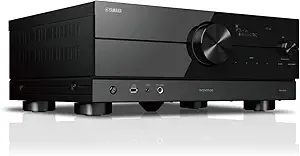 | Best for Multi-Room and Room Calibration | Channels: 7.2 | Zone support: Zone 2 | HDMI inputs / outputs: 7 / 1 | VIEW ON AMAZON | See Our Full Breakdown |
| Denon AVR-X1800H 7.2-Channel AV Receiver with Wi-Fi and Bluetooth |  | Best for a Modern 7.2-Channel Theater | Channels: 7.2 | Power output: 80 W per channel | HDMI inputs / outputs: 6 / 2 | VIEW ON AMAZON | See Our Full Breakdown |
| Yamaha RX-V4A 5.2-Channel AV Receiver with MusicCast |  | Best for a Straightforward 5.2-Channel Setup | Channels: 5.2 | HDMI inputs / outputs: 4 / 1 | HDMI features: HDMI 2.1, HDCP 2.3, eARC | VIEW ON AMAZON | See Our Full Breakdown |
| Denon AVR-S570BT 5.2-Channel AV Receiver with 8K HDMI |  | Best 8K Starter Receiver | Channels: 5.2 | Power output: 70 W x 5 | HDMI inputs: 4 HDMI 2.1 inputs with 8K support | VIEW ON AMAZON | See Our Full Breakdown |
| av receiver | Channels | Audio formats | Video support |
|---|---|---|---|
| Sony STR-DH190 2-Channel Home | 2 | — | — |
| Onkyo TX-RZ50 9.2-Channel THX- | 9.2-channel; processing up to 11.2 channels | — | — |
| Onkyo TX-NR6100 7.2-Channel TH | 7.2 | Dolby Atmos, DTS:X | 8K |
| Sony STR-DH590 5.2-Channel 4K | 5.2 | — | 4K HDR pass-through, HDCP 2.2 |
| Yamaha RX-V385 5.1-Channel 4K | 5.1 | — | 4K Ultra HD, HDR10, Dolby Vision |
| Denon AVR-X1700H 7.2-Channel 8 | 7.2 | Dolby Atmos, Dolby Atmos Height Virtualization, DTS:X, DTS Virtual:X | — |
| Yamaha RX300A 5.2-Channel AV R | 5.2 | Dolby Atmos, DTS Virtual:X | 4K/120, 8K/60 |
| Yamaha RX-A2A AVENTAGE 7.2-Cha | 7.2 | — | All inputs support 4K/60; three support 8K/60B and 4K/120AB |
| Denon AVR-X1800H 7.2-Channel A | 7.2 | Dolby Atmos, DTS:X, DTS Virtual:X | — |
| Yamaha RX-V4A 5.2-Channel AV R | 5.2 | Dolby TrueHD, Dolby Digital, DTS-HD Master Audio | 4K/60, 4K/120AB, 8K/60B |
| Denon AVR-S570BT 5.2-Channel A | 5.2 | DTS-HD Master Audio, Dolby TrueHD | — |
More Details on Our Top Picks
Sony STR-DH190 2-Channel Home Stereo Receiver with Phono Inputs and Bluetooth
The Sony STR-DH190 suits a listener building a straightforward music setup around a turntable. Its phono input avoids the need for a separate phono preamp, while Bluetooth and several analog inputs make it easy to add a phone or other sources. A/B speaker switching can serve two speaker pairs, though it does not turn this into a multichannel home theater receiver. Compared with the Sony STR-DH590, it gives up surround sound and HDMI connections in favor of a simpler stereo layout with more direct vinyl support. That makes it a better fit for music-first cabinets, but a poor match for buyers routing a TV and multiple video devices. Choose it for stereo playback and flexible speaker switching; skip it if movies and surround formats are part of the plan.
Pros:- Built-in phono input connects a turntable directly.
- Bluetooth adds wireless playback from compatible devices.
- A/B switching supports two speaker pairs.
- Four stereo RCA inputs accommodate multiple analog sources.
Cons:- Two-channel design does not support multichannel movie sound.
- No HDMI inputs for connecting a TV or video sources.
Best for: Vinyl listeners who want Bluetooth, several analog sources, and the option to switch between two speaker pairs.
Not ideal for: Home theater buyers who need HDMI video switching, a center channel, or surround sound.
- Channels:2
- Output power:100 W × 2 (8 ohms, 1 kHz)
- Speaker impedance:6–16 ohms
- Inputs:Phono, 4 stereo RCA, 3.5 mm
- Outputs:Stereo RCA
- Speaker support:Up to 4 speakers with A/B switching
- FM presets:30
- Power requirement:AC 120 V, 60 Hz
Our verdict“Pick the STR-DH190 for a turntable-centered stereo system, and look to the STR-DH590 for basic multichannel TV and movie use.”
Onkyo TX-RZ50 9.2-Channel THX-Certified AV Receiver
The Onkyo TX-RZ50 is the strongest fit here for buyers planning a large, carefully tuned theater. It drives a 9.2-channel setup and can process up to 11.2 channels, while Dirac Live room correction helps adapt sound to the room rather than relying on speaker placement alone. THX certification and 8K/4K HDMI transfer add support for a capable home theater and newer video sources. The Onkyo TX-NR6100 also offers immersive formats and 8K video, but the RZ50 gives builders more processing headroom and room correction options. That extra capability comes with a large, heavy chassis and more setup complexity. It is a considered choice for a dedicated system; buyers with a basic 5.1 plan may find the Sony STR-DH590 easier to live with.
Pros:- 9.2-channel receiver with processing for up to 11.2 channels.
- Dirac Live room correction can help tailor sound to the listening space.
- THX certification and 8K/4K HDMI transfer support theater and video setups.
- Three HDMI outputs and multiple streaming services offer flexible connections.
Cons:- At 36.1 pounds, the chassis is heavy and needs suitable cabinet space.
- Its channel processing and correction features can add setup work for simpler systems.
Best for: Home theater builders adding multiple height or surround speakers who want Dirac Live room correction and broad source support.
Not ideal for: Small-room buyers seeking a compact, simple receiver for a basic 5.1 setup.
- Channels:9.2-channel; processing up to 11.2 channels
- Room correction:Dirac Live
- Certification:THX
- HDMI ports:8
- HDMI outputs:3
- HDMI transfer:8K/4K at up to 40 Gbps
- Connectivity:Bluetooth
- Dimensions and weight:15.68 × 17.13 × 7.94 inches; 36.1 pounds
Our verdict“Choose the TX-RZ50 for a larger theater where expanded processing and Dirac Live matter more than compact size and simple setup.”
Onkyo TX-NR6100 7.2-Channel THX Certified Network AV Receiver, Black
The Onkyo TX-NR6100 is a middle-ground pick for buyers who want immersive formats and a second zone without moving up to the TX-RZ50’s larger processing ceiling. Its 7.2 channels support Dolby Atmos and DTS:X playback, and discrete Zone 2 audio and video can serve another room. Three 40 Gbps HDMI 2.1 inputs bring high-bandwidth connections to compatible video sources, while THX Select certification marks it for home theater use. Compared with the Sony STR-DH590, it is better equipped for height effects and multiroom flexibility; compared with the RZ50, it has less channel processing and no listed Dirac Live correction. The supplied power figure is described as dynamic amplification, so it should not be read as a straightforward continuous per-channel rating. This receiver suits buyers with a clear plan for Atmos or Zone 2.
Pros:- Dolby Atmos and DTS:X support enable immersive sound formats.
- Three 40 Gbps HDMI 2.1 inputs support high-bandwidth sources.
- Discrete Zone 2 handles audio and video in another area.
- THX Select certification is aimed at home theater use.
Cons:- Seven-channel playback offers less expansion room than the TX-RZ50.
- The listed 210 W per channel is a dynamic amplification figure, not a clearly specified continuous output rating.
Best for: Movie and gaming households planning a 7.2 setup, Atmos or DTS:X playback, and a separate Zone 2 system.
Not ideal for: Listeners who need more than 7.2 channels of playback or want the RZ50’s Dirac Live room correction.
- Channels:7.2
- Amplifier power:210 W per channel dynamic audio amplification
- Audio formats:Dolby Atmos, DTS:X
- Video support:8K
- HDMI:HDMI 2.1; three 40 Gbps inputs
- Certification:THX Select
- Zone support:Discrete Zone 2 audio and video
- Color:Black
Our verdict“Choose the TX-NR6100 if Atmos, HDMI 2.1 sources, and Zone 2 fit your system, while the TX-RZ50 is the step up for expanded processing.”
Sony STR-DH590 5.2-Channel 4K HDR Home Theater AV Receiver with Bluetooth
The Sony STR-DH590 keeps a basic home theater plan approachable: it has four HDMI inputs, 4K HDR pass-through with HDCP 2.2, and Bluetooth for music without adding a streamer. Its 5.2-channel layout is a practical fit for a TV room with a center speaker and subwoofer, while S-Force PRO offers a virtual surround mode for a two-speaker arrangement. That mode is not a substitute for dedicated surround speakers, so buyers building an immersive system should compare it with the Onkyo TX-NR6100, which supports Dolby Atmos and DTS:X. The Yamaha RX-V385 adds YPAO auto-calibration, a useful setup aid absent from the supplied Sony details. The STR-DH590 makes more sense for a modest conventional setup than for future expansion or advanced surround formats.
Pros:- Four HDMI inputs connect several video sources.
- 4K HDR pass-through with HDCP 2.2 supports compatible video components.
- Bluetooth includes standby support for convenient music playback.
- FM radio and a headphone jack add listening options.
Cons:- S-Force PRO virtual surround is designed for a two-speaker setup.
- No Dolby Atmos or DTS:X support is listed, limiting immersive-format options.
Best for: TV and movie viewers assembling a conventional 5.1 or 5.2 system with a few HDMI sources and Bluetooth music.
Not ideal for: Buyers seeking Dolby Atmos, DTS:X, advanced room correction, or extensive system expansion.
- Channels:5.2
- HDMI inputs and output:4 inputs, 1 output
- Video support:4K HDR pass-through, HDCP 2.2
- Bluetooth:Yes
- Power:725 watts
- Speaker impedance:6 ohms
- Audio inputs:4 stereo RCA
- Digital audio inputs:1 optical, 1 coaxial
Our verdict“Pick the STR-DH590 for a simple 4K HDR living-room system, or choose the TX-NR6100 for Atmos and DTS:X expansion.”
Yamaha RX-V385 5.1-Channel 4K Ultra HD AV Receiver with Bluetooth
The Yamaha RX-V385 is a sensible entry point for buyers who want a conventional 5.1 system and help matching sound to their room. Its YPAO auto-calibration can simplify initial speaker setup, while Bluetooth handles casual music playback and support for 4K, HDR10, and Dolby Vision keeps compatible video sources in the mix. Compared with the Sony STR-DH590, the Yamaha offers automatic calibration and Dolby Vision support, while the Sony provides a 5.2 layout and FM radio. Neither is the right choice for a buyer set on Atmos or DTS:X; the Onkyo TX-NR6100 offers those formats and 8K video at a more expansive system tier. Four HDMI inputs may fill up quickly if a TV, console, streamer, and disc player all need direct connections. Its appeal is a manageable first setup, with limited room to grow.
Pros:- YPAO auto-calibration helps with initial room and speaker setup.
- Supports 4K Ultra HD, HDR10, and Dolby Vision.
- Bluetooth provides wireless audio playback.
- Audio delay adjustment allows synchronization tuning.
Cons:- Four HDMI inputs can be restrictive for systems with several video sources.
- 5.1 channels do not provide the expansion options of the Onkyo models.
- Built-in Wi-Fi is not listed in the supplied product details.
Best for: First-time 5.1 buyers who want YPAO calibration, Bluetooth, and Dolby Vision support in a conventional setup.
Not ideal for: Buyers with many HDMI sources or plans for Atmos, DTS:X, and a larger speaker layout.
- Channels:5.1
- Video support:4K Ultra HD, HDR10, Dolby Vision
- Connectivity:HDMI 2.1, Bluetooth
- HDMI inputs and output:4 inputs, 1 output
- Audio features:Audio delay adjustment, 0–500 ms
- Room calibration:YPAO auto-calibration
Our verdict“Choose the RX-V385 for a first 5.1 system where guided calibration matters, and the TX-NR6100 if immersive formats are a priority.”
Denon AVR-X1700H 7.2-Channel 8K AV Receiver with HEOS
The AVR-X1700H pairs a 7.2-channel layout with HEOS, Wi-Fi, AirPlay 2, and Bluetooth, so it suits a theater that also serves as a regular music system. Its 80 watts per channel and Dolby Atmos and DTS:X support give it more room for immersive speaker setups than the 5.2-channel Yamaha RX-V4A. Six HDMI inputs and 8K pass-through cover a broad range of sources, while two subwoofer pre-outs make dual-subwoofer connections straightforward. The tradeoff is that only select HDMI inputs support 4K/120Hz, which can complicate setups with several current-generation gaming sources. Choose it for the combination of surround sound and multi-room streaming; skip it if every connected device needs a high-refresh HDMI input.
Pros:- 7.2 channels support Dolby Atmos and DTS:X speaker layouts
- HEOS, Wi-Fi, AirPlay 2, and Bluetooth provide several streaming paths
- Two subwoofer pre-outs simplify a dual-subwoofer setup
- Voice assistant compatibility includes Alexa, Google Assistant, Siri, and Josh.ai
Cons:- Only select HDMI inputs support 4K/120Hz pass-through
- One HDMI output offers less display flexibility than the AVR-X1800H’s two outputs
Best for: Households building a 7.2-channel theater that also want HEOS multi-room music and broad voice assistant support
Not ideal for: Gamers connecting several 4K/120Hz devices who need high-refresh pass-through on every HDMI input
- Channels:7.2
- Power output:80 W per channel
- HDMI inputs / outputs:6 / 1
- Video pass-through:8K/60Hz and select 4K/120Hz
- Audio formats:Dolby Atmos, Dolby Atmos Height Virtualization, DTS:X, DTS Virtual:X
- Wireless streaming:HEOS, Wi-Fi, AirPlay 2, Bluetooth
- Subwoofer pre-outs:2
Our verdict“Pick the AVR-X1700H if you want a 7.2-channel theater with versatile HEOS streaming and can work around its limited 4K/120Hz inputs.”
Yamaha RX300A 5.2-Channel AV Receiver with Dolby Atmos, 4K/120 and 8K/60 HDMI, and Bluetooth Multipoint
The Yamaha RX300A is aimed at a focused gaming and movie setup: it supports 4K/120, VRR, ALLM, and 8K/60, while Dolby Atmos can be configured in a 3.1.2 layout. That makes it a stronger fit for a current console and a height-channel effect than the stereo-focused Sony STR-DH190, though its 5.2-channel limit gives less room to grow than the Denon AVR-X1800H’s 7.2 channels. The included setup microphone helps tailor playback to the room, and Bluetooth Multipoint lets two source devices pair for wireless audio. At 70 watts, it also has less stated output than the Denon models listed here. Pick it when gaming features matter more than adding rear surround speakers later.
Pros:- 4K/120 and 8K/60 support with ALLM and VRR gaming features
- Supports Dolby Atmos and DTS Virtual:X in layouts up to 3.1.2
- Included setup microphone optimizes sound for the room
- Bluetooth Multipoint pairs two source devices
Cons:- 5.2 channels limit expansion compared with 7.2-channel receivers such as the Denon AVR-X1800H
- 70 W output is lower than the 80 W per channel specified for the Denon AVR-X1700H
- The listed audio format support is narrower than the 7.2-channel alternatives
Best for: Console players creating a 3.1.2 Dolby Atmos system who want room calibration and modern gaming video features
Not ideal for: Home theater owners planning a 7.1 or larger speaker layout, or seeking more than 70 watts of stated power
- Channels:5.2
- Power:70 W
- Supported speaker layout:Up to 3.1.2 channels
- Audio formats:Dolby Atmos, DTS Virtual:X
- Video support:4K/120, 8K/60
- HDR formats:Dolby Vision, HDR10+
- HDMI and gaming features:eARC/ARC, ALLM, VRR
- Room setup:Included setup microphone
Our verdict“Choose the RX300A for a gaming-led 3.1.2 setup with room calibration, and skip it if you expect to expand beyond five main channels.”
Yamaha RX-A2A AVENTAGE 7.2-Channel AV Receiver
The RX-A2A AVENTAGE makes sense for buyers who want a 7.2-channel theater with Zone 2, multipoint YPAO R.S.C. calibration, and MusicCast. Compared with the Denon AVR-X1700H, it offers more HDMI inputs and Zone 2 audio, giving owners more flexibility to connect sources and send sound elsewhere in the home. Three inputs support 8K/60B and 4K/120AB, with ALLM and VRR for gaming, while the others support 4K/60. Its wide streaming and voice control support add convenience, and the phono input accommodates a turntable. The drawback is that advanced video formats are available on only three inputs; Sonos use also requires a separate Sonos Port. This is a better match for a planned multi-room system than a buyer seeking uniform high-refresh support across all inputs.
Pros:- Seven HDMI inputs accommodate more connected sources than the Denon AVR-X1700H
- Zone 2 and MusicCast support multi-room listening
- Multipoint YPAO R.S.C. calibration measures sound across the room
- Phono input supports direct turntable connection
Cons:- Only three HDMI inputs support 8K/60B and 4K/120AB
- Sonos integration requires a separately sold Sonos Port
Best for: Home theater owners who want Zone 2 audio, a turntable input, and multipoint room calibration in a 7.2-channel system
Not ideal for: Buyers who need 4K/120 or 8K pass-through on every HDMI input or want Sonos integration without extra hardware
- Channels:7.2
- Zone support:Zone 2
- HDMI inputs / outputs:7 / 1
- Video support:All inputs support 4K/60; three support 8K/60B and 4K/120AB
- Gaming features:ALLM, VRR
- Room calibration:YPAO R.S.C. with multipoint measurement
- Wireless connectivity:Wi-Fi, Bluetooth, AirPlay 2, MusicCast
- Other features:Dolby Atmos, DTS:X, phono input, eARC
Our verdict“Choose the RX-A2A for calibrated 7.2-channel sound with Zone 2 and turntable support, provided three advanced-video HDMI inputs are enough.”
Denon AVR-X1800H 7.2-Channel AV Receiver with Wi-Fi and Bluetooth
The Denon AVR-X1800H is a capable center for a small or medium-sized room, combining 7.2 channels, 80 watts per channel, and Dolby Atmos and DTS:X. It suits buyers ready to move beyond the 5.2-channel Yamaha RX-V4A, with room for a larger surround layout and two HDMI outputs for display flexibility. Three dedicated 8K inputs support 4K/120Hz, while HEOS, Wi-Fi, Bluetooth, and AirPlay 2 cover wireless listening. Denon’s guided setup and Audyssey EQ can make configuring a home theater less involved. Its stated room fit is small to medium, so owners filling a large space may prefer a more powerful receiver such as the Onkyo TX-RZ50. The two outputs are useful; the six-input count still calls for planning if many devices are connected.
Pros:- 7.2-channel support for Dolby Atmos and DTS:X
- Three dedicated 8K HDMI inputs support 4K/120Hz
- Two HDMI outputs offer added display connection flexibility
- HEOS, Wi-Fi, Bluetooth, AirPlay 2, Audyssey EQ, and guided setup
Cons:- Designed for small to medium-sized rooms
- Six HDMI inputs may constrain setups with many source devices
Best for: Owners of small to medium rooms building a 7.2-channel Atmos system with several HDMI sources and wireless music
Not ideal for: Buyers filling a large room or seeking a receiver specified for higher output than 80 watts per channel
- Channels:7.2
- Power output:80 W per channel
- HDMI inputs / outputs:6 / 2
- Video pass-through:8K/60Hz and 4K/120Hz
- Audio formats:Dolby Atmos, DTS:X, DTS Virtual:X
- Wireless connectivity:Wi-Fi, Bluetooth, AirPlay 2
- Multi-room streaming:HEOS Built-in
- Setup and room correction:Audyssey EQ and guided setup interface
Our verdict“Pick the AVR-X1800H for a feature-rich 7.2-channel system in a small or medium room, especially if two HDMI outputs are useful.”
Yamaha RX-V4A 5.2-Channel AV Receiver with MusicCast
The Yamaha RX-V4A suits a simpler theater built around five speakers and a subwoofer, with YPAO room calibration to adjust sound for the space. Its four HDMI inputs cover a modest source lineup, and HDMI 2.1 features include eARC plus 4K and 8K support. Wi-Fi, MusicCast, AirPlay 2, Spotify Connect, and voice control make it useful for music as well as TV and films. Compared with the 5.2-channel RX300A, it offers a clear Yamaha streaming and calibration package, while the RX300A lists Dolby Atmos and 4K/120 gaming features such as VRR and ALLM. The RX-V4A lists Dolby TrueHD and DTS-HD Master Audio, but no Atmos support in the supplied data. Its 5.2-channel ceiling also trails the Denon AVR-X1800H for system expansion.
Pros:- YPAO automatic room calibration helps tune sound to the listening space
- Wi-Fi, AirPlay 2, Spotify Connect, and MusicCast support music streaming
- HDMI 2.1 with eARC and listed 4K and 8K video support
- Voice control support includes Alexa, Google Assistant, and Siri via AirPlay 2
Cons:- 5.2 channels provide less room to expand than the Denon AVR-X1800H’s 7.2 layout
- The supplied audio format list does not include Dolby Atmos or DTS:X
- Four HDMI inputs may be limiting for setups with several connected sources
Best for: Buyers building a straightforward 5.2-channel living-room theater who want automatic room calibration and built-in music streaming
Not ideal for: Gamers prioritizing 4K/120 with VRR and Atmos fans planning height speakers, who may prefer the RX300A
- Channels:5.2
- HDMI inputs / outputs:4 / 1
- HDMI features:HDMI 2.1, HDCP 2.3, eARC
- Video support:4K/60, 4K/120AB, 8K/60B
- HDR formats:Dolby Vision, Hybrid-Log Gamma, BT.2020
- Wireless connectivity:Wi-Fi 2.4 GHz and 5 GHz, AirPlay 2, Spotify Connect
- Audio formats:Dolby TrueHD, Dolby Digital, DTS-HD Master Audio
- Room calibration:YPAO automatic room calibration
Our verdict“Choose the RX-V4A for a compact 5.2-channel system centered on Yamaha streaming and room calibration, but look elsewhere for Atmos or expanded gaming features.”
Denon AVR-S570BT 5.2-Channel AV Receiver with 8K HDMI
The Denon AVR-S570BT suits a straightforward five-speaker home theater where current video connections matter more than adding height or surround channels later. Its four 8K-capable HDMI inputs, broad HDR format support, and gaming features such as VRR and ALLM make it a more forward-looking video hub than the Sony STR-DH590, whose listed support is limited to 4K HDR. Dolby TrueHD and DTS-HD Master Audio cover lossless movie sound, while the on-screen setup assistant and Bluetooth make everyday setup and streaming approachable.
The tradeoff is its fixed five amplified channels: buyers seeking Dolby Atmos expansion or a larger system should look to a seven-channel option such as the Denon AVR-X1700H. Bluetooth is included, but the supplied details do not establish built-in Wi-Fi, so this is less suited to buyers who want network music features. I’d choose it for a compact, gaming-friendly 5.1 setup, not as a foundation for a growing theater.
Pros:- Four HDMI 2.1 inputs support 8K video and a range of HDR formats.
- VRR, QFT, and ALLM support smoother gaming and responsive display switching.
- Dolby TrueHD and DTS-HD Master Audio support lossless movie sound.
- Bluetooth streaming and an on-screen setup assistant simplify daily use.
Cons:- Five amplified channels limit expansion to larger or height-speaker layouts.
- Built-in Wi-Fi support is not specified in the product details.
Best for: Buyers building a five-speaker home theater who want 8K and modern gaming support without needing network streaming features.
Not ideal for: Home theater owners planning Dolby Atmos height speakers, more than five amplified channels, or built-in Wi-Fi music streaming.
- Channels:5.2
- Power output:70 W x 5
- HDMI inputs:4 HDMI 2.1 inputs with 8K support
- HDMI output:1
- eARC bandwidth:Up to 40 Gbps
- Audio formats:DTS-HD Master Audio, Dolby TrueHD
- Video formats:HDR, HLG, Dolby Vision, HDR10+, Dynamic HDR
- Gaming features:VRR, QFT, ALLM
- Wireless connectivity:Bluetooth
Our verdict“Choose the AVR-S570BT for a simple five-speaker system that needs modern 8K and gaming connections; choose a seven-channel receiver if you expect to expand.”

How We Picked
I compared these AV receivers by their fit for real setups: channel capacity, supported video connections, sound-format support, networking and streaming options, room-correction features, and ease of operation. I also considered build and product role, since a stereo receiver, an entry-level surround model, and a premium 9.2-channel receiver solve different problems.
The ranking favors useful capability for the intended buyer, rather than treating more channels or features as an automatic win. That puts the Denon AVR-X1800H near the top as a flexible home theater choice, with the Onkyo TX-RZ50 above it for buyers whose systems can make use of its expanded capabilities. Simpler 5.2-channel models rank well for straightforward rooms and budgets, while the Sony STR-DH190 is included for stereo listeners but ranks lower for a roundup centered on AV receivers. Every model has a tradeoff: buyers should match its channels, inputs, and ecosystem to their actual equipment before deciding.
| av receiver | Audio formats |
|---|---|
| Sony STR-DH190 2-Channel Home | — |
| Onkyo TX-RZ50 9.2-Channel THX- | — |
| Onkyo TX-NR6100 7.2-Channel TH | Dolby Atmos, DTS:X |
| Sony STR-DH590 5.2-Channel 4K | — |
| Yamaha RX-V385 5.1-Channel 4K | — |
| Denon AVR-X1700H 7.2-Channel 8 | Dolby Atmos, Dolby Atmos Height Virtualization, DTS:X, DTS Virtual:X |
| Yamaha RX300A 5.2-Channel AV R | Dolby Atmos, DTS Virtual:X |
| Yamaha RX-A2A AVENTAGE 7.2-Cha | — |
| Denon AVR-X1800H 7.2-Channel A | Dolby Atmos, DTS:X, DTS Virtual:X |
| Yamaha RX-V4A 5.2-Channel AV R | Dolby TrueHD, Dolby Digital, DTS-HD Master Audio |
| Denon AVR-S570BT 5.2-Channel A | DTS-HD Master Audio, Dolby TrueHD |
Factors to Consider When Choosing Av Receivers
Before choosing an AV receiver, map out the system you want to connect and use. The following factors can help narrow the field beyond headline channel counts or feature lists.
Match channel count to your speaker plan
Count the speakers you plan to connect now, then decide whether you are likely to add height or surround speakers later. A 5.2-channel receiver is a sensible match for many conventional living-room systems, while a 7.2-channel model gives you more routing options. A receiver with extra channels only helps if it supports the layout you intend to build. Buyers sometimes count subwoofers as extra surround channels; check the model’s channel description and speaker assignment options instead. Also confirm that the number of powered channels matches your plan, since some receivers list processing channels that require a separate amplifier. Leave room for realistic expansion, but avoid choosing a larger model solely for a possible setup you may never build.
Check every HDMI source and display
Write down the devices you connect, such as a game console, streaming box, disc player, and television, and compare them with the receiver’s HDMI inputs and supported formats. An “8K” or “4K/120” label alone does not tell you whether every input supports the video features your devices need. Look at the exact format support, input count, and whether the receiver can pass the signal through to your display. A common mismatch occurs when a buyer has several newer sources but only one compatible receiver input. If the TV handles switching and you rarely use the receiver’s video inputs, that capability may matter less. Verify the full connection chain, including cables and display support, before treating a format label as a guarantee of your setup’s performance.
Treat room correction as part of the setup
Room correction adjusts speaker levels, timing, and tonal balance to account for your room and speaker placement. Its usefulness depends on the tools supplied, how much adjustment you want, and whether you are willing to take measurements carefully. Buyers with an irregular room or speakers placed at different distances may value these features more than people with a compact, symmetrical setup. Automatic calibration can save time, but it cannot fix poor speaker placement or make a speaker suitable for a room it cannot cover. Check whether the receiver’s setup process is approachable and whether its correction system offers the controls you expect. If you are new to home theater, a clear guided setup may be more useful than a long menu of adjustments.
Choose a streaming and control ecosystem
Receivers differ in how they connect to home networks and how they fit into multiroom audio or music services. Start with the service and speakers you already use, then check whether the receiver’s platform supports the way you want to play and control audio. Bluetooth can be convenient for quick playback, but it is not a substitute for the network features needed to group rooms or control playback from an app. A feature-rich receiver may be a poor match if its control system feels unfamiliar or does not connect with your existing equipment. Consider who else in the household will use it and how often they will switch sources. Familiar controls can make a receiver easier to live with than a broader set of features that rarely gets used.
Decide when more capability is worth it
Paying for a more capable receiver makes sense when its extra channels, connections, format support, or adjustment tools solve a specific problem in your system. It makes less sense to buy around a maximum specification that your speakers, room, or sources cannot use. A simpler 5.2-channel model may leave more room in the budget for speakers or a subwoofer, which can have a more direct effect on your listening setup. On the other hand, replacing a receiver later can be inconvenient if you already know you want more channels or newer video connections. Compare the cost of the complete system you plan to build, not the receiver in isolation. The right point to step up is where the added capability supports a clear near-term use or a realistic upgrade plan.
Frequently Asked Questions
Can I use the Sony STR-DH190 for a surround sound home theater?
The Sony STR-DH190 is a two-channel stereo receiver, so it is designed for left and right speakers rather than a conventional surround speaker layout. It can suit music listening or a simple stereo TV setup, but it does not fill the role of the 5.2- or 7.2-channel receivers in this roundup. If you want a center speaker, surround speakers, or a subwoofer managed as part of a home theater system, choose a model built for that layout. Decide based on the speakers you plan to connect, not just the word “receiver” in the product name.
Should I choose a 5.2-channel or 7.2-channel AV receiver?
Choose by your planned speaker layout and upgrade path. A 5.2-channel receiver can serve a straightforward surround setup, while a 7.2-channel model offers more options for adding speakers or arranging a larger system. The extra channels do not improve a setup that lacks the speakers or room to use them. Check each model’s supported speaker configurations, since channel count alone does not describe every possible layout. If your plan is settled at five speakers, a 5.2 model may be the more practical fit; if you expect to expand, compare the 7.2 models’ connections and setup features.
Do I need an AV receiver with 8K or 4K/120 HDMI?
You need those formats only if your sources and display use them and you want the receiver to pass their video through. Check the exact supported formats and which HDMI inputs provide them on the model you are considering. A label on the receiver does not mean every input or connected device supports the same capabilities. If you connect sources directly to your TV and send audio back to the receiver, your needs may differ from a setup that routes every source through the receiver. Match the receiver to your actual console, TV, and cable setup before making this feature a deciding factor.
Is a premium receiver worth choosing before I buy better speakers?
It can be, if the premium receiver’s specific capabilities support a system you are building soon, such as a larger channel layout or a particular connection plan. If you will use only a basic speaker setup, extra channels and adjustment tools may sit idle. Speakers, room placement, and subwoofer integration all shape the result, so do not judge the system by the receiver alone. Compare the whole setup you can build with each choice. A simpler receiver paired with speakers that suit the room may be a better match than buying capabilities without a clear use for them.
What should I check before replacing an older AV receiver?
List your current speakers, source devices, TV connections, and the functions you use every day. Then check that the replacement supports your speaker layout, has enough inputs, and passes the video formats your sources and display require. Confirm whether you depend on a particular streaming or multiroom platform, since network features and controls vary. Look at speaker connections and subwoofer outputs too, especially if you are keeping existing equipment. A short compatibility check can reveal whether you need a full-featured 7.2-channel model or a simpler receiver that covers the same tasks.
Conclusion
For a flexible home theater starting point, I recommend the Denon AVR-X1800H as best overall. Buyers seeking a strong feature set in a more straightforward 5.2-channel system should compare the Denon AVR-S570BT and Yamaha RX-V385 as value-minded choices, while beginners may prefer a simpler receiver whose setup matches their speaker plan and comfort with network features. For a more ambitious system, the Onkyo TX-RZ50 is my premium pick; choose it when its additional capacity fits a real speaker and source plan. The Sony STR-DH190 is the specific pick for two-channel stereo, not surround sound. Before settling on any model, check its HDMI support, inputs, and control ecosystem against the equipment you already own.