Among these Italian pasta makers, I’d choose the MARCATO Atlasmotor 110V as the best overall for cooks who want a familiar Atlas machine with motor assistance. The Marcato Atlas 150 is a strong manual alternative, while the Imperia iPasta Classic offers a straightforward traditional setup. The main choice is between hand-crank control and powered rolling, followed by machine width, cutter options, and how much counter or storage space you can spare. Lower-cost multi-setting models may offer more listed adjustments, but brand, construction, and the details of their attachments also matter. Read on for the full breakdown and guidance on choosing a machine that fits how you make pasta.

Get kitchen staples and gadgets delivered free with Prime
- Fast, free delivery on millions of items
- Prime Video, Amazon Music and more included
- Member-only deals all year
Key Takeaways
- The Atlasmotor is the roundup’s powered pick: it suits buyers who want to reduce the effort of feeding and cranking dough, while manual Atlas and Imperia models keep the process simpler and more hands-on.
- The Atlas 150 family is the clearest manual reference point: several entries share its core format, so buyers should compare the exact version and included setup rather than assuming the names indicate different capabilities.
- The Atlas 180 stands apart by width: its broader format may appeal to cooks who want to work with wider sheets, but it takes more space than a compact 150-style machine.
- Sailnovo and other multi-setting machines emphasize adjustment choices: those settings can help with thickness control, but a higher setting count alone does not establish better sheet quality or more useful cutters.
- The lineup includes repeated models in different finishes or listings: red, silver, chrome, and Design labels can affect appearance, but buyers should verify the precise model and included accessories before treating them as functionally distinct.
| MARCATO Atlasmotor 110V Electric Pasta Machine, Chrome Steel |  | Best for Hands-Free Rolling | Operation: 110V electric motor; hand crank also included | Sheet width: 150 mm (6 in) | Thickness settings: 10 | VIEW LATEST PRICE | See Our Full Breakdown |
| Marcato Atlas+ Manual Pasta Machine, Red |  | Best for a Ready-to-Cut Manual Set | Model: Atlas+ | Operation: Hand crank; compatible with optional motor drives | Thickness settings: 10 | VIEW LATEST PRICE | See Our Full Breakdown |
| Imperia iPasta Classic Manual Pasta Maker, Red |  | Best for Included Storage and Stability | Model: 4120 | Operation: Manual | Thickness settings: 6 | VIEW LATEST PRICE | See Our Full Breakdown |
| MARCATO Atlas 150 Manual Pasta Machine, Chrome Steel |  | Best Classic Manual Foundation | Model: MCAT150ROL | Operation: Manual | Thickness settings: 10 | VIEW LATEST PRICE | See Our Full Breakdown |
| Sailnovo 3-in-1 Manual Pasta Maker with 9 Thickness Settings, Red |  | Best for Budget-Minded Variety | Operation: Manual | Thickness settings: 9 | Sheet thickness range: 0.3–3 mm | VIEW LATEST PRICE | See Our Full Breakdown |
| MARCATO Atlas 180 Classic Manual Pasta Machine, Chrome Steel |  | Best for Wider Pasta Sheets | Brand: MARCATO | Model: AT-180-CLS | Operation: Manual | VIEW LATEST PRICE | See Our Full Breakdown |
| MARCATO Atlas 150 Manual Pasta Maker | 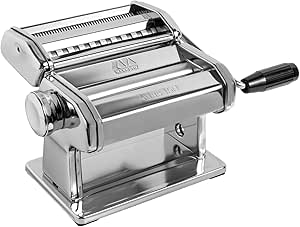 | Best Overall | Brand: MARCATO | Operation: Manual | Material: Chrome steel, with nickel-plated steel, ABS, and aluminum blade components | VIEW LATEST PRICE | See Our Full Breakdown |
| Manual Pasta Maker with 7 Thickness Settings and 2 Cutters |  | Best for Beginners | Brand: AceChef | Operation: Manual, hand crank | Material: Stainless steel | VIEW LATEST PRICE | See Our Full Breakdown |
| Imperia iPasta Classic Manual Pasta Maker, Silver |  | Best Accessory-Ready Pick | Brand: Imperia | Model: 4110 | Operation: Manual | VIEW LATEST PRICE | See Our Full Breakdown |
| Sailnovo 3-in-1 Manual Pasta Maker with 9 Thickness Settings |  | Best for Thickness Adjustment | Brand: Sailnovo | Model: Machine1 | Operation: Manual | VIEW LATEST PRICE | See Our Full Breakdown |
| Nuvantee Manual Pasta Maker with Adjustable Thickness Settings |  | Best for Dough Versatility | Brand: Nuvantee | Model: XK1005 | Operation: Manual | VIEW LATEST PRICE | See Our Full Breakdown |
| Marcato Atlas 150 Design Manual Pasta Maker – Chrome Steel |  | Best Premium Italian Craftsmanship | Materials: Aluminum and chrome-plated steel | Blade material: Stainless steel | Operation mode: Manual | VIEW LATEST PRICE | See Our Full Breakdown |
| Imperia iPasta Classic Line Manual Pasta Maker |  | Best for a Traditional Italian Setup | Brand and model: Imperia 4100 | Made in: Italy | Operation mode: Manual | VIEW LATEST PRICE | See Our Full Breakdown |
| Italian pasta maker | Thickness settings | Operation | Model |
|---|---|---|---|
| MARCATO Atlasmotor 110V Electr | 10 | 110V electric motor; hand crank also included | — |
| Marcato Atlas+ Manual Pasta Ma | 10 | Hand crank; compatible with optional motor drives | Atlas+ |
| Imperia iPasta Classic Manual | 6 | Manual | 4120 |
| MARCATO Atlas 150 Manual Pasta | 10 | Manual | MCAT150ROL |
| Sailnovo 3-in-1 Manual Pasta M | 9 | Manual | — |
| MARCATO Atlas 180 Classic Manu | 10 | Manual | AT-180-CLS |
| MARCATO Atlas 150 Manual Pasta | 10 | Manual | — |
| Manual Pasta Maker with 7 Thic | 7 | Manual, hand crank | — |
| Imperia iPasta Classic Manual | 6 | Manual | 4110 |
| Sailnovo 3-in-1 Manual Pasta M | 9 | Manual | Machine1 |
| Nuvantee Manual Pasta Maker wi | 7 | Manual | XK1005 |
| Marcato Atlas 150 Design Manua | 10 | — | — |
| Imperia iPasta Classic Line Ma | 6 | — | — |
More Details on Our Top Picks
MARCATO Atlasmotor 110V Electric Pasta Machine, Chrome Steel
The Atlasmotor is the clearest choice here if you want to guide dough with both hands rather than crank as you feed it. Its Pastadrive motor comes with the Atlas 150, so unlike the Atlas 150 Manual, it is ready for powered rolling without a separate motor purchase. The machine still offers 10 thickness settings and sheets up to 6 inches wide, giving it the same useful range for common home pasta projects. A tradeoff is that its motor does not add more cutting options: extra Marcato attachments are sold separately. Cleanup also takes patience; the rollers are not dishwasher safe, and dough should dry for at least 30 minutes before brushing away residue. I’d choose it for repeated batches, not for someone seeking the simplest manual setup.
Pros:- Included motor enables hands-free rolling without clamping the machine to a worktop.
- Rolls sheets up to 150 mm wide with 10 thickness settings.
- Resin scrapers help clear dough from the rollers during use.
- Compatible with 11 separately available Marcato accessories.
Cons:- Rollers cannot be washed in a dishwasher.
- Dough residue needs at least 30 minutes to dry before dry-brush cleanup.
- Additional pasta-shape accessories are sold separately.
Best for: Home cooks who regularly roll pasta and want both hands free to guide wide sheets.
Not ideal for: Occasional pasta makers who prefer a lower-complexity hand-crank machine or want more cutters included.
- Operation:110V electric motor; hand crank also included
- Sheet width:150 mm (6 in)
- Thickness settings:10
- Minimum sheet thickness:1.5 mm
- Materials:Chrome steel and anodized aluminum rollers
- Included components:Atlas 150 machine, hand crank, clamp, Pastadrive motor, instruction manual
- Country of manufacture:Italy
- Warranty:2 years against manufacturing defects
Our verdict“Choose the Atlasmotor if hands-free rolling matters more than keeping the setup manual and simple.”
Marcato Atlas+ Manual Pasta Machine, Red
The red Atlas+ makes a strong case for buyers who want a manual Italian machine with cutters included, rather than adding them later. Its double cutter handles fettuccine and spaghetti, while the rollers prepare lasagna sheets; the 10-position dial gives finer adjustment than the six settings on the Imperia iPasta Classic. It also accepts Atlas 150 attachments and optional motor drives, leaving room to expand without making powered operation part of the initial setup. The tradeoff is straightforward: you turn the crank yourself, and the motor is not included. At 2.2 pounds, it is lighter than the Imperia listed here, but buyers should still plan for a stable working surface while feeding dough. This is a practical middle ground between the electric Atlasmotor and a bare-bones manual roller.
Pros:- Included double cutter makes fettuccine and spaghetti.
- Ten thickness settings allow detailed adjustment of pasta sheets.
- Compatible with Atlas 150 attachments and optional motor drives.
- Made in Italy with chrome-plated steel and aluminum alloy rollers.
Cons:- Hand-crank operation requires continuous manual effort.
- Compatible motor drive is sold separately.
Best for: Pasta-making beginners who want a manual machine with sheet rolling and two common noodle cuts included.
Not ideal for: Cooks who want powered rolling out of the box or need a machine that requires no hand-cranking.
- Model:Atlas+
- Operation:Hand crank; compatible with optional motor drives
- Thickness settings:10
- Pasta types:Lasagna, fettuccine, spaghetti
- Materials:Chrome-plated steel and aluminum alloy rollers
- Dimensions:8.15 × 7.87 × 6.1 in
- Weight:2.2 lb
- Origin:Made in Italy
Our verdict“Pick the Atlas+ if you want more included cutting versatility than the Imperia iPasta Classic without moving to an electric machine.”
Imperia iPasta Classic Manual Pasta Maker, Red
The Imperia iPasta Classic suits buyers who value a more complete storage and setup kit alongside the core pasta functions. Its package includes a non-slip base, table support, cleaning brush, and cotton pouch, details the red Marcato Atlas+ does not list in its included components. The machine rolls sheets up to 150 mm and cuts fettuccine and tagliolini, so it covers two useful noodle shapes without relying on optional cutters. Its six thickness settings, ranging from 0.5 to 5 mm, offer less adjustment than the Atlas+ and the manual Atlas 150, both of which have 10 settings. The heavier 3.66 kg build may feel more substantial on a worktop, though it is less appealing if easy lifting and storage are priorities. It remains a fully manual machine, with extra shapes and motor use requiring compatible add-ons.
Pros:- Includes a non-slip base and table support for setup.
- Cuts fettuccine and tagliolini with the included machine.
- Comes with a cleaning brush and cotton storage pouch.
- Compatible with a motor and optional accessories for additional shapes.
Cons:- Six thickness settings provide fewer adjustment steps than the 10-setting Marcato models.
- Manual cranking requires effort while feeding the dough.
- Additional pasta shapes and motor operation require compatible optional accessories.
Best for: Home cooks who want a manual Italian pasta maker with a stabilizing base and storage pouch included.
Not ideal for: Buyers who want more thickness increments, a lightweight machine, or powered operation included.
- Model:4120
- Operation:Manual
- Thickness settings:6
- Sheet thickness:0.5–5 mm
- Maximum sheet width:150 mm
- Cutter widths:Fettuccine: 6.5 mm; tagliolini: 2 mm
- Material:Chromed alloy steel
- Weight:3.66 kg
- Country of manufacture:Italy
Our verdict“Choose the Imperia if included stability and storage accessories matter more to you than the finer adjustment range of the Marcato Atlas+.”
MARCATO Atlas 150 Manual Pasta Machine, Chrome Steel
The Atlas 150 Manual is the traditional hand-crank pick for buyers who want a well-supported pasta platform without paying for a motor they may not need. Its 10 thickness settings match the Atlasmotor and red Atlas+, and it rolls sheets up to 150 mm wide for lasagne, ravioli preparation, and other pasta projects. Unlike the Atlas+, this model’s description does not include cutters, so the total setup depends on which separately sold Marcato attachments you choose. It can also roll soft dough such as fondant, adding a use beyond pasta that the Imperia iPasta Classic listing does not specify. The machine is made and assembled in Italy, but cleanup is dry-only: let residue dry, then brush or wipe it away. If you want powered rolling ready to go, the Atlasmotor is the more suitable Marcato option.
Pros:- Ten thickness settings support a range of sheet thicknesses.
- Rolls pasta sheets up to 150 mm wide.
- Can also roll soft dough such as fondant.
- Compatible with separately sold Marcato attachments and the Pastadrive motor.
Cons:- Pastadrive motor and pasta attachments are sold separately.
- Dough residue must dry before it can be brushed or wiped away.
Best for: Traditional pasta makers who want a manual Italian roller with 10 thickness settings and room to add attachments.
Not ideal for: Buyers who want cutters included, hands-free powered rolling, or wet-and-done cleanup.
- Model:MCAT150ROL
- Operation:Manual
- Thickness settings:10
- Pasta sheet width:150 mm (6 in)
- Minimum sheet thickness:0.6 mm
- Materials:Alloy steel and aluminum
- Dimensions:8 × 5.5 × 8 in
- Weight:3 lb
- Country of manufacture:Italy
Our verdict“Choose this Atlas 150 if you want a flexible manual base and are comfortable selecting cutters separately.”
Sailnovo 3-in-1 Manual Pasta Maker with 9 Thickness Settings, Red
The Sailnovo 3-in-1 offers a straightforward way to adjust sheet thickness and cut two noodle widths without choosing a Marcato attachment system. Its nine settings cover a 0.3–3 mm range, and the 2 mm and 6.25 mm cutters give home cooks two distinct noodle options. Compared with the Italian-made Marcato Atlas 150 Manual, its listed materials and features make it a simpler, more self-contained alternative, but it does not offer the same stated Italian manufacture or compatibility with the Marcato accessory range. The detachable design is intended to help with cleanup, though washing is still not recommended: dough should be handled with a dry brush or cloth. It also needs hand-cranking and a desk clamp, so it is best for occasional, small-batch use rather than cooks seeking powered convenience or broader accessory expansion.
Pros:- Nine thickness settings span 0.3–3 mm.
- Two cutter widths make 2 mm and 6.25 mm noodles.
- Detachable design is intended to simplify cleaning.
- Desk clip helps secure the machine during manual operation.
Cons:- Hand-crank operation requires manual effort while feeding dough.
- Cleaning calls for a dry brush or cloth rather than washing.
- The supplied product data does not specify Italian manufacture or compatibility with a motor.
Best for: Occasional home pasta makers who want adjustable sheets and two cutter widths in one manual machine.
Not ideal for: Buyers seeking an Italian-made machine, motor compatibility, or dishwasher-safe cleanup.
- Operation:Manual
- Thickness settings:9
- Sheet thickness range:0.3–3 mm
- Cutting widths:2 mm and 6.25 mm
- Roller and cutter material:Aluminum alloy
- Body material:Stainless steel
- Included component:Desk clip
- Color:Red
Our verdict“Pick the Sailnovo for an uncomplicated manual setup with two included cutting widths, but choose a Marcato if Italian manufacture and accessory support are priorities.”
MARCATO Atlas 180 Classic Manual Pasta Machine, Chrome Steel
I’d choose the Atlas 180 Classic when wider sheets matter more than having cutters included. Its 180 mm working width gives you more room for lasagne sheets than the Atlas 150, which tops out at 150 mm, and the chrome-plated steel body with anodized aluminum rollers makes this the more specialized pick for sheet-making. It can also make fettuccine and tagliolini with compatible accessories, so the wider format leaves room to expand your pasta routine. The tradeoff is that those accessories—and a compatible motor—are sold separately. Like the Atlas 150 and other manual models here, it needs hand-powered cranking and dry-brush cleanup; it is not dishwasher safe. I’d rank it for cooks who value sheet width over an all-in-one setup.
Pros:- Makes pasta sheets up to 180 mm wide, wider than the 150 mm Atlas 150 and Imperia iPasta.
- Chrome-plated steel body and anodized aluminum rollers.
- Made and assembled in Italy.
- Compatible with a separately available motor and pasta-shaping accessories.
Cons:- Motor and additional shape-making accessories are sold separately.
- Not dishwasher safe; dough must dry before brushing away residue.
Best for: Home cooks who regularly make broad lasagne sheets and want an Italian-made manual machine with the option to add a motor later.
Not ideal for: Beginners looking for included cutters or anyone who wants dishwasher-safe cleanup; accessories are separate and the machine must be cleaned dry.
- Brand:MARCATO
- Model:AT-180-CLS
- Operation:Manual
- Body material:Chrome-plated steel
- Roller material:Anodized aluminum alloy
- Maximum sheet width:180 mm (7 in)
- Thickness settings:10
- Dimensions:9 × 7.5 × 6 in
- Country of manufacture:Italy
Our verdict“Choose the Atlas 180 if wide pasta sheets are your priority; pick the Atlas 150 if you want included cutters instead.”
MARCATO Atlas 150 Manual Pasta Maker
For a straightforward Italian manual machine that can make both sheets and familiar long-cut pasta, I’d put the MARCATO Atlas 150 first. It comes with cutters for lasagna, fettuccine, and tagliolini, so it is a more ready-to-use choice than the Atlas 180, whose extra width requires separately purchased accessories for those shapes. Ten thickness settings, ranging from 0.8 to 4.8 mm, give cooks room to adjust dough for different recipes. The 150 mm sheet width is narrower than the Atlas 180’s, and this model still requires hand cranking and dry-brush cleaning. It also does not include cutters for every pasta style. I rank it ahead of the Imperia iPasta for buyers who want three named pasta formats included with Italian construction.
Pros:- Includes cutters for lasagna, fettuccine, and tagliolini.
- Ten thickness settings span 0.8 to 4.8 mm.
- Chrome steel construction and made-and-assembled-in-Italy production.
- Compatible with a separately available Pastadrive motor.
Cons:- Maximum sheet width is 150 mm, narrower than the Atlas 180.
- Not dishwasher safe; cleanup calls for a dry brush.
- Other pasta shapes require separately available accessories.
Best for: Home cooks seeking an Italian-made manual pasta machine with included cutters for lasagna, fettuccine, and tagliolini.
Not ideal for: Cooks who need wider-than-150-mm sheets, want powered operation out of the box, or expect to wash pasta equipment in a dishwasher.
- Brand:MARCATO
- Operation:Manual
- Material:Chrome steel, with nickel-plated steel, ABS, and aluminum blade components
- Thickness settings:10
- Sheet thickness range:0.8–4.8 mm
- Maximum sheet width:150 mm (6 in)
- Included components:Pasta maker, black crank handle, user manual
- Dimensions:8 × 8 × 7 in
- Country of manufacture:Made and assembled in Italy
Our verdict“Pick the Atlas 150 for an Italian manual machine with three useful pasta formats included, unless wider sheets are your main goal.”
Manual Pasta Maker with 7 Thickness Settings and 2 Cutters
The AceChef manual pasta maker is the approachable entry in this group for cooks who want a defined starter setup: a crank, table clamp, cleaning brush, and cutters for 2 mm spaghetti and 4.5 mm fettuccine. Its seven thickness settings provide some adjustment without the ten-step range of the MARCATO Atlas 150 or Atlas 180. The stainless steel construction and clamp make it a practical choice for occasional batches, while the roller can also prepare sheets for lasagna and wonton wrappers. Unlike those Italian-made MARCATO machines, the supplied product details do not identify this model as made in Italy, so I would not choose it when Italian manufacture is the deciding factor. Manual cranking and dry-brush cleaning remain part of the routine.
Pros:- Includes cutters for 2 mm spaghetti and 4.5 mm fettuccine.
- Seven settings allow dough thickness adjustment.
- Table clamp helps hold the machine steady during hand-cranking.
- Roller can prepare sheets for lasagna and wonton wrappers.
Cons:- Requires manual cranking, with no compatible motor specified in the supplied details.
- Cleaning instructions call for a brush or dry cloth rather than washing.
- The supplied product data does not identify an Italian country of manufacture.
Best for: First-time pasta makers who want a hand-crank setup with a clamp, brush, and two cutters included.
Not ideal for: Buyers specifically seeking a pasta maker made in Italy or cooks who want a stated sheet-width measurement and finer thickness control.
- Brand:AceChef
- Operation:Manual, hand crank
- Material:Stainless steel
- Thickness settings:7
- Minimum sheet thickness:2 mm
- Cutter widths:2 mm spaghetti; 4.5 mm fettuccine
- Weight:2.87 kg
- Included components:Pasta maker base, dough roller, 2-in-1 cutter, hand crank, table clamp, instruction
Our verdict“Choose the AceChef for a ready-to-start manual kit, but look to the MARCATO Atlas 150 if Italian manufacture and a wider thickness range matter more.”
Imperia iPasta Classic Manual Pasta Maker, Silver
I’d favor the Imperia iPasta Classic if a useful set of supplied handling accessories matters alongside the core pasta functions. It includes a storage pouch, cleaning brush, non-slip base, and table support, while its chromed steel rollers produce sheets, fettuccine, and tagliolini. The six thickness settings cover a 0.5–5 mm adjustment range, fewer steps than the Atlas 150’s ten, but with a stated range that reaches both thin and thicker sheets. Its 150 mm dough width matches the Atlas 150 rather than the wider Atlas 180. The machine is still manual, and the compatible motor and additional attachments are not included. I see it as the more accessory-ready alternative to the Atlas 150, though buyers who prioritize more thickness increments may prefer the MARCATO.
Pros:- Includes a cotton storage pouch, cleaning brush, non-slip base, and table support.
- Chromed steel rollers make dough sheets, fettuccine, and tagliolini.
- Six settings cover a stated 0.5–5 mm roller adjustment range.
- Compatible with the Pasta Facile 4600 motor and listed Imperia accessories.
Cons:- Manual operation requires turning the crank.
- Motor and additional pasta accessories are not included.
- Six thickness settings offer fewer adjustment steps than the Atlas 150’s ten.
Best for: Pasta makers who want a manual Italian-style setup with included storage and stability accessories, plus a path to compatible add-ons.
Not ideal for: Cooks who want motorized operation or many thickness steps without buying separate accessories.
- Brand:Imperia
- Model:4110
- Operation:Manual
- Material:Alloy steel with chromed steel rollers
- Thickness settings:6
- Roller adjustment range:0.5–5 mm
- Dough sheet width:150 mm
- Cut widths:Fettuccine: 6.5 mm; tagliolini: 2 mm
- Included components:Machine, cotton storage pouch, crank handle, cleaning brush, non-slip base, table support, user manual
Our verdict“Choose the Imperia iPasta if its included storage and support accessories suit your setup; choose the Atlas 150 for more thickness settings.”
Sailnovo 3-in-1 Manual Pasta Maker with 9 Thickness Settings
The Sailnovo 3-in-1 stands out for cooks who want more thickness choices than the seven-setting AceChef, without moving to the ten settings on the MARCATO Atlas 150. Its nine settings span 0.5–3 mm, and the two cutting widths cover 2 mm and 4.5 mm pasta. That gives home cooks flexibility for rolling and cutting familiar shapes, with a clamp included to steady the machine. The stainless steel body and aluminum rollers are designed to resist rust, but the blade attachment needs dry cleaning with a brush or stick—not water or a dishwasher. Unlike the Atlas 150, the supplied details do not establish Italian manufacture or include a stated pasta-sheet width. I’d rank this as an adjustment-focused alternative, not the pick for buyers prioritizing Italian provenance.
Pros:- Nine settings span a stated dough thickness range of 0.5–3 mm.
- Two cutting widths: 2.0 mm and 4.5 mm.
- Stainless steel body and aluminum rollers are designed to resist rust.
- Includes a clamp and English manual.
Cons:- Blade attachment must be cleaned with a brush or stick, not water or a dishwasher.
- Manual cranking is required; no motor compatibility is specified in the supplied details.
- The supplied product data does not state Italian manufacture or maximum sheet width.
Best for: Home cooks who want nine thickness settings, two cutter widths, and a table clamp in a manual machine.
Not ideal for: Buyers who require confirmed Italian manufacture, a stated maximum sheet width, or water-safe cleaning for the blade attachment.
- Brand:Sailnovo
- Model:Machine1
- Operation:Manual
- Materials:Stainless steel body and aluminum rollers
- Thickness settings:9
- Dough thickness range:0.5–3 mm
- Cutting widths:2.0 mm and 4.5 mm
- Included components:Pasta maker, clamp, English manual
Our verdict“Choose the Sailnovo for its nine thickness settings and clamp, but select the MARCATO Atlas 150 if Italian manufacture and included named pasta cutters are your priority.”
Nuvantee Manual Pasta Maker with Adjustable Thickness Settings
I’d pick the Nuvantee when one manual machine needs to handle both pasta sheets and wrapper dough. Its seven thickness settings span 0.5 mm to 3 mm, giving useful control for rolling dough thin or keeping it sturdy for dumpling wrappers. The two cutters make 2 mm and 6 mm noodles, covering tagliolini-style strands and fettuccine-width pasta. Compared with the Marcato Atlas 150 Design, it offers fewer thickness settings and no stated accessory expansion, but its stated uses extend clearly to wrappers. The tradeoff is a narrow cutter selection: cooks seeking more pasta shapes will need another tool, and every sheet and noodle requires hand cranking. I’d choose it for flexible dough preparation, not for the broadest pasta repertoire.
Pros:- Seven thickness settings provide control from 0.5 mm to 3 mm
- Two cutter widths make both 2 mm and 6 mm noodles
- Can roll sheets for lasagna and dough for dumpling wrappers
- Aluminum and stainless-steel construction
Cons:- Only two cutter widths are specified, limiting noodle variety
- Manual operation requires repeated hand cranking
- No expandable accessory system is listed
Best for: Home cooks who want one manual machine for pasta sheets, two noodle widths, and dumpling-wrapper dough
Not ideal for: Cooks who want several built-in cutter widths or powered rolling, since it has two cutters and requires manual cranking
- Brand:Nuvantee
- Model:XK1005
- Operation:Manual
- Thickness settings:7
- Sheet thickness range:0.5 mm to 3 mm
- Cutter widths:2 mm and 6 mm
- Materials:Aluminum and stainless steel
- Dimensions:5.39 × 6.89 × 8.5 in
Our verdict“Choose the Nuvantee if wrapper dough and two everyday noodle widths matter more than a wide range of pasta attachments.”
Marcato Atlas 150 Design Manual Pasta Maker – Chrome Steel
The Marcato Atlas 150 Design is my premium pick for cooks who want a well-specified Italian-made machine and room to expand their pasta repertoire. Its ten thickness settings span 0.5 mm to 4.8 mm, giving more adjustment points and a wider stated range than the Nuvantee’s seven settings and 0.5–3 mm range. The included cutters make lasagna sheets, fettuccine, and tagliolini; optional accessories add further shapes. That expansion is useful if pasta-making becomes a regular hobby, but it adds separate purchases rather than giving you every shape out of the box. Its aluminum and chrome-plated steel construction is a step up in finish, while the manual crank still sets the pace. Hand wiping is required, so I’d skip it if dishwasher-safe cleanup is a priority.
Pros:- Ten thickness settings cover a 0.5 mm to 4.8 mm sheet range
- Makes lasagna sheets, fettuccine, and tagliolini
- Aluminum and chrome-plated steel construction with stainless-steel blades
- Optional accessories allow expansion to additional pasta shapes
Cons:- Cleaning requires hand wiping; it is not dishwasher safe
- Additional pasta shapes require separately purchased accessories
- Manual cranking may be tiring when rolling large batches
Best for: Pasta enthusiasts seeking an Italian-made manual machine with fine thickness control and the option to add more shapes later
Not ideal for: Buyers who want dishwasher-safe parts, powered operation, or a broad set of pasta accessories included
- Materials:Aluminum and chrome-plated steel
- Blade material:Stainless steel
- Operation mode:Manual
- Thickness settings:10
- Sheet thickness range:0.5 mm to 4.8 mm
- Included blades:2
- Weight:2.3 kg
- Dimensions:7.87 × 7.87 × 5.7 in
Our verdict“Choose this Marcato if Italian construction, broad thickness adjustment, and future accessory options justify hand cleaning and manual operation.”
Imperia iPasta Classic Line Manual Pasta Maker
The Imperia iPasta Classic Line suits buyers who want a traditional Italian-made roller with its everyday cutting widths specified up front. It rolls sheets up to 150 mm wide and cuts fettuccine at 6.5 mm or tagliolini at 2 mm. Its six settings cover a 0.5–5 mm range, broader at the thick end than the Nuvantee’s 0.5–3 mm range, though it offers fewer adjustment steps than the Marcato Atlas 150 Design’s ten. The included non-slip base and table support help anchor the machine during hand-cranked rolling, and a brush and storage pouch are supplied. An optional motor can reduce cranking, but it is not included; additional accessories are also add-ons. At 3.66 kg, it is heavier than the Marcato, which may matter if you store it after each use.
Pros:- Made in Italy with chromed-steel rollers
- Rolls dough sheets up to 150 mm wide
- Cuts 6.5 mm fettuccine and 2 mm tagliolini
- Includes a non-slip base, table support, cleaning brush, and storage pouch
Cons:- Six thickness settings offer fewer adjustment steps than the Marcato Atlas 150 Design
- The optional electric motor and additional accessories are not included
- At 3.66 kg, it is heavier than the Marcato model listed here
Best for: Home pasta makers who want an Italian-made manual roller with a stable base, included cleaning brush, and defined fettuccine and tagliolini cuts
Not ideal for: Buyers who want a lightweight machine, many thickness increments, or an electric motor included in the box
- Brand and model:Imperia 4100
- Made in:Italy
- Operation mode:Manual
- Roller material:Chromed steel
- Dough sheet width:Up to 150 mm
- Thickness settings:6
- Roller thickness range:0.5 mm to 5 mm
- Cut widths:Fettuccine: 6.5 mm; tagliolini: 2 mm
- Weight:3.66 kg
Our verdict“Choose the Imperia if you value its Italian-made construction, stable setup, and included storage and cleaning accessories over lighter weight or finer adjustment steps.”
How We Picked
I compared these 13 listings by the factors that shape everyday pasta making: manual versus motor-assisted operation, stated thickness adjustment, machine width, cutter setup, construction cues, and the likely demands of cleaning and storage. I gave more weight to a clear, practical format than to a long list of settings, since adjustment ranges are useful only when they match the dough and pasta shapes a buyer plans to make. Italian heritage and recognizable model families informed the comparison, but neither served as a substitute for checking the specific listing.
The order favors machines with a clearly differentiated role and a useful balance of control, versatility, and ease of operation. That puts the Atlasmotor first for buyers seeking assistance, followed by manual options that serve distinct needs; the Atlas 180 earns a place for its wider format, while multi-setting alternatives make sense for buyers focused on adjustment options. Repeated Atlas 150 and Imperia listings are treated as close variants rather than assumed upgrades. Since listing details can vary, I would confirm included cutters, attachments, and compatibility before buying.
Factors to Consider When Choosing Italian Pasta Makers
The right pasta maker depends less on the number of settings printed on a listing than on how often you’ll make pasta, what shapes you prefer, and how much hands-on work you enjoy. These broader checks can help separate a useful machine from one that looks capable but does not suit your kitchen routine.
Choose between manual control and motor assistance
A hand-crank machine gives you direct control over the pace of each sheet and avoids relying on a motor or power connection. That works well when you make small batches, enjoy a hands-on process, or have a helper available to guide the dough. A motor can make repeated rolling less tiring and free one hand to feed or catch a sheet, which matters more as batch size grows. It also adds another component and may affect setup, storage, and cleaning. Avoid choosing powered operation just because it sounds faster: dough preparation and shaping still take time. Match the mechanism to the amount of pasta you expect to make at once.
Match machine width to the pasta you plan to make
Machine width affects how broad a sheet you can roll, which can matter for filled pasta or recipes that call for wide ribbons. A narrower format can be easier to store and may suit cooks who mainly make standard-width noodles. The Atlas 180’s wider format offers a distinct reason to choose it over the common 150-style machines, but a wider unit needs room both on the work surface and in storage. Check the actual roller width rather than relying on a model number or product photo. Also think about the size of your counter and whether you can support a long sheet without it drooping. Buy for your regular recipes, not a single ambitious project.
Read thickness settings as a range, not a quality score
More adjustment positions can give you finer control over sheet thickness, but the count alone does not tell you how evenly a machine rolls. Very thin settings may be useful for delicate filled pasta, while thicker sheets can suit some noodles and starting passes. Dough hydration, resting time, and how gradually you reduce thickness all affect the result. A common mistake is to push dough straight to a thin setting, which can tear or stick even on a capable machine. Look for clear information about the adjustment range and use a gradual rolling sequence. Prioritize reliable control over the largest advertised number.
Check which cutters and attachments are actually included
A pasta maker’s usefulness depends partly on whether its cutters match the shapes you want to prepare. Listings may show accessories that are optional, sold separately, or limited to a particular version, so confirm the package contents before comparing models. Built-in or included cutters can make familiar noodle shapes convenient, but they do not replace a separate extruder for shapes such as tubes. If you mostly want sheets for lasagna or filled pasta, extra noodle cutters may add little value. Check attachment compatibility as well, especially when comparing different brands or model families. A precise accessory list is more useful than a broad claim of versatility.
Plan for clamping, cleaning, and storage
Manual machines usually need a stable work surface and a secure clamp, so check whether your counter edge can accommodate the attachment. A machine that shifts while cranking makes sheet feeding harder and can disrupt a consistent result. Pasta rollers also call for dry cleaning methods; sticky dough and water can make upkeep more difficult, so follow the maker’s care instructions. Before buying, consider where the machine will live between pasta sessions and whether any motor or attachments need separate storage. A heavier or wider machine may feel steady in use but take more effort to put away. Choose a setup you can retrieve and clean without turning a simple batch into a chore.
Compare model names and listings carefully
This roundup contains repeated or closely related Atlas 150 and Imperia iPasta listings, sometimes distinguished by finish or wording. A different color or “Design” label does not automatically mean a different roller, cutter, or accessory package. Compare the precise model identifier, included parts, stated materials, and manufacturer compatibility details. For similar listings, the one with clearer specifications may be the safer choice than the one with more promotional language. Keep a shortlist based on function first, then choose a finish that suits your kitchen. This prevents paying attention to cosmetic distinctions while overlooking a missing cutter or incompatible attachment.
Frequently Asked Questions
Should I choose the Atlasmotor or a manual Atlas machine?
Choose the Atlasmotor if you expect to roll larger batches or want motor assistance while feeding dough through the rollers. A manual Atlas model is a better fit if you prefer direct hand control, want a simpler mechanism, or make pasta only occasionally. The motor does not remove the need to prepare, portion, and guide dough, so it is not a shortcut through the whole process. Compare the space and setup needs of the powered version with the straightforward storage of a hand-crank machine. Your batch size and comfort with repetitive cranking should decide between them.
Is the Atlas 180 a better choice than the Atlas 150?
Not for every cook: the Atlas 180’s main distinction in this lineup is its wider format, which can be useful for recipes that call for broader sheets. The Atlas 150 is the more familiar choice among the listed manual Atlas models and may suit cooks focused on standard-width pasta. A wider roller can also require more counter space and make long sheets harder to manage alone. Check the exact roller width and included cutters for the listing you plan to buy. Choose based on the shapes and workspace you use regularly, rather than treating the larger number as an automatic upgrade.
Do nine thickness settings make a Sailnovo machine better than an Atlas or Imperia?
No: a higher setting count indicates more listed adjustment positions, not necessarily more even rolling or better durability. Sailnovo may appeal if you specifically value its stated range and 3-in-1 format, while Atlas and Imperia models offer different brand and machine-family considerations. The best comparison is the actual thickness range, cutter setup, construction details, and care instructions. Also check what the “3-in-1” description means for the exact listing and which components arrive in the box. If the listing is vague, do not use the setting count alone to make the decision.
Are the red, silver, chrome, and Design versions functionally different?
Finish names and product titles do not by themselves establish a change in rolling or cutting capability. The lineup includes several Atlas 150 and Imperia iPasta listings that may be close variants, so compare model identifiers and included accessories directly. A color choice can matter if the machine will stay on display, but it should come after functional checks. Verify whether a particular version includes the same cutters, clamp, and attachments as another listing. If those details are not clear, consult the maker’s product information before choosing based on appearance.
Can any of these machines make every kind of pasta?
No single roller-style machine covers every pasta shape. These machines are intended for rolling sheets and, depending on the model and cutters, making selected flat noodles; shapes that need extrusion call for different equipment. If your main goal is lasagna sheets, filled pasta, or familiar ribbons, a roller machine may cover your needs. If you want a wide variety of short or hollow shapes, check whether the machine supports a compatible attachment or plan for a separate tool. Decide on your target shapes before buying so you do not mistake a versatile sheet roller for an all-purpose pasta system.
Conclusion
For the best overall, I’d start with the MARCATO Atlasmotor 110V if motor assistance fits your routine. For the best manual all-rounder, the Marcato Atlas 150 is the clearest choice among the familiar Atlas formats; for the best value-minded pick, compare the Sailnovo 3-in-1 listings closely and confirm exactly what is included. Buyers seeking a premium-feeling traditional setup may prefer a chrome Atlas model, while the Imperia iPasta Classic suits someone who wants a simple manual alternative. For beginners, I’d favor a straightforward manual machine and learn dough consistency and gradual thickness changes before paying for extra settings. Choose the Atlas 180 for wider sheets, and skip a wider machine if your recipes and storage space do not call for it.