
TL;DR

Get kitchen staples and gadgets delivered free with Prime
- Fast, free delivery on millions of items
- Prime Video, Amazon Music and more included
- Member-only deals all year
The Twenty Dishes That Explain Italy, Region by Region uses one representative dish from each of Italy’s 20 administrative regions to show that Italian cuisine is actually a network of local food cultures. Follow the dishes and you will taste Alpine dairy, Po Valley rice, Roman pasta, southern durum wheat, Mediterranean vegetables, and centuries of trade.
Drive 90 minutes in Italy and the pasta shape, cooking fat, cheese, and local definition of a proper lunch can all change. In Bologna, ragù belongs with silky egg-rich tagliatelle. Reach Liguria and the scent shifts to crushed basil, pine nuts, garlic, and olive oil, green as a shaded garden.
This guide gives you one representative dish from each region, not 20 official winners. Every selection is a cultural argument. Pizza says something powerful about Naples and Campania, but it leaves out mozzarella di bufala, ragù napoletano, seafood, pastries, and the lemon groves of the Amalfi Coast.
You will learn what each plate reveals about geography, agriculture, trade, and local thrift. You will also get practical cues for ordering the dishes, choosing protected ingredients, and building a food trip that reaches beyond Rome, Florence, Venice, and Naples. Think of the list as a railway map rather than a final verdict: each dish marks a useful stop, while countless smaller lines lead toward villages, family kitchens, markets, and seasonal festivals.
Treat each representative dish as an invitation to explore its region, not as an official or complete definition of that region.
Plan food trips around landscape and season: Alpine dairy in colder areas, Po Valley rice, central Italian pasture and woodland foods, or southern durum wheat…
Order dishes in their local form, such as tagliatelle al ragù in Bologna and soft-centered pizza napoletana in Naples.
Check DOP and IGP labels when buying ingredients such as Fontina, Genovese basil, Olive Ascolane del Piceno, or Peperone di Senise.
Ask about allergens and use safe temperatures when cooking meat, sausage, egg sauces, or refrigerated leftovers at home.
The Twenty Dishes That Explain Italy, Region by Region
Italian cuisine is not one menu. It is a network of Alpine dairies, irrigated rice fields, pastoral hills, trading ports, durum-wheat country and island kitchens—each answering the same question differently: what can we make from what grows, travels and survives here?
A plate is geography made edible
Modern borders help organize the journey, but older kingdoms, mountain passes, ports and provincial loyalties often explain more. “Authentic” Italian cooking is local before it is national.
Mountains store abundance
Seasonal milk becomes cheese; bread becomes dumplings; preserved meat carries calories through winter. Fonduta, frico and canederli turn isolation into flavor.
Ports rewrite tradition
Anchovies travel inland, cod reaches Venice and imported crops become local icons. Tradition is often the successful digestion of exchange.
Thrift requires technique
Cucina povera is not crude cooking. Modest vegetables, bread, legumes and scraps demand soaking, drying, kneading, simmering and practiced judgment.
Twenty plates, twenty cultural arguments
Each choice makes one revealing connection between food and place. Other selections are equally defensible; the point is to begin asking better regional questions.
Northwest
Alps · plains · seaAosta Valley · Fonduta valdostana
Fontina DOP and the concentrated nourishment of Alpine dairy culture.
Piedmont · Bagna càuda
Anchovy and garlic connect inland vegetables to historic salt routes.
Lombardy · Risotto alla Milanese
Po Valley rice, butter and saffron express agricultural wealth and timing.
Liguria · Pesto Genovese
Basil, olive oil and steep coastal hills create a northern exception.
Northeast
Borders · ports · pastureTrentino-Alto Adige/Südtirol · Canederli
Bread dumplings reveal Alpine thrift and Central European influence.
Friuli-Venezia Giulia · Frico
Crisped cheese embodies a borderland shaped by mountains and migration.
Veneto · Baccalà mantecato
Silky preserved cod records Venice’s far-reaching maritime commerce.
Emilia-Romagna · Tagliatelle al ragù
Egg-rich pasta and patient meat sauce signal prosperous northern cooking.
Center
Pasture · woodland · citiesTuscany · Bistecca alla Fiorentina
Chianina cattle, live fire and a fiercely Florentine identity.
Umbria · Strangozzi with black truffle
Handmade pasta and wild woodland foods define landlocked abundance.
Marche · Olive all’ascolana
Stuffed, breaded olives turn local produce into elaborate festive food.
Lazio · Carbonara
Rome’s pasta culture meets modern, much-debated culinary origins.
South & Islands
Durum · sun · preservationAbruzzo · Arrosticini
Skewered mutton translates transhumance and pastoral work into street food.
Molise · Cavatelli with ragù
Hand-shaped pasta sustains rural household traditions.
Campania · Pizza napoletana
Naples, tomatoes, quick heat and Italian food’s global transformation.
Apulia · Orecchiette con cime di rapa
Durum wheat and bitter greens express agricultural thrift.
Basilicata · Pasta with peperoni cruschi
Sun-dried sweet peppers show preservation becoming identity.
Calabria · Fileja with ’nduja
Handmade pasta and spicy preserved pork reward bold economy.
Sicily · Pasta alla Norma
Eggplant and tomato reflect a layered Mediterranean crossroads.
Sardinia · Malloreddus alla Campidanese
Durum-wheat pasta and sausage assert a distinct island identity.
What each dish helps you see
Pasta matters, but it is only part of the story. Rice, bread, dumplings, meat, cheese, vegetables and preserved seafood are equally useful evidence.
| Regional system | Anchor dishes | Core ingredients | Technique | What it reveals |
|---|---|---|---|---|
| Alpine Aosta, Trentino, Friuli |
Fonduta · Canederli · Frico | Dairy, bread, speck, potatoes | Preserve | Short growing seasons reward cheese-making, reuse and concentrated energy. |
| Po Valley Lombardy, Emilia-Romagna |
Risotto · Tagliatelle al ragù | Rice, butter, eggs, meat | Enrich | Irrigation and fertile plains support rice and prosperous egg-pasta traditions. |
| Port & coast Liguria, Veneto, Campania |
Pesto · Baccalà · Pizza | Olive oil, cod, basil, tomato | Exchange | Maritime routes turn imported goods and mobile ideas into local signatures. |
| Central hills Tuscany, Umbria, Marche, Lazio |
Bistecca · Strangozzi · Olives · Carbonara | Meat, woodland foods, wheat, eggs | Refine | Pasture, forests and urban dining create sharply provincial specialties. |
| Southern mainland Abruzzo to Calabria |
Arrosticini · Orecchiette · Fileja | Durum wheat, greens, pork, peppers | Stretch | Drying, hand-shaping and strong seasoning make modest stores memorable. |
| Islands Sicily, Sardinia |
Norma · Malloreddus | Eggplant, tomato, durum, sausage | Layer | Isolation preserves identity while centuries of contact complicate every bite. |
The list could change
Tortellini could replace tagliatelle; porchetta could speak for Umbria; pane carasau for Sardinia; caponata or arancine for Sicily. Selection is interpretation.
One icon cannot hold a region
Pizza powerfully symbolizes Campania, yet leaves out buffalo mozzarella, seafood, ragù napoletano, pastries and the Amalfi Coast’s citrus culture.
Landscape
Altitude, water, soil and coast determine what thrives.
Ingredient
Milk, rice, wheat, vegetables or livestock become the pantry.
Technique
Drying, frying, fermenting, kneading and simmering add survival value.
Dish
A repeatable local answer becomes recognizable and loved.
Identity
Family memory, town rivalry and heritage accumulate around the plate.
Build a better food trip in five moves
Choose one region, one season and one local question at a time. The goal is not to collect famous dishes—it is to understand why they belong where they do.
Italy’s menu is a network, not a hierarchy
The best question is not “Which dish represents Italy?” It is “What does this particular dish reveal about the people, terrain, work and exchange that sustained it?”
Local beats universal
A recipe can change across a provincial boundary and both versions can remain faithful to living traditions.
Thrift is expertise
Cheap ingredients often require more labor, patience and judgment—not less culinary skill.
Follow the smaller lines
Move beyond Rome, Florence, Venice and Naples toward village markets, regional producers and seasonal tables.
Why These 20 Plates Tell You More Than a Single Italian Menu
The Twenty Dishes That Explain Italy, Region by Region works because each plate reveals a local answer to the same basic question: what can you cook from the land, climate, and trade routes around you? The result is 20 starting points, not an official culinary constitution.
Italy became a unified political state in the 19th century, after its food cultures had spent centuries developing within separate kingdoms, duchies, republics, and mountain communities. Five of today’s 20 regions have special autonomous status: Sicily, Sardinia, Aosta Valley, Trentino-Alto Adige/Südtirol, and Friuli-Venezia Giulia.[1] That political detail matters when your dumplings in Bolzano resemble food across the Austrian border more than pasta served in Palermo.
The implication is that a modern regional label is useful but imperfect. Administrative borders can organize a food trip, yet they may conceal older cultural zones that cross those borders or divide a single region into coast, plain, and mountain. A dish therefore explains most when you ask not only where it belongs, but which town, landscape, livelihood, and historical connection sustained it.
The familiar north-south split offers a useful first sketch. Northern tables often feature butter, rice, polenta, dairy, and egg pasta, while southern cooking leans more heavily on olive oil, durum wheat, tomatoes, legumes, and vegetables. Yet the rule bends constantly. Liguria sits in the north but smells of olive oil and basil, while inland Sicily has robust meat traditions far from the island’s fishing ports.
These patterns reflect practical tradeoffs rather than fixed culinary laws. Butter suits dairy-rich country but travels and stores differently from olive oil; fresh egg pasta offers tenderness and richness but depends on eggs, while dried durum-wheat pasta withstands storage and transport. Rice flourishes in irrigated plains, whereas preserved meat, cheese, and bread help mountain households carry calories through winters and periods of isolation.
Authentic Italian cooking is local before it is national. A recipe can change across a provincial boundary, and both versions may belong to living traditions.
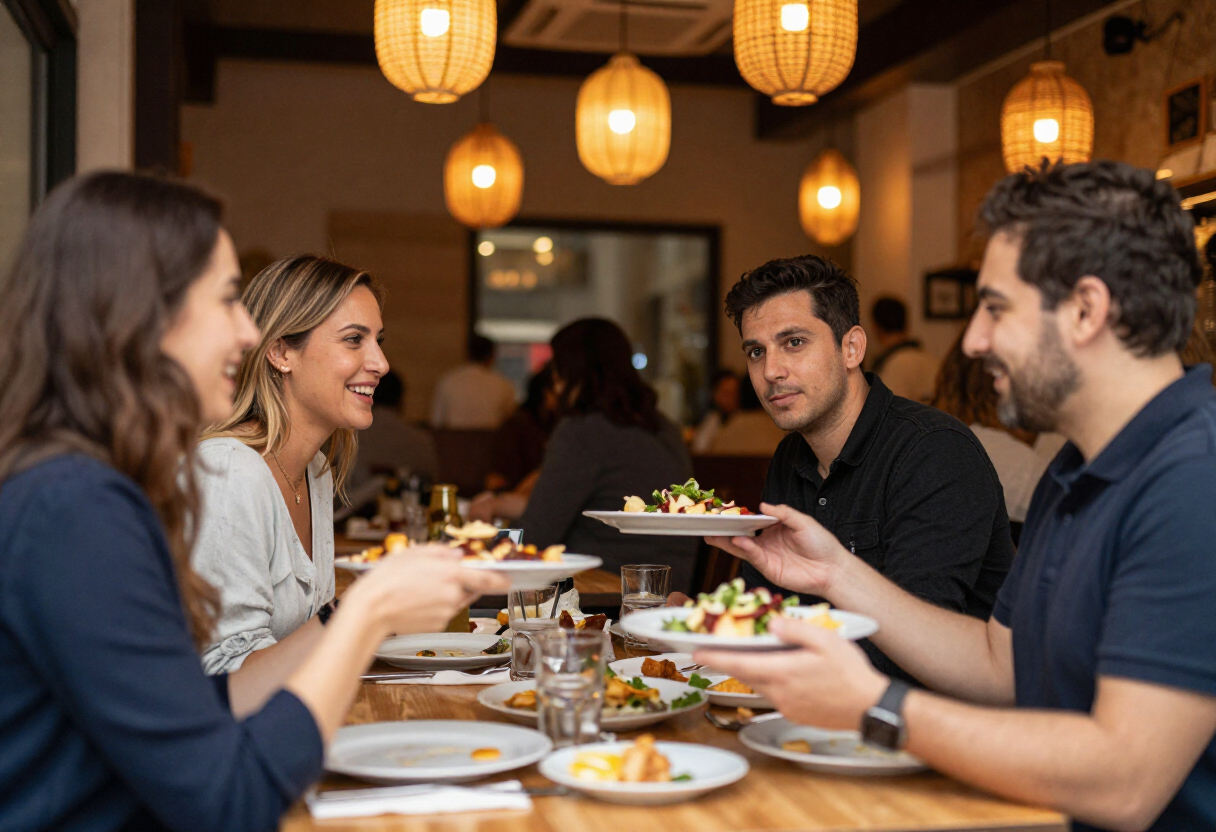
You see this at a Sunday lunch in Emilia-Romagna. One relative insists tortellini belong in broth; another defends green lasagne; a third brings tagliatelle with ragù and calls the discussion settled. That organized chaos is the point. Food carries family memory, town rivalry, and the taste of what grew nearby.
Authenticity, then, is not simply a checklist of ingredients. It can mean fidelity to a place, continuity within a family, or skillful adaptation when seasons and livelihoods change. Protected names help defend producers from imitation, but a tradition survives only if people can still afford to cook it, sell it, and make room for it in daily life.
You should also treat cucina povera, meaning resourceful cooking from modest ingredients, with respect. Stale bread, offal, beans, wild greens, and leftovers were not signs of careless cooking. Skilled hands turned them into ribollita, polpette, soups, and crisp-edged pasta dishes through soaking, simmering, frying, and patient seasoning.
Calling such food “simple” can obscure the labor and judgment behind it. Cheap ingredients often demand more time: bread must be revived, tough cuts softened, greens cleaned, and scraps balanced so that nothing dominates. Today those dishes may appear in expensive restaurants, creating a revealing tension between their origins in necessity and their modern value as heritage.
As an affiliate, we earn on qualifying purchases.
Taste the Alps, Rice Fields, and Trading Ports in Northern Italy
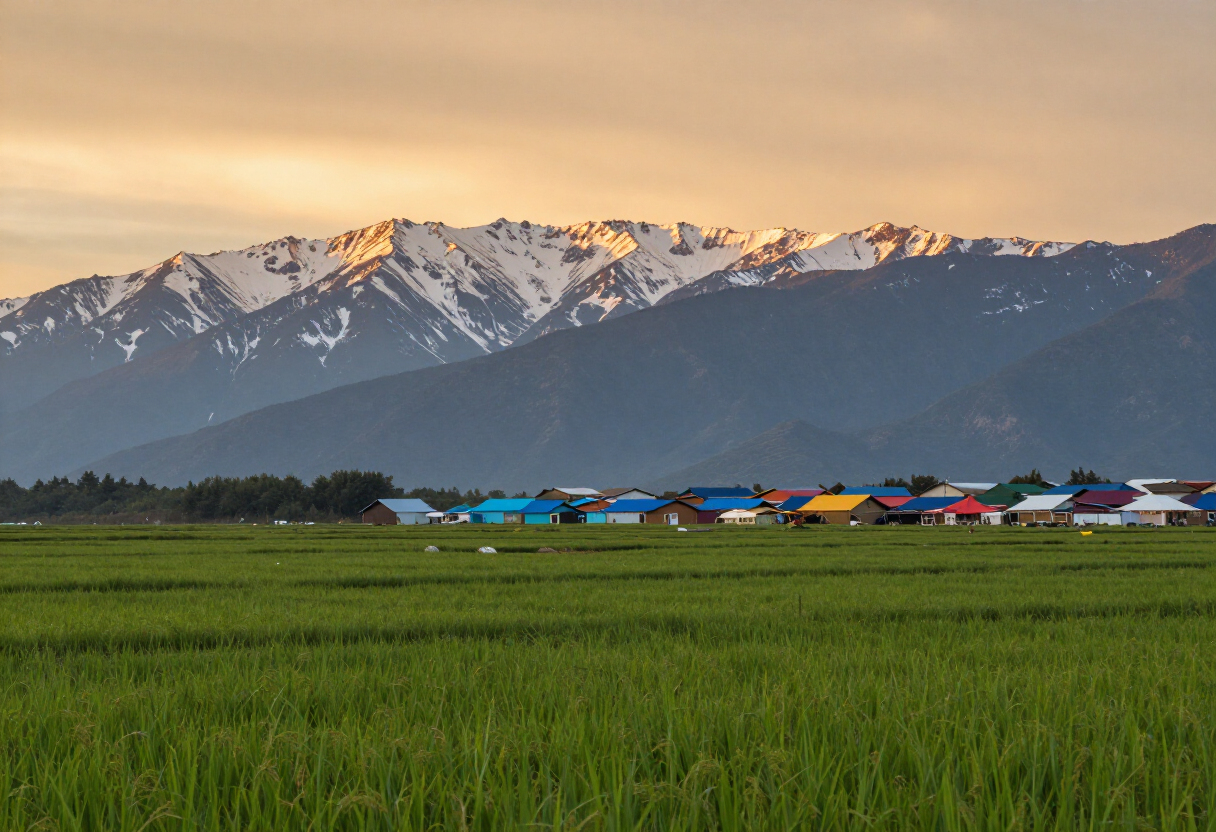
The Twenty Dishes That Explain Italy, Region by Region begins in northern Italy with cheese, rice, preserved fish, and sauces shaped by travel. These seven dishes show why the north is more than butter and polenta: mountain isolation, fertile plains, and busy ports each leave a different flavor.
- Aosta Valley: fonduta valdostana. This smooth fondue centers on nutty Fontina DOP, an Alpine cow’s-milk cheese. Order it after a cold walk near Courmayeur and you understand why rich dairy became mountain fuel; the bowl arrives warm and golden, with the quiet plop of bread dipping into cheese. Its richness also reveals an old preservation strategy: turning seasonal milk into cheese made valuable nutrition last beyond the pasture’s brief abundance.
- Piedmont: bagna càuda. The name means hot bath, a garlicky anchovy sauce kept warm for dipping cardoons, peppers, and other vegetables. Anchovies reached inland Piedmont through historic salt and trading routes, so this communal dish tastes like a map connecting mountains to the sea. The expensive, intensely flavored fish is stretched across a tableful of inexpensive vegetables, showing how scarcity can encourage concentration rather than blandness.
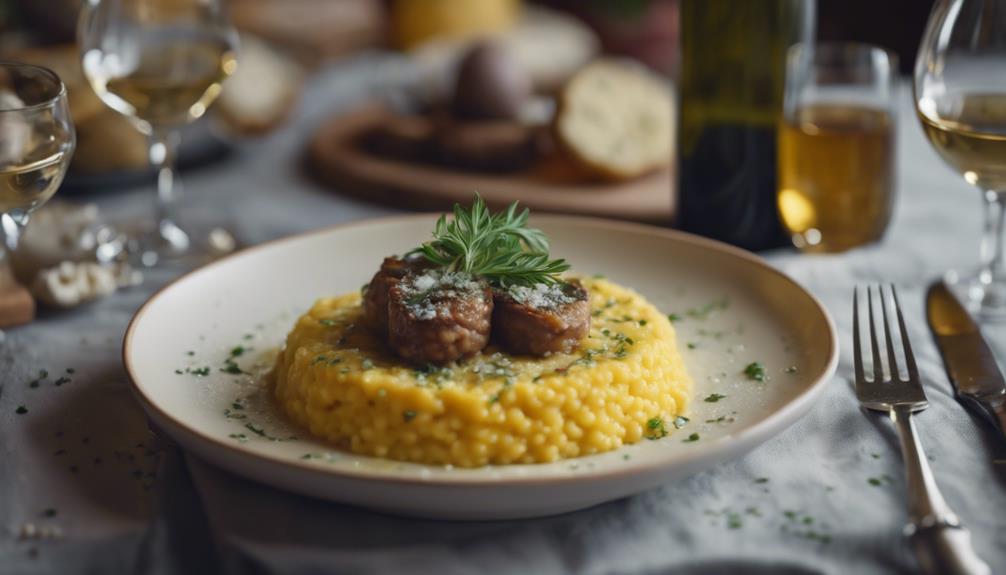
- Lombardy: risotto alla Milanese. Rice from the Po Valley meets butter, stock, Parmigiano Reggiano DOP, and saffron. A well-made serving spreads softly across the plate all’onda, or like a wave, rather than standing in a stiff mound. That texture depends on gradual cooking and immediate service, so risotto expresses both agricultural abundance and restaurant timing: unlike dried pasta, it resists waiting.
- Trentino-Alto Adige/Südtirol: canederli. These bread dumplings often contain speck, cheese, or herbs and arrive in broth or with melted butter. In Bolzano, a bowl can feel closer to Tyrolean cooking than to a southern pasta lunch, reflecting the region’s Italian- and German-speaking traditions. Using stale bread as the structure also shows that thrift crosses linguistic borders even when seasonings and names differ.
- Veneto: baccalà mantecato. Venetians use the word baccalà here for stockfish, dried cod that is soaked and worked into a pale, creamy spread. Spoon it onto grilled polenta in Venice and you taste how maritime commerce turned a preserved northern fish into lagoon comfort food. Its adoption matters because regional identity is not built only from native ingredients; imported goods can become local through generations of technique and habit.
- Friuli-Venezia Giulia: frico. Cheese and potatoes cook until the surface goes crrrisp and bronze while the center stays soft. Frico began as practical mountain cooking and now makes a fine reason to visit a frasca, a rustic Friulian tavern. The contrast between crust and soft center demonstrates how heat can add variety to a narrow pantry, making familiar staples feel abundant.
- Liguria: pesto Genovese. Genovese Basil DOP, extra-virgin olive oil, pine nuts, garlic, Parmigiano Reggiano, and Pecorino are crushed into a fragrant sauce. Try it with trofie and potatoes in Genoa; the herbal brightness lands like green sunlight after the heavier Alpine plates. Pesto complicates the stereotype of a dairy-heavy north: Liguria’s mild coast, steep terrain, and maritime connections favor an oil-based sauce whose freshness comes with the tradeoff of a short life.
Together, these plates show that preservation and exchange are as important as latitude. Cheese, stale bread, dried fish, and anchovies solved problems of season and distance, while rice and basil depended on particular environments and careful timing. Northern cooking alternates between foods designed to endure and foods whose quality disappears quickly, which is why both cellar knowledge and last-minute technique matter.
These dishes also carry clear allergen flags. Fonduta, risotto, canederli, frico, and pesto commonly contain milk; canederli and pasta contain gluten, and pesto contains pine nuts. Bagna càuda and baccalà contain fish, while egg may appear in fonduta or dumpling recipes, so ask before ordering if you have an allergy.
Follow Handmade Pasta and Live Fire Through Central Italy
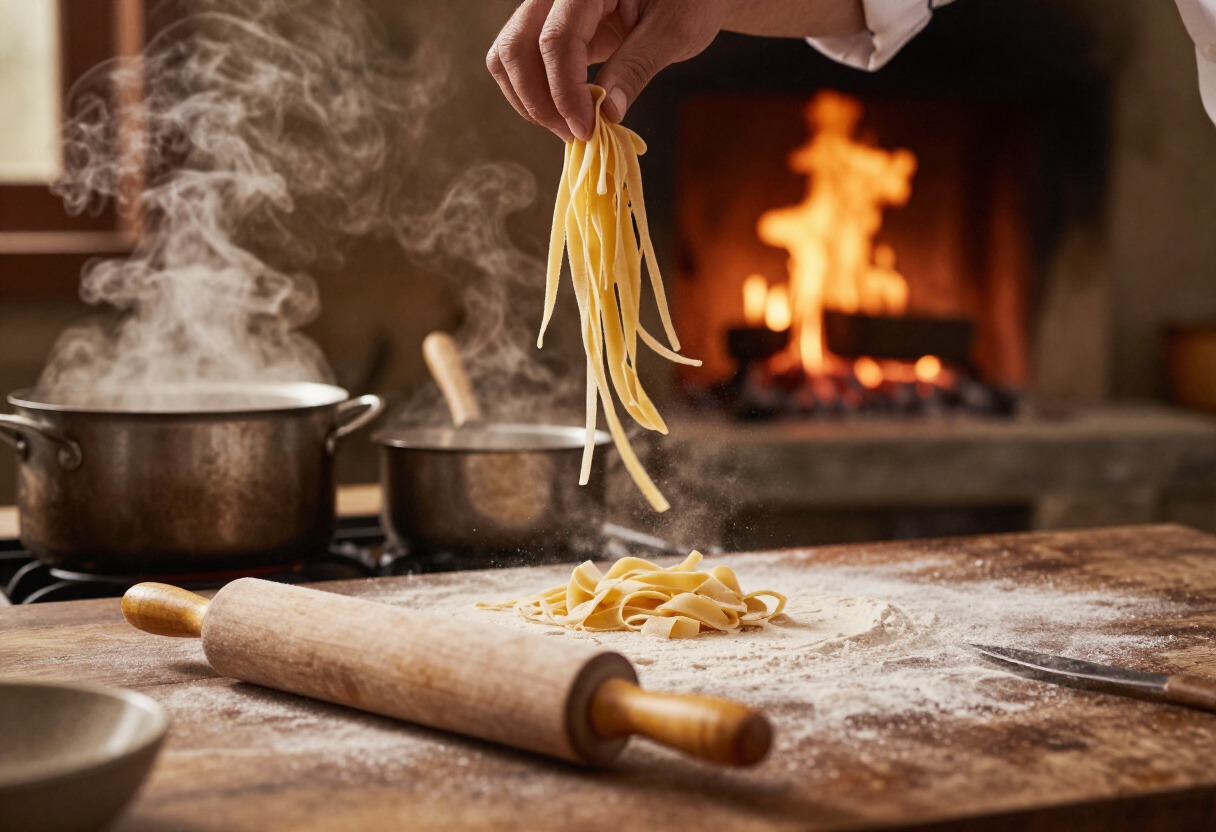
The Twenty Dishes That Explain Italy, Region by Region reaches Italy’s center through rolling grain country, sheep pasture, forests, and city trattorias. These six plates give you egg pasta, truffles, fried olives, Roman guanciale, pastoral mutton, and beef cooked over coals.
- Emilia-Romagna: tagliatelle al ragù. Ribbons of egg pasta hold a slow meat sauce associated with Bologna. In a Bolognese dining room, ordering spaghetti Bolognese marks you as a visitor; ragù traditionally dresses tagliatelle or fills lasagne, where the broad pasta catches the sauce. The pairing is functional as well as conventional: porous, wide ribbons distribute a dense sauce differently from smooth dried spaghetti, so changing the pasta changes the balance of every bite.
- Tuscany: bistecca alla Fiorentina. This thick, bone-in steak is strongly tied to Florence and traditionally linked with Chianina cattle. The meat cooks over fierce coals, hissing sssss as fat meets fire, then arrives deeply charred outside and red within. Its size encourages sharing, turning an expensive ingredient into a communal centerpiece; the tradeoff is that the traditional rare interior will not suit every diner or every food-safety need.
- Umbria: strangozzi with black truffle. The hand-cut pasta reflects a landlocked region known for woodland ingredients, pork, and olive oil. Eat it near Norcia in autumn and the truffle smells dark and earthy, like rain sinking into forest soil. Because truffle aroma is volatile, restrained cooking matters: heavy sauces or prolonged heat can overwhelm the very ingredient that gives the dish value.
- Marche: olive all’ascolana. Olive Ascolane del Piceno DOP are stuffed with seasoned meat, breaded, and fried until crisp. In Ascoli Piceno, a paper cone of hot olives turns an evening walk across Piazza del Popolo into a small feast. Their elaborate preparation transforms small portions of meat into many celebratory bites, linking household economy with the generosity expected of festival food.
- Lazio: carbonara. Rome’s famous pasta joins guanciale, eggs, Pecorino Romano DOP, and black pepper without cream. Its exact origin remains disputed, and its modern history is younger than many diners assume, yet it now carries a firmly Roman identity. Carbonara shows that authenticity can form rapidly when a city repeatedly refines and claims a dish; its difficulty lies in controlling residual heat so the eggs emulsify instead of scrambling.
- Abruzzo: arrosticini. Slender skewers of mutton cook over a narrow charcoal grill called a fornacella. You eat them hot with bread and perhaps Montepulciano d’Abruzzo wine, a direct link to the region’s sheep-herding past. Cutting the meat into small cubes makes a strongly flavored, sometimes tough animal quick to cook and easy to share, converting pastoral necessity into social food.
These central dishes reveal two different kinds of skill. Handmade pasta, stuffed olives, and carbonara reward precise handwork and control, while steak and arrosticini depend on judging fire. Neither category requires a long ingredient list; their depth comes from matching shape, heat, fat, and timing to what the landscape supplies.
They also expose a modern tradeoff in heritage cooking. Travelers may seek an uncompromising “traditional” result, but cooks must respond to ingredient availability, food-safety expectations, and changing tastes. A respectful kitchen can preserve the dish’s defining logic while adapting portion size, doneness, or sourcing rather than treating tradition as untouchable theater.
Live-fire meat needs sensible handling. For a whole beef steak, food-safety guidance uses an internal temperature of 63°C followed by a 3-minute rest; diners who are pregnant, elderly, very young, or immunocompromised should avoid undercooked meat. Keep raw meat away from cooked food and refrigerate leftovers within 2 hours.
Wine can sharpen the experience, but it is for adults of legal drinking age and best enjoyed responsibly. A glass is optional. Sparkling water and a bitter, citrusy chinotto can sit just as naturally beside fried olives or arrosticini.
See How Southern Sun and Island Ingenuity Turn Scarcity Into Flavor
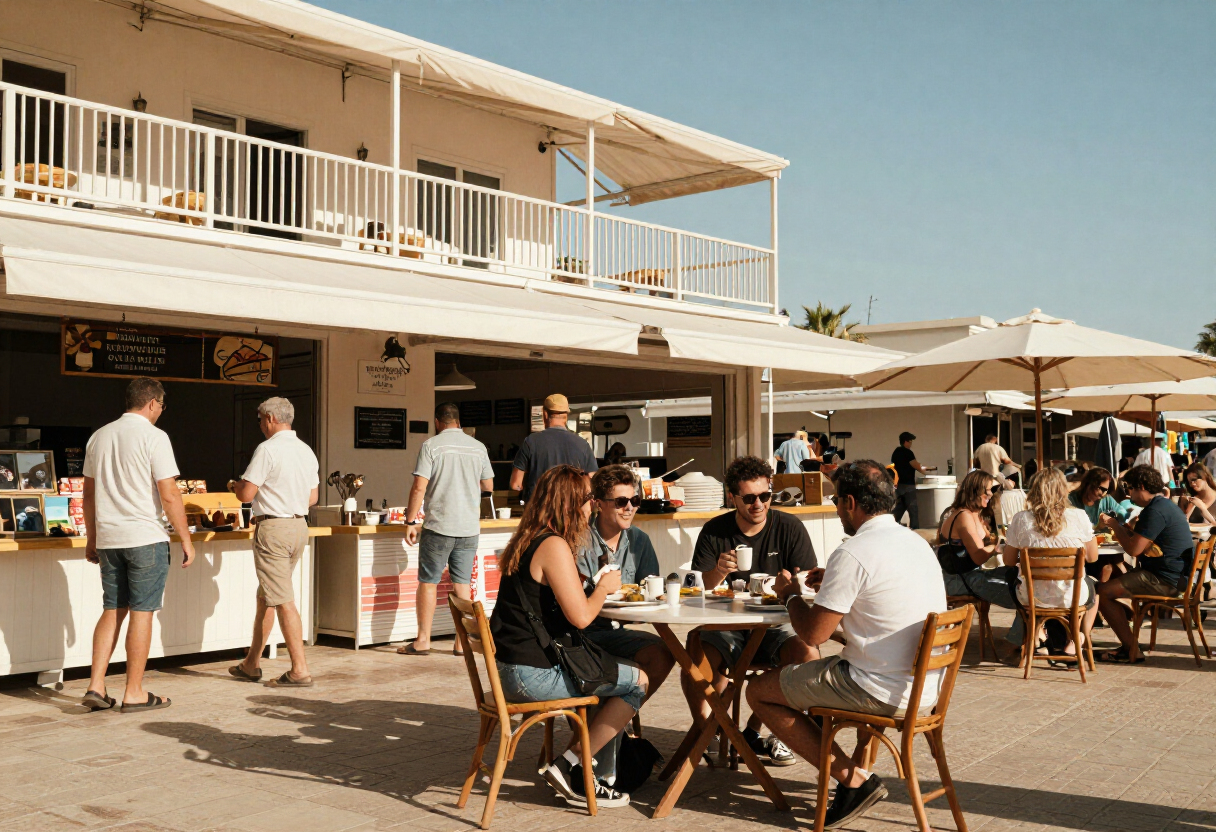
The Twenty Dishes That Explain Italy, Region by Region finishes its map with seven southern and island dishes built around durum wheat, vegetables, pork, and preservation. Here, sun-drying, hand shaping, frying, and slow simmering turn inexpensive ingredients into food with sharp regional character.
- Molise: cavatelli with ragù. Small hollowed pasta pieces catch slow-cooked meat sauce in their thumb-shaped centers. Watch someone roll them across a wooden board in Campobasso and you see rural technique carried through muscle memory: press, flick, curl. The shape extracts more satisfaction from a modest amount of sauce, proving that geometry can be a form of economy.
- Campania: pizza napoletana. Naples transformed dough, tomato, and heat into one of the world’s most traveled foods. A Neapolitan pizza has a soft center and blistered cornicione, or raised rim; it is supple rather than cracker-crisp. Its apparent simplicity makes process unusually visible: fermentation, hydration, stretching, and oven heat cannot hide behind abundant toppings, while the tender center trades portability for immediacy.
- Apulia: orecchiette con le cime di rapa. Ear-shaped durum-wheat pasta meets pleasantly bitter turnip tops, garlic, chilli, olive oil, and often anchovy. On Bari’s Strada Arco Basso, you may see pasta drying on screens while hands press each piece with a butter knife. The bitterness is not a flaw to erase but a counterweight to starch and oil, while dried pasta converts grain into food that can outlast a harvest.
- Basilicata: pasta with peperoni cruschi. Peperone di Senise IGP peppers are dried, then fried briefly until brittle and bright. They shatter over pasta like savory red glass, showing how preservation can intensify sweetness without relying on expensive meat. The technique carries risk as well as reward: a few seconds produce fragrance and crunch, but excess heat turns the thin peppers bitter.
- Calabria: fileja with ’nduja. Fileja is a twisted handmade pasta, while ’nduja is Calabria’s soft, spicy preserved pork sausage. Stirred into tomato sauce, the sausage melts through the dish and leaves a deep brick-red glow. Preservation concentrates both fat and chilli, allowing a small amount to season an entire pot, though its intensity can overwhelm the pasta when treated as bulk meat rather than condiment.
- Sicily: pasta alla Norma. Eggplant, tomato, basil, and grated ricotta salata create a Catanian dish with smoky sweetness and salty lift. The plate reflects Sicily’s Mediterranean complexity, yet it represents only one corner of an island where caponata, couscous, and arancine tell different stories. Frying gives eggplant depth but increases richness, so the tomato’s acidity and ricotta salata’s measured sharpness are structural, not decorative.
- Sardinia: malloreddus alla Campidanese. Ridged durum-wheat dumplings meet tomato, sausage, saffron, and Sardinian pecorino in a dish associated with southern Campidano. The chewy pasta feels made for the sauce, each groove holding a little saffron-scented fat. Its firm texture and ridges show how pasta design mediates between grain and condiment, making a relatively restrained sauce taste complete.
Scarcity here does not mean an absence of pleasure. It often means concentrating flavor in a few ingredients—dried pepper, cured pork, anchovy, salted cheese—and using pasta or dough to distribute them. That model remains economically useful, but it depends on labor, knowledge, and time that modern households may have less of.
These dishes also challenge the idea that southern cooking is simply “light Mediterranean food.” Frying, pork fat, cheese, and slow ragù coexist with vegetables and olive oil. The meaningful pattern is not purity but balance: bitter greens cut fat, acid lifts fried eggplant, and durable wheat carries perishable or expensive flavor.
When cooking sausage or ’nduja at home, bring pork mixtures to 71°C. Cool cooked pasta and sauces promptly, refrigerate them at 4°C or colder, and use them within 3 to 4 days. Gluten appears in every pasta and pizza listed here; anchovies add a fish allergen, while ricotta salata and pecorino contain milk.
Use This Table to Read Italy’s Landscape From the Plate
The fastest way to compare the 20 dishes is to group them by the forces that shaped them: mountains, plains, coastlines, pasture, trade, and preservation. The table lets you move beyond a simple north-south split and spot the ingredient pattern behind each regional choice.
| Landscape or force | Regions and dishes | What you can taste |
|---|---|---|
| Alpine dairy and cold winters | Aosta Valley fonduta; Trentino-Alto Adige/Südtirol canederli; Friuli-Venezia Giulia frico | Melting cheese, bread, potatoes, broth, and preserved meat |
| Po Valley agriculture | Lombardy risotto alla Milanese; Emilia-Romagna tagliatelle al ragù | Rice, butter, egg pasta, saffron, and slow-cooked meat |
| Historic trade routes | Piedmont bagna càuda; Veneto baccalà mantecato; Liguria pesto Genovese | Anchovies inland, dried cod at a port, and ingredients moving through Genoa |
| Pasture, forests, and live fire | Tuscany bistecca; Umbria strangozzi; Marche stuffed olives; Abruzzo arrosticini | Beef, truffle, fried festival food, and mutton smoke |
| Urban pasta and street culture | Lazio carbonara; Campania pizza napoletana | Fast service, strict local technique, and powerful city identities |
| Durum wheat and preservation | Molise cavatelli; Apulia orecchiette; Basilicata cruschi; Calabria fileja; Sardinian malloreddus | Firm pasta, dried peppers, sausage, bitter greens, and resourceful storage |
| Mediterranean vegetable cooking | Sicily pasta alla Norma | Eggplant, tomato, basil, salted cheese, and layered island history |
The categories describe pressures, not sealed culinary compartments. Mountains encourage preservation but do not prevent trade; ports import ingredients but still depend on inland farms; cities concentrate customers and professional skill but absorb habits from migrants and surrounding countryside. Reading the table this way prevents geography from becoming destiny.
A real journey makes the pattern clearer. If you travel from Milan to Bari, your plate may shift from buttery saffron rice to firm durum-wheat pasta with bitter greens. Yet trade keeps disrupting the tidy map: Piedmont’s anchovies came from coastal networks, while Veneto turned imported preserved cod into a cherished local food.
That disruption matters because “local” often describes where an ingredient was culturally transformed rather than where it originated. A community can import a product, develop specialized techniques around it, and eventually make it inseparable from local identity. Insisting that authentic food use only native ingredients would erase much of the history that made regional cuisines distinctive.
Protected designations help you shop with more precision. DOP, or Denominazione di Origine Protetta, protects products tied closely to a defined area and production process; IGP, or Indicazione Geografica Protetta, links at least one production stage or reputation to a place.[2] Fontina DOP, Genovese Basil DOP, and Peperone di Senise IGP are regional ingredients, not decorative wording on a label.
These designations offer traceability and defend accumulated expertise, but they do not automatically guarantee that every protected product will suit your taste or that every unprotected artisan product is inferior. They also impose rules and certification costs. For shoppers, the best use of a designation is as evidence about origin and process, followed by questions about producer, season, and handling.
Climate change is putting added pressure on olives, wheat, rice, tomatoes, and specialty crops through heat, drought, floods, and shifting harvest windows. When you buy from smaller producers or choose seasonal menus, you support the farming systems behind the dish rather than treating regional food as a frozen museum piece.
Adaptation may alter planting dates, crop varieties, irrigation, or the availability of familiar ingredients. That creates a difficult balance: strict traditions protect identity and prevent misleading imitation, while excessive rigidity can leave producers unable to respond to new conditions. A living cuisine must preserve the reasons a dish tastes as it does while allowing farmers and cooks enough flexibility to keep producing it.
Build a Better Italian Food Trip in Five Practical Moves
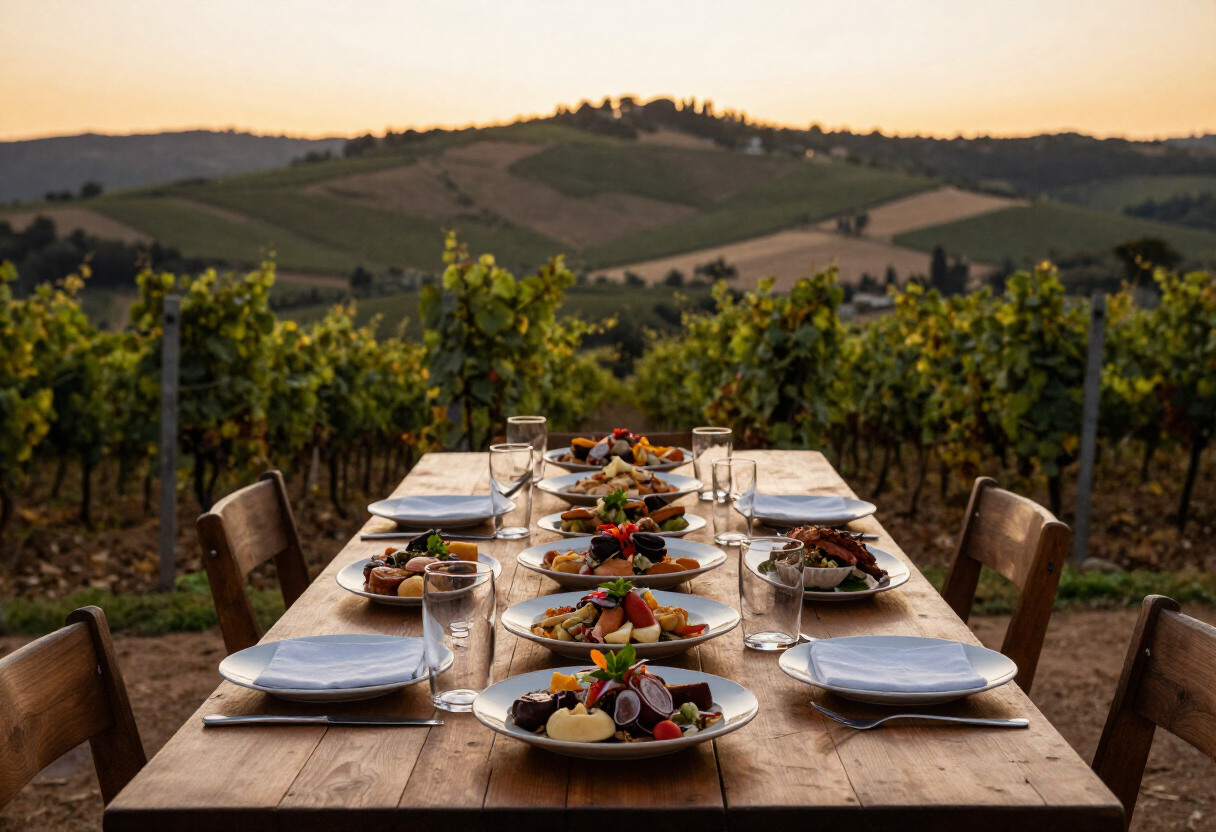
You can turn these 20 dishes into a useful travel plan by choosing one region, one season, and one local food question at a time. The goal is not to collect famous plates like souvenirs. It is to connect each dish with the market, landscape, producer, and daily rhythm that made it.
- Start with a geographic thread. Follow Alpine cheese through Aosta Valley and Trentino, or trace durum-wheat pasta from Molise through Apulia and Calabria. A focused route makes changes in texture and fat easier to taste. The tradeoff is breadth: you will see fewer headline cities, but the comparisons between neighboring places will become more meaningful.
- Match the season. Seek cardoons for Piedmontese bagna càuda in colder months, fresh basil for Ligurian pesto in summer, and truffles in Umbria during their legal harvest seasons. A seasonal menu usually tells you more than a laminated list that never changes. It may also mean accepting that a famous dish or ingredient is unavailable, which is evidence that the kitchen follows the land rather than merely satisfying demand.
- Order the local form. Ask for tagliatelle al ragù in Bologna, not spaghetti Bolognese. In Venice, expect baccalà mantecato to mean a preparation made from soaked stockfish despite the local wording. Local terminology helps you understand technique, but use it with curiosity rather than as a purity test; household and restaurant versions can differ without either being fraudulent.
- Read the designation. Look for DOP or IGP names on menus and market labels, then ask where the ingredient was produced. A jar labeled pesto-style sauce is not the same promise as pesto made with Genovese Basil DOP. The designation verifies a defined relationship to place, not personal preference, freshness, or the skill with which a restaurant used the product.
- Let the dish open another door. After pizza in Naples, try pasta e patate or sfogliatella. After pasta alla Norma in Catania, taste caponata and ask how the local version differs from one served in Palermo. This prevents a celebrated dish from flattening an entire region into one flavor and directs some of your spending toward less famous traditions.
Imagine you have three days in Bologna. Eat tagliatelle once, then visit the covered Mercato delle Erbe, look for fresh egg pasta, and compare ragù with tortellini in broth. You return home understanding a system of cooking, not merely remembering one bowl.
Comparison works best when you control a few variables. Try related dishes within the same season, note whether you are eating in a market stall, home-style trattoria, or formal restaurant, and resist ranking every version immediately. Price and polish can change presentation without necessarily revealing which preparation is more rooted in daily local life.
Small towns often reward the extra train or bus ride. Ascoli Piceno gives you olive all’ascolana in their home setting; Senise connects cruschi peppers with Basilicata’s dry hills; Norcia places truffles beside cured pork and lentils. Food tourism is strongest when you stay curious about neighboring traditions rather than hunting a single supposedly perfect recipe.
Your choices also have consequences for the places you visit. Spending locally, traveling outside peak periods, and ordering seasonal dishes can spread benefits beyond crowded centers. Yet no meal is automatically ethical because it is traditional: ask respectfully about sourcing, avoid treating working markets as stage sets, and remember that residents need ordinary shops and affordable restaurants as well as visitor-focused experiences.
At home, buy one region-specific ingredient and cook around it. Crush Ligurian pesto by hand, crisp Peperone di Senise IGP peppers for only a few seconds, or shape Apulian orecchiette with a blunt knife. The tap-tap of dough on wood teaches you something a generic jar of Italian sauce never can.
Do not measure success only by perfect replication. Your water, flour, climate, equipment, and produce may differ from those in Italy. The more useful lesson is to understand the dish’s internal logic—why a pasta has that shape, why a bitter green balances oil, or why a preserved ingredient is used sparingly—then make any substitutions openly and deliberately.
Frequently Asked Questions
Is there an official dish for each Italian region?
No. These 20 dishes are editorial choices that explain regional themes, not dishes assigned by the Italian government. Emilia-Romagna could just as credibly be represented by tortellini, while Sicily could offer caponata, couscous, or arancine.
Why do so many northern Italian dishes lack tomatoes?
Tomatoes reached Europe after contact with the Americas and became especially prominent in parts of central and southern Italy. Much of northern cooking had already grown around butter, cheese, rice, maize, meat, and egg pasta, though local exceptions are plentiful.
Does every Italian region have a major pasta tradition?
Pasta appears across Italy, but it does not tell the whole story. Rice dominates famous Lombard dishes, polenta matters across much of the north, bread becomes canederli in the Alps, and cheese forms the heart of dishes such as frico and fonduta.
Are pizza and carbonara ancient Italian recipes?
No. The modern form of pizza developed in Naples, while carbonara appears to be a relatively recent Roman dish whose exact origin remains disputed. Cultural authenticity does not require ancient origins; a community can adopt, refine, and strongly identify with a newer preparation.
What does cucina povera mean?
Cucina povera means resourceful cooking based on inexpensive, seasonal, or leftover ingredients. It includes techniques that turn stale bread, beans, wild greens, offal, or scraps into satisfying dishes, much like Basilicata’s dried peppers turn a short harvest into flavor that lasts through winter.
Why do neighboring Italian towns argue about the same recipe?
Recipes carry family history and town identity, so a change in cheese, pasta shape, or cooking fat can feel deeply personal. The disagreement often reflects older political borders, local crops, or rivalries rather than one side cooking incorrectly.
What should I check before ordering these dishes with food allergies?
Ask about gluten, egg, milk, nuts, and fish, which appear frequently across the 20 dishes. Pesto commonly contains pine nuts and cheese, bagna càuda contains anchovies, canederli contain gluten, and carbonara contains egg and milk products; kitchens may also have cross-contact.
Conclusion
Remember the map, not just the menu. Italy’s food makes more sense when you connect Fontina to Alpine pasture, risotto to Po Valley rice fields, bagna càuda to salt routes, arrosticini to shepherds, and orecchiette to Apulia’s durum wheat. One plate gives you a doorway; the region supplies the rest of the house.
Choose one dish and follow it back to its landscape, whether that means planning a train to Bologna, buying Peperone di Senise IGP, or rolling cavatelli across your kitchen table. When the knife scrapes the board and each piece curls under your thumb, Italy stops being a red-sauce idea and becomes what it has always been: many local worlds sharing one boot-shaped peninsula.
Columbus Day / Indigenous Peoples' Day Picks
long weekend sales
As an affiliate, we earn on qualifying purchases.