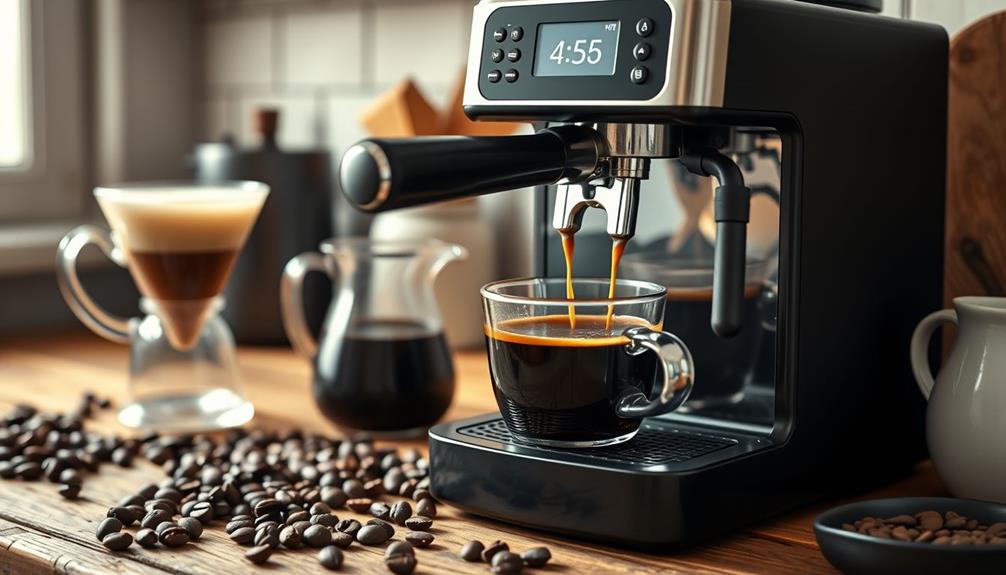

When comparing an espresso machine by price, the biggest difference is often how much control and convenience you get—not a pressure number on the box. My best overall pick is the Breville Bambino for its compact format and focused espresso-making workflow; the Breville Barista Express stands out for buyers who want a built-in grinder, while the De’Longhi Stilosa suits shoppers seeking a simpler manual setup. The tradeoff is between a lower-complexity machine with fewer adjustments and a more involved setup that can give you greater control over grinding and milk. Features such as a grinder, steam wand, footprint, and cleaning routine can matter more to daily use than headline specifications. Read on for the full comparison and a guide to choosing the right machine for your budget and habits.

Get kitchen staples and gadgets delivered free with Prime
- Fast, free delivery on millions of items
- Prime Video, Amazon Music and more included
- Member-only deals all year
Complete the kit


Key Takeaways
- The Bambino is the roundup’s best overall direction for shoppers who want a compact machine from a well-established espresso line without adding a built-in grinder to the workflow.
- The Barista Express models prioritize an all-in-one setup: their built-in grinder can save counter space and simplify equipment selection, but adds another part of the machine to learn and maintain.
- Entry-level compact machines make different compromises: models such as the KEENSTAR, Stilosa, and compact CASABREWS options focus on accessible, space-conscious brewing rather than the broader workflow of an integrated grinder setup.
- A steam wand is useful only if you want to make milk drinks; buyers who mostly drink straight espresso may prefer to prioritize controls, machine size, and cleaning over frothing features.
- Repeated high-pressure claims do not settle the comparison: several compact models advertise 20-bar pressure, but buyers should also weigh usability, included equipment, maintenance, and the consistency of the brewing process.
| KEENSTAR 3.5-Bar Compact Espresso Machine, 800W |  | Best for a Minimal Setup | Model: BCM2201 | Machine type: Semi-automatic espresso machine | Wattage: 800 W | VIEW ON AMAZON | See Our Full Breakdown |
| CASABREWS CM5418 Compact Espresso Machine with Milk Frothing Wand |  | Best Value for a Compact Pump Setup | Machine type: Semi-automatic espresso machine | Pump pressure: 20 bar | Wattage: 1350 W | VIEW ON AMAZON | See Our Full Breakdown |
| CASABREWS 3700 Essential Stainless Steel Espresso Machine with Steam Wand |  | Best for Fewer Tank Refills | Operation mode: Semi-automatic | Pump pressure: 20 bar | Wattage: 1350 W | VIEW ON AMAZON | See Our Full Breakdown |
| Breville Bambino Espresso Machine, Brushed Stainless Steel |  | Best Premium Compact Pick | Model: BES450BSS | Heating system: ThermoJet; reaches extraction temperature in 3 seconds | Temperature control: Digital PID | VIEW ON AMAZON | See Our Full Breakdown |
| Mr. Coffee 4-Shot Steam Espresso Maker with Milk Frother |  | Best for Making Several Servings at Once | Model: BVMCECM-STMMN-BL | Machine type: Semi-automatic espresso machine | Brewing capacity: Up to 4 shots | VIEW ON AMAZON | See Our Full Breakdown |
| Spacekey Espresso Machine with Grinder and Frother |  | Best Value for an All-in-One Setup | Type: Semi-automatic espresso machine | Grinder: Built-in conical burr grinder with 30 settings | Pump pressure: 20 bar | VIEW ON AMAZON | See Our Full Breakdown |
| Breville Barista Express Espresso Machine, Black Truffle |  | Best for Hands-On Espresso Enthusiasts | Model: BES870BTR | Type: Semi-automatic espresso machine | Grinder: Integrated precision conical burr grinder | VIEW ON AMAZON | See Our Full Breakdown |
| Arecovas Espresso Machine with 20-Bar Pressure and Milk Frother |  | Best for Ground-Coffee Simplicity | Machine type: Semi-automatic espresso machine | Pressure: 20 bar | Power and voltage: 1300 watts, 120 volts | VIEW ON AMAZON | See Our Full Breakdown |
| AMZCHEF Semi-Automatic Espresso Machine with Self-Cleaning |  | Best Lightweight Pick for Easier Upkeep | Operation mode: Semi-automatic | Power and voltage: 1350 watts, 120 volts | Pump pressure: 20 bar | VIEW ON AMAZON | See Our Full Breakdown |
| De’Longhi Linea Classic Espresso Machine with Adjustable Milk Frother |  | Best for Preset Espresso Convenience | Coffee maker type: Espresso machine | Operation mode: Fully automatic | Pump pressure: 15 bar | VIEW ON AMAZON | See Our Full Breakdown |
| BYESHOP 20 Bar Compact Espresso Machine with Milk Frother |  | Best for Saved Brewing Preferences | Machine type: Semi-automatic espresso machine | Output pressure: 20 bar | Water tank: 37 oz (1.1 liters), removable | VIEW ON AMAZON | See Our Full Breakdown |
| AMZCHEF Compact 20-Bar Semi-Automatic Espresso Machine |  | Best Value for Temperature Control | Model: EM3131 | Machine type: Semi-automatic espresso machine | Pump pressure: 20 bar | VIEW ON AMAZON | See Our Full Breakdown |
| Breville Barista Express Espresso Machine, Brushed Stainless Steel |  | Best All-in-One Grinder Setup | Model: BES870XL | Machine type: Manual espresso machine | Grinder: Integrated precision conical burr grinder | VIEW ON AMAZON | See Our Full Breakdown |
| De’Longhi Stilosa Compact Manual Espresso Machine with Milk Frother |  | Best Entry-Level Manual Pick | Model: EC260BK | Operation mode: Manual | Pump pressure: 15 bar | VIEW ON AMAZON | See Our Full Breakdown |
| Chefman CraftBrew Semi-Automatic Espresso Machine with Steam Wand | 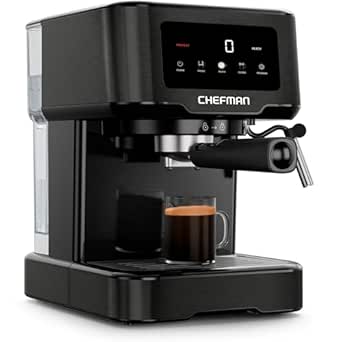 | Best for Adjustable Shot Volume | Model: CraftBrew RJ54-SS-15-D-BLK | Operation mode: Semi-automatic | Coffee type: Ground coffee | VIEW ON AMAZON | See Our Full Breakdown |
| price espresso machine | Dimensions | Model | Pump pressure |
|---|---|---|---|
| KEENSTAR 3.5-Bar Compact Espre | 9.4 × 6.1 × 13.3 in | BCM2201 | — |
| CASABREWS CM5418 Compact Espre | — | — | 20 bar |
| CASABREWS 3700 Essential Stain | — | — | 20 bar |
| Breville Bambino Espresso Mach | 13.7 × 6.3 × 12 in | BES450BSS | — |
| Mr. Coffee 4-Shot Steam Espres | 11.2 × 11.2 × 15 in | BVMCECM-STMMN-BL | — |
| Spacekey Espresso Machine with | 12 × 10 × 14 inches (D × W × H) | — | 20 bar |
| Breville Barista Express Espre | 13.8 × 12.5 × 15.9 inches | BES870BTR | — |
| Arecovas Espresso Machine with | 12 × 5.2 × 11.9 inches (D × W × H) | — | — |
| AMZCHEF Semi-Automatic Espress | — | — | 20 bar |
| De’Longhi Linea Classic Espres | 11.22 × 13.98 × 15.94 inches | — | 15 bar |
| BYESHOP 20 Bar Compact Espress | — | — | — |
| AMZCHEF Compact 20-Bar Semi-Au | — | EM3131 | 20 bar |
| Breville Barista Express Espre | 13.8 × 12.5 × 15.9 in (D × W × H) | BES870XL | — |
| De’Longhi Stilosa Compact Manu | 12.13 × 9.45 × 14.17 in | EC260BK | 15 bar |
| Chefman CraftBrew Semi-Automat | 10.8 × 8.9 × 11.9 in (D × W × H) | CraftBrew RJ54-SS-15-D-BLK | 15 bar |
More Details on Our Top Picks
KEENSTAR 3.5-Bar Compact Espresso Machine, 800W
For buyers focused on keeping an espresso setup small and simple, the KEENSTAR trades brewing pressure and capacity for a light, compact machine. Its 240 ml capacity and 4 lb weight suit occasional single-cup use, while the control knob and pause function keep operation uncomplicated. A milk frother also adds options for cappuccinos without needing a separate appliance. The tradeoff is its 3.5-bar output pressure, which differs from the 20-bar pump systems in the CASABREWS CM5418 and CASABREWS 3700. Those models are better fits for shoppers prioritizing a pump-based espresso setup and larger water tanks. I’d choose the KEENSTAR when compactness and straightforward controls matter more than capacity or pressure; frequent drink makers should look elsewhere.
Pros:- Compact footprint and 4 lb weight make it easy to place or move.
- Simple control knob and pause function support straightforward operation.
- Built-in milk frother enables milk-based drinks without another appliance.
- Can prepare hot or iced coffee.
Cons:- The 240 ml capacity is limiting for multiple drinks.
- Its 3.5-bar output pressure is lower than the 20-bar pump pressure listed for the CASABREWS CM5418 and 3700.
- Ground coffee is required, so it does not offer the convenience of a built-in grinder.
Best for: Occasional coffee drinkers with limited counter space who want a lightweight machine, simple controls, and a built-in milk frother.
Not ideal for: Households making several drinks in a row or buyers seeking a pump-based machine with the higher stated pressure of the CASABREWS models.
- Model:BCM2201
- Machine type:Semi-automatic espresso machine
- Wattage:800 W
- Output pressure:3.5 bar
- Capacity:240 ml
- Dimensions:9.4 × 6.1 × 13.3 in
- Weight:4 lb
- Coffee input:Ground coffee
Our verdict“Choose the KEENSTAR for occasional drinks in a compact, simple setup, but pick a larger pump machine for frequent brewing.”
CASABREWS CM5418 Compact Espresso Machine with Milk Frothing Wand
The CASABREWS CM5418 brings more brewing flexibility than the KEENSTAR without taking up the role of a high-end, highly automated machine. It supports single or double shots, has a removable 34 oz water tank, and includes a steam wand for milk drinks. A built-in pressure gauge gives the user feedback when adjusting extraction, a hands-on feature that the simpler KEENSTAR lacks. The main compromise is workflow: after frothing milk, the machine must cool before brewing, so making a latte and then another espresso can take extra time. Compared with the CASABREWS 3700, its tank is smaller, but the CM5418 offers a pressure gauge for monitoring adjustments. I’d favor it for a compact counter and manual control, not for users who want fast back-to-back milk drinks.
Pros:- Supports both single and double shots.
- Removable 34 oz water tank makes refilling more convenient.
- Built-in pressure gauge helps users monitor extraction adjustments.
- Includes a steam wand and core portafilter accessories.
Cons:- Requires a cooling period after frothing milk before brewing.
- Manual preparation and adjustment take more involvement than the Breville Bambino’s automatic steam wand.
- Its tank is smaller than the 43.9 oz tank on the CASABREWS 3700.
Best for: Home or office users who want a compact pump machine, single- and double-shot options, and a steam wand with visible extraction feedback.
Not ideal for: People who regularly make several milk drinks in sequence or want automatic milk texturing and a faster workflow.
- Machine type:Semi-automatic espresso machine
- Pump pressure:20 bar
- Wattage:1350 W
- Water tank capacity:34 oz, removable
- Material:Stainless steel
- Milk frothing:Steam wand
- Included filters:One-cup and two-cup filters
- Included accessories:Portafilter, tamper with spoon, instruction manual
Our verdict“Pick the CM5418 if you want a compact, manually adjustable pump machine and can accept pauses between steaming and brewing.”
CASABREWS 3700 Essential Stainless Steel Espresso Machine with Steam Wand
The CASABREWS 3700 makes the most sense for buyers who want a straightforward pump machine with room for more water between refills. Its 43.9 oz removable tank is larger than the CM5418’s 34 oz reservoir, a practical advantage when multiple people share the machine. Both models have a 20-bar pump, 1350-watt heating system, and steam wand, so the 3700’s clearest distinction is capacity rather than a major change in drink-making approach. It includes one- and two-cup filters, a portafilter, and a tamper, but it requires a first-use cycle before brewing. Unlike the Breville Bambino, it does not list automatic milk texturing or three-second heat-up. I’d put it ahead of the smaller CASABREWS for shared use, while buyers wanting more automation should compare the Bambino.
Pros:- 43.9 oz removable tank holds more water than the CM5418’s 34 oz tank.
- 20-bar pump and 1350-watt heating system support a pump-based brewing setup.
- Steam wand allows milk frothing and latte art practice.
- Includes one- and two-cup filters, a portafilter, and a tamper.
Cons:- Requires a first-use cycle before brewing.
- Milk frothing is manual, unlike the Breville Bambino’s automatic steam wand.
- The product data does not specify a pressure gauge or rapid heat-up feature.
Best for: Couples, shared households, or small offices that want a compact pump machine with a larger removable tank and manual milk frothing.
Not ideal for: Buyers who want automatic milk texture control, a specified rapid heat-up, or a machine ready to brew without a first-use cycle.
- Operation mode:Semi-automatic
- Pump pressure:20 bar
- Wattage:1350 W
- Voltage:120 V
- Water tank capacity:43.9 oz
- Coffee input:Ground coffee
- Milk frother:Steam wand
- Included accessories:One-cup and two-cup filters, portafilter, tamper with spoon
Our verdict“Choose the CASABREWS 3700 over the CM5418 when a larger water tank matters more than a smaller footprint or added extraction feedback.”
Breville Bambino Espresso Machine, Brushed Stainless Steel
The Breville Bambino earns its place for buyers willing to pay for a more guided, quicker home workflow rather than just a pump and steam wand. Its ThermoJet system reaches extraction temperature in 3 seconds, while PID temperature control and low-pressure pre-infusion are designed to support more consistent extraction. The automatic steam wand also lets users adjust milk temperature and texture, reducing the manual effort required by the CASABREWS CM5418 and 3700. The tradeoff is that the Bambino still uses ground coffee and requires manual preparation; it is not a push-button bean-to-cup machine. Its 47 fl oz water capacity is larger than either CASABREWS tank listed here, though its 10.9 lb weight makes it less portable than the 4 lb KEENSTAR. I’d choose it for compact kitchens where control and speed justify the extra complexity.
Pros:- ThermoJet system reaches extraction temperature in 3 seconds.
- PID temperature control and low-pressure pre-infusion support controlled extraction.
- Automatic steam wand offers adjustable milk temperature and texture.
- 47 fl oz water capacity and included brewing and cleaning accessories.
Cons:- Requires ground coffee and manual espresso preparation.
- More involved than the KEENSTAR’s simple control-knob operation.
- At 10.9 lb, it is heavier than the compact 4 lb KEENSTAR.
Best for: Home espresso drinkers who want fast heat-up, adjustable automatic milk texturing, and a compact machine with more guided extraction features.
Not ideal for: Buyers seeking a low-involvement bean-to-cup setup, or shoppers who prioritize minimal weight and basic operation over temperature control.
- Model:BES450BSS
- Heating system:ThermoJet; reaches extraction temperature in 3 seconds
- Temperature control:Digital PID
- Portafilter:54 mm
- Wattage:1560 W
- Water capacity:47 fl oz
- Dimensions:13.7 × 6.3 × 12 in
- Weight:10.9 lb
- Warranty:1-year limited product warranty
Our verdict“Choose the Bambino if quick heat-up and adjustable automatic milk texturing matter more than the simpler controls of lower-featured options.”
Mr. Coffee 4-Shot Steam Espresso Maker with Milk Frother
The Mr. Coffee 4-Shot Steam Espresso Maker is the lineup’s batch-oriented choice: it can brew up to four shots at a time, unlike the single- or double-shot focus of the CASABREWS CM5418. Its integrated frothing wand, stainless steel pitcher, marked water pitcher, and measuring scoop give new users a more complete starting kit for preparing several servings. But its steam-brewing system sets it apart from the pump-based CASABREWS machines and Breville Bambino; buyers specifically seeking a pump espresso setup should choose one of those instead. The reusable filter avoids disposable-filter dependence, though ground coffee is still required. I’d consider this for shared servings and simple preparation, not for shoppers who value pump-based extraction or compact dimensions—the listed body is 11.2 × 11.2 × 15 inches.
Pros:- Brews up to four shots at once, more than the CM5418’s single- or double-shot options.
- Integrated frothing wand supports cappuccinos and lattes.
- Includes a stainless steel frothing pitcher, marked water pitcher, and measuring scoop.
- Reusable filter supports repeated brewing without disposable filters.
Cons:- Uses steam brewing rather than the pump-based system in the CASABREWS models and Breville Bambino.
- Requires ground coffee rather than offering an integrated grinder.
- Its 15-inch height may be awkward under some cabinets.
Best for: Households or hosts who want to prepare several coffee servings together and appreciate included measuring and milk-frothing accessories.
Not ideal for: Espresso enthusiasts seeking a pump-based machine, or buyers with limited vertical counter space who prefer a compact design.
- Model:BVMCECM-STMMN-BL
- Machine type:Semi-automatic espresso machine
- Brewing capacity:Up to 4 shots
- Wattage:1200 W
- Voltage:240 V
- Dimensions:11.2 × 11.2 × 15 in
- Filter:Reusable
- Included components:Frothing wand, water pitcher, measuring scoop, stainless steel frothing pitcher
Our verdict“Choose this Mr. Coffee for convenient multi-serving steam brewing and included accessories, but skip it if pump-based espresso is your priority.”
Spacekey Espresso Machine with Grinder and Frother
For buyers comparing the upfront cost of a complete setup, the Spacekey’s built-in conical burr grinder is its defining advantage: it offers 30 settings without requiring a separate grinder. PID temperature control and a steam wand add useful brewing and milk-drink flexibility, while the cold brew function gives it an option the Breville Barista Express does not list. Its LCD display and included dosing accessories also make the setup feel self-contained. The tradeoff is a more hands-on routine: it is semi-automatic, so dialing in grind and extraction takes practice. Compared with the ground-coffee-only Arecovas, the Spacekey is better suited to whole-bean buyers, but its 15-pound weight makes it less convenient to move around the kitchen.
Pros:- Built-in conical burr grinder with 30 settings reduces the need for a separate grinder
- PID temperature control supports steadier brewing temperatures
- Steam wand and cold brew function cover more drink styles
- Removable 61 oz tank and included dosing accessories make setup more self-contained
Cons:- Semi-automatic brewing and grinder adjustment require practice
- At 15 pounds, it is less convenient to move than the lighter AMZCHEF model
- A built-in grinder makes the machine a larger commitment than simpler ground-coffee options
Best for: Home users who want a built-in grinder, milk frothing, and multiple drink styles without adding separate equipment
Not ideal for: Beginners seeking push-button simplicity or anyone who needs a lightweight machine to move frequently
- Type:Semi-automatic espresso machine
- Grinder:Built-in conical burr grinder with 30 settings
- Pump pressure:20 bar
- Power:1350 watts
- Water tank:61 oz (1.8 liters), removable
- Dimensions:12 × 10 × 14 inches (D × W × H)
- Weight:15 pounds
- Controls and features:LCD display, PID temperature control, steam wand, cold brew function
- Warranty:One-year limited
Our verdict“Choose the Spacekey if you want an all-in-one whole-bean machine with broad drink options and are willing to learn its manual workflow.”
Breville Barista Express Espresso Machine, Black Truffle
The Barista Express earns its place for buyers who want more control over espresso preparation, not simply a machine that makes a quick cup. Its integrated conical burr grinder doses into the portafilter, while low-pressure pre-infusion and PID temperature control give users tools to refine extraction. The steam wand can produce microfoam for milk drinks, though learning to texture milk well takes practice. Compared with the Spacekey, this Breville has a larger 67 fl oz tank and a more clearly specified 1600-watt power rating, but it is also substantially heavier at 22.1 pounds. The Arecovas is a simpler ground-coffee alternative; the Barista Express suits buyers who want the grinder built in and accept a more involved workflow and heavier countertop presence.
Pros:- Integrated conical burr grinder doses fresh coffee directly into the portafilter
- Low-pressure pre-infusion and PID temperature control support extraction adjustments
- Steam wand can create microfoam for milk drinks
- 67 fl oz water tank reduces refill frequency compared with the smaller Arecovas tank
Cons:- Manual milk texturing has a learning curve
- At 22.1 pounds, it is heavier than the Spacekey and AMZCHEF options
- An integrated grinder and hands-on workflow may be more machine than casual espresso drinkers need
Best for: Espresso hobbyists who want an integrated grinder, hands-on shot adjustment, and the ability to practice milk texturing
Not ideal for: Buyers prioritizing a light machine, minimal steps, or a ground-coffee setup without grinder adjustment
- Model:BES870BTR
- Type:Semi-automatic espresso machine
- Grinder:Integrated precision conical burr grinder
- Bean hopper:1/2 lb
- Water tank:67 fl oz
- Power and voltage:1600 watts, 120 volts
- Dimensions:13.8 × 12.5 × 15.9 inches
- Weight:22.1 pounds
- Warranty:One-year limited
Our verdict“Pick the Barista Express if you want a grinder-equipped machine for learning and refining espresso technique, and can spare the counter space.”
Arecovas Espresso Machine with 20-Bar Pressure and Milk Frother
The Arecovas makes more sense for buyers who already use ground coffee and want a compact machine with clear drink controls. Its single- and double-shot settings plus an Americano button offer a straightforward route to common drinks, and the touchscreen shows a real-time pressure gauge. PID temperature control with dual NTC sensors and a steam wand add more control than a basic espresso-only appliance. Unlike the Spacekey and Breville Barista Express, it has no built-in grinder, so whole-bean users need a separate grinder or must buy pre-ground coffee. Its 1.2-liter tank is also smaller than the Breville’s 67 fl oz reservoir. That tradeoff can suit a compact setup, but buyers who value fresh grinding in one machine should look at the grinder-equipped options instead.
Pros:- Americano setting complements single- and double-shot options
- Touchscreen and real-time pressure gauge make brewing controls visible
- PID control with dual NTC sensors supports temperature management
- Compact 5.2-inch width can fit narrow counter spaces
Cons:- Requires ground coffee and does not include a grinder
- The 1.2-liter tank is smaller than the Breville Barista Express reservoir
- Semi-automatic operation still involves user input for brewing and milk frothing
Best for: Ground-coffee users who want espresso, Americanos, and milk drinks from a compact machine with guided controls
Not ideal for: Whole-bean buyers who want grinding built into the machine or users who prefer fully automated preparation
- Machine type:Semi-automatic espresso machine
- Pressure:20 bar
- Power and voltage:1300 watts, 120 volts
- Water tank:1.2 L (41 oz), removable
- Dimensions:12 × 5.2 × 11.9 inches (D × W × H)
- Interface:Touchscreen with LED display and real-time pressure gauge
- Temperature control:PID algorithm with dual NTC sensors
- Coffee input:7–9 g for a single shot; 13–15 g for a double shot
- Included accessories:One- and two-cup filters, portafilter, tamper with spoon, instruction manual, user guide
Our verdict“Choose the Arecovas if you already have ground coffee and want compact, guided drink controls without paying for a built-in grinder you will not use.”
AMZCHEF Semi-Automatic Espresso Machine with Self-Cleaning
The AMZCHEF stands out for buyers who want a ground-coffee machine that is easier to shift on the counter and includes a cleaning assist. At 8.5 pounds, it is much lighter than the 22.1-pound Breville Barista Express, and the removable 44 oz tank gives it more capacity than the Arecovas’s 41 oz reservoir. The touchscreen, PID temperature control, and 20-bar pump cover the core features in this group, while self-cleaning and safety protections may reduce some routine upkeep. It still requires ground coffee, and its manual steam wand leaves milk texturing in the user’s hands. That makes it less suited to people seeking an all-in-one grinder setup like the Spacekey. The three-year warranty is a useful differentiator, though it does not remove the need to learn semi-automatic brewing.
Pros:- At 8.5 pounds, it is easier to move than the Breville Barista Express
- Self-cleaning function adds convenience to routine maintenance
- 44 oz removable water tank is larger than the Arecovas tank
- Three-year warranty is longer than the one-year coverage listed for the Spacekey and Breville
Cons:- Requires ground coffee rather than whole beans
- Manual steam wand requires practice and user control
- Semi-automatic operation is less hands-off than a fully automatic machine
Best for: Ground-coffee users who want a lighter machine, a removable tank, and cleaning assistance for regular home use
Not ideal for: Whole-bean drinkers who want an integrated grinder or users who want automatic milk preparation
- Operation mode:Semi-automatic
- Power and voltage:1350 watts, 120 volts
- Pump pressure:20 bar
- Water tank:44 oz, removable
- Coffee input:Ground coffee
- Display:LED touchscreen
- Steam wand:Manual, 360-degree swivel
- Dimensions and weight:12.1 × 13 × 6.5 inches; 8.5 pounds
- Warranty:3 years
Our verdict“Choose the AMZCHEF if you want a relatively light ground-coffee machine with cleaning assistance and do not need a built-in grinder.”
De’Longhi Linea Classic Espresso Machine with Adjustable Milk Frother
The Linea Classic is the most convenience-led choice here: its customizable single- and double-espresso presets can simplify repeat drinks, while the adjustable steam wand handles milk and milk alternatives. Its compact stainless-steel design and 9.3-pound weight make it easier to reposition than the Breville Barista Express, although the listed dimensions show it still needs a defined spot on the counter. Compared with the Arecovas, the De’Longhi lists fully automatic operation and preset recipes, but it does not list a touchscreen or an Americano button. It also requires ground coffee, unlike the Spacekey and Breville machines with built-in grinders. The 15-bar pump and Thermoblock heating are part of its espresso setup, but buyers seeking fresh grinding in one appliance should choose another pick in this roundup.
Pros:- Customizable single- and double-espresso presets simplify repeat drinks
- Adjustable steam wand works with milk and milk alternatives
- Stainless-steel construction gives it a compact, straightforward countertop profile
- At 9.3 pounds, it is lighter than the Breville Barista Express
Cons:- Requires ground coffee and has no listed built-in grinder
- Does not list the touchscreen or Americano setting found on the Arecovas
- Dimensions may require more counter depth than its compact description suggests
Best for: Home or office users who want repeatable single and double espresso presets and an adjustable wand for milk drinks
Not ideal for: Whole-bean coffee drinkers who want an integrated grinder or buyers who want a highly hands-on extraction setup
- Coffee maker type:Espresso machine
- Operation mode:Fully automatic
- Pump pressure:15 bar
- Power and voltage:1350 watts, 120 volts
- Coffee input:Ground coffee
- Dimensions:11.22 × 13.98 × 15.94 inches
- Weight:9.3 pounds
- Features:Adjustable milk frother, removable tank, auto shut-off
- Preset recipes:Customizable single and double espresso
Our verdict“Pick the Linea Classic if preset espresso and an adjustable milk wand matter more to you than built-in grinding or extensive manual control.”
BYESHOP 20 Bar Compact Espresso Machine with Milk Frother
For buyers comparing features against upfront simplicity, the BYESHOP pairs customizable one- and two-cup settings with a memory function, so a repeat drink can take fewer control adjustments. Its pressure and temperature displays offer more visible brewing feedback than the straightforward controls on the De’Longhi Stilosa, though displays alone do not make dialing in espresso effortless. A steam wand adds milk drinks without a separate frother, and the removable tank and drip tray make routine cleanup less awkward.
The tradeoff is limited clarity in the supplied specifications: the listed dimensions of 8 × 2.5 × 2.9 inches appear unusually small for a machine with these features, so I would verify the actual footprint before planning a counter space. This is a better fit for someone who values saved settings and feedback than for a buyer seeking the simplest low-cost routine.
Pros:- Memory function can retain preferred brewing settings
- Pressure and temperature displays provide brewing feedback
- Steam wand supports milk-based drinks
- Removable water tank and drip tray simplify cleaning
Cons:- Listed dimensions appear unusually small and should be verified before purchase
- Semi-automatic brewing and steaming require hands-on steps
- Uses ground coffee rather than an integrated grinder
Best for: Espresso drinkers who make the same one- or two-cup recipes regularly and want saved settings plus visible pressure and temperature readings.
Not ideal for: Buyers who need confirmed countertop measurements or want a simpler machine with fewer controls, such as the De’Longhi Stilosa.
- Machine type:Semi-automatic espresso machine
- Output pressure:20 bar
- Water tank:37 oz (1.1 liters), removable
- Coffee input:Ground coffee
- Controls:LED touchscreen with customizable one- and two-cup presets and memory
- Displays:Pressure and temperature gauges
- Milk frother:Steam wand
- Housing:Stainless steel
- Listed dimensions:8 × 2.5 × 2.9 in (D × W × H); verify measurements
Our verdict“Choose the BYESHOP if saved recipes and visible brewing feedback matter more to you than verified sizing and simple operation.”
AMZCHEF Compact 20-Bar Semi-Automatic Espresso Machine
The AMZCHEF makes a strong case for buyers who want brewing control without moving up to a grinder-equipped machine like the Breville Barista Express. Its PID temperature control, specified at ±2°C, aims to keep brewing temperature consistent, while a listed 30-second heat-up can shorten the wait for a morning cup. One-touch single- and double-cup options and a rotating steam wand cover the essentials without the Barista Express’s larger footprint or manual grinding workflow.
The compromise is a more basic coffee setup: it takes ground coffee, so buyers need a separate grinder or pre-ground beans, and its plastic construction is less substantial than the Breville’s steel body. At 8.2 pounds, it is easier to move, but that lighter build may not feel as solid during portafilter handling. I’d pick it for temperature features and compact dimensions, not for an all-in-one bean-to-cup workflow.
Pros:- PID temperature control is specified at ±2°C
- Listed 30-second heating time can reduce waiting
- Removable 50-ounce tank cuts down on refill frequency
- Rotating steam wand supports milk drinks
Cons:- Requires ground coffee and has no built-in grinder
- Plastic construction feels less substantial than the steel-bodied Breville Barista Express
- Milk steaming and shot preparation still require manual involvement
Best for: Apartment or office users who want PID temperature control, quick stated heat-up, and a removable tank in a relatively compact machine.
Not ideal for: Buyers who want freshly ground beans from an integrated grinder or prefer a metal-bodied machine like the Breville Barista Express.
- Model:EM3131
- Machine type:Semi-automatic espresso machine
- Pump pressure:20 bar
- Power:1350 watts, 120 volts
- Temperature control:PID, ±2°C
- Listed heating time:30 seconds
- Water tank:50 oz, removable
- Coffee input and filter:Ground coffee; reusable filter
- Dimensions and weight:12.5 × 7 × 14.4 in (D × W × H); 8.2 lb
Our verdict“Pick the AMZCHEF for a compact, temperature-controlled setup if you are comfortable supplying and dosing ground coffee yourself.”
Breville Barista Express Espresso Machine, Brushed Stainless Steel
The Barista Express is the most complete coffee-preparation setup in this group: its integrated conical burr grinder grinds beans directly into the portafilter, eliminating the need to buy a separate grinder. Low-pressure pre-infusion and digital temperature control give hands-on users more ways to shape extraction than the simpler preset-focused AMZCHEF Compact 20-Bar. A 67-ounce tank also reduces interruptions, while the steam wand lets users texture milk rather than relying on an automatic frother.
That breadth comes with a higher-complexity routine. Grinding, dosing, tamping, pulling shots, and steaming milk all take practice, so the De’Longhi Stilosa is a more approachable pick for someone who wants fewer moving parts. The Breville is also heavier and wider, and its one-year limited warranty is specified in the product data. I’d choose it for a buyer who wants control and an integrated grinder, not for someone prioritizing compactness or speed.
Pros:- Integrated conical burr grinder handles fresh grinding at the machine
- Low-pressure pre-infusion and digital temperature control support extraction adjustments
- Steam wand allows manual milk texturing
- 67-ounce water tank and included preparation accessories support a full workflow
Cons:- Manual grinding, dosing, tamping, and steaming require practice
- Larger and heavier than compact options such as the De’Longhi Stilosa
- One-year limited warranty is specified
Best for: Home espresso hobbyists who want an integrated grinder, manual milk texturing, and control over extraction without purchasing a separate grinder.
Not ideal for: Beginners seeking a quick, low-effort routine, or buyers with limited counter space who would prefer the smaller, simpler De’Longhi Stilosa.
- Model:BES870XL
- Machine type:Manual espresso machine
- Grinder:Integrated precision conical burr grinder
- Bean hopper capacity:1/2 lb
- Water tank capacity:67 oz
- Power and voltage:1600 watts, 120 volts
- Dimensions:13.8 × 12.5 × 15.9 in (D × W × H)
- Weight and material:22.1 lb; steel with stainless steel exterior finish
- Warranty:1-year limited
Our verdict“Choose the Barista Express if you want a grinder built into a hands-on espresso setup and have room to learn its workflow.”
De’Longhi Stilosa Compact Manual Espresso Machine with Milk Frother
The Stilosa keeps the feature set focused: it uses ground coffee, offers single- and double-shot filters, and adds a manual steam wand for cappuccinos and lattes. That simplicity makes it a more approachable starting point than the Breville Barista Express, which adds an integrated grinder and a more involved workflow. Its two-level cup holder also helps accommodate different cup heights, while the removable tank supports straightforward refilling.
There is less brewing feedback and automation here than on the BYESHOP, which has pressure and temperature displays plus saved settings. The Stilosa’s manual controls and milk steaming mean buyers still have to manage each step, and it does not include a grinder. Its 15-bar pump and 1,000 ml tank suit basic home use, but this is not the pick for someone chasing extensive extraction adjustments or a one-touch milk drink. I’d choose it for a restrained, compact entry into manual espresso.
Pros:- Includes separate single- and double-shot filters
- Manual steam wand can froth milk for cappuccinos and lattes
- Two-level cup holder accommodates different cup heights
- Removable water tank supports easier refilling
Cons:- Manual shot preparation and milk steaming require attention
- No integrated grinder, so beans must be ground separately
- Offers fewer feedback and customization features than the BYESHOP
Best for: First-time home espresso buyers who want a compact manual machine for occasional single or double shots and milk drinks.
Not ideal for: Buyers who want saved recipes, brewing displays, an integrated grinder, or automated milk preparation.
- Model:EC260BK
- Operation mode:Manual
- Pump pressure:15 bar
- Power and voltage:1100 watts, 120 volts
- Water capacity:1000 ml
- Dimensions:12.13 × 9.45 × 14.17 in
- Weight:8.6 lb
- Coffee input:Ground coffee
- Included components:Single- and double-shot filters, measuring scoop, portafilter
Our verdict“Choose the Stilosa if you want a straightforward manual starting point and do not need the extra controls found on the BYESHOP.”
Chefman CraftBrew Semi-Automatic Espresso Machine with Steam Wand
The CraftBrew suits buyers who want more shot-volume control than the basic manual De’Longhi Stilosa while keeping the machine smaller than the grinder-equipped Breville Barista Express. Its touch panel lets users adjust shot volume, and a built-in timer adds a useful reference for repeat brewing. The 1.5-liter removable reservoir is the largest stated capacity among the compact ground-coffee options here, so frequent drink makers may need fewer refills.
A 15-bar pump and steam wand cover espresso and milk drinks, but the semi-automatic label does not mean hands-free preparation: users still supply ground coffee and handle manual steps, including steaming milk. Unlike the Barista Express, it has no built-in grinder, and its listed features do not include the temperature control offered by the AMZCHEF. This is a practical middle ground for buyers who value adjustable shot volume and tank capacity over integrated grinding or advanced extraction controls.
Pros:- Adjustable shot volume supports different drink preferences
- Removable 1.5-liter reservoir reduces refill frequency
- Built-in steam wand supports cappuccinos and lattes
- Touch controls and a built-in timer add convenient operating feedback
Cons:- Requires ground coffee and has no integrated grinder
- Semi-automatic brewing and milk steaming still involve manual steps
- Does not list PID temperature control like the AMZCHEF
Best for: Ground-coffee users who want adjustable shot volume, a touch control panel, and a larger removable reservoir for regular home drinks.
Not ideal for: Buyers who want an integrated grinder, PID temperature control, or a fully automated espresso-and-milk routine.
- Model:CraftBrew RJ54-SS-15-D-BLK
- Operation mode:Semi-automatic
- Coffee type:Ground coffee
- Pump pressure:15 bar
- Water reservoir:1.5 liters, removable
- Power and voltage:1350 watts, 120 volts
- Dimensions:10.8 × 8.9 × 11.9 in (D × W × H)
- Controls and features:Touch control panel, adjustable shot volume, built-in timer, descale function
- Certification and warranty:cETL approved; 1-year warranty
Our verdict“Pick the CraftBrew if adjustable shot volume and reservoir capacity matter more than an integrated grinder or advanced temperature control.”

How We Picked
I organized the lineup around the factors that change day-to-day ownership: brewing workflow, grinder inclusion, milk-frothing capability, footprint, controls, cleaning demands, and the kind of buyer each design serves. I treated marketing claims such as a high pressure figure as one specification among many, not as proof of better espresso. Because the roundup includes compact machines, steam-driven designs, semi-automatic models, and grinder-equipped options, I compared each product with alternatives that ask buyers to make a similar choice.
The ranking favors machines that appear to offer a useful balance of capability, usability, and flexibility for their intended buyer. A focused, established design can rank ahead of a longer feature list if it keeps the workflow clearer; a grinder-equipped machine earns a distinct place for buyers who want fewer separate appliances, while simpler compact models remain relevant for tighter spaces and more limited routines. I also account for tradeoffs: milk features add steps, integrated grinders add complexity, and a small footprint may mean fewer controls or less room to work.
Factors to Consider When Choosing Price Espresso Machine
Choosing an espresso machine is less about finding one universal winner and more about matching the machine’s workflow to your kitchen and coffee routine. These factors can help you decide which compromises are worth making before you compare individual models.
Decide Whether You Need a Built-In Grinder
A grinder changes both the machine’s footprint and the number of steps involved in making a drink. An integrated setup can reduce the need to choose a separate grinder, but it also means one appliance handles more of the routine and may require more involved cleaning. A machine without a grinder leaves you free to select equipment separately, though that can add counter space and another purchase decision. Avoid choosing an all-in-one model simply because it sounds more complete; it suits you best when you want the grinder built into the same workflow. If you already own a grinder you like, paying for another one may add little value.
Match the Controls to Your Interest in Learning
Semi-automatic and manual-style machines ask you to take a more active role in preparing each shot. That can appeal to buyers who enjoy adjusting their routine, but it can feel like unnecessary work if the goal is a quick cup before leaving home. A simpler machine may reduce decision points at the cost of control over the process. Think about whether you want espresso making to be a hobby or a repeatable household task. A common mistake is buying a machine for its potential and then rarely using the extra controls. Favor the workflow you can see yourself repeating on busy mornings.
Treat Milk Frothing as a Separate Workflow
A steam wand adds flexibility for lattes and cappuccinos, but it also means steaming, cleaning the wand, and learning to handle milk. If you usually drink espresso without milk, a frother may take up space without improving your routine. For households with different preferences, a wand can make one machine serve more people, provided someone is willing to use and clean it. Check whether you want manual steaming or a simpler frothing approach rather than assuming every milk feature works the same way. Consider how often you make milk drinks, not just whether you might want one occasionally. That answer can help you avoid paying in space and effort for a feature that stays unused.
Measure the Whole Setup, Not Just the Machine
Compact machines can fit a small counter, but the working area also needs room for a cup, any grinder or accessories, and access to the water reservoir. Measure the height beneath cupboards as well as the width and depth of the counter. A built-in grinder may reduce the number of appliances while making the machine itself a larger part of the setup. Think about where you will place used grounds, milk, and cleaning tools during preparation. A tight fit can make a capable machine frustrating to use every day. Map the complete routine before deciding that a small footprint alone makes a model right for your kitchen.
Compare Maintenance Before Chasing Features
Every extra part that handles coffee, water, or milk can add to the cleaning routine. Grinder-equipped machines may need attention around the grinding area, while steam wands need prompt cleaning after milk use. A self-cleaning claim can be convenient, but it does not mean the whole machine needs no regular care. Look for a routine you are willing to follow, including the places that need cleaning after each drink and any periodic care described by the manufacturer. Buyers sometimes focus on brewing features and only later discover that upkeep conflicts with their habits. A simpler machine can be a better fit if low-effort maintenance matters more than extra functions.
Spend on Useful Capability, Not a Single Headline Number
Specifications such as advertised pressure can look decisive, especially when multiple compact machines list similar figures. They do not tell you by themselves how straightforward the workflow is or whether the machine fits the drinks you make. Give more weight to capabilities you will use: an integrated grinder, accessible controls, a suitable milk setup, or a footprint that works in your kitchen. Paying more makes the most sense when it removes a real friction point, such as a separate grinder you do not want or a workflow that feels too limited. It makes less sense when the added feature is unlikely to leave the box or when it adds cleaning you do not want. Compare the complete ownership routine rather than ranking machines by a single specification.
Frequently Asked Questions
Should I buy an espresso machine with a built-in grinder or choose a separate grinder?
A built-in grinder is a practical choice if you want a more integrated setup and have room for a larger appliance. A separate grinder gives you more freedom to choose or replace that part independently, but it takes extra counter space and adds another step to compare. If you already own a grinder that suits your routine, an integrated grinder may duplicate equipment. If you are starting from scratch and prefer one combined station, the Barista Express models are the clearest fit in this roundup. Base the decision on space and workflow rather than assuming either arrangement automatically makes better espresso.
Do I need a steam wand if I usually drink espresso black?
No; a steam wand matters most when you regularly make drinks with steamed or frothed milk. It adds flexibility for households with varied drink preferences, but it also brings extra cleanup and practice. If you mostly drink straight espresso, prioritize a setup that fits your space and preferred brewing routine instead. A wand can still be useful for occasional milk drinks, but it should not outweigh more relevant needs. Think about your usual week of drinks rather than an occasional special order.
Are compact 20-bar machines automatically a better choice than lower-bar models?
No single pressure figure is enough to choose an espresso machine. Several compact options in this roundup advertise 20-bar pressure, but that claim does not describe the full brewing workflow, ease of use, or cleaning demands. Compare the controls, included features, footprint, and intended style of use as well. A simpler machine may suit you better even if its headline specification looks less ambitious. Treat pressure as one detail, not a shortcut for judging the whole machine.
Is a small espresso machine a good choice for a shared household?
It can be, but the right fit depends on how many people will use it and whether they make the same kinds of drinks. A compact model can preserve counter space, while a shared milk-drink routine may make a steam wand more useful. An integrated grinder can simplify the appliance setup, though it does not remove the need to learn and clean the machine. Consider where multiple cups, milk, and coffee grounds will go during preparation. If several people want different drinks, prioritize a workflow everyone is willing to repeat.
When does it make sense to choose a more involved espresso machine?
Choose a more involved setup when you value hands-on control, want a grinder integrated into the machine, or expect to make a range of drinks regularly. The extra features are less useful if you want a quick, low-effort cup and are unlikely to adjust the process. More capability can also mean more parts to understand and maintain, so consider the routine as well as the feature list. For a buyer who already enjoys learning coffee preparation, that extra involvement may be part of the appeal. For a convenience-first buyer, a simpler compact option may fit better.
Conclusion
For the strongest all-around fit in this comparison, I would start with the Breville Bambino: its compact, focused approach suits buyers who want an espresso machine without a built-in grinder. For best value in a straightforward setup, compare the De’Longhi Stilosa and compact CASABREWS models against your preferred controls and milk routine. The Breville Barista Express is my premium-style recommendation for buyers who want an integrated grinder and are comfortable with a more involved workflow. Beginners who want a simple starting point can look first at the Stilosa or a compact CASABREWS, while shoppers with limited counter space should weigh the small-footprint options against the room needed for accessories. If you make milk drinks often, choose a model with a steam wand; if you do not, favor a simpler routine. Match the machine to the work you want to do each morning, and the right choice becomes clearer.
Halloween Picks
halloween
As an affiliate, we earn on qualifying purchases.