
For a dependable Japanese-style rice cooker, I’d start with the Zojirushi Neuro Fuzzy NS-ZCC10: its menu range and adjustable cooking logic make it the most adaptable all-rounder here. The Toshiba induction cooker is the stronger fit for shoppers who want dedicated grain options and induction heating, while the Zojirushi Micom 3-Cup makes more sense when small portions and easy storage matter more than batch size.

Get kitchen staples and gadgets delivered free with Prime
- Fast, free delivery on millions of items
- Prime Video, Amazon Music and more included
- Member-only deals all year
This lineup covers more than rice. The StarBlue takoyaki maker is a specialized choice for Japanese octopus-ball cooking, not a substitute for an everyday cooker. I rank the appliances by versatility, household fit, and how clearly their features solve a real kitchen need. The main tradeoffs are capacity versus compactness, specialized functions versus everyday usefulness, and the extra care required by nonstick cookware.
Key Takeaways
- The Zojirushi Neuro Fuzzy is my best overall pick for households that cook several kinds of rice and want keep-warm and delay functions.
- The Toshiba offers induction heating plus quinoa, oatmeal, and low-carb modes, but its inner pot needs hand washing.
- The Zojirushi 3-Cup model is the clearest choice for one or two people, small servings, and compact storage.
- The Zojirushi NS-TSC10 adds steam and cake modes, making it more versatile than a rice-only routine requires.
- The StarBlue cooks 18 takoyaki at a time, but it is a specialized party and snack appliance rather than an everyday cooker.
| Zojirushi Neuro Fuzzy Rice Cooker and Warmer, 5.5-Cup, White |  | Best Overall | Model: NS-ZCC10 | Uncooked capacity: 5.5 cups | Cooked capacity: 10 cups | VIEW ON AMAZON | See Our Full Breakdown |
| Toshiba Induction Heating Rice Cooker, 5.5-Cup |  | Best for Induction Heating and Grain Variety | Model: TRSH01 | Uncooked capacity: 5.5 cups | Heating technology: Induction heating with fuzzy logic | VIEW ON AMAZON | See Our Full Breakdown |
| Zojirushi NS-TSC10 5.5-Cup Micom Rice Cooker and Warmer |  | Best for Steam and Extra Cooking Modes | Capacity: Up to 5.5 cups / 1.0 liter | Power: 610 watts | Cooking functions: Rice cooking, steam, cake | VIEW ON AMAZON | See Our Full Breakdown |
| Zojirushi Micom 3-Cup Rice Cooker and Warmer | 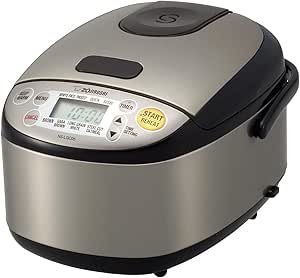 | Best Compact Cooker for Small Portions | Model: NS-LGC05XB | Capacity: 3 cups | Minimum portion: 1/2 cup | VIEW ON AMAZON | See Our Full Breakdown |
| StarBlue Electric Takoyaki Maker with 18 Molds |  | Best Specialized Appliance for Takoyaki | Capacity: 18 takoyaki | Power: 650 watts | Voltage: AC 120V, 50/60Hz | VIEW ON AMAZON | See Our Full Breakdown |
| japanese appliance | Power | Dimensions | Model | Weight |
|---|---|---|---|---|
| Zojirushi Neuro Fuzzy Rice Coo | 680 watts | 10-1/8 x 13 x 8-1/8 inches | NS-ZCC10 | — |
| Toshiba Induction Heating Rice | 1130 watts | 11.89 x 10.43 x 8.66 inches | TRSH01 | 4.76 kg |
| Zojirushi NS-TSC10 5.5-Cup Mic | 610 watts | 10.13 x 14 x 8.5 inches | — | 9.5 pounds |
| Zojirushi Micom 3-Cup Rice Coo | 450 watts | 11.8 x 9.1 x 7.5 inches | NS-LGC05XB | — |
| StarBlue Electric Takoyaki Mak | 650 watts | 9 x 9 x 3.5 inches | — | 700 grams |
More Details on Our Top Picks
Zojirushi Neuro Fuzzy Rice Cooker and Warmer, 5.5-Cup, White
The NS-ZCC10 is my best overall pick because it balances a household-friendly capacity with a broad set of rice-specific controls. Neuro Fuzzy logic adjusts cooking time and temperature across rice types, so this model is better suited to mixed routines than a basic cooker with a single white-rice cycle. White, brown, porridge, sweet, semi-brown, and rinse-free settings cover more of the rice choices a home cook may rotate through.
Its keep-warm, extended keep-warm, reheat, and delay timer make the cooker useful beyond the moment rice finishes. Compared with the Toshiba, it has less emphasis on grains such as quinoa and fewer non-rice functions, but it offers a similarly flexible 5.5-cup uncooked capacity and a particularly rice-centered menu. Compared with the NS-TSC10, it is the cleaner choice for buyers who care more about rice options than steam or cake cooking.
The limit is scale: 5.5 cups uncooked may not suit frequent large gatherings, and a one-year limited warranty is not a reason to expect unusually long coverage. I’d also choose another model if oatmeal or quinoa is a regular part of the cooking plan. Still, among these five appliances, it has the strongest blend of rice flexibility and day-to-day convenience.
Pros:- Neuro Fuzzy logic adjusts time and temperature across rice types.
- Multiple settings include brown rice, porridge, and rinse-free rice.
- Keep-warm, reheat, and delay timer support flexible serving times.
- Includes measuring cups, rice spoon, spoon holder, and recipes.
Cons:- The 5.5-cup uncooked capacity may be limiting for large gatherings.
- The listed warranty is limited to one year.
- Its menu is more rice-focused than Toshiba’s grain and oatmeal options.
Best for: Households that regularly prepare different rice varieties and want a full-size cooker with timer and warming functions.
Not ideal for: Large households needing more than a 5.5-cup uncooked batch, or buyers who mainly want quinoa, oatmeal, or a compact one-person appliance.
- Model:NS-ZCC10
- Uncooked capacity:5.5 cups
- Cooked capacity:10 cups
- Power:680 watts
- Cooking settings:White, mixed, porridge, sweet, semi-brown, brown, rinse-free, quick cooking
- Inner pan:Spherical nonstick
- Convenience features:Automatic and extended keep-warm, reheat, delay timer, LCD clock, retractable cord
- Dimensions:10-1/8 x 13 x 8-1/8 inches
- Warranty:1-year limited
Our verdict“I’d choose the NS-ZCC10 as the strongest all-purpose rice cooker here for households that value rice variety over specialty grain modes.”
Toshiba Induction Heating Rice Cooker, 5.5-Cup
Toshiba’s TRSH01 is the best match for cooks who want more than rice modes. Induction heating paired with fuzzy logic is designed to adjust cooking time and temperature, while its eight programs cover white and brown rice, mixed grains, quinoa, oatmeal, steaming, quick cooking, and a low-carb setting. That gives it a broader grain-and-meal role than the rice-centered NS-ZCC10.
The 24-hour timer and automatic keep-warm are helpful when meal timing changes, and the included steam basket extends its use beyond the inner pot. Against the Zojirushi NS-TSC10, Toshiba gives more explicit grain choices; the Zojirushi counters with a cake mode and a removable lid. Buyers should not mistake the feature count for a universal advantage: if the household mostly cooks plain rice, the extra programs may not justify choosing this over the simpler Zojirushi options.
The practical drawback is hand-washing the inner pot, which makes cleanup less convenient than a dishwasher-safe setup would be. Its larger footprint than the compact 3-Cup Zojirushi also makes it less appealing for a crowded counter. I rank it second because its heating technology and menu stand out, while maintenance and physical size narrow its audience.
Pros:- Induction heating and fuzzy logic adjust cooking time and temperature.
- Eight modes include quinoa, oatmeal, low-carb, and steam.
- A 24-hour timer and automatic keep-warm support flexible meal timing.
- Includes a steam basket and serving accessories.
Cons:- The inner pot requires hand washing.
- Its functions may be unnecessary for buyers who mainly cook white rice.
- Larger than the 3-Cup Zojirushi, so it is less suited to tight storage.
Best for: Home cooks who alternate between rice, quinoa, oatmeal, mixed grains, and steaming, and want induction heating in one appliance.
Not ideal for: People who want dishwasher-safe cookware, a compact cooker, or only need a straightforward white-rice routine.
- Model:TRSH01
- Uncooked capacity:5.5 cups
- Heating technology:Induction heating with fuzzy logic
- Cooking functions:Low Carb, Quick, White, Brown, Mixed Grain, Quinoa, Steam, Oatmeal
- Power:1130 watts
- Dimensions:11.89 x 10.43 x 8.66 inches
- Weight:4.76 kg
- Convenience and safety:24-hour timer, automatic keep-warm, automatic shut-off, locking lid
- Care:Hand-wash inner pot; wipe exterior with a damp cloth
Our verdict“I’d pick Toshiba over the Zojirushi rice specialists when grain variety and induction heating matter more than easy pot cleanup.”
Zojirushi NS-TSC10 5.5-Cup Micom Rice Cooker and Warmer
The NS-TSC10 makes the most sense for cooks who want a rice cooker with a couple of extra jobs. Its fuzzy-logic cooking, automatic and extended keep-warm, and reheating cycle cover familiar rice-cooker needs, while the steam setting and cake menu add options the NS-ZCC10 does not list. A steaming basket is included, so those additions have practical support rather than being menu labels alone.
Compared with Toshiba, this Zojirushi gives up dedicated quinoa, oatmeal, and low-carb programs in exchange for steam and cake settings. Compared with the top-ranked Neuro Fuzzy model, it has a similar 5.5-cup uncooked capacity and the same broad idea of automated rice cooking, but its menu is less oriented toward different rice types. The stainless-steel exterior and retractable cord may also suit buyers who prefer a more finished counter appliance.
Its stated care instructions call for hand washing, so it does not remove cleanup work. Capacity remains the same household-scale limit found in the other full-size Zojirushi here. I place it below the NS-ZCC10 because the latter offers more rice-specific settings, but above a compact-only pick for shoppers who want one appliance for rice plus occasional steaming or cake.
Pros:- Fuzzy logic supports automated rice cooking.
- Steam and cake menus add uses beyond rice.
- Automatic and extended keep-warm plus a reheating cycle.
- Includes a steaming basket and retractable power cord.
Cons:- Hand-wash care is specified.
- The 5.5-cup capacity may be excessive for small households and limiting for large ones.
- Fewer named grain options than the Toshiba induction model.
Best for: Rice-cooking households that will use the steam and cake menus and want keep-warm and reheating functions.
Not ideal for: Buyers who prioritize quinoa and oatmeal settings, dishwasher convenience, or a smaller footprint for one-person portions.
- Capacity:Up to 5.5 cups / 1.0 liter
- Power:610 watts
- Cooking functions:Rice cooking, steam, cake
- Convenience features:Automatic and extended keep-warm, reheating cycle, delay timer, LCD controls
- Exterior:Stainless steel
- Dimensions:10.13 x 14 x 8.5 inches
- Weight:9.5 pounds
- Included components:Measuring cup, spatula, spatula holder, steaming basket
- Warranty:1 year
Our verdict“I’d choose the NS-TSC10 over the Neuro Fuzzy when steaming and cake cooking matter more than a wider list of rice settings.”
Zojirushi Micom 3-Cup Rice Cooker and Warmer
For one or two people, the Zojirushi Micom 3-Cup is the most purposeful rice cooker in this group. It can prepare as little as half a cup of rice or oats, avoiding the awkward oversizing of a 5.5-cup model when dinner is small. Dedicated settings for steel-cut oatmeal, brown rice, and long-grain white rice also make it more than a mini version of the larger Zojirushi cookers.
The fold-down handle and retractable cord favor storage and carrying, giving it an advantage over the NS-ZCC10 and NS-TSC10 when cabinet space is limited. Toshiba offers more cooking programs and induction heating, but it is the less fitting choice for buyers who rarely need a large batch. The tradeoff is less capacity and a narrower overall menu: this cooker is built for small servings, not hosting.
Hand washing is required, so the compact form does not mean care-free cleanup. The listed weight is unusually light for a countertop cooker, but buyers should still plan around its stated dimensions rather than assuming it will disappear into any drawer. I rank it fourth overall because it serves a specific household size exceptionally well, while the first three models cover broader family routines.
Pros:- Prepares portions as small as 1/2 cup.
- Dedicated settings cover steel-cut oatmeal, brown rice, and long-grain white rice.
- Fold-down handle and retractable cord help with storage and portability.
- Smaller capacity suits kitchens where a 5.5-cup cooker would be excessive.
Cons:- Hand-wash care is required.
- Three-cup capacity is unsuitable for larger households or gatherings.
- Fewer listed cooking modes than the Toshiba and larger Zojirushi models.
Best for: Solo cooks, couples, small kitchens, and anyone who wants modest portions of rice or oats without running a full-size cooker.
Not ideal for: Families, frequent hosts, or cooks who want many rice and grain programs in one machine.
- Model:NS-LGC05XB
- Capacity:3 cups
- Minimum portion:1/2 cup
- Power:450 watts
- Cooking settings:Steel-cut oatmeal, brown rice, long-grain white rice
- Material and color:Stainless steel; stainless black
- Dimensions:11.8 x 9.1 x 7.5 inches
- Storage features:Retractable power cord and fold-down handle
- Included components:Rice cooker, spatula, measuring cup
Our verdict“I’d pick this compact Zojirushi over every larger rice cooker here when small portions and storage are the main priorities.”
StarBlue Electric Takoyaki Maker with 18 Molds
The StarBlue takoyaki maker is the specialist in this roundup, built for cooking Japanese octopus balls rather than handling rice or general meal prep. Its 18 rounded molds let a cook make a full small batch together, and the 9-inch square footprint is easier to store than a countertop cooker designed for family portions. For buyers who make takoyaki at home, a dedicated plate is a more direct fit than trying to adapt a rice cooker to the task.
That specialization is also its defining limitation. Compared with the four rice cookers, it has no grain programs, keep-warm mode, or broader cooking role in the supplied details. It prepares 18 pieces at a time, so larger gatherings may require repeated batches. The lightweight body helps with storage, but the nonstick surface calls for careful cleaning to avoid coating damage.
I rank it fifth for general Japanese kitchen utility, not because it fails at its intended job, but because it serves a narrower cooking habit than a rice cooker. Buyers focused on takoyaki should treat it as a deliberate specialty purchase; anyone seeking one Japanese appliance for everyday meals should choose one of the Zojirushi or Toshiba cookers instead.
Pros:- Eighteen rounded molds prepare a batch of takoyaki together.
- Compact size and light weight make storage easier.
- Nonstick cooking surface helps release cooked pieces.
- Heat-resistant HDPE casing surrounds an aluminum body.
Cons:- Limited to 18 pieces per batch.
- Careful cleaning is needed to protect the nonstick coating.
- Its dedicated purpose gives it less everyday versatility than the rice cookers.
Best for: Takoyaki fans who want a compact electric appliance for making up to 18 pieces per batch at home.
Not ideal for: Shoppers seeking an everyday rice cooker, a multi-function appliance, or a high-volume takoyaki setup.
- Capacity:18 takoyaki
- Power:650 watts
- Voltage:AC 120V, 50/60Hz
- Dimensions:9 x 9 x 3.5 inches
- Weight:700 grams
- Construction:Aluminum body with HDPE casing
- Cooking surface:Nonstick
Our verdict“I’d buy the StarBlue only for regular takoyaki making; for broader kitchen use, the rice cookers are more practical choices.”

How We Picked
I compared these appliances as a small, practical selection of Japanese kitchen equipment, not as interchangeable rice cookers. Four models focus on rice, but their capacities, heating approaches, menu choices, and storage features point to different households. The StarBlue occupies a separate role: it prepares takoyaki, a Japanese snack, and earns a place for buyers seeking that specific cooking experience.
My ranking puts the Neuro Fuzzy NS-ZCC10 first because its broad rice menu and fuzzy logic suit the widest range of ordinary rice-cooking needs. Toshiba follows for shoppers who prioritize induction heating and grain variety; its more specific modes are useful, though the hand-wash pot is a daily-care tradeoff. The NS-TSC10 is a capable alternative with steam and cake functions, but overlaps with the higher-ranked rice cookers. The compact 3-Cup model ranks ahead of the takoyaki maker for everyday utility in a small home, while the takoyaki maker remains the right pick for a narrower, clearly defined use.
I used the supplied product details to weigh cooking flexibility, capacity, convenience, and care. I did not treat a longer feature list as automatically better: a small household may benefit more from a compact cooker, and a takoyaki fan may value a dedicated mold plate more than another grain setting. I also account for stated limits, including hand-wash care, batch size, and warranty duration where provided.
| japanese appliance | Model |
|---|---|
| Zojirushi Neuro Fuzzy Rice Coo | NS-ZCC10 |
| Toshiba Induction Heating Rice | TRSH01 |
| Zojirushi NS-TSC10 5.5-Cup Mic | — |
| Zojirushi Micom 3-Cup Rice Coo | NS-LGC05XB |
| StarBlue Electric Takoyaki Mak | — |
Factors to Consider When Choosing Japanese Appliances
I’d choose among these appliances by starting with what you cook most often, then matching capacity and cleanup to your routine. A larger menu matters only when you will use those extra modes.Match capacity to your usual batch
The 5.5-cup uncooked cookers suit family meals and batch cooking better than the 3-Cup Zojirushi, while the compact model can start at half a cup. Think about how much cooked rice you actually serve, not just the maximum printed capacity. If your household often makes several portions, the NS-ZCC10, Toshiba, or NS-TSC10 gives more headroom. For solo meals, choosing the compact cooker may reduce unused capacity and save storage space.
Choose menus around your regular foods
For varied rice types, I favor the Neuro Fuzzy NS-ZCC10, with settings for porridge, brown, sweet, and other rice styles. Toshiba is more compelling if quinoa, oatmeal, mixed grains, or steaming appear in your weekly routine. The NS-TSC10 adds cake and steam functions; the 3-Cup model focuses on a smaller set of rice and oatmeal needs. I would not pay attention to a long menu list unless it maps to food you plan to cook.
Understand heating and convenience features
Toshiba is the only listed option with induction heating and fuzzy logic; its 24-hour timer and automatic keep-warm are useful if cooking needs to align with a changing schedule. The Zojirushi models also offer automated cooking or warming conveniences, though their listed features differ by model. A delay timer can help coordinate rice with dinner, while a reheat cycle can be useful when serving time moves. These features simplify timing, but do not replace choosing a cooker with a suitable capacity.
Factor cleanup and storage into the decision
The Toshiba’s inner pot and the NS-TSC10 both require hand washing according to the supplied details; the compact Zojirushi also specifies hand-wash care. The StarBlue’s nonstick surface needs gentle handling to protect its coating. Check your counter and cupboard space as well: the fold-down handle and retractable cord on the small Zojirushi are aimed at easier storage, while the 5.5-cup models occupy more room. Small convenience details can matter every day.
Treat specialty cooking as a separate category
The StarBlue belongs on a different shortlist from the rice cookers. Its 18 molds are useful when takoyaki is the goal, but it does not replace a multi-use rice appliance. If you want to cook Japanese-style meals more often, a rice cooker is the broader starting point; if you already have rice preparation covered and make takoyaki regularly, the dedicated mold plate fills a specific gap. Its batch limit makes it less suited to large groups without multiple rounds.
Frequently Asked Questions
Which Japanese appliance in this roundup is the best choice for most households?
I’d start with the Zojirushi Neuro Fuzzy NS-ZCC10 for most households that cook rice regularly. Its 5.5-cup uncooked capacity, range of rice settings, keep-warm functions, reheat cycle, and delay timer cover a wider everyday routine than the specialized takoyaki maker or the small-capacity model. Toshiba is a better match if quinoa, oatmeal, and induction heating are priorities.
Is the Toshiba induction rice cooker better than the Zojirushi models?
It depends on the menu you need. Toshiba stands out for induction heating and grain variety, including quinoa, oatmeal, mixed grain, and a low-carb mode. The Zojirushi NS-ZCC10 offers a broader rice-focused selection, while the NS-TSC10 adds cake and steam functions. Toshiba’s hand-wash inner pot is also a cleanup tradeoff, so I would choose it for its specific cooking modes rather than assuming it is better for every kitchen.
Which cooker makes the most sense for one person?
The Zojirushi Micom 3-Cup is the clearest fit for one person or a small household because it can prepare as little as half a cup. It also has dedicated oatmeal, brown rice, and long-grain white rice settings, along with a fold-down handle and retractable cord. A 5.5-cup model is the better pick if you regularly cook ahead or share meals with several people.
Can the StarBlue takoyaki maker replace a rice cooker?
No. The StarBlue is a specialty appliance for takoyaki, with 18 rounded molds and a compact electric design. It does not offer rice programs, grain cooking, or warming functions in the supplied product details. I’d choose it to make takoyaki at home, but it does not fill the everyday role of any Zojirushi or Toshiba rice cooker in this lineup.
What should I check before choosing a Japanese rice cooker?
I’d compare uncooked capacity, the foods you actually prepare, and cleanup needs before focusing on secondary features. A larger cooker may be unnecessary for small portions, while a compact model can be limiting when serving a family. Check whether you want rice-specific settings, grain modes, steam or cake functions, and whether you are comfortable hand washing the pot. A timer and keep-warm feature matter most when they fit your meal schedule.
Conclusion
For the broadest everyday rice routine, I recommend the Zojirushi Neuro Fuzzy NS-ZCC10. Choose the Toshiba if induction heating and quinoa or oatmeal programs matter more than washing the pot by hand; choose the NS-TSC10 if cake and steaming are useful extras. For small servings and limited storage, the Zojirushi 3-Cup is the more sensible fit. The StarBlue is for takoyaki fans who want a dedicated appliance, not a general kitchen workhorse. My ranking follows those differences: versatility first, then distinct cooking strengths, with compactness and specialty use rewarded when they fit the right buyer.
Halloween Picks
halloween
As an affiliate, we earn on qualifying purchases.