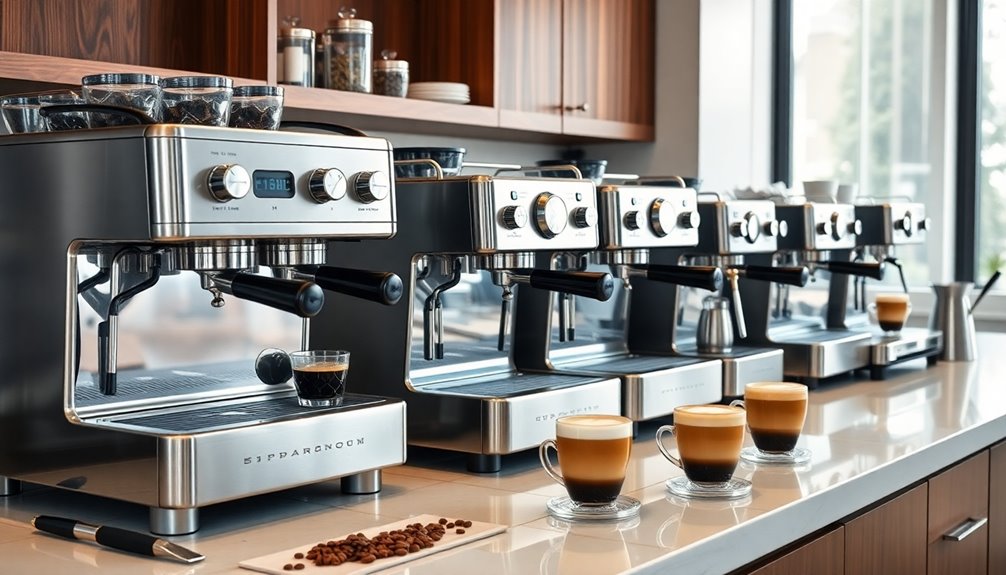

The Breville Barista Express is my best overall pick among these espresso machines because it combines a built-in grinder with hands-on control over the brewing process. For a more compact setup, the Breville Bambino keeps the machine footprint small, while the De’Longhi Stilosa offers a simpler manual starting point. The main tradeoff is between convenience and control: touchscreens and preset functions can simplify routines, while manual machines give you more say over each shot. Grinder needs, counter space, milk drinks, and cleanup also separate these options. Read on for how each machine fits different buyers and what to weigh before choosing.

Get kitchen staples and gadgets delivered free with Prime
- Fast, free delivery on millions of items
- Prime Video, Amazon Music and more included
- Member-only deals all year
Complete the kit


Key Takeaways
- The Barista Express is the most complete setup: its built-in grinder reduces the need to buy a separate one, though it takes more room and asks the user to learn more steps.
- The Bambino prioritizes a smaller footprint: it suits buyers who already have a grinder or want to choose one separately.
- The Stilosa favors a straightforward manual routine: it has fewer convenience features than touchscreen models, which can be a benefit for buyers who want a simpler machine.
- Touchscreen and cold brew features are convenience choices: the 20-Bar touchscreen model and Arecovas add interface options, but buyers should check cleaning and workflow needs alongside those extras.
- The lower-profile machines have less established feature detail in their names: Aromaster, CASABREWS 3700, Chefman CraftBrew, and both XIXUBX models call for careful spec checking around dimensions, controls, and included accessories.
| Aromaster 1400W Espresso Machine with Milk Frother, Stainless Steel |  | Best for Temperature Control | Type: Semi-automatic espresso machine | Power: 1400 W | Pump pressure: 20 bar | VIEW ON AMAZON | See Our Full Breakdown |
| De’Longhi Stilosa Compact Manual Espresso Machine with Milk Frother | 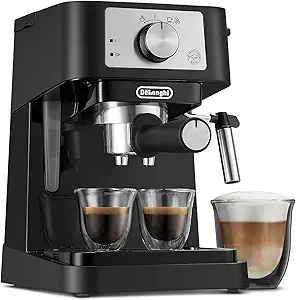 | Best for Hands-On Beginners | Type: Manual espresso machine | Boiler: Stainless steel | Milk frother: Manual | VIEW ON AMAZON | See Our Full Breakdown |
| 20-Bar Espresso Machine with Milk Frother, Touch Screen, and Cold Brew Function |  | Best for Drink Variety | Pump pressure: 20 bar | Boiler power: 1350 W | Temperature control: PID | VIEW ON AMAZON | See Our Full Breakdown |
| CASABREWS 3700 Essential Stainless Steel Espresso Machine with Steam Wand |  | Best for Simple Shared Use | Operation mode: Semi-automatic | Pump pressure: 20 bar | Power: 1350 W | VIEW ON AMAZON | See Our Full Breakdown |
| Chefman CraftBrew Digital Espresso Machine with Steam Wand | 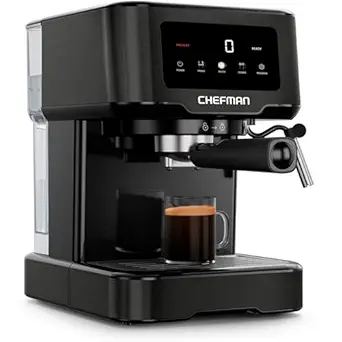 | Best for Adjustable Shot Sizes | Operation mode: Semi-automatic | Pump pressure: 15 bar | Power: 1350 W | VIEW ON AMAZON | See Our Full Breakdown |
| XIXUBX Espresso Machine with Milk Frother, Grey |  | Best for Hot and Cold Drinks | Type: Semi-automatic espresso machine | Color: Grey | Power: 1350 W | VIEW ON AMAZON | See Our Full Breakdown |
| Breville Barista Express Espresso Machine, Brushed Stainless Steel (BES870XL) |  | Best for Fresh-Ground Control | Model: BES870XL | Color: Brushed stainless steel | Grinder: Integrated precision conical burr grinder | VIEW ON AMAZON | See Our Full Breakdown |
| Breville Bambino Espresso Machine, Brushed Stainless Steel | 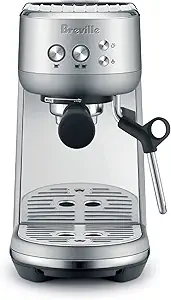 | Best Compact Pick | Model: BES450BSS | Color: Brushed stainless steel | Heating system: ThermoJet | VIEW ON AMAZON | See Our Full Breakdown |
| XIXUBX Espresso Machine with Milk Frother, Stainless Steel |  | Best for Larger Water Capacity | Pressure: 20 bar | Water tank capacity: 42 oz | Steam wand: 360° rotating and detachable | VIEW ON AMAZON | See Our Full Breakdown |
| Arecovas Espresso Machine with Touchscreen and Milk Frother |  | Best for Touchscreen Controls | Operation mode: Semi-automatic | Pressure: 20 bar | Power: 1300 W | VIEW ON AMAZON | See Our Full Breakdown |
| espresso machine money can buy | Power | Water tank capacity | Temperature control | Pump pressure |
|---|---|---|---|---|
| Aromaster 1400W Espresso Machi | 1400 W | 37 oz | PID | 20 bar |
| De’Longhi Stilosa Compact Manu | — | — | — | — |
| 20-Bar Espresso Machine with M | — | 45 oz | PID | 20 bar |
| CASABREWS 3700 Essential Stain | 1350 W | 43.9 oz | — | 20 bar |
| Chefman CraftBrew Digital Espr | 1350 W | 1.5 liters | — | 15 bar |
| XIXUBX Espresso Machine with M | 1350 W | — | NTC sensor | 20 bar |
| Breville Barista Express Espre | 1600 W | 67 oz | Digital PID | — |
| Breville Bambino Espresso Mach | 1560 W | — | Digital PID | — |
| XIXUBX Espresso Machine with M | — | 42 oz | — | — |
| Arecovas Espresso Machine with | 1300 W | 1.2 L (40 oz) | PID with low-pressure pre-infusion | — |
More Details on Our Top Picks
Aromaster 1400W Espresso Machine with Milk Frother, Stainless Steel
The Aromaster earns a place for buyers who want more control over extraction in a compact semi-automatic machine. Its PID temperature control and pre-infusion are useful tools for steadier shots, while the 360-degree swivel steam wand gives milk drink makers room to work. Compared with the simpler De’Longhi Stilosa, it adds temperature-focused features and one-touch descaling, so it better suits someone willing to adjust their routine. The tradeoff is that it still calls for hands-on preparation, and its 37-ounce tank is smaller than the 45-ounce reservoir on the 20-Bar Touch Screen machine. I’d choose it for a compact setup where shot control and easier upkeep matter more than a larger tank or automated drink selection.
Pros:- PID temperature control and pre-infusion support more controlled extraction
- Swivel steam wand makes milk frothing more flexible
- One-touch descaling and removable tank simplify routine upkeep
- Compact stainless steel body includes a cup warmer
Cons:- Semi-automatic preparation requires hands-on brewing
- 37-ounce tank is smaller than the 45-ounce tank on the 20-Bar Touch Screen machine
Best for: Home espresso drinkers who want PID temperature control and a steam wand in a compact machine
Not ideal for: Buyers seeking push-button drinks or a larger reservoir for frequent back-to-back brewing
- Type:Semi-automatic espresso machine
- Power:1400 W
- Pump pressure:20 bar
- Water tank capacity:37 oz
- Dimensions:13 × 7 × 14 in
- Material:Stainless steel
- Temperature control:PID
- Other features:Pre-infusion, fast heat-up, one-touch descaling, cup warmer, removable tank
Our verdict“Choose the Aromaster if temperature control and convenient descaling matter more to you than a larger water tank or simpler operation.”
De’Longhi Stilosa Compact Manual Espresso Machine with Milk Frother
The Stilosa is the straightforward pick for a beginner who wants to learn manual espresso preparation without a feature-heavy interface. Its single- and double-shot filters make it easy to choose a basic serving, and the two-level cup holder accommodates different cup heights. Compared with the more control-focused Aromaster, the Stilosa offers fewer extraction aids, so buyers give up PID temperature control and pre-infusion. In return, its simple manual setup keeps the learning process centered on the portafilter and milk wand. That same approach takes attention and practice: it is less suited to anyone who expects one-touch convenience or wants detailed temperature adjustments. I’d shortlist it for a small counter and a buyer who values a simple manual routine over extra controls.
Pros:- Compact design fits smaller kitchen counters
- Manual frother supports cappuccinos, lattes, and flat whites
- Portafilter includes single- and double-shot filters
- Two-level cup holder accommodates different cup heights
Cons:- Manual brewing and frothing require more hands-on effort
- Does not list PID temperature control or pre-infusion features found on the Aromaster
Best for: First-time espresso makers with limited counter space who want to learn manual brewing and milk frothing
Not ideal for: Busy buyers who want automated drink preparation or temperature controls to help tune shots
- Type:Manual espresso machine
- Boiler:Stainless steel
- Milk frother:Manual
- Included accessories:Portafilter with single- and double-shot filters
- Cup holder:Two-level
- Drink options:Espresso, cappuccino, latte, and flat white
Our verdict“Pick the Stilosa if you want a compact, simple machine for learning manual espresso and can accept the extra effort.”
20-Bar Espresso Machine with Milk Frother, Touch Screen, and Cold Brew Function
This machine stands apart from the lineup by pairing espresso and milk drinks with a cold brew function. Its touch screen lets users customize coffee volume, while PID temperature control and low-pressure pre-infusion provide more extraction guidance than the button-based CASABREWS 3700. The 45-ounce removable tank also holds more water than the Aromaster’s 37-ounce reservoir, which can reduce refill interruptions. That broader feature set comes with a practical uncertainty: the product data does not give its dimensions, so it is harder to judge counter fit. It also remains a semi-automatic espresso setup, rather than a fully hands-off machine. I’d choose it for someone who wants multiple drink styles and customizable volume, provided there is room to accommodate its unspecified footprint.
Pros:- Cold brew function expands the drink options beyond espresso
- PID control and pre-infusion support more consistent extraction
- Touch screen allows coffee volume customization
- 45-ounce removable tank and detachable drip tray aid everyday use and cleaning
Cons:- Machine dimensions are not provided, making counter fit difficult to assess
- Semi-automatic espresso preparation still requires hands-on steps
Best for: Households that want espresso, steamed milk drinks, and a cold brew option from one machine
Not ideal for: Buyers with tightly measured counter space or anyone seeking fully automatic drink preparation
- Pump pressure:20 bar
- Boiler power:1350 W
- Temperature control:PID
- Water tank capacity:45 oz
- Body material:Stainless steel
- Controls:Touch screen with customizable coffee volume
- Features:Low-pressure pre-infusion, milk frother, cold brew function
Our verdict“Choose this model if cold brew and customizable drink volume are worth accepting uncertainty about its footprint.”
CASABREWS 3700 Essential Stainless Steel Espresso Machine with Steam Wand
The CASABREWS 3700 keeps its pitch focused: ground coffee, basic button controls, a steam wand, and filters for one or two cups. That makes it a practical fit for home or office users who want to prepare espresso drinks without a touch screen or specialized drink menu. Compared with the Chefman CraftBrew, it has a slightly smaller tank but lists stainless steel construction and a 20-bar pump; the Chefman adds adjustable shot volume and touch controls. The CASABREWS also has no pressure gauge, so users get less feedback while adjusting a shot. Its first-use cycle adds a setup step, but the removable tank and drip tray make routine handling more manageable. I’d favor it when simple shared operation matters more than fine-grained shot customization.
Pros:- One-cup and two-cup filters support different serving sizes
- Steam wand enables milk frothing
- Removable 43.9-ounce tank and drip tray ease handling and cleanup
- Button interface keeps operation simple
Cons:- No pressure gauge for feedback during extraction
- Requires a first-use cycle before brewing
- Does not list adjustable shot volume like the Chefman CraftBrew
Best for: Small households or office kitchens that want a basic machine for single and double espresso drinks
Not ideal for: Espresso hobbyists who want a pressure gauge or adjustable shot-volume controls
- Operation mode:Semi-automatic
- Pump pressure:20 bar
- Power:1350 W
- Voltage:120 V
- Water tank capacity:43.9 oz
- Coffee input:Ground coffee
- Interface:Buttons
- Included filters:One-cup and two-cup brewing filters
- Material:Stainless steel
Our verdict“Choose the CASABREWS if you want straightforward single- and double-cup brewing for shared use and do not need shot feedback.”
Chefman CraftBrew Digital Espresso Machine with Steam Wand
The Chefman CraftBrew is the clearest choice here for buyers who want to change shot volume without stepping up to the more feature-rich touch screen model. Its adjustable shot volume supports lungo- or ristretto-style servings, while the digital touch panel gives it a more configurable feel than the button-controlled CASABREWS 3700. The compact listed dimensions and 1.5-liter removable reservoir make it easier to plan around a small counter, though the CASABREWS provides a stated 20-bar pump compared with Chefman’s 15-bar specification. Both require manual milk steaming, and the Chefman uses ground coffee rather than whole beans. I’d pick it for a small kitchen where variable shot length and simple touch controls matter more than bean grinding or an automatic milk system.
Pros:- Adjustable shot volume supports lungo- and ristretto-style servings
- Touch control panel offers a digital interface
- Removable 1.5-liter reservoir simplifies refilling
- Compact listed dimensions suit smaller counters
Cons:- Uses ground coffee and does not include a built-in grinder
- Milk must be steamed manually
- Its listed 15-bar pump pressure is lower than the 20-bar specification on the CASABREWS 3700
Best for: Ground-coffee users with limited counter space who want to adjust espresso shot length
Not ideal for: Buyers who want an integrated grinder, whole-bean workflow, or automatic milk preparation
- Operation mode:Semi-automatic
- Pump pressure:15 bar
- Power:1350 W
- Water tank capacity:1.5 liters
- Coffee input:Ground coffee
- Dimensions:10.8 × 8.9 × 11.9 in (D × W × H)
- Voltage:120 V
- Warranty:1-year assurance
Our verdict“Pick the CraftBrew if adjustable shot length and compact dimensions matter more than an integrated grinder or automatic milk drinks.”
XIXUBX Espresso Machine with Milk Frother, Grey
I’d choose this XIXUBX for a household that wants espresso and a quick cold drink from one compact routine. Its one-touch cold brew sets it apart from the Breville Bambino, which focuses on hot espresso and milk drinks. Push-button controls and an approximately 30-second heat-up make this a simpler entry point than the hands-on Breville Barista Express, though neither convenience nor the stated 20-bar pump tells me how much control I’ll have over extraction. This machine offers a steam wand and pitcher for milk drinks, but the product details list no pressure gauge, manual temperature adjustment, water capacity, or dimensions. That makes it harder to judge fit and tune shots. I’d rank it for drink variety and straightforward operation, not for buyers seeking detailed brewing feedback.
Pros:- Makes hot espresso and offers one-touch cold brew
- Push-button controls keep basic operation approachable
- Steam wand and included pitcher support milk drinks
- About 30-second heating time
Cons:- No pressure gauge or temperature dial for monitoring or adjustment
- Water tank capacity and machine dimensions are not provided
Best for: Beginners who want push-button espresso, milk drinks, and a cold-brew option in one machine
Not ideal for: Espresso hobbyists who want adjustable temperature or pressure feedback, or buyers who need confirmed dimensions and tank capacity
- Type:Semi-automatic espresso machine
- Color:Grey
- Power:1350 W
- Pump pressure:20 bar
- Heating time:About 30 seconds
- Temperature control:NTC sensor
- Features:One-touch cold brew, steam frother, push-button controls
- Included accessory:Milk pitcher
- Warranty:1 year
Our verdict“Choose this XIXUBX if cold drinks and simple controls matter more to you than detailed shot adjustment or known countertop fit.”
Breville Barista Express Espresso Machine, Brushed Stainless Steel (BES870XL)
The Barista Express earns its place for buyers who want the grinder and espresso workflow together. Its integrated conical burr grinder feeds fresh grounds into the portafilter, while PID temperature control and low-pressure pre-infusion give more brewing tools than the Breville Bambino, which requires separately sourced beans and a grinder. That added control takes practice: this is manual preparation, and milk texturing also depends on the user. Compared with the touchscreen Arecovas, the Barista Express puts more of the process in your hands and includes a bean hopper, but its 67-ounce tank and grinder make it a larger commitment than a compact machine such as the Bambino. I’d rank it for a buyer who values a connected grind-to-shot workflow and accepts the learning curve that comes with it.
Pros:- Integrated conical burr grinder delivers fresh grounds to the portafilter
- PID temperature regulation supports controlled brewing
- Low-pressure pre-infusion is designed to support even extraction
- Includes portafilter, baskets, tamper, milk jug, and cleaning accessories
Cons:- Manual espresso preparation requires dialing in and hands-on operation
- Milk texturing is manual and takes practice
Best for: Home espresso learners who want an integrated grinder, fresh-ground shots, and hands-on control
Not ideal for: Buyers who want automatic drink preparation, minimal daily steps, or a compact machine without a built-in grinder
- Model:BES870XL
- Color:Brushed stainless steel
- Grinder:Integrated precision conical burr grinder
- Water tank capacity:67 oz
- Bean hopper capacity:1/2 lb
- Power:1600 W
- Shot settings:Single or double
- Temperature control:Digital PID
- Warranty:1-year limited
Our verdict“Pick the Barista Express if you want grinding and brewing in one hands-on setup and are willing to learn the workflow.”
Breville Bambino Espresso Machine, Brushed Stainless Steel
The Bambino makes the most sense when counter space and a short wait before brewing matter more than an all-in-one setup. Its 3-second ThermoJet heat-up gets you to extraction temperature quickly, and PID control with low-pressure pre-infusion gives it brewing features the more basic XIXUBX Grey model does not list. The Barista Express goes further by including a grinder and a larger water tank, but that adds equipment and hands-on steps; the Bambino keeps the machine compact and leaves bean grinding to you. Its automatic steam wand helps with milk texture, while the 1- or 2-cup settings keep drink selection simple. That simplicity also limits shot options, and the need for a separate grinder adds to the setup. I’d rank it for small kitchens and buyers who want fast, controlled espresso without a built-in grinder.
Pros:- Reaches extraction temperature in 3 seconds
- PID temperature control and low-pressure pre-infusion support even extraction
- Compact design suits small kitchens
- Automatic steam wand and included milk jug support milk drinks
Cons:- Requires a separate grinder or pre-ground coffee
- Shot settings are limited to one or two cups
Best for: Apartment dwellers and espresso drinkers with limited counter space who already have, or plan to buy, a grinder
Not ideal for: Buyers who want an integrated grinder, many shot-size choices, or a machine that prepares drinks from beans without extra equipment
- Model:BES450BSS
- Color:Brushed stainless steel
- Heating system:ThermoJet
- Heat-up time:3 seconds
- Temperature control:Digital PID
- Portafilter:54 mm; 19 g dose
- Power:1560 W
- Settings:1 cup, 2 cups, hot water, steam
- Warranty:1-year limited
Our verdict“Choose the Bambino when a compact footprint and rapid heat-up are priorities and you’re comfortable supplying your own grinder.”
XIXUBX Espresso Machine with Milk Frother, Stainless Steel
This stainless steel XIXUBX is a practical choice for people who make several drinks between refills. Its 42-ounce water tank gives it a clear capacity advantage over the Arecovas, whose listed tank holds 40 ounces, while the visible pressure gauge adds brewing feedback missing from the XIXUBX Grey model. The rotating, detachable wand can make frothing easier to position and clean, and the included pitcher gets milk drinks into the routine without another accessory purchase. The tradeoff is that the product information offers less detail on temperature control and shot settings than the Breville Bambino, and it doesn’t state the machine’s dimensions or weight. I’d rank this XIXUBX for capacity and practical wand access, rather than for buyers who want a documented precision workflow or need to check a tight counter fit.
Pros:- 42 oz water tank supports multiple servings between refills
- Visible pressure gauge provides extraction feedback
- 360-degree rotating, detachable steam wand aids positioning and cleaning
- Stainless steel milk pitcher is included
Cons:- Dimensions and weight are not specified
- Temperature controls and shot settings are not detailed in the product information
Best for: Households that prepare several espresso or milk drinks before they want to refill the water tank
Not ideal for: Buyers who need confirmed dimensions, weight, or detailed temperature and shot controls before choosing a machine
- Pressure:20 bar
- Water tank capacity:42 oz
- Steam wand:360° rotating and detachable
- Included accessory:Stainless steel milk frothing pitcher
- Material:Stainless steel
- Warranty:1 year
Our verdict“Choose this XIXUBX if a larger listed tank and a visible pressure gauge matter more than detailed control specifications.”
Arecovas Espresso Machine with Touchscreen and Milk Frother
The Arecovas is the pick for buyers who want a compact machine with clear digital controls and a few built-in drink choices. Its touchscreen and LED display provide a more guided interface than the manual Breville Barista Express, while single-shot, double-shot, and Americano settings make its range more explicit than the Bambino’s one- or two-cup options. A listed width of 5.2 inches also helps buyers assess a narrow counter, and PID control with low-pressure pre-infusion gives the brewing setup more detail than the XIXUBX Grey model. It remains semi-automatic, so using the screen does not remove the need for user involvement. The description also does not specify a grinder, and the 1.2-liter tank is smaller than the Barista Express tank. I’d rank it for compact digital guidance, not for a complete grind-to-cup setup.
Pros:- Touchscreen and LED display provide a digital control interface
- Offers single-shot, double-shot, and Americano settings
- PID temperature control and low-pressure pre-infusion support consistent brewing
- Listed 5.2-inch width suits narrow counter spaces
Cons:- Semi-automatic operation still requires user involvement
- A grinder is not specified in the product information
- Its 40 oz tank is smaller than the Barista Express’s 67 oz tank
Best for: Small-kitchen buyers who want touchscreen drink selections and a stated narrow footprint
Not ideal for: People seeking an integrated grinder or a mostly hands-off espresso routine
- Operation mode:Semi-automatic
- Pressure:20 bar
- Power:1300 W
- Water tank capacity:1.2 L (40 oz)
- Controls and display:Touchscreen; LED display with real-time pressure gauge
- Temperature control:PID with low-pressure pre-infusion
- Dimensions:12 x 5.2 x 11.9 inches (D x W x H)
- Body material:Stainless steel
- Coffee input:7–9 g single shot; 13–15 g double shot
Our verdict“Choose the Arecovas if touchscreen controls and a narrow stated footprint suit your kitchen, and you’re prepared to provide a grinder.”

How We Picked
I compared the ten machines by the decisions that most affect a home espresso routine: whether a grinder is included, how much control or automation the interface offers, whether milk steaming is available, and how much counter space the machine is likely to claim. I also weighed the likely learning curve and the upkeep implied by each machine’s feature set. These criteria matter because an added function only helps when it fits how often and how comfortably someone wants to make espresso.
The Barista Express ranks first as the most self-contained option in this group, while the Bambino ranks for compactness and the Stilosa for a simpler manual entry point. Touchscreen machines earn consideration for interface convenience, but their names alone do not establish better espresso or easier maintenance. Models with limited detail in their product names rank as alternatives rather than clear leaders; buyers should verify included parts, dimensions, and controls before choosing among them.
| espresso machine money can buy | Temperature control |
|---|---|
| Aromaster 1400W Espresso Machi | PID |
| De’Longhi Stilosa Compact Manu | — |
| 20-Bar Espresso Machine with M | PID |
| CASABREWS 3700 Essential Stain | — |
| Chefman CraftBrew Digital Espr | — |
| XIXUBX Espresso Machine with M | NTC sensor |
| Breville Barista Express Espre | Digital PID |
| Breville Bambino Espresso Mach | Digital PID |
| XIXUBX Espresso Machine with M | — |
| Arecovas Espresso Machine with | PID with low-pressure pre-infusion |
Factors to Consider When Choosing Espresso Machine Money Can Buy
Choose around the routine you want to repeat, not the longest feature list. These machines span integrated grinding, compact manual brewing, and touchscreen controls, so the best fit depends on your kitchen and how involved you want to be.
Decide Where Grinding Belongs
An espresso machine can only do its part if the coffee is ground suitably for espresso. A built-in grinder, as on the Barista Express, makes a more self-contained setup and reduces the number of separate items to buy and position. A machine without one may be a better match if you already own a capable grinder or want to choose that component independently. Avoid treating a grinder as a minor accessory: it affects shot preparation every day. Before buying, confirm whether the listing includes one and whether its adjustment range suits espresso. Also account for the counter space a separate grinder will take.
Match Control to Your Routine
Manual controls give you a more hands-on role in preparing a shot, while touchscreen interfaces can make common functions easier to access. Neither approach automatically produces better coffee; the useful choice is the one you will use consistently. If you enjoy adjusting your routine, a simpler manual machine may leave room to learn without extra interface layers. If you value guided controls, inspect which settings the touchscreen actually changes rather than assuming it automates the whole process. A screen can simplify selection but may add another part to clean or maintain. Think about your weekday routine as well as occasional experimentation.
Plan for Milk Drinks and Cleanup
A steam wand can support cappuccinos and lattes, but it also adds a task after each drink. If you mostly drink straight espresso, a wand may see little use while still requiring regular wiping and purging. For milk drinks, check how the wand is positioned and whether you have room to work with a pitcher. Do not assume that every frother works the same way or creates the same amount of control. Consider whether multiple people will share the machine and how much time they will spend cleaning it. A feature that matches your usual drinks is more useful than one that merely sounds versatile.
Measure the Space Around the Machine
Machine dimensions matter, but the usable footprint includes room for a portafilter, cup, milk pitcher, and any separate grinder. A compact model such as the Bambino can be appealing in a small kitchen, especially when the grinder lives elsewhere. Check the height beneath cabinets too, since filling a water tank may require lifting it upward. Leave enough space to wipe surfaces and reach controls without moving the machine each time. Buyers often compare width alone and miss the clearance needed for everyday use. Measure the counter and overhead space before settling on a model.
Separate Useful Features from Extra Modes
Touch controls, cold brew functions, and extra presets may suit a household that wants several drink styles from one appliance. They may add little for someone who makes the same espresso each morning. Each additional mode can complicate the interface and expand the number of functions to understand. Check whether a listed feature changes brewing, simplifies a repeated task, or simply adds another selection. Confirm how its cleaning steps fit your schedule. Paying for features makes sense when they solve a problem you actually have, not when they only broaden the spec sheet.
Check What the Product Listing Leaves Unclear
Several products in this lineup are identified mainly by broad descriptions such as wattage, pressure, or a touchscreen. Those labels do not tell you how much control you have over a shot or what accessories come in the box. Before choosing, look for clear dimensions, water tank details, portafilter and basket information, and instructions for cleaning. Verify whether a grinder is included rather than inferring it from the machine’s appearance. Also check what support information and replacement parts the seller documents. Specifics help distinguish a useful bargain from a machine that leaves key setup questions unanswered.
Frequently Asked Questions
Should I choose the Barista Express or the Bambino if I already own a grinder?
If your grinder is suited to espresso, the Bambino’s compact setup may make more sense because you would not need the Barista Express’s integrated grinder. The Barista Express is the more self-contained pick for someone starting without that equipment. Compare your available counter space as well as the workflow you prefer. Keeping a separate grinder means another appliance to position and clean. Choose based on the setup you want to maintain, not on the assumption that an all-in-one machine is always the better fit.
Is a touchscreen espresso machine a better choice for a first-time buyer?
A touchscreen can make functions easier to find, but it does not by itself teach the basics of grinding, dosing, or preparing a shot. A first-time buyer who wants a clear, manual routine may prefer the Stilosa’s simpler approach. Someone who values interface prompts or several modes may prefer a touchscreen model, after checking what its controls actually do. Consider whether you want to learn by adjusting each step or keep selections straightforward. The best beginner choice is the one whose routine feels manageable after the novelty wears off.
Do I need a steam wand if I usually drink espresso without milk?
Probably not as a priority. A steam wand is useful for milk drinks, but it brings extra cleaning and takes up part of the machine’s workflow. If your regular drink is straight espresso, put more weight on grinder fit, shot control, and machine size. A wand can still be handy for guests or occasional drinks, so the choice depends on how often that flexibility would matter. Avoid paying attention to a frother simply because it appears on many listings. Choose it when milk drinks are part of your normal routine.
What should I verify before buying one of the lesser-known models?
Start with practical details the product name may not reveal: exact dimensions, included baskets and portafilter, water tank access, and whether a grinder is part of the package. Find the cleaning instructions and check what replacement parts or support information the seller provides. A wattage or pressure figure alone does not explain how easy the machine is to operate. Look for clear photos and a manual that describes the controls. If key setup or maintenance details are missing, compare against a model with more transparent documentation before deciding.
Is an all-in-one machine worth choosing over separate espresso equipment?
An all-in-one machine can save counter space and simplify buying because the grinder and brewer are combined. That convenience comes with a more integrated setup, so you have less freedom to choose or replace each component independently. Separate equipment can suit buyers who already own a grinder or want to upgrade parts at different times. It also requires more space and a little more planning. Decide whether a single coordinated workflow or component flexibility matters more in your kitchen. The Barista Express is the clearest integrated option in this roundup, while the Bambino fits a separate-grinder setup.
Conclusion
For the best overall setup, I recommend the Breville Barista Express to buyers who want a grinder and espresso machine together. The Bambino is my compact pick for people who already have a grinder or prefer choosing one separately, while the De’Longhi Stilosa is the best beginner fit for a hands-on routine. For a more feature-led interface, compare the touchscreen options against your actual use of their added modes. The lineup does not establish a clear premium alternative beyond the Barista Express’s more complete setup, so I would verify documented build and support details before treating another model as an upgrade. If a particular listing leaves dimensions, accessories, or maintenance unclear, choose the model whose daily workflow and documentation are easiest to confirm.
Fall Picks
fall essentials
As an affiliate, we earn on qualifying purchases.