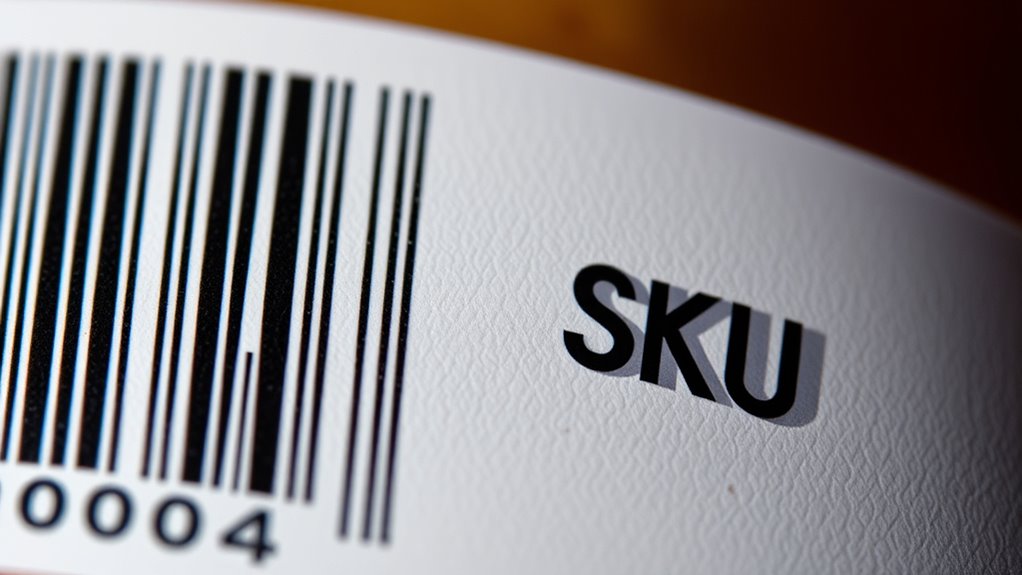

To understand a SKU or UPC, start by recognizing the barcode type, like UPC (12 digits) or EAN (13 digits). Look at the numbers printed beneath the barcode; these help you verify the product details. The barcode itself encodes manufacturer info, item specifics, and a check digit for accuracy. Mastering these elements allows you to quickly identify products and guarantee authenticity. Keep exploring to gain a deeper grasp of how these codes work together.
Key Takeaways
- Identify the barcode type (UPC or EAN) to understand its structure and digit length.
- Look at the digits beneath the barcode to manually verify product details.
- Recognize the sections: manufacturer number, product code, and check digit.
- Calculate or verify the check digit to ensure barcode accuracy during scanning.
- Use barcode scanning apps or readers to quickly retrieve product information.
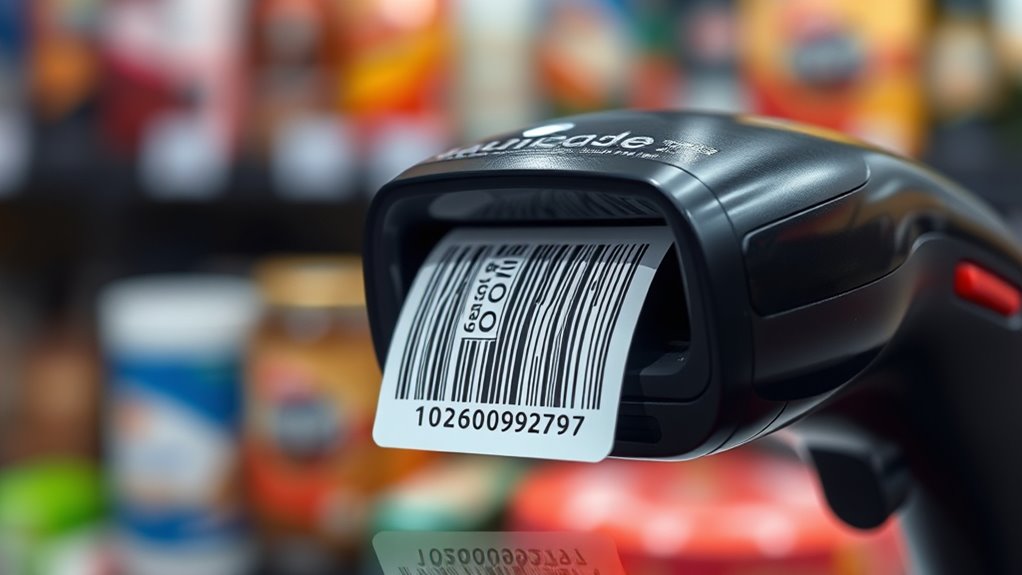
Ever wonder how to quickly identify a product or verify its details? It all comes down to understanding how to read a SKU or UPC. These codes are essential tools in product identification, allowing you to instantly access information about items at retail stores, warehouses, or online platforms. When you grasp how these barcodes work, you can streamline inventory management, reduce errors, and improve your overall efficiency. One key aspect is becoming familiar with barcode varieties, as different types serve different purposes and formats. Most common are the UPC (Universal Product Code) and EAN (European Article Number), but there are others like QR codes and Data Matrix codes. Each barcode variety has its unique structure, but they all encode essential product details in a machine-readable format. Recognizing these barcode varieties helps ensure accurate product identification across various systems and regions.
Starting with UPCs, you’ll notice they are typically 12 digits long. These numbers are divided into sections: the manufacturer’s identification number, the product’s specific code, and a check digit for validation. When you see a UPC barcode, you can often read the digits printed beneath the lines, which helps you manually verify the product details if needed. Similarly, EAN barcodes are slightly longer, usually 13 digits, and are used internationally. They follow a similar structure, with sections for the country code, manufacturer, product, and a check digit. Recognizing these barcode varieties enables you to understand the coding system and verify product authenticity or details without relying solely on scanners.
Understanding how these codes are utilized in logistics and inventory management can further enhance your ability to manage products efficiently. To effectively read a SKU or UPC, you should understand what each part of the barcode represents. The manufacturer’s number helps identify the company that produced or distributed the product, while the product code specifies the particular item. The check digit, calculated using a mathematical formula, ensures the barcode was scanned correctly, helping you avoid errors. When you scan or visually inspect a barcode, knowing how to interpret these elements speeds up the process of product identification. Plus, with the help of scanning apps or barcode readers, you can quickly pull up product information, prices, or stock levels in seconds.
barcode scanner app for smartphones
As an affiliate, we earn on qualifying purchases.
As an affiliate, we earn on qualifying purchases.
Frequently Asked Questions
Can SKUS or UPCS Be Used Internationally?
Yes, SKUs and UPCs can be used internationally, but you should be aware of global standards and regional variations. UPCs are primarily used in North America, while other regions often rely on EAN codes, which are similar but differ in format. When expanding globally, verify your products have the correct barcode system for each market to avoid confusion and streamline inventory management across different countries.
Are There Differences Between SKUS and UPCS?
Yes, SKUs and UPCs serve different purposes in product identification and inventory management. SKUs are unique to each retailer, helping you track specific products and variations internally. UPCs are standardized across the industry, making them ideal for global product identification and streamlining inventory management across different stores and countries. Understanding these differences guarantees efficient stock control and accurate product tracking in your business operations.
How Often Do SKUS or UPCS Change?
Changes to SKUs or UPCs are like seasons—they happen when your inventory management needs shift, usually due to new products, updates, or rebranding. You might see updates every few months or years, depending on your business. Staying on top of these changes guarantees accurate product identification, reduces stock errors, and keeps your supply chain smooth. Regular reviews help you adapt quickly, keeping your inventory healthy and well-organized.
Can I Create My Own SKU System?
Yes, you can create your own SKU system by designing custom SKU formats that suit your inventory needs. Make sure to follow barcode labeling best practices to guarantee easy scanning and accurate tracking. Use clear, consistent patterns, avoid special characters, and include relevant details like product type or location. This helps streamline inventory management and prevents confusion, making your custom SKU system both effective and scalable for your business.
What Tools Are Best for Scanning UPCS?
Did you know that over 90% of retail transactions involve barcode scanning? When choosing scanning devices, consider those compatible with various barcode formats like UPC, EAN, and QR codes. Handheld scanners are versatile and easy to use, while fixed-position scanners suit high-volume environments. Look for devices with fast decoding speeds and durable designs to improve efficiency and accuracy in your operations.
handheld barcode scanner for inventory
As an affiliate, we earn on qualifying purchases.
As an affiliate, we earn on qualifying purchases.
Conclusion
Now that you know how to read a SKU or UPC, you’re better equipped to decode product info quickly. Remember, it’s not rocket science—once you get the hang of it, you’ll be reading those codes like a pro. Don’t let the details overwhelm you; it’s all about taking it step by step. With a little practice, you’ll see these codes no longer hold any secrets. It’s a small skill that can really pay off in the long run.
UPC and EAN barcode reader
As an affiliate, we earn on qualifying purchases.
As an affiliate, we earn on qualifying purchases.
product barcode verification tool
As an affiliate, we earn on qualifying purchases.
As an affiliate, we earn on qualifying purchases.