
TL;DR
Risotto alla Milanese is Milan’s signature golden rice dish, built on short-grain rice (Carnaroli, Arborio, or Vialone Nano), saffron-infused hot stock added gradually over 18–20 minutes, and a final off-the-heat mantecatura of cold butter and Parmigiano-Reggiano that emulsifies the starch into a glossy, flowing texture called all’onda. Cream is never traditional — the creaminess comes entirely from technique.
There is a plate of golden rice in Milan that has survived six centuries of fashion, famine, and fusion cuisine without changing its mind. Risotto alla Milanese — saffron risotto — is the city’s signature rice dish, and it contains no cream, no shortcuts, and no apology. Its famous creaminess comes from starch, butter, cheese, and about twenty minutes of your undivided attention.

Get kitchen staples and gadgets delivered free with Prime
- Fast, free delivery on millions of items
- Prime Video, Amazon Music and more included
- Member-only deals all year
That last part is why so many home versions disappoint. People rush the stock, stir frantically, or fold in cream to fake the texture. The dish knows, and it sulks.
In this guide you’ll learn how Milan actually makes it: which rice to buy, why the tostatura (toasting of the rice) matters, how to handle saffron so it smells like honey instead of nothing, and how to execute the mantecatura — the final emulsion that turns everything glossy. You’ll also get the answers to the questions that ruin most first attempts.
Use Carnaroli for the most forgiving result; never rinse risotto rice, because surface starch is half your sauce.
Infuse saffron threads in warm stock for 15–20 minutes and add them in the final minutes of cooking — about 0.3–0.5 g for four servings; more turns the dish bi…
Add only hot stock, one ladle at a time, for 18–20 minutes total; all stock at once gives you boiled rice, not risotto.
Pull the pan off the heat before the mantecatura and beat in cold cubed butter and Parmigiano-Reggiano energetically for 30–60 seconds — direct heat makes the…
Never add cream: the glossy all’onda texture comes from starch, fat, and emulsion. If the risotto stiffens while resting, loosen it with hot stock, not dairy.
Serve immediately, or par-cook to 75%, cool quickly, and finish to order the way restaurant kitchens do.
Risotto alla Milanese: Saffron, Patience, and the Perfect Mantecatura
Milan’s signature golden rice dish, built on short-grain Carnaroli, saffron-infused hot stock added gradually, and a final off-the-heat mantecatura of cold butter and Parmigiano-Reggiano. No cream. No shortcuts. No apology — six centuries without changing its mind.
The 18-Minute Sequence: Tostatura to All’Onda
From the first addition of liquid, Risotto alla Milanese takes about 18–20 minutes, structured around four phases. Master the sequence and the timing takes care of itself.
Soffritto
Sweat finely diced onion in butter over medium-low heat until translucent and sweet. No color.
⏱ 5–7 minTostatura
Toast the rice in butter until edges turn translucent and grains feel hot and slightly chalky. This builds flavor and structural strength.
⏱ 2–3 minWine
A splash of dry white wine, evaporated completely. The alcohol cooks off; the acidity stays as balance.
⏱ 1–2 minStock, Gradually
Hot stock one ladle at a time, waiting until each is mostly absorbed. Stir frequently — never frantically. Saffron infusion goes in during the final minutes.
⏱ 18–20 minMantecatura
Off the heat, beat in cold cubed butter and Parmigiano-Reggiano energetically until glossy and flowing — all’onda.
⏱ 30–60 sCold stock drops the pan temperature and interrupts absorption, giving you unevenly cooked grains — crunchy outsides, mushy centers. All the stock at once gives you boiled rice, not risotto.
Carnaroli, Arborio, or Vialone Nano: Which Rice Actually Wins
Po Valley rice varieties release surface starch while holding a firm core. Never rinse risotto rice — that dusty coating is roughly half of your sauce. Rinsing it away is like buying flour and washing it before baking.
| Variety | Starch Release | Overcooking Tolerance | Best For |
|---|---|---|---|
| Carnaroli | ✓ High, creamy | ✓ High | Beginners; classic Milanese texture |
| Arborio | ✓ High | ✗ Lower — goes soft fast | Widely available weeknight option |
| Vialone Nano | ~ Moderate | ~ Moderate | Looser, silkier risotto; Venetian style |
Handle Saffron So It Actually Tastes Like Something
Good saffron smells like honey and hay with something floral underneath. Turmeric gives you the yellow and none of the soul. Quantity fails in both directions: too little is beige rice with a rumor of flavor; too much turns the dish medicinal and bitter.
Steep, don’t dump
Infuse threads in warm stock for 15–20 minutes so color and aroma distribute evenly. Dropping dry threads into the pan wastes most of their fragrance; add the infusion in the last minutes so heat doesn’t cook off the aromatics.
Threads over powder
Buy threads rather than powder — powder is easier to adulterate and loses aroma faster. If your jar smells like nothing, the saffron is old or poorly dried, and no technique will rescue it.
The Mantecatura Rules — and the Sins That Ruin First Attempts
Mantecatura is more than stirring in butter and cheese: it is the final emulsion that binds starch, fat, and liquid. Off the heat, the butter won’t separate and the cheese won’t go stringy.
✓ Do
- Pull the pan off the heat before the mantecatura
- Use cold cubed butter and beat energetically for 30–60 seconds
- Loosen a stiffened risotto with hot stock, not dairy
- Serve immediately — or par-cook to 75%, cool fast, finish to order
- Keep extra stock warm: rice is not a precision instrument
✗ Don’t
- Never add cream — gloss comes from starch, fat, and emulsion
- Never rinse the rice — surface starch is half your sauce
- Never pour in all the stock at once — that’s boiled rice
- Never add cold stock — it interrupts absorption unevenly
- Never double the saffron — magnificent looks, pharmacy taste
What Makes Risotto alla Milanese Different From Every Other Rice Dish
Risotto alla Milanese is a saffron-scented rice dish from Milan in which Italian short-grain rice is first toasted in fat, then cooked by gradually adding hot stock until the grains are tender with a firm center, and finally emulsified with butter and Parmigiano-Reggiano off the heat. That last step — the mantecatura — is what separates it from pilaf, from paella, and from every ‘rice with stuff in it’ you’ve ever eaten.
The method exists because of the rice itself. Northern Italian cooking built its rice culture around varieties like Carnaroli, Arborio, and Vialone Nano, which are s signature rice types of the Po Valley. These grains are rich in surface starch and hold a firm core even as their outer layers dissolve into cream. Long-grain rice can’t do this. Basmati stays separate and dry by design — the exact opposite of what you want here.
The saffron is not decoration. It is the dish’s identity: a vivid gold color, a floral aroma, and a faintly honeyed, earthy flavor that no other spice reproduces. Turmeric, the common stand-in, gives you the yellow and none of the soul.
Traditionally, the dish is traditionally associated with Milan’s tables alongside ossobuco alla Milanese — braised veal shank — but it stands perfectly well on its own, which is how most Milanese families eat it on an ordinary Tuesday.

Products Worth Considering

Samsung 65-Inch Class M70H Series 4K Mini LED Smart TV (2026)

eufy C28 Robot Vacuum and Mop with 15,000 Pa Suction

Dyson V8 Cyclone Cordless Vacuum
As an affiliate, we earn on qualifying purchases.
Carnaroli, Arborio, or Vialone Nano: Which Rice Actually Wins
Carnaroli is the best choice for most home cooks because it releases starch generously while resisting overcooking better than any other risotto variety — a forgiving quality when you’re learning. Arborio is the most available and the most forgiving on price, but it softens fast, so timing matters more. Vialone Nano, the pride of Veneto, produces a particularly fluid, delicate risotto closer to the all’onda ideal.
| Rice | Starch Release | Overcooking Tolerance | Best For |
|---|---|---|---|
| Carnaroli | High, creamy | High | Beginners; classic Milanese texture |
| Arborio | High | Lower — goes soft fast | Widely available weeknight option |
| Vialone Nano | Moderate | Moderate | Looser, silkier risotto; Venetian style |
Whichever you choose, never rinse the rice. That dusty coating on the grains is surface starch, and surface starch is roughly half of your sauce. Rinsing it away is like buying flour and washing it before baking.
A practical note on quantity: 80 grams (about ⅓ cup) of rice per person as a main course, with roughly three to four times that volume in stock. Have extra stock warm regardless — rice is not a precision instrument, and humidity, rice age, and your pan all shift the math.

How to Handle Saffron So It Actually Tastes Like Something
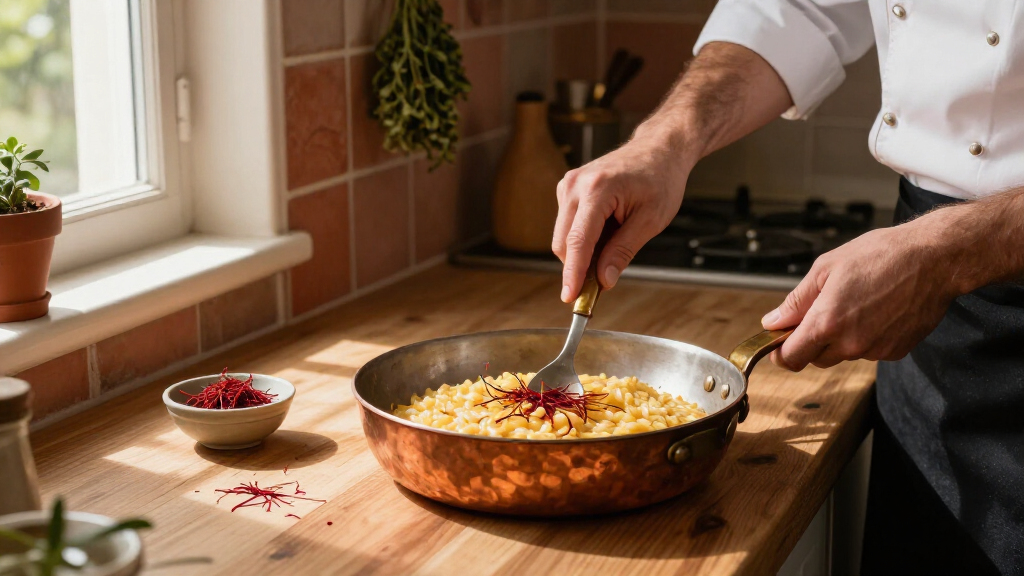
Saffron works best when it is infused in advance: steep the threads in a small amount of warm stock or water for at least 15–20 minutes before the rice needs them, so the color and aroma distribute evenly through the whole dish rather than landing in patches. Dropping dry threads straight into the pan wastes most of their fragrance.
Good saffron should smell like honey and hay with something floral underneath. If your jar smells like nothing, the saffron is old or was poorly dried, and no technique will rescue it. Buy threads rather than powder when you can — powder is easier to adulterate and loses aroma faster.
Quantity matters more than people expect, in both directions. Too little and you get beige rice with a rumor of flavor. Too much and the dish turns medicinal and bitter, which is a real failure mode, not a theoretical one. For a risotto serving four, a generous pinch — roughly 0.3 to 0.5 grams, or about two small pinches of threads — is the working range.
For instance: a friend once doubled the saffron in a Milanese for guests, reasoning that more gold meant more luxury. The risotto looked magnificent and tasted like a pharmacy. Restraint is the Milanese way.
Add the infusion toward the end of cooking — the last few minutes of stock additions — so the heat doesn’t cook off the delicate aromatics you paid so much for.

The 18-Minute Method: Tostatura, Stock, and All’onda
Risotto alla Milanese takes about 18–20 minutes from the first addition of liquid, structured around four phases: tostatura, wine, gradual stock, and mantecatura. Master the sequence and the timing takes care of itself.
- Soffritto: Sweat a finely diced onion in butter over medium-low heat until translucent and sweet, about 5–7 minutes. No color.
- Tostatura: Add the rice and toast it in the butter for 2–3 minutes, stirring, until the edges turn translucent and the grains feel hot and slightly chalky. This develops flavor and helps the grains keep their structure.
- Wine: Pour in a splash of dry white wine and let it evaporate completely. The alcohol cooks off; the acidity stays as balance.
- Stock, gradually: Add hot stock a ladle at a time, waiting until each addition is mostly absorbed before the next. Stir frequently — not constantly, and not violently. Total time: 18–20 minutes.
- Saffron: Stir in the saffron infusion during the final minutes.
- Mantecatura: Off the heat, beat in cold butter and Parmigiano (next section).
Why must the stock be hot? Cold stock drops the pan temperature and interrupts absorption, giving you unevenly cooked grains — crunchy outsides, mushy centers.
How do you know it’s done? The rice is al dente — tender with a slight firmness at the center — and the texture is all’onda, ‘like a wave.’ Spoon it onto a flat plate and tap the plate’s edge: the risotto should spread slowly outward, not sit in a stiff mound or flood the rim.

Common rookie error: adding all the stock at once. That’s boiled rice, not risotto — the gradual addition is what forces the starch out slowly while the grain stays intact.
The Mantecatura: The 60-Second Step That Makes or Breaks It
Mantecatura is the vigorous off-the-heat incorporation of cold butter and finely grated Parmigiano-Reggiano that emulsifies the rice’s released starch, the fat, and the remaining liquid into one glossy sauce. It is not ‘stirring in butter.’ It is the moment the dish becomes risotto.
The details matter. Pull the pan off the burner first — direct heat makes the butter separate into an oily slick and turns the cheese stringy. Use cold butter, cubed, straight from the fridge. Then beat energetically with a wooden spoon, almost whipping the risotto, for 30–60 seconds until the surface shines.
You’ll see the change: what looked slightly matte and loose suddenly turns glossy and elastic, and the grains seem to float in a sauce that wasn’t there before. That sauce is the emulsion. It exists only when starch, fat, and liquid are in balance.
Let the pan rest for one or two minutes before serving — the texture settles and improves. But not longer. Risotto stiffens as it sits, which is why the dish is famously unforgiving about waiting guests. In Milan, the risotto waits for no one.
Grana Padano is a legitimate alternative to Parmigiano-Reggiano if that’s what you have. What you should not add is cream — the classic dish never calls for it, and it coats the palate with fat that hides the saffron you just paid for.

Why Your Risotto Failed — and the Fix for Each Failure
Most risotto failures come down to five causes: overcooking, excessive stirring, too much liquid, low-quality rice, or letting the dish stand too long before serving. Diagnose which one you committed and the fix is usually obvious.
| Symptom | Likely Cause | The Fix |
|---|---|---|
| Sticky, gummy texture | Overcooking or aggressive stirring that broke the grains | Cook to 18 minutes max; stir gently and frequently, not violently |
| Runny, soupy | More stock than the rice could absorb | Cook another 1–2 minutes; remember risotto should stay loose, not stiff |
| Stiff, mound-shaped | Absorbed liquid while resting | Beat in a little hot stock just before serving |
| Stringy, oily finish | Mantecatura done over heat | Pan off the burner, cold butter, energetic beating |
| Bland despite saffron | Under-seasoned or weak stock | Season the stock itself; taste before the final cheese |
A note on safety and storage: cool leftover risotto within two hours and refrigerate it in a shallow container, where it keeps for up to two days. Reheat it with a splash of stock or water over medium heat until steaming throughout. Reheated rice dishes should reach 165°F (74°C) — and because this dish contains butter, cheese, and (if used) wine, it’s an adults’ table dish either way; the wine cooks off, but the dish is calibrated for grown-up palates, so pair it thoughtfully rather than abundantly.
You can also prep ahead the restaurant way: par-cook the rice to about 75% done, spread it on a tray to cool fast, then finish it later with hot stock and a fresh mantecatura. This is exactly how busy Milanese kitchens serve risotto to a full dining room without twenty-minute ticket times.

Can You Modernize It Without Ruining It?
Yes — but the saffron-rice foundation and the mantecatura are non-negotiable. What contemporary chefs change is everything around them: mushrooms, citrus zest, herbs, fermented notes, or a modern garnish layered on top of the classic structure. When the technique holds, the variations read as creativity. When it doesn’t, they read as camouflage.
Dietary adaptations work reasonably well. Olive oil can replace some of the butter, and dairy-free versions use plant-based butter and vegan hard cheese — though the emulsion behaves differently, so expect a looser finish. Nutritional yeast adds savor but not the crystalline saltiness of aged cheese.
Appliances are the more contested territory. Pressure-cooker and one-pot methods genuinely shorten cooking time, and they’re fine for a weeknight. The tradeoff is control: the gradual release of starch — the whole point of the method — becomes a single pressurized event, and the texture is never quite the same. According to cooking writers at madtasting.com, the incremental stock addition is not a superstition; it’s the mechanism.
If you want the modern Milan experience, order the classic once — ideally beside ossobuco in a traditional trattoria near the Navigli — and you’ll understand why six centuries of cooks left the recipe alone. Some dishes are finished, not outdated.
Frequently Asked Questions
Can I use turmeric instead of saffron in risotto alla Milanese?
Turmeric will give you a similar yellow color, but it doesn’t replicate saffron’s aroma or flavor at all. Treat it as a different ingredient for a different dish, not a substitute — saffron’s floral, honeyed character is the entire point of the Milanese version.
Do I really need to stir risotto constantly?
No. Stir frequently enough to prevent sticking and encourage starch release — every 30 seconds or so is plenty. Overly aggressive or nonstop stirring can break the grains and give the risotto a gummy texture. Gentle, regular attention beats frantic agitation.
Why did my risotto turn out sticky or gummy?
The usual causes are overcooking, stirring too hard, too much liquid, low-quality rice, or letting the finished dish stand too long. Check your rice variety (Carnaroli tolerates error best), stop cooking the moment the grains are al dente at about 18–20 minutes, and serve immediately after the mantecatura.
Can I make risotto alla Milanese ahead of time?
Fully finished risotto doesn’t hold well — it stiffens as it sits. The restaurant method is to par-cook the rice to about 75% done, spread it on a tray to cool it quickly, then finish it to order with hot stock and a fresh mantecatura. Refrigerate the par-cooked rice and use it within a day.
Should I add cream to make risotto creamier?
No — traditional risotto alla Milanese never contains cream. The creaminess comes from starch released by the rice, cold butter, and Parmigiano-Reggiano emulsified off the heat. Cream actually coats the palate and masks the saffron’s delicate aroma.
What should I serve with risotto alla Milanese?
The classic pairing is ossobuco alla Milanese, braised veal shank. It also works alongside roasted vegetables, braised meats, mushrooms, or a simple green salad with sharp dressing to cut the richness.
Conclusion
If you remember one thing, make it this: risotto alla Milanese is a technique wearing a costume of gold. The saffron gets the applause, but the standing ovation belongs to the tostatura, the patient ladle-by-ladle stock, and the off-the-heat mantecatura. Do those three things honestly and the dish delivers its famous creaminess without a drop of cream.
Cook it once for people you like. Set the plate flat, tap the rim, and watch the golden wave spread — that slow, glossy movement is six centuries of Milan saying you did it right. The question worth sitting with afterward: what else in your kitchen have you been rushing that deserves eighteen minutes of patience instead?